No Flying No Tights has been hard at work updating our Anime List for librarians. We’ve reviewed perennial favorites as well as trendy and popular titles. The idea is to review content so clubs and individuals can pick and choose what might be best for their interests and needs.
Something that must be mentioned before moving on is that who owns what can change at a moment’s notice. Although the streaming services we have listed here are among the most popular and widely used, it is important to note that once a series is on a particular streaming service, there is no guarantee it will stay there—this depends on the licensing agreement between the owners and the distributors.
We hope that librarians can use this list as a starting point for discussing what to screen and how to support their local anime clubs. It is of the utmost importance that librarians take care to follow all the steps necessary to legally screen or show anime in their institutions.
Common streaming services:
Crunchyroll is the best-known and has the largest selection of anime titles. Additionally, and perhaps most importantly, it is the only anime streaming site that we could find with a dedicated library outreach program. Qualified organizations can use this program to get premium access to Crunchyroll’s collection. As of the writing of this piece, the program is still active.
Kanopy and Hoopla are noteworthy since many public libraries offer these services to their patrons. Do not expect to find the newest and most popular titles here, but these services still have enjoyable and excellent titles for individual use.
Other non-library-related services include HiDive, Netflix, and Hulu.
To get screening permissions for items not on Crunchyroll, you’ll have to do a little digging:
Kanopy’s screening process at an event. Kanopy also has a tag that indicates if something can be used for screening purposes—look for the Public Performance Rights (PPR) in the video page description.
Distributors are the best starting point in getting information about licensing to screen.
Librarians: Please follow all the necessary steps to ensure that you are legally streaming anime in your institution.
We are also working hard to review and assess anime content, which might be unfamiliar or challenging for the uninitiated to navigate. Please let us know how else we can help!
Acro Trip
Directed byAyumu Kotake
Chizuko, a quiet girl, becomes a super fan of the local magical girl Berry Blossom after staying with her grandfather. It turns out the villain, Chroma, isn't actually that effective. But when Chizuko meets him it turns out they're both fans of Berry and he asks her to join his evil organization so he can keep fighting Berry and having fun. And so, Chizuko somehow ends up being a minion of the bad guy of the magical girl she adores.
Appeals to
Acro Trip falls into the smaller subset of magical girl anime that's a comedy but not quite a parody, but it'll pull in fans of parody series like Cute High Earth Defense Club or Magical Girl Ore. In general, it's a pretty accessible entry into magical girl series, since it's not as over the top cute as series like Pretty Cure, so anime fans that don't typically watch magical girl series could find this one fun.
Creator Identities
Japanese |
Main Character Identities:
Japanese |
Bocchi the Rock
Directed byKeichiro Saito
Hitori Gotoh (Bocchi) is uncomfortable and awkward around other people, but when she's alone in her room she's gotten pretty great at playing the guitar, even dreaming of someday being famous for her playing. When she finally gets the opportunity to join a band and maybe make some friends, at first she tries to say no and go back to dreaming alone, but her new bandmates help her experience the world she'd hoped for. There are some hijinks, some hard moments, and some unexpected lessons along the way for Bocchi and friends.
Appeals to
Bocchi the Rock is goofy and sometimes absurd, which makes it great for people that enjoyed series like Azumanga Daioh (though unlikely that anyone in a teen anime club will know this series, but members of an adult club will). It's also a clear hit for fans of K-On, and has some similar moods as My Deer Friend Nokotan.
Content Notes
Some curse words, depiction of an adult drinking alcohol
Creator Identities
Japanese |
Main Character Identities:
Japanese |
Cowboy Bebop
Directed byShinichiro Watanabe
Cowboy Bebop is a neo-noir space opera that follows the misadventures of a ragtag bunch of bounty hunters as they traverse the solar system, looking for their next paycheck. Get to know the Bebop and her crew of freeloaders: ex-cop Jet Black, charming lowlife Spike Spiegel, independent hustler Faye Valentine, and genius hacker Radical Edward as they fight, swindle, cheat, and confront their fears across the galaxy. Set against an amazing soundtrack.
Appeals to
Teens and up. Fans of heists-gone-wrong and comedic action (Hong Kong films were a huge influence for the fight scenes) are going to love this series. A darker, overarching plot exists in the background and advances ever further to the forefront as the series progresses.
Content Notes
Although largely comedic, there is blood and gun violence depicted. There are also a few instances of domestic abuse. The episodes Jupiter Jazz (Part 1) and Jupiter Jazz (Part 2) depict frontal nudity of a gender nonconforming person.
Creator Identities
Japanese |
Main Character Identities:
Gender Nonconforming |
Autistic Spectrum |
Dandadan
Directed byFūga Yamashiro
Delinquent Momo Ayase forges an unlikely partnership with her shy classmate Ken Takakura over obscure claims about ghosts, the occult, and aliens. They get a little more than they bargain for once their doubts turn out to be completely true - ghosts are real, aliens are real, and although neither are equipped to deal with that on their own, together they make a formidable team!
Appeals to
Young teens and up.
Content Notes
As of the time of writing this, DanDaDan is still being released. 8 is not necessarily the final count of episodes, just where the series is at currently.
Creator Identities
Japanese |
Main Character Identities:
Japanese |
Demon Slayer
Directed byHaruo Sotozaki
Tanjiro is a kind boy who sells charcoal to support his family. After his sister Nezuko is changed into a demon, Tanjiro joins the Demon Slayer Corps to seek vengeance against Muzan, the demon who transformed Nezuko, and seek a cure for her as well.
Appeals to
With its historical setting, fantastic action sequences, engaging cast, and strong balance of action, tragedy, and comedy, Demon Slayer is currently one of the most popular series out there for good reason. Fans who like traditional Japanese aesthetics and epic and lengthy storylines will gravitate toward this series.
Content Notes
Demon Slayer has intense and gory violence and addresses difficult topics like abuse and ostracization. Keep those facts in mind when recommending it or considering it for an anime club.
Creator Identities
Main Character Identities:
GeGeGe no Kitaro
Directed byKoji Ogawa
In this new version of a classic tale by Shigeru Mizuki, it's modern day and people have mostly forgotten about yokai. But as strange things happen like a tree appearing in Shibuya and people turning into trees, Mana sends a letter through the Yokai Post, only half-believing that it will do anything. Kitaro himself appears though, and he thinks this is definitely the work of a very old yokai. Thus begins the adventures of Mana in the world of yokai with Kitaro. At the time of this list, the series is available on both Crunchyroll and Apple TV.
Appeals to
Gegege no Kitaro has has some fairly juvenile humor, though not in a bad way, but also some serious spooky or sad moments. It's a great choice for viewers interested in ghost-adjacent stories, since yokai range from the ghostly to the ghastly, but want stories that mix in a bit of humor too.
Content Notes
Because this series deals with supernatural creatures, there is some discussion of death in its various forms
Creator Identities
Japanese |
Main Character Identities:
Japanese |
Hyouka
Directed byYasehiro Takemoto
Hotaro's plans to expend as little energy as possible is ruined when his sister forces him to join the classical literature club to keep it from being dissolved. Then he meets Eru, whose relentless curiosity finds him searching for answers on all kinds of questions he never thought he wanted to answer. The first of course, is the mystery of Eru's uncle and his time at this very high school, but there are many more mysteries to solve.
Appeals to
Somehow, Hyouka manages to be both a slice of life series and a compelling mystery series, pulling in viewers with Eru's questions and Hotaro's deductions. It's just dark enough to pull in viewers looking for that but never gets gruesome or explicit, so viewers that don't want more extreme stories aren't excluded. Also, since it's a Kyoto Animation production, the animation is beautiful.
Content Notes
Discussion of suicide, depiction of smoking cigarettes
Creator Identities
Japanese |
Main Character Identities:
Japanese |
Jujutsu Kaisen
Directed byGege Akutami
Itadori Yuuji, a young boy, is told by his dying grandfather to help others when he can, live a good life, and to die surrounded by loved ones. What a strange coincidence that Yuuji gets several chances to do all three when he gets pulled into the mysterious and dark world of curses, vengeful spirits, and sorcery. Now that he's in too deep, the only way to go is forward with his new-found friends!
Appeals to
Younger teens and up.
Content Notes
Be aware of cartoon violence and some blood.
Creator Identities
Japanese |
Main Character Identities:
Japanese |
Keep Your Hands off Eizouken!
Directed byMasaaki Yuasa
Midori Asakusa loves creating big worlds and machines; teen model Tsubame Mizusaki loves paying attention to little character details. Sayaka Konamori, a money-loving teen with serious management skills, offers to play manager so Asakusa and Mizusaki can follow their dream of making anime. With that the film club is born...only to immediately face challenges, such an unsupportive school board and their own ambitions and quirks. Can they succeed in creating great anime?
Appeals to
With its delightful characters and imaginative daydreaming sequences, Keep Your Hands Off Eizouken is a fun series with lots of energy! It will likely most appeal to viewers who are curious about animation and enjoy stories about creativity and art.
Content Notes
Some swearing, but generally pretty clean
Creator Identities
Main Character Identities:
Laid-Back Camp
Directed byYoshiaki Kyogoku
New girl Nadeshiko loves the outdoors. During an ill-fated trip to see Mount Fuji, she meets and befriends Rin, an introverted bibliophile who relishes solo camping. Together the girls-along with other members of the outdoors club-go camping around Japan! So get cozy and get ready for some adventure!
Appeals to
With beautiful scenery shots, impressive food spreads, and light-hearted storylines, Laid-Back Camp is a great show if you’re looking for a quality slice of life show.
Content Notes
Other than some adult drinking, Laid-Back Camp is fairly clean, making this series ideal for tweens and up.
Creator Identities
Main Character Identities:
Nina the Starry Bride
Directed byKen'chiro Komaya
Pulled from the life of an orphaned street rat, Nina takes the place of a princess who is meant to marry the king of a neighboring city but falls in love with her new "brother."
Appeals to
Teens and fans of romantic comedies
Content Notes
There are a couple of scenes of women being almost sexually assaulted but the men are stopped before more than forceful grabbing happens.
Creator Identities
Main Character Identities:
Odd Taxi
Directed byBaku Kinoshita
This is a world of animal people and Odokawa, a walrus person, is a taxi driver who keeps encountering odd moments and customers as he drives around Tokyo. It starts out with a slightly different customer and situation each episode but as the series progresses things start to come together as part of a larger, mysterious plot. Odd Taxi is a bit melancholy, as a lot of series about customers through a shop of some kind are, but it has some great moments of humor too.
Appeals to
Because this series sticks to the darkness of the real world, other than the animal people, it may appeal more to viewers that shy away from the supernatural or want more of a thriller type series. And the fact that Odd Taxi is only thirteen episodes means it would be pretty easy for an anime club to get through without feeling like they're spending half the year watching one series. The animation is also fantastic, and the English dub is high quality as well if that's what a club prefers to watch.
Content Notes
Discussion of drug sales, discussions of physical violence
Creator Identities
Japanese |
Main Character Identities:
Play It Cool, Guys
Directed byChiaki Kon
Soma Shiki, Takayuki Mima, Hayate Ichikura, and Shun Futami are all guys who look really cool but are actually quite awkward and often clumsy! Follow their every day adventures as they navigate life and try to handle those moments as best they can.
Appeals to
Readers looking for some light, humorous tv will want to watch this. As an added bonus, Play It Cool, Guys’ episodes are short--just over ten minutes--making it a nice show to put on if your club or patron needs something light and quick to watch!
Content Notes
There is some adult drinking and language, but generally the show is light and often silly.
Creator Identities
Main Character Identities:
Shangri-La Frontier
Directed byToshiyuki Kubooka
In a world littered with VR videogames, Hizutome loves playing the "trashy" ones until he is introduced to society's new obsession and he discovers that his practice with glitches and crazy issues allows him to spring ahead in a well-planned game.
Appeals to
Teens through adult will enjoy the clever gameplay and storyline.
Content Notes
There is plenty of fantasy violence on screen throughout. Season 1 is complete at 25 episodes and season 2 is airing now.
Creator Identities
Main Character Identities:
The Apothecary Diaries
Directed byNorihiro Naganuma
A historical mystery series featuring early medicine and set in the emperor's inner palace, for most of it, with lots of political intrigue and cleverness.
Tweens through adults as it's very clever and not graphic in terms of violence or sex on screen
Content Notes
Season 2 starts in January 25! Season 1 will release in two parts on DVD and Blu-ray in January 2025 as well. There are currently 12 manga volumes and 3 light novels translated and available physically in English.
Creator Identities
Japanese |
Main Character Identities:
The Stories of Girls Who Couldn't Be Magicians
Directed byMasato Matsune
After meeting a magician when she was young, Kurumi vowed to work hard and join the Magumi class at the magic academy; however, she fails to pass the entry exam and is put in the regular class with Magumi noble, Yuzu, who also failed to pass the exam. Their dreams might still come true when they learn about another version of magic from their new teacher.
Appeals to
Younger audiences and fans of magic academy stories
Content Notes
Not a lot of violence and no sexual references so far.
Creator Identities
Main Character Identities:
The Weakest Tamer Began a Journey to Pick Up Trash
Directed byShigeyasu Yamauchi
In an isekai where the main character is not overpowered but seemingly underpowered, Ivy is rejected by her small hometown and family when it is revealed that she only has one zero star talent. She leaves in order to avoid a murderous mob and travels alone as a boy and finds a rare slime that she tames.
Appeals to
A younger audience and anyone who appreciates slice of life with a wholesome story
Content Notes
In the first episode, there is mention of sacrificing the main character to lift a "curse." And there is a larger plot that features human trafficking, but it is only discussed not shown on screen.
Creator Identities
Main Character Identities:
Toilet-Bound Hanako-Kun
Directed byMasaomi Ando
The myth of a spirit called Hanako-chan, a girl who haunts the girls' restrooms in schools, is well known. This Hanako however, is a boy. Who is still in the girls' bathroom. Nene Yashiro finds all of this out when she tries to ask Hanako-chan for help getting a boyfriend. Instead, she gets bound to Hanako-kun and gets way more spooky adventures than she could ever have expected, learning about Hanako's past and the important balance that has to be kept between the human and spirit worlds.
Appeals to
The darker tone of Hanako-Kun is perfect for people that prefer spooky stories, but it's not so dark that it can't be shown in a teen anime club. There's some fights and weapons, but not really blood or gore. It also has a fair amount of humor, and that paired with its unusual art style this series could easily hook those who don't consider themselves anime fans. Side note: there is a side series called After School Hanako-Kun that follows the cast in their downtime between the big adventures of the main series, and a re-boot of the main series is in production.
Content Notes
Some violence/fighting, discussions of death and suicide, depictions of an adult smoking
Creator Identities
Japanese |
Main Character Identities:
Japanese |
True Beauty
Ju-kyung Lim's experience at her first high school is so bad, she's pulled out and enrolled in an arts-focused school. Determined not to have the same reputation there, she spends her summer learning how to use makeup, skincare, and haircare to transform her look. It works; she is immediately popular at this new school, but now she has to keep up the façade and make sure no one finds out she's secretly someone who prefers lounging in comfy clothes while listening to heavy metal and reading horror comics. And of course, there's two very different boys interested in her. How will she balance all of this?
Appeals to
The high drama and contemporary setting is great for teens who enjoy live action Korean dramas, as well as fans of anime series like A Sign of Affection or Komi Can't Communicate. The focus on physical beauty is pretty intense at first in the series, but it does eventually start to talk about how that affects self-esteem and the fact that it's not really a good thing. A side note: this is a Korean series, so for people more familiar with Japanese tropes, they might be thrown off at first.
Content Notes
Depictions of bullying (physical harm, social media, name calling), some curse words
Creator Identities
Korean |
Main Character Identities:
Korean |
WIND BREAKER
Directed byToshifumi Akai
Ostracized because of his appearance, Haruka Sakura has forged himself into a skillful fighter and makes a point of keeping others at bay. He starts attending Furin High School in order to become top dog of the ruling gang. What Sakura doesn’t expect is to find a place where his skills are welcomed, and the gang members are protectors and bona fide community members of the town!
Appeals to
The premise has the potential to go horribly wrong, but the students’ heartfelt efforts to help their community and Sakura’s awkward and often hilarious personality make this a fun show with lots of awesome fight choreography. Show this to fans of shows about misfit characters.
Set in a Japanese middle school (equivalent to junior high in the US) during the nineties, Magic: the Gathering is a hot new card game. Hajime Kano plays in every spare moment between his studies. He’s determined to be the best. Best in his class. Best at Magic: the Gathering. But his school rival, Emi Sawatari retains the top spot in school! When Hajime travels to a new game store, he’s horrified to find Emi there playing Magic and dominating the competition. He challenges her to a three-round game. He quickly wins the first round, but after swapping cards with her sideboard, Emi wins the second round. They don’t start the tie breaking round though because Hajime dropped a die, and they both dive under the table to retrieve it and touch hands. Embarrassed, Emi rushes out of the shop, leaving her deck behind.
When Hajime tries to return her deck at school, Emi freaks out and asks if he told anyone she was at the game store or that she plays. Turns out, she doesn’t want anyone to know because she thinks it will ruin her respected honor student persona, so she plays in secret. It isn’t long before Hajime challenges her to a rematch, and their competition is renewed. The rest of the book features their growing relationship while explaining some of Magic’s metagame information.
Although Magic: the Gathering was first released in 1993, it wasn’t released in Japanese until 1996 with the set Fourth Edition. So, this story is set shortly after that in 1998. I know a little bit about early Magic history and the metagame, but not a lot of specifics. I wasn’t quite sure what to expect from the story. So often, a story about a fantasy-based game will take on those fantastical elements; however, there was none of that in this story. Except for the occasional illustrative flare to make a scene more dramatic!
The energy and excitement of the characters felt real, and the author and illustrator both did a fantastic job capturing the intensity of those emotions throughout. The black and white illustrations were nicely detailed and made good use of shading and texture to give each panel depth. It was a little harder to recognize the colors of cards, which is essential to gameplay, but overall, the dialogue made it clear what was happening. I also liked that they were able to utilize the original art and design of the cards to make it feel more authentic.
Outside of the card game, this felt like a rivals-to-friends romcom. From hardcore nerds into Magic history and metagaming to slice of life readers, this series will appeal to a wide range of readers and would do well in high school and public libraries.
Destroy All Humans. They Can’t Be Regenerated. A Magic: The Gathering Manga Vol. 01 By Katsura Ise Art by Takuma Yokota VIZ, 2024 ISBN: 9781974747214
Company Age Rating: Teen Plus Related media: Game to Comic
NFNT Age Recommendation: Adult (18+), Older Teen (16-18)
Scarlet finds herself face to face with the Devil himself, who is thrilled to finally meet her. He tells her she was the worst of the worst in life and he wants her to become the Grim Reaper. She has no memory of anything before waking up in hell and the offer is to either go straight to level 9 or return to Earth as the grim reaper and bring the devil one soul a day. Sinners will be marked with a giant red X on their chest so she can find them. Scarlet opts to try out the new job, only to struggle with the morality of it.
She meets a disgraced police detective named Chase who is interested in her immediately. In this volume we don’t learn much about him other than he wants to earn his way back onto the force and his mom is the chief of police (or an equivalent.) Scarlet and Chase come to an agreement to work together to try and solve a crime that will restore Chase and hopefully in the process help Scarlet piece her memory back together about the life on Earth she cannot remember. Both have secrets and both are troubled. Scarlet has trouble killing people and bringing them to the devil as the morality and finality of it feels like too much, but the devil always has easy answers for her.
With the popularity of Lore Olympus it is not surprising to see publishers grabbing webcomics in the hopes of adapting them for new audiences. The problem is not all comics are created equally and not everything that finds an audience in an app like WEBTOON will necessarily find an audience at the bookstore. Some webcomics also have trouble making the jump to physical books because it loses something in the layout and format change. This book feels like one of those where too much is lost in the transition.
I’m the Grim Reaper was originally a WEBTOON comic that has been adapted to manga format by Viz Media. This volume contains episodes 1-16, with a second volume set to publish later this year.
The writing and the approach to the subject matter felt like it was written by someone much younger. The way the characters talk about love, is murder ever justifiable, who should go to hell and what constitutes being bad enough to condemn someone there; it has a rather juvenile attitude and approach. It also tries to inject some humor through the art by switching character styles, like in other manga, giving some juxtaposition to the seriousness of the subject matter. It never quite struck the right note for me in doing so and I found myself mostly unimpressed by it. Additionally, I believe this book would have been better if like most printed manga it was in black and white. The colors throughout were just flat and lifeless. The lack of detail and copy/paste backgrounds made it hard to enjoy. These things you can get away with when people are reading your new webcomic chapter in a couple of minutes and moving on to something else, but when you are faced with 240 pages of it all at once, it become grating.
This book creates a dilemma for me as someone who purchases graphic novels and recommends them. The publisher rates it Teen+ (which they identify as 16 and older) with the following disclaimer, “This volume contains graphic violence, mature language, and violence towards children.” However, the tone and art I believe are meant to appeal to a younger crowd of readers than myself and those who enjoy webcomics generally. I would not purchase this for our adult section, as I don’t believe those readers would enjoy it, but I cannot recommend it to anyone under 17 who might actually like it. It somehow tries to do too much and doesn’t do nearly enough at the same time.
Because this was originally a WEBTOON comic, you can find it in it’s entirety on that site/app now. If this is something you are considering, I might encourage you to take at least a quick look there and see if the audience you are purchasing for might be better suited than I was.
I’m the Grim Reaper Vol. 01 By GRAVEWEAVER VIZ, 2024 ISBN: 9781974739080
Publisher Age Rating: Teen+
NFNT Age Recommendation: Adult (18+), Older Teen (16-18)
He talks to the dolls in his toy collection, spits out razor sharp nails with stunning accuracy, and conjures forth curses upon those who have wronged him to wreak spiteful vengeance. In his latest foray into the macabre, Junji Ito aims the spotlight at one of the quirkiest characters from his horrific imagination—young Soichi Tsujii—in Soichi: Junji Ito Story Collection.
In the opening story “A Happy Summer Vacation,” Michina and Yuskue pay a visit to their second cousins in the rural town of Fukazawa. No sooner than they settle down to play a game of cards does pesky little Soichi, the unhinged eleven-year-old child of the Tsujii family, sneak up on them. Muttering incoherently, his mouth crammed with protruding nails resembling fangs (he supposedly sucks on them to supplement iron in his blood), he makes his intrusive appearance. Dismissing him as nothing more than a little brat, Michina ignores him, which prompts Soichi to cast a voodoo-like spell by hammering a straw doll resembling Michina to a wall. Strangely enough, in the middle of the night, Michina begins experiencing stabbing chest pains. Could Soichi really be capable of supernatural dark magic? What lurks within the skewed corridors of his twisted mind?
Other stories explore aspects of his character from multiple perspectives. In “Soichi’s Happy Diary,” Michina stumbles upon his diary and gains access to his deluded fantasies, the entries revealing how he methodically carries out curses on others with vengeful glee, with her being the first victim of his vicious pranks. But is he really jinxing others into accidents and mishaps, or are these mere coincidences? In “Soichi’s House Visit,” a schoolteacher pays a home visit to Soichi. However, Soichi places a hex on him, turning him into a cloth doll that bends towards his will, much to the shock of the students at school when they encounter the teacher’s erratic behavior. “Soichi’s Birthday” sheds light on his sickly grandmother, also known as “old lady prophet,” due to the ominous prophecies she spouts even though they rarely came true. But she predicts the birth of a demon child to be born on June 6 at six in morning and forms a special connection with him, believing he is destined to become a genius.
Unlike other collections, this one centers on an antihero alongside recurrent side characters and plots, delving into an intriguing character study. While not packed with grotesque shock scares as in his other works, Ito manages to deliver a deeper, psychological exploration of an enigmatic character. The imagery exudes haunting overtones as in “The Four Layered Room,” wherein Koichi, Soichi’s older brother, needs to study for his exams and hires a contractor to build a soundproof room so he can concentrate and insulate himself from Soichi’s persistent pestering. The contractor—a sickly looking fellow—builds a super confining space enclosed by four concentric layers of walls. Claustrophobic angled shots unfold through a montage of panels, creating a creepy maze-like sensation as Koichi navigates the infrastructure of the house, playing a warped game of cat and mouse with his insidiously mischievous brother.
Dark humor mixed with hilarious moments fill the pages of this fascinating foray into the haunting conundrum of Soichi. Is he merely a mischievous brat craving attention? Or does he harbor a sinister machination against his family and the world at large, especially those who dare cross him? A fun, amusing, and quirky collection, this venture into the multiple facets of Soichi highlights a weirdly delightful exploration into one of Ito’s most confounding characters yet, serving up a unique blend of horror and eerie comedy to adult manga collections.
Soichi Junji Ito Story Collection By Junji Ito VIZ, 2023 ISBN: 9781974739028
Publisher Age Rating: 16+
NFNT Age Recommendation: Adult (18+), Older Teen (16-18) Creator Representation: Japanese, Character Representation: Japanese,
When I first saw Wolverine: Snikt! I thought I was simply reading the next installment from Viz Media of Marvel characters that were being given their own manga book. I was both right and wrong; this book is a Wolverine story told in magna formatting, but it isn’t new.
Wolverine: Snikt! was originally published by Marvel Comics as a five-issue series way back in 2003. It was part of a Marvel short lived “Tsunami” line of comics that were “manga-style” so they could try and jump on the growing demand for manga in United States. This edition is being formatted by Viz as a traditional manga and it is being labeled a deluxe edition with an introduction from Nick Dragotta (East of West, Fantastic Four) and an art gallery at the end.
On the third page of this book, and with no dialog to tell us why, Logan is pulled into another time by a young mutant girl. She loses track of him in the transfer and he finds himself alone in a dystopian future where a weird biomechanical monster starts to fight him immediately. It has the ability to self-repair and Logan would be lost if not for The Colonel, a man-shaped machine with the only weapon capable of taking down a Mandate. They are running out of ammunition for the gun and they are running out of warriors. Fusa, the girl who brought him here, explains that 11 years ago in 2047 the Mandate attacked and wiped nearly everyone out. It turns out the Mandate itself is a mutant, sort of. It’s a mutant disease that started out as a lab experiment where they hoped to turn a bacteria into a microorganism that would decompose the toxic materials poisoning the Earth. However, once it was outside of the lab environment it couldn’t be contained and it gained sentience. Now, they have to destroy the original Mandate, called Primogenitor, otherwise it will never stop producing more Mandates. You have to destroy a Mandates orb-core to kill it, otherwise it will keep knitting itself back together. By now, you can guess what element will destroy an orb-core and what The Colonel is made out of, Adamantium, making Logan their only hope.
This story is going to be a tough sell to an audience older than tweens and teens. Viz rates this Teen+ for older teens, but I think Teen is fine rating for this. It’s violent, but they are fighting robotic monsters and it is only 136 pages with credits. The story itself is tissue-paper thin and there are no surprises anywhere along the way. A teen reader might give this a pass and enjoy the action, but I found myself mostly disappointed. I appreciate that Tsutomu Nihei had the unenviable task of trying to get the entirety of a story into five issues, but I’ve seen other creators do more with that same task.
The art from Nihei is a lot murkier than his later, much lauded work Knights of Sidonia. That is to say, this art feels like it’s from 2003 and the artist is still evolving. His later work is a lot cleaner, here faces are tough to tell apart and are very sparse on details. Some of the larger vistas that he illustrates show the range of his talent, but Logan hardly looks like the character most comic fans know. Marvel made the choice to have this colored, which probably hinders the work more than it helps. I don’t know that this book is going to make a convert of anyone, but it is hard to deny Wolverine’s appeal and ability to sell books. I think there is certainly an audience out there for this story and there are plenty of teen readers who will enjoy both the manga aesthetic and “otherworld” approach to the storytelling.
Wolverine: Snikt! By Tsutomu Nihei VIZ, 2023 ISBN: 9781974738533
Publisher Age Rating: Teen+(older teen)
NFNT Age Recommendation: Older Teen (16-18), Teen (13-16) Creator Representation: Japanese,
When two high school students, one who believes in spirits and one who believes in aliens, challenge each other’s beliefs, it sets off a series of paranormal encounters that quickly spiral out of control in dramatic and absurd fashion.
One day, Momo Ayase intervenes to protect a boy at her school from being bullied, accidentally sparking a tense rapport with the loner she nicknames Okarun. This interaction leads to a challenge. Momo does not believe in aliens. Okarun does not believe in spirits. Because of this, Momo will go to a spot known for alien activity while Okarun will go to an area rumored to be haunted. The pair will then report back on whether they have become believers based on what they find. Neither of them is prepared for the consequences of this simple dare.
In a secluded tunnel, Okarun encounters the spirit known as Turbo Granny who tries to possess him while also stealing… shall we say, a specific part of his anatomy? Meanwhile, Momo runs across the Serpoians, a group of aliens searching for a way to reproduce other than cloning themselves. The encounters leave Momo and Okarun changed—through a mix of psychic abilities and spiritual possession—while also drawing the ire of Turbo Granny and an entire alien race. From this point on, life will never be the same. The pair is launched into an adventure of giant supernatural crabs and randy aliens as they try to make Okarun whole once again while also dealing with the increasingly eccentric cast of characters, human and otherwise, who are drawn into their orbit. Okarun and Momo have become believers—now they just need to survive the beings they never knew existed while also sorting out how they feel about each other. What could go wrong?
Dandadan is created by Yukinobu Tatsu and published by Viz Media. The story begins simply enough, but quickly gains a momentum that rarely lets up as Momo and Okarun are thrust from one situation into the next. Alongside alien encounters and supernatural attacks, Tatsu manages to deliver two characters the reader has no trouble rooting for, even with their personal complications. Moments of sincere emotion intersperse increasingly absurd battles against the paranormal enemies our heroes keep encountering. From early on, this series promise a wild ride, and Tatsu keeps delivering on a premise that has no issue being silly, horny, and wildly dramatic at every turn without overshadowing the characters and relationships that keep it grounded.
The art is fun to look at, too, often richly detailed and capturing the characters and settings in all their complexity. The action sequences play out in familiar enough manga style, but the visuals are bold and easy to follow as the super-powered action keeps raising the stakes. Tatsu also does a great job capturing the visual humor of the series, balancing absurdity and threat to create an epic adventure that never takes itself more seriously than it should. In the end, Dandadan is distinct, wildly fun, and over the top enough to be exactly the sort of story it sets out to be.
Viz gives the series a mature rating with a warning of explicit content. The violence is never overly strong and the tone remains mostly comedic, but there are scattered moments of serious character death and other thematic issues aimed at more mature readers. The larger reason for the rating is simply the constant thread of sexual humor and innuendo that runs through the adventure. The visuals are limited to characters in their underwear and occasional non-graphic nudity, but the suggestive tones of the story—from recovering Okarun’s stolen “family jewels” to the Serpoians’ quest to reproduce—is clearly aimed at an adult audience. There is also occasional sexual threat and other thematic content that, despite the consistently humorous tone of the story, may not be for all readers.
The final verdict is that Dandadan is a madcap paranormal adventure that keeps raising the bar for how weird it’s willing to go. The series is a lot of fun as it introduces an increasing number of complications and fascinating side characters alongside Momo, Okarun, and their uncertain relationship to each other and the very strange world around them. The series is clearly aimed at mature readers, but it is absolutely worth picking up—both for those who are established manga readers and those who haven’t encountered the form before but are open to the sort of chaotic adventure and humor presented here. The first three volumes of Tatsu’s series are a fascinating ride, and I’m curious to see where it goes next.
Rooster Fighter is one of those rare books that delivers exactly what you would expect from the title. I had every hope this book would not simply be about a rooster who fights other roosters, but instead one who fights people. Shu Sakuratani does one better as this rooster is out there fighting demons. Gigantic, building wrecking demons that are suddenly spawning all over the place. In the vein of something like Kaiju No. 8 or One-Punch Man, someone has to stop the demons from destroying towns and the lone wandering hero of this tale happens to be a rooster.
Told like an epic samurai saga, it opens with the line “This is the story of how one rooster saved humanity.” With that level of investment, we see a tale unfold of a wandering rooster who is righting wrongs where he finds them and hunting demons. It is not until very late in the story we learn his name is Keiji, which means “the Rooster’s Will” in Japanese. His brother was killed by a demon, thus his quest for vengeance drives him on, searching for the demon with a spiral mark behind its ear. Demons are people whose hearts are infected and they mutate into gigantic monsters fixated on what vexed them in their human lives. We do not learn why this happens, but late in the story, we see it happen. There is still plenty to be explored by the author in future volumes on how or why this all began, but in this first volume, we get a sense of how big this problem is.
Along the way Keiji makes some animal friends who provide aid and lessons. There are victories that increase his fame and losses that affect communities. Throughout it all you can feel the influence of books like Usagi Yojimbo and Lone Wolf and Cub, but in a modern setting. There are panels that look like they are from epic sweeping samurai films, but again, with a rooster as the hero standing in front of a blazing sun. There are running themes, like a new food discovery in almost every chapter like stink bugs, Brazilian grasshoppers and sea urchin. He doesn’t like children, human or animal, but he protects everyone equally. He has a strict moral code, like any good samurai, and he lives on his terms.
Obviously, this is a very silly conceit, but it manages to pull it off by taking itself seriously enough and drawing from such recognizable sources. The art is fantastic and while some of the demons are not quite as clean and crisp as other characters, they are certainly impressive in scale and work for the story. This isn’t going to win any awards for dialogue, but the fun isn’t in how well-constructed each exchange is, it’s in lines like “My comb is burning with rage!” The scope of battles and design of the fights makes me think of a book I’ve already mentioned in One-Punch Man, and much like that book this one has signature moves with their names emblazoned across multiple panels.
This is published by Viz Media who rates it Teen+, for older teens. There is no bad language in this book and the violence is a rooster fighting demons, so it is hard to say that it is inappropriate for anyone in particular because it can’t be replicated in real life. The only awkward moment reading this for me was on page 8 Keiji was mating with a hen (for a single panel) because he was “in heat.” While I get what the author was going for as a story device several pages later, it did make me think this might rule it out for younger readers who would have had no other problems with this book. This is a quick, funny, light read that is an easy recommendation for anyone who likes off-beat manga. It feels very familiar while also being unlike anything I have read recently. I think it is a good investment for libraries looking to diversify the types of manga they offer with something that I think spans a good age range of readers.
Rooster Fighter Vol. 01 By Shu Sakuratani VIZ Signature, 2022 ISBN: 9781974729845
Publisher Age Rating: Teen Plus
NFNT Age Recommendation: Adult (18+), Older Teen (16-18), Teen (13-16)
Pokémon trainer Ash Ketchum and his buddy Pikachu are back! This time they are joined by a friend called Goh and his Pokémon partners for adventures that have them traveling all over the Pokémon world.
At the start of this series, Ash and Goh meet and are invited to become “research fellows” by Professor Cerise, who runs a lab studying Pokémon. They accept the position, and Cerise Laboratory becomes their home base in between trips that are theoretically about research but also involve lots of Pokémon battles. While most Pokémon manga are set in a particular “region” of the world—that is, the setting of one of the Pokémon video games—this series sees its protagonists traveling between several regions, sometimes in the same volume. In particular, they spend a lot of time in the Galar region, the setting of the games Pokémon: Sword and Pokémon: Shield.
Each volume of the Pokémon Journeys manga is essentially a collection of short stories. While theoretically these stories are sequential, many of them can easily stand alone. The stakes vary from “save the realm from an unstable, overpowered Pokémon with the aid of legendary heroes” to “we found a mischievous little Pokémon, does it belong to someone?” A couple of plotlines come up repeatedly: Ash is competing in a battle tournament called the World Coronation Series, and the goofy Team Rocket villains Jesse, James, and Meowth periodically show up to try and steal Pikachu or otherwise meddle. Neither of these is likely to leave readers confused if they start reading in the middle of the series.
Like most Pokémon manga, this series features optimistic, good-hearted young heroes and lots of creatures with different personalities and powers. There are frequent Pokémon battles, some friendly (like when Ash and Goh’s Pokémon train against each other), some competitive (like the ones to move up the ranks in the World Coronation Series), and some serious (like to defeat villains or control a rampaging Pokémon). There is also silly humor and some character development, as when Goh learns that he has to pay attention to what his Scorbunny wants in order for them to battle effectively as a team.
The visual style will be familiar to readers of other Pokémon manga series. The art is black and white, the book reads from right to left, and there is tons of action—much of it the over-the-top superpowered action of Pokémon battles, which can involve things like lightning, fire, and significant damage to buildings.
There is not much explanation here of how things work in the world of Pokémon. Battles, Pokéballs, and Pokémon evolution, for instance, may confuse readers who are brand-new to the franchise. For those who know the basics, however, this is an accessible entry point to the Pokémon manga universe, not requiring readers to know the events of many other volumes to understand what is happening. The “journeys” aspect may particularly appeal to fans of the games, who will recognize the different regions but may not be used to seeing characters travel between them.
Some manga take themselves incredibly seriously, whether they have earned it or not. Others infuse a few moments of humor into the story to keep it lighter and faster paced. Then there are books like Mashle, which immediately leans into its main conceit, knows exactly the joke it’s making and never looks back. It manages to be funny, clever, dumb and familiar all at the same time.
Mash Burnedead lives in a world where people use magic as a part of everyday life. If you were born without a “mark” to show your magical prowess, you are expelled from society for the greater good. Mash was born without a mark and was abandoned as a baby. His adoptive father Regro Burnedead was born with very little magical talent himself, but when he finds Mash he decides to save him and raise him away from society. He encourages Mash to exercise and develop his physical strength since it is one of the only things he can do to help himself in their world. In doing this, Mash develops a near superhuman physique. After sneaking in to town one day against his father’s advice, Mash is discovered by a local detective with the magical police, Brad Coleman. The police raid the Burnedead house, but when they see what Mash is capable of with his strength, Brad offers them a choice. He explains that every year a single exceptional student from the Easton Magic Academy is revered as one of the gods chosen and they become a Divine Visionary. If Mash were to become a Divine Visionary it would legitimize him in the eyes of society and they wouldn’t have to live in fear. Brad would simply take whatever prize money and fame comes with that status for Mash.
I have read people describe this world as being like that of Harry Potter and that is an understatement. This is the world of Harry Potter, down to all the Professors looking like they were lifted directly from the movie adaptations of the books. The students are sorted into houses, the headmaster looks exactly like Richard Harris’s Dumbledore, they play a Quidditch-esque game on brooms called Duelo and there are plenty of character archetypes you’ll recognize from that world in the students around Mash. Instead of House Points, the students at Easton are all trying to earn coins on an individual basis. This is how they will work their way up the ladder to become a Divine Visionary, but there are unwritten rules about how you can take coins from others. This will lead to the main conflict in Mashle, the struggle for magical dominance over other students and taking coins from those weaker than you.
Hajime Komoto does a great job in this book creating a recognizable world for those in the know. Anyone who hasn’t read the Harry Potter series or seen the movies starts at a slight disadvantage for some of the jokes, but that isn’t the entirety of this book. It also has a lot of heart and Mash is a good person at his core. He tries to be a good friend to those around him, but he’s also a bull in a china shop and since he never knows his own strength, a fair amount of chaos follows him. This leads to more visual gags and some exaggerated takes from other characters. Watching Mash bluff his way around not using magic by being strong and fast doesn’t get old.
This is an ongoing series, so a library adding this to their collection should be aware that they are in for at least 5 more volumes (at the time of this review) and likely more to be translated yet. The violence in these books is “magical” in nature and mostly cartoonish in execution. There is no reference to anything sexual and there is no profanity. VIZ Media rated it T for teens and that is absolutely a fair assessment. It does a good job of balancing some of the over the top gags with moments of humanity and compassion. It is as silly as it is mysterious and this volume should hook readers who want to know more about the wilder world of magic outside of just the Academy. The tone is reminiscent of One-Punch Man and The Way of the Househusband for readers trying to find read-alikes.
Mashle: Magic and Muscles, Vol 1 Vol. 01 By Hajime Komoto VIZ, 2021 ISBN: 9781974728718
Publisher Age Rating: Teen
NFNT Age Recommendation: Adult (18+), Older Teen (16-18), Teen (13-16)
The idea behind Deadpool: Samurai feels like a corporation trying to generate a profitable book based on a premise: “Teens like manga, right? Teens like Deadpool as a character, right? A Deadpool manga should be something teens would love, right…?” I think they would have been right too, but this particular book makes a very odd choice: it takes an incredibly simple story that would be a great entry point for newer/younger readers and then adds just enough violent gore to make this book inaccessible to that age group. For all the tropes one might expect from a Deadpool book and a Shonen manga, this should be a great marriage of humor and action, but it can’t figure out who it wants to be for and ultimately unravels into nothing.
Early in the story, Iron Man shows up and asks Deadpool to join The Avengers, except it is a side-team offer. Japan is getting a team of its own called Samurai Squad and this is where the book immediately gives up any aspirations it had of being interesting or unique. We meet Sakura Spider, filling in for Peter Parker’s Spider-Man, who is the first new member of this team. She wants to hold Deadpool to a hero standard, but is mostly the straight man for Deadpool’s joke cracking. Captain America makes a cameo, encouraging them to recruit someone like teen idol Neiro. Neiro is not only a pop star, but she also has a Symbiote attached to her called Kage (or “Shadow” in Japanese.) So, now we have a Venom/Spider-Man/Deadpool book without the copyright issues of the original characters being here. Loki is the bad guy in this book, but it could have been literally any Marvel Universe villain. There is no motivation and the MacGuffin he is searching for in Japan isn’t even identified until the last few pages of this volume.
So much of what makes Deadpool a fun and funny character felt clunky and out of place in this book. Deadpool breaking the fourth wall and the snarky asides to the reader work best when used sparingly and with intention. Precision is key to the decision making and execution with a Deadpool story and everything in this book feels too loose and unmotivated. Again, if they hadn’t illustrated blood and been less over-the-top with the violence, there is a huge audience of younger teen readers who would have loved this. Conversely, had they written a tighter plot with a more motivated villain, this could have appealed to the age group the publisher recommends it for.
Viz Media has this book rated T+ for older teens, which I agree with to a point. For a library looking to add manga along these lines, I would recommend instead something like Kaiju No. 8 or One-Punch Man. If you’re looking for a Deadpool book that is closer to the age recommendation here, the books written by Brian Posehn and Gerry Duggan, starting with Deadpool, Volume 1: Dead Presidents, are a great starting place.
Deadpool: Samurai, Vol. 1 By Sanshiro Kasama Art by Hikaru Uesugi VIZ, 2022 ISBN: 9781974725311

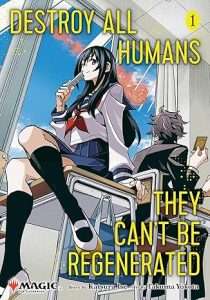 new card game. Hajime Kano plays in every spare moment between his studies. He’s determined to be the best. Best in his class. Best at Magic: the Gathering. But his school rival, Emi Sawatari retains the top spot in school! When Hajime travels to a new game store, he’s horrified to find Emi there playing Magic and dominating the competition. He challenges her to a three-round game. He quickly wins the first round, but after swapping cards with her sideboard, Emi wins the second round. They don’t start the tie breaking round though because Hajime dropped a die, and they both dive under the table to retrieve it and touch hands. Embarrassed, Emi rushes out of the shop, leaving her deck behind.
 worst of the worst in life and he wants her to become the Grim Reaper. She has no memory of anything before waking up in hell and the offer is to either go straight to level 9 or return to Earth as the grim reaper and bring the devil one soul a day. Sinners will be marked with a giant red X on their chest so she can find them. Scarlet opts to try out the new job, only to struggle with the morality of it.
 those who have wronged him to wreak spiteful vengeance. In his latest foray into the macabre, Junji Ito aims the spotlight at one of the quirkiest characters from his horrific imagination—young Soichi Tsujii—in Soichi: Junji Ito Story Collection.
 When I first saw Wolverine: Snikt! I thought I was simply reading the next installment from Viz Media of Marvel characters that were being given their own manga book. I was both right and wrong; this book is a Wolverine story told in magna formatting, but it isn’t new.
 When two high school students, one who believes in spirits and one who believes in aliens, challenge each other’s beliefs, it sets off a series of paranormal encounters that quickly spiral out of control in dramatic and absurd fashion.
 Rooster Fighter is one of those rare books that delivers exactly what you would expect from the title. I had every hope this book would not simply be about a rooster who fights other roosters, but instead one who fights people. Shu Sakuratani does one better as this rooster is out there fighting demons. Gigantic, building wrecking demons that are suddenly spawning all over the place. In the vein of something like Kaiju No. 8 or One-Punch Man, someone has to stop the demons from destroying towns and the lone wandering hero of this tale happens to be a rooster.
 Pokémon trainer Ash Ketchum and his buddy Pikachu are back! This time they are joined by a friend called Goh and his Pokémon partners for adventures that have them traveling all over the Pokémon world.
 Some manga take themselves incredibly seriously, whether they have earned it or not. Others infuse a few moments of humor into the story to keep it lighter and faster paced. Then there are books like Mashle, which immediately leans into its main conceit, knows exactly the joke it’s making and never looks back. It manages to be funny, clever, dumb and familiar all at the same time.
 The idea behind Deadpool: Samurai feels like a corporation trying to generate a profitable book based on a premise: “Teens like manga, right? Teens like Deadpool as a character, right? A Deadpool manga should be something teens would love, right…?” I think they would have been right too, but this particular book makes a very odd choice: it takes an incredibly simple story that would be a great entry point for newer/younger readers and then adds just enough violent gore to make this book inaccessible to that age group. For all the tropes one might expect from a Deadpool book and a Shonen manga, this should be a great marriage of humor and action, but it can’t figure out who it wants to be for and ultimately unravels into nothing.
