In the distant future, monsters have taken over the Earth. Clouds dominate the skies, blanketing the land in eternal winter. The sun is a myth, remembered only vaguely by the eldest humans. Total silence is required to evade the sharp-eared creatures in the dark, and, in one remote village, everyone communicates with sign language.
It is here a youth named Saber has come to the age that he is allowed to accompany Gray, the hunter of the village, in checking his traps. Unfortunately, Saber is a flighty lad, better at telling stories to calm the younger children than staying silent. As a result of his panic, Gray is permanently injured and the village endangered.
Salvation arrives in the form of Lune, a young woman whom Saber encounters after he and his friend, Spot, sneak outside to recover the food Saber lost. Lune is an oddity, being unafraid of speaking out loud, and wearing bells that attract monsters. This is because Lune found a way to fight back, though it is risky and requires devouring parts of the monsters and consuming their essence. This grants those bold enough the ability to transform into something not quite human.
With Lune’s guidance, Saber is the first to test her strange alchemical stew. However, the greater challenge is convincing the people of the village to risk a journey to a nearby settlement Lune thinks will offer them a better chance of survival. Thus begins a grand exodus, as Saber struggles to master his new power and redeem his past mistakes.
Silence Vol. 1 is an eclectic mash-up, mixing the plots of A Quiet Place and Delicious in Dungeon, without the humor of the latter. French creator Yoann Vornière draws off the mythology of his native France for his monsters, though his artwork has a distinctly Japanese influence. The setting of Silence is ambiguous, however, as it could be nearly anywhere on Earth. The final pages, however, do suggest a European setting, as we see Christian monks in the apparent paradise of High-Fort.
Vornière is an engaging scribe, whose characters are distinctive in terms of appearance and dialogue. Saber is an likeable protagonist and Lune an interesting mentor. Spot is somewhat less well developed, being a semi-Tsundere who is jealous of Saber being allowed privileges she is denied as a girl. This issue is forgotten midway through the volume, however, as everyone must pitch in to the village’s battle for survival.
Unfortunately, the artwork is where Silence Vol. 1 suffers most. Many of the action sequences are poorly blocked and the linework does more to clutter the artwork than enhance it. It is a stylistic choice I’ve seen in many modern shonen, meant to suggest the chaos of combat. In this case, however, the choice does not work.
Silence Vol. 1 is rated for audiences 13 and up by the publisher. I believe that to be a fair assessment. There’s a bit of violence and body horror as Saber tries to master his transformative powers. There’s no nudity or sexual content, beyond Saber questioning if he really must take his shirt off for Lune to study his transformations.
In the panels of Patrick McDonnell’s long-running comic strip Mutts, Guard Dog began his part in the story as a tough aggressor, an almost clichéd big dog meant to create comedic challenges for the two main characters, Mooch and Earl. However, one of the biggest clichés of the big, tough dog is that he is an outside dog, chained to his yard, and McDonnell’s Guard Dog transcended that cliché to become a beloved character with an important message to share about tethered animals…
Breaking the Chain: The Guard Dog Story is a compilation of the story of Guard Dog’s freedom from his chained life. Almost 30 years in the making, Guard Dog’s story ran online and in newspapers from November 1 to December 19, 2023. Fans have been rooting for Guard Dog to be unchained almost ever since he was introduced. Mutts is a comic strip dedicated to sweet humor while also conveying the message of kindness to animals.
The compiled strips in Breaking the Chain covers only the story arc of Guard Dog’s freedom from his chain, but the beginning of the book contains plenty of McDonnell’s commentary and other selected strips to showcase Guard Dog’s journey through the years so even readers who aren’t as familiar with the Mutts comic strip will connect with Guard Dog’s story and message without feeling too lost. Readers are introduced to important characters such as Mooch and Earl, Earl’s human Ozzie, and the neighborhood girl Doozy, who has played a critical role in the strip as the one human depicted showing kindness to Guard Dog. The culmination of Doozy and Guard Dog’s bond is a satisfying conclusion to the Breaking the Chain storyline.
In addition to the introductory material and the collected strips of Guard Dog’s freedom, the book features reactions from members of the animal welfare community, true stories from readers about their own experiences with unchaining dogs (featuring cute dog pictures!), and a helpful resource guide for people who would like to learn more about unchaining dogs.
While there is a lot of wholesome written information in the book, the art is the true strength of the actual story of Guard Dog. Anyone familiar with Patrick McDonnell’s gentle art will know that it harkens to the beloved work of Peanuts creator Charles Schulz, McDonnell’s inspiration and eventual friend. McDonnell can transform a plain line into an expression of incredible sadness or relieved joy. The art in Breaking the Chain evokes heartbreak and urgency in one scene and then warm love and safety in another, all with the simplest of strokes.
Breaking the Chain: The Guard Dog Story is a beautiful resolution for a long-adored character with the very obvious message addressing the real world issue of tethered animals. Guard Dog didn’t have to earn his freedom, it should have been his in the first place, but it is satisfying to witness after so many years. McDonnell mentions that Charles Schulz admitted to him once that he wished he had let Charlie Brown kick the football before the Peanuts strip ended, and he knew he couldn’t leave Guard Dog chained forever.
The publisher’s age rating wasn’t immediately listed for Breaking the Chain: The Guard Dog Story, but it is a story that kids and adults alike will cherish. There are references to animal neglect and abuse, but love and kindness win in the end. All readers should have tissues ready!
Breaking the Chain: The Guard Dog Story Story by Patrick McDonnell Abrams ComicArts, 2024 ISBN: 9781419779084
NFNT Age Recommendation: Middle Grade (7-11), Tween (10-13), Teen (13-16), Older Teen (16-18), Adult (18+)
Many graphic novel fans in the Western world know about Japanese manga, just as there are many people, including those same Western graphic novel fans, who have very rigid preconceived notions about manga, believing it to be about stories featuring magical girls or martial arts battles. Manga, like other formats of graphic storytelling, can tell a wide variety of stories that feature everything from hyperkinetic action sequences to quiet moments of psychological tension. The latter is demonstrated in Shiro Kuroi’s Leviathan Vol. 1.
The story begins in space with a group of looters in spacesuits discovering the derelict cruise ship Leviathan, a ship that disappeared decades ago. Realizing they’ve discovered a legendary ghost ship, the crew are initially excited about their discovery. One looter even discovers a diary from a middle schooler who, along with his class, was part of the ship’s final, fatal voyage. The looters soon discover that not everyone who was aboard the Leviathan died and something on the ship seems intent on making sure they can never leave.
An elevator pitch for this story could be “William Golding’s Lord of the Flies in space,” but Kuroi’s narrative choices help it stand apart from Golding’s tale. With the story opening decades after the events that killed everyone aboard the Leviathan, Kuroi thrusts readers into the middle of the story. The inclusion of the diary being read by a looter limits the information the reader has while also tantalizing the reader with the slow but inevitable discovery of what truly happened to those who died. While the narrative moves back and forth between past and present, most of the narrative, at least in Volume 1, is told through schoolboy Kazuma’s point of view as his diary is read in the present. As a somewhat withdrawn student, Kazuma serves as a mostly reliable observer of his classmates’ and teachers’ duplicity and eventual savagery.
Though there are bloody moments within the narrative, most of the conflict comes from a more introspective horror, which blooms like mold in the scenes rendered by Kuroi. The book’s black and white color scheme means that blackness of space is truly black, while the cold, geometric interiors of the Leviathan makes the environment the characters navigate all the more oppressive. As these characters come to grips with their predicament, including seeing the corpses of people they know, their faces remain understated, seeming to actively deny expressing their emotions, leaving the reader to deconstruct them through their words and actions.
While this book features many middle school-aged characters, its violence and psychological complexities frames it for older audiences. For librarians looking to add to some manga to their adult collections, and for patrons who are fans of science fiction, horror, or when the two genres combine, now is the time to board the Leviathan.
Leviathan By Shiro Kuroi Abrams ComicArts, 2024 ISBN: 9781419777677
Publisher Age Rating: 16 and up
NFNT Age Recommendation: Adult (18+), Older Teen (16-18) Creator Representation: Japanese,

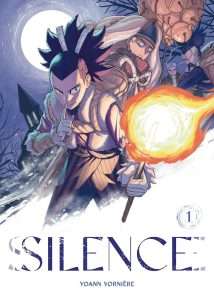 In the distant future, monsters have taken over the Earth. Clouds dominate the skies, blanketing the land in eternal winter. The sun is a myth, remembered only vaguely by the eldest humans. Total silence is required to evade the sharp-eared creatures in the dark, and, in one remote village, everyone communicates with sign language.
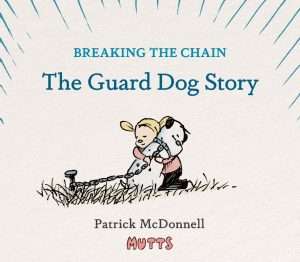 almost clichéd big dog meant to create comedic challenges for the two main characters, Mooch and Earl. However, one of the biggest clichés of the big, tough dog is that he is an outside dog, chained to his yard, and McDonnell’s Guard Dog transcended that cliché to become a beloved character with an important message to share about tethered animals…
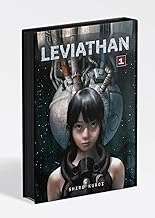 Many graphic novel fans in the Western world know about Japanese manga, just as there are many people, including those same Western graphic novel fans, who have very rigid preconceived notions about manga, believing it to be about stories featuring magical girls or martial arts battles. Manga, like other formats of graphic storytelling, can tell a wide variety of stories that feature everything from hyperkinetic action sequences to quiet moments of psychological tension. The latter is demonstrated in Shiro Kuroi’s Leviathan Vol. 1.
