Best friends Grace and Lola are on a mission to understand love! In volume one, the girls decide to research the topic, interviewing people at school to learn more about the elusive and confusing emotion and keeping their findings in a notebook called The Love Report. In volumes two and three, they have other things going on: new friends and fun adventures, including a beachy trip to Sardinia. Everywhere they go, though, Grace and Lola find reasons to wonder about love. Boys flirt with them, but what are their intentions? Should Grace confess her feelings to her new crush?
The girls are more casual now about their investigation; no more notebook or interviews, just lots of conversations and musing. And love isn’t the only thing on their minds. A boy at school is bullying and harassing people, including some of Grace and Lola’s friends. Grace is frustrated with shuttling between the households of her newly divorced parents. Lola struggles with body image issues. Their friend Adele has a rough home life, but is suddenly finding major success as an artist. But in and around all that, there’s enough romantic drama and intrigue to keep Grace and Lola asking questions about the nature of love.
Strong female friendships are the throughline of this series. Grace and Lola have some challenges to their bond in volume one, but come through them closer than ever. They also befriend Adele, Felicity, and Charlie, who all get more attention in the second and third volumes. Sometimes, the story follows one of them for awhile, showing the reader things that Grace and Lola don’t know. This expands the world of the story, since their experiences are very different—and sometimes creates juicy drama, as when the readers learn a secret Charlie is keeping from the others. All of these girls mean well and care about each other, and they are all spunky and willing to get creative to take on bullies or help their friends.
These books are translated from French (BeKa is a France-based two-person writing team). The translation is polished – minor errors noted in my review of volume one appeared in an advance copy, and have been corrected. The first two English volumes each collect and translate two of the shorter French volumes, while the English book three translates only one volume, so these three books contain volumes one through five of the French version of The Love Report.
These books touch on some heavy topics. Multiple characters have body image issues, and several have strained relationships with their parents. The school bully is constantly harassing people, especially girls, both in person and online. He even gets scandalous photos of a classmate (wearing a bra but no shirt) and shows them to other classmates. There is some harsh language (e.g. slut, bitch), which is used very rarely and not by the protagonists. Sex is only referred to occasionally, with no specifics. Refreshingly, the one queer couple is quickly accepted by most of the characters.
The manga-inspired art is detailed and full of rich, exuberant colors. Each character has a different personal style and shows it off with lots of fun, varied outfits and hairstyles. There are many different settings, from school to Adele’s art studio to the beaches of Sardinia, and they all add visual interest without stealing the spotlight from the characters.
This series will appeal to readers who like lots of emotion and drama. Grace and Lola are curious but tentative and nervous about love and romance, which will be relatable to some young readers. Hand it to fans of school stories and friendship stories, especially those who like high-drama manga.
The Love Report By BeKa Willcox Art by Maya Willcox Hippo Park / Astra Books for Young Readers, 2024 ISBN: 9781662640605
Volume
ISBN
2
9781662640605
3
9781662640889
Company Age Rating: 10 and up
NFNT Age Recommendation: Teen (13-16), Tween (10-13) Creator Representation: French, Italian, Character Representation: Queer,
Death and birth. Those are the opening moments of Rebis, the new medieval fantasy graphic from Irene Marchesini and Carlotta Dicataldo and translated from Italian by Carla Roncalli Di Montorio.
Shown in terrifyingly elegant detail, readers see a mob influenced execution paired with the birth of a child who is immediately viewed as “not right.” These panels cut back and forth with such rapid jumps that the reader can tell immediately these two elements will be intrinsically linked. Martino, our central character, is an albino with paler than pale skin and paper white hair. In their superstitious village this alone would be viewed as a curse, but Martino’s differences go beyond that. (Due to the nature of the story and Martino’s eventual transformation, I’m choosing to use they/them pronouns).
Martino simply isn’t what their father and children their age think a boy should be; they’re soft and quiet, obsessed with bugs, and seem more comfortable in the company of their sisters then other boys. And in a town ruled by fear, these differences are quickly seen as a curse. Martino’s father is ready to send them away to save the town’s harvest, to make the neighbor’s cow give more milk, to be like anyone else. And the unknown is as scary as a place where they are unaccepted.
Desperate for any place to belong, Martino finds Viviana, a woman living alone in the woods. This is a tricky story to summarize without giving away some lovely plot reveals, but meeting Viviana sets Martino on the path to self discovery which shows them exactly how hard it is to be yourself and how much you may be asked to sacrifice, even in a world where magic weaves through the everyday. This is a story about the family you choose and the incredibly hard journey towards loving oneself and rebirth.
Where this book really sings is in the art. Marchesini and Dicataldo show their story in rich, saturated panels that hint at Renaissance art while being entirely their own. They play with shadows, especially around Viviana’s face, in a really interesting, captivating way. The art is so good in fact, that there are times when they forgo potentially useful dialogue or exposition in favor of wordless scenes that, while beautiful, do not round out the plot. There is a lot left to reader interpretation in this graphic and I feel like the story would have been stronger if more questions were answered.
The publisher’s description of Rebis compares it to Nimona and Snapdragon and I think that does the story a disservice. There is a lightness and humor to the latter graphics that Rebis just doesn’t have. That’s not a bad thing, in fact the reserve, frustration, and unfulfilled rage that the creators give this story make it very impactful. It’s a story that the young adults the book is targeting can relate to. Rebis resembles Nimona and Snapdragon in that they all involve a child connecting to an adult and finding their own path to who they are, but that is where the similarity ends. Don’t read Rebis if you’re looking for a follow up to Nimona. Read Rebis if you want a more serious, at times heartbreaking, story that still manages to leave the reader with the promise that hope and love can triumph. This graphic does depict state sanctioned violence against women, ableism, and attempts at self harm.
Rebis By Irene Marchesini, Carla Roncalli Di Montorio, , Art by Carlotta Dicataldo Macmillan First Second, 2025 ISBN: 9781250359087
Company Age Rating: 14-18
NFNT Age Recommendation: Older Teen (16-18), Teen (13-16) Creator Representation: Italian, Character Representation: Trans,
From movie star to wartime nurse to mom to UNICEF ambassador, Audrey Hepburn lived a storied life, and author Michele Botton and illustrator Dorilys Giacchetto clearly take great joy in exploring the different eras of this icon in the appropriately named comic, Audrey Hepburn. Starting with the actress’ later years, the creators jump back to when Hepburn was 20 (after she had given up aspirations of becoming a professional ballerina) and move mostly chronologically through her life, hitting on the major film roles and relationships that would shape her career, occasionally stepping back to examine her childhood during World War II.
The back cover features a quote from Hepburn’s son, Luca, that seems to inform every aspect of the comic: “Everyone has their own Audrey.” Indeed, the book’s greatest strength seems to be how the creators depict the multifaceted identity of such a major figure of popular culture. The character is in a constant rotation of hairstyles and attire, suggesting her desire to continually push and reinvent herself. This is reinforced by the chapter title pages, which depict full body images of Hepburn in different poses and outfits, as if she is changing costumes or personas as the story progresses. Botton and Giacchetto see Hepburn as a woman of many dimensions, and take every opportunity to express this visually.
Giacchetto revels in big gestures and facial expressions, bringing a strong sense of cartooning to Audrey Hepburn that is both playful and exceedingly legible. A biography about an actress doesn’t offer over-the-top action, but the artist nonetheless finds subtle ways to infuse movement into the storytelling by relying on dynamic poses that give an energy to scenes that would otherwise feel rather static. Giacchetto’s characters have large eyes, emotive hands and faces, and evoke that classic cartooning style that will be immediately recognizable to even the most casual of Disney fans.
The book is a breezy read, which is usually good, but it also seems to gloss over some of the more intriguing and perhaps less discussed years of Hepburn’s life, notably her time volunteering as a nurse in a field hospital during World War II, as well as her later career as an ambassador for UNICEF. I suspect dwelling too much on these moments, however, would have weighed down an otherwise intentionally upbeat book, so I can’t say their omission is a surprise.
Audrey Hepburn falls into some of the expected pitfalls of biographies, in that sometimes it feels more like a list of historical occurrences rather than a carefully crafted story, but if you enjoy mostly straightforward, step-by-step accounts (or biographies, of course), this comic will feel extremely familiar. If you’re looking for a deeply critical analysis of the complex cultural icon that is Audrey Hepburn, you will not find it in this comic, but what Botton and Giacchetto have done is create a book that has fun in highlighting the successes of an exceptional woman who probably doesn’t get the credit she deserves as an artist and performer.
Audrey Hepburn Vol. By Michele Botton Art by Dorilys Giacchetto NBM Publishing, 2024 ISBN: 9781681123462
NFNT Age Recommendation: Adult (18+), Older Teen (16-18), Teen (13-16) Creator Representation: Italian, Character Representation: British,
American jazz history is full of big personalities, original sounding composers, and inspiring musicians. Few, however, loom as large in that history as Charles Mingus. Italian journalist Flavio Massaruto brings pieces of Mingus’s life to this story told in vignettes, broken-up with reinterpreted album covers done beautifully by artist Squaz (Pasquale Todisco.) This isn’t a straightforward biography, but rather a series of moments from a life that redefined a jazz movement. After reading you’ll have a sense of the size of the man, the volatile temper, the genius of the music, and heartbreak of his end.
The book opens in 1940 with Charles working as a part time actor in Los Angeles. You see the restlessness in the man and how he can sense the change about to take place around him. This is also where you start to learn that this isn’t going to be a simple biography—there is a double page splash of Charles emerging naked from the ocean with his upright bass surrounded by cherub musicians. The following chapters find him at different musical stops: composing music for films, working in the studio with his band, fights with musicians who don’t understand his vision, struggling with authenticity, and finally battling ALS (Lou Gehrig’s disease) in Mexico. As we skip through time, there are some sections that have very little dialog and we’re left to experience the setting and tone of the world swirling around Mingus. This doesn’t work well every time, but there are moments that remind the reader about the racism and classism at play in his world.
Each section is illustrated in stark black, white and yellow, with heavy line work and pronounced highlights. Visually, it’s a very interesting story to watch unfold. Squaz has illustrated a very distinct looking story that is cohesive and well plotted. The visual is really what kept me turning pages. Narratively, it left me wanting more.
This book is translated by Nanette McGuiness from the original Italian, and while I believe she did a good job bringing the conversations to life, this *feels* like a European book. American jazz music has had an incredibly wide influence and there are pieces of art that try to reflect back people’s feelings about the music. It often looks like this, a loose and vaguely emotional interpretation of the people and the times. I found myself hoping for more substance here, but without the aid of the music to help influence my experience of the text, it felt a little thin.
There isn’t a publisher recommended age for this book, but I would say older teens and adults would be the best audience. There is mild profanity, some nudity and smoking, but no violence to speak of. The end of the book includes recommendations of other titles to read, albums to listen to, and even some movies you can watch for more context. This much I really appreciated as someone who enjoys Mingus’s music, and was interested in knowing where the author had found their source materials.
Mingus By Flavio Massarutto Art by Squaz NBM ComicsLit, 2023 ISBN: 9781681123103
NFNT Age Recommendation: Adult (18+)
Creator Representation: Italian Character Representation: African-American
Charles M. Schulz’s name is as synonymous with comic strips as printer’s ink. His comic strip Peanuts moved beyond newspapers and into books, television, movies, and even products like snow cone machines. Peanuts’ lead character Charlie Brown has never kicked the football held in place by Lucy Van Pelt and that fact has been a consistent metaphor for Charlie Brown’s existence. Though Schulz (or “Sparky” to his friends) had a great deal more professional success as a cartoonist than Charlie Brown received at sports, there are many similarities between the cartoonist and his socially awkward, self-deprecating creation. Artist Luca Debus and writer Francesco Matteuzzi explore the parallels between Sparky and Charlie Brown in the biography Funny Things: A Comic Strip Biography of Charles M. Schulz, and in a format the icon known as Sparky would appreciate.
Charles “Sparky” Schulz was a boy growing up in Minnesota with lofty aspirations of becoming a cartoonist. Sparky was never an outgoing child, more willing to talk about his drawings than about himself. But he managed to live an interesting life. Even before he created the Peanuts characters, Sparky was a staff sergeant during WWII, active in his church, and an avid hockey player. Thanks to Charlie Brown, Sparky worked in television, traveled the world, and gained a fanbase that continues to grow. However, he still had his “Charlie Brown moments” where he would feel anxious and awkward, whether fretting about his interactions with others or considering the nature of the universe. Even in his final days, Sparky needed to be convinced that he was indeed beloved by his family and by his many fans.
This work is biographical, but its format and its humor keeps it from ever getting dry. The creators tell Schulz’s story using four panel comic strips that tell a continuous story, from his early childhood through his two marriages and from the early beginnings of his singular creation to near the end of his life when a stroke and various health problems forced him into retirement. The scope of Schulz’s life, as presented by Debus and Matteuzzi, is broad but skims over what could be darker moments of the book, such as how Sparky’s infidelity broke up his marriage or how Schulz’s father died suddenly just as his studio burned down. This book might not be for those who prefer their biographies to show a subject’s ugly secrets, but its lighter tone makes it a testament to the subject who inspired it.
The book pays homage to Charles Schulz, and Debus’s artwork does so by referencing the medium that made him famous. Telling Schulz’s story through four panel comics (with occasional larger, full-color comics) is like opening up the comics page of the newspaper. This “funny pages” look extends to the characters that populated Schulz’s life, especially Schulz at different ages, from quietly anxious child to shy, creative adult. The overall book is over four-hundred pages of these panels, but the breaking up of these moments in Schulz’s life into four panel comics, which are quite humorous, keep this biography from being a complete slog. There may be a question of authenticity, as there’s always the question of how much accurate information was sacrificed for the punchline. Nevertheless, it gives the highlights of Schulz’s life and portrays him as very much like Charlie Brown; serious, self-effacing, and surprisingly deep.
Librarians might be tempted to simply put this into their graphic novel collections, but it would be better served in their biography shelves. Even if it’s using pictures and panels to tell its story, its story of Schulz the artist, husband, father, and spiritual man is an enjoyable exploration into what made the man who made Charlie Brown and Snoopy.
Funny Things: A Comic Strip Biography of Charles M. Schulz By Francesco Matteuzzi Art by Luca Debus Top Shelf, 2023 ISBN: 9781603095266
Picking up right where volume one ended, Sorceline must face more than one secret about her family in order to save her new friends from a mystery assailant. Meanwhile, a new apprentice, Charlie, arrives on the island to everyone’s surprise, including Charlie’s since he can’t see mythical creatures at all. This causes some confusion as they work to further unravel the mysteries presented in book one, which lead to new and more dangerous mysteries. As the overarching story progresses, the characters explore different areas of the island to help cryptids in distress, discover new and unexpected abilities, and learn about old enemies that may not be as helpless anymore.
This was an excellent second volume that manages to answer questions posed in the first book while introducing new storylines that will hopefully be expanded on in volume three, which does not currently have an English release date. I continue to be impressed by the use of color in the illustrations. The illustrator uses them to evoke emotions to great effect and enhances the storytelling by juxtaposing bright, cool color schemes with darker elements.
All of the characters are given more definition, building on volume one. Because there are so many side characters in this series, it is hard for each of them to have the same depth of characterization, especially when they do not appear central to the main plot. However, each character does contribute to solving the mysteries presented. This volume also includes a bestiary that highlights the name, habitat, special characteristics, and life span of the various cryptids found on the Isle of Vorn.
I still highly recommend that this series be added to any library with a middle grade patron population that enjoys magical schools, mythical animals, or a layered mystery. There is a little more violence in this volume than in the first, but not much.
Sorceline Vol. 02 By Sylvia Douye Art by Paola Antista Andrews McMeel, 2023 ISBN: 9781524882310
Publisher Age Rating: 9-12
NFNT Age Recommendation: Middle Grade (7-11) Creator Representation: Italian,
Best friends Grace and Lola talk about everything together—and lately, they’re talking a lot about love. Relationships and boys are a mystery to both girls, but they are curious,. They decide to launch a project together to find out more: the Love Report.
In a shared notebook, they record everything they learn as they interview people who might have a useful angle on love: the school gossip, a couple who just started dating, two female friends who are feuding over a boy, the pretty girl who all the boys like, and the tough girl with a bad reputation. Lola even gets up the nerve to talk to the boy she likes! But heartache is coming for both girls. Will their friendship get them through? And will they ever understand love?
This story features close friendships, school drama, and family issues. Grace is a little jaded and skeptical, with a string of short relationships behind her, while Lola is less experienced and more hopeful about romance. The rest of the cast—mostly their classmates, with occasional appearances by their family members—brings other backgrounds and personalities to the mix. The story is set mostly at school and at various character’s homes, with a few forays into other parts of the unnamed city where it takes place.
In all the talk about love and relationships, the story acknowledges, but does not thus far actually show, the existence of LGBTQ+ people. For instance, Grace suggests that the boy who keeps dodging Lola’s attention might already have a girlfriend, or “maybe a boyfriend.” Characters take it in stride when the possibility of same-sex dating is mentioned, but we don’t actually see any of it happen.
This book collects the first two volumes of The Love Report, which were originally published in French as Coeur Collège (BeKa is a two-person writing team based in France). The illustrator is Italian. There are a few traces of the original French, including characters whose names have changed: for example, whenever Lola’s name appears in the illustrations, and at least once in a speech bubble, she is called Linon. There are also a couple of places with possible missing words or other small editing slips, but nothing big enough to cause confusion.
The illustrations are rich with detail. The delicate line art and varied but low-intensity color palette give a sense of cozy softness that is underscored by a lot of the visuals: fluffy hair, puffy or slouchy jackets and sweaters, rumpled beds, even poofy autumn trees. The style is realistic, but with clear manga influences. The characters are lively and expressive.
While the book has zero nudity and doesn’t show anything more sexual than a few kisses, there is discussion of one girl having a reputation for being “easy.” The words “bimbo,” “slut,” and “bitch” appear once or twice each, though the latter two are used by unpleasant characters and clearly not meant to be viewed as acceptable. There are some tough family situations, including parents who fight and a verbally abusive stepmother. There is also one scene of mild danger when a man chases and threatens our protagonists before being scared away.
With sympathetic characters exploring a topic of near-universal interest, plus a cozy and colorful art style, this book will appeal to fans of realistic fiction and school stories. Hand it to older readers of Raina Telgemeier, Victoria Jamieson, and Shannon Hale’s graphic novels, especially if they are open to an art style with more of a manga feel.
The Love Report Vol. 1 By BeKa Art by Maya Hippo Park (an imprint of Astra Books for Young Readers), 2023 ISBN: 9781662640407
Publisher Age Rating: 10 and up
NFNT Age Recommendation: Teen (13-16), Tween (10-13) Creator Representation: French, Italian Character Representation: Assumed Black
Sorceline travels to the Isle of Vorn to study cryptids under the tutelage of Professor Archibald Balzar alongside four other students. Sorceline quickly starts connecting with her fellow students, some more positively than others. In fact, Tara seems determined to outshine everyone, even going so far as to steal answers from Sorceline and present them as her own. During the first session, an unconscious and dehydrated gorgon is discovered and must be cared for. Unfortunately, Sorceline’s classmates start disappearing and the only clue left behind is a pile of glass. At the same time, Sorceline and her friends find some pixies that are acting like zombies and think they might be related to the disappearances.
Over the course of the story, the friends find some answers but many more questions. They must piece together what they know and separate the information to discover the cause before they all disappear.
Set in a fantasy world, there are multiple mysteries woven together with lots of visual clues for readers to discover as they try to solve it along with the characters. Each new thread introduces a bit of the world or adds to a character. I liked how the author brought in real world examples of animal behavior when building the mystery around the cryptids.
The illustrations have an overall dark, cool palette that gives depth to the ethereal nature of the island and its mythical creatures, while adding a bit of terror sprinkled throughout by utilizing swatches of light color to draw attention to important moments.
This is clearly the start of a series, as it ends on a cliffhanger. It would be an excellent series addition to any library with a middle grade patron population that enjoys magical schools, mythical animals, or a layered mystery. Although there is no violence on the page, please be aware that several children go missing and death is discussed.
Sorceline, Vol. 1 By Sylvia Douye Art by Paola Antista Andrews McNeel, 2022 ISBN: 9781524871314
Publisher Age Rating: 9-12
NFNT Age Recommendation: Middle Grade (7-11) Creator Representation: Italian
The Mastiff is the fifth book in Frederic Brremaud’s wordless Loveseries, which follows the adventures of a mastiff surviving in the Australian outback after his owner succumbs to a deadly snake bite while out hunting. The mastiff is forced to flee when a pack of wild dogs finds his owner’s body, he comes across a variety of other snakes, and subsequently has a run in with the wild dogs. Besides focusing on the mastiff’s journey, many pages follow the story of a platypus mother who is living near a pond where the mastiff eventually takes refuge.
Previous volumes followed a tiger, a fox, a lion, and a dinosaur. The reader gets to see the types of challenges and interactions each animal might face in a typical day as well as short asides to highlight other animals’ behavior. The author and artist do not shy away from the natural processes of life, including death, territorial disputes, and reproduction. For example, in The Tiger, although the tiger is unable to capture a monkey, a python is shown strangling one of the monkeys from the back of the group and slithering off with it still in its coils. In The Lion, male lions fight over a lioness and her cubs.
There is no text throughout this series. Instead, the artist includes lots of details and multiple panels per page to convey movement and emotion. It’s like watching a nature documentary but in the form of a book, giving the reader lots of time to analyze the backgrounds and flip back and forth to examine cause and effect. I personally loved the animal side characters and how well they are incorporated into each of the volumes.
Although the publisher has this series rated as All Ages, parents should be aware that death, blood, and violence are found in every volume. I imagine that the conversations spawned by reading it as a family would be engaging and informative. And since there is no shared storyline, each volume is standalone. Back matter includes sketches in all the volumes. The Mastiff also includes three pages about climate change and global warming, the effects felt in Australia, and ten suggestions to fight global warming.
Love: The Mastiff By Frederic Brremaud Art by Federico Bertolucci OtherMagnetic Press, 2021 ISBN: 9781951719173
Publisher Age Rating: All Ages Series ISBNs and Order
NFNT Age Recommendation: Tween (10-13) Creator Representation: French, Italian
Leslie, described as a “simple pig girl,” is getting to the age that her government mandates coupling for procreation. All other forms of romantic relationships are banned, with “re-education” camps for offenders. This wouldn’t usually bother Leslie, except she keeps having steamy dreams… of a wolf man. She doesn’t know who the wolf is, but reality pales in comparison to the dream.
She is automatically enrolled in a matchmaking program, which in turn has been infiltrated by some kind of cultists who believe that Leslie is the reincarnation of a blue haired pig woman from ancient prophecy. It turns out that the cult is correct, and Leslie ends up on the run for her life, trying not to draw too many people into her orbit, because her friends are being killed to get to her. So now she has to evade capture, fight the cult, and possibly overthrow a tyrannical government.
That’s a lot for anyone to handle, and Leslie certainly has her moments of weakness, frustration, and loss. As a reader this happens a few too many times, with the story being reset to a status quo of “on the run, and struggling against a power within her.” There’s nothing wrong with that, but I felt the story went on maybe an issue or two too long, and could have avoided at least one of those detours.
While the plotting is fine, Mirka Andolfo’s art shines, and it is easy to see why she is blowing up in the industry. The art is cartoony, sexy, and violent, often in the same image. Dream sequences with the white wolf are frequently nude, and the characters are drawn to be attractive even though they are animals. All in all, it reminds me of an adult take on Zootopia more than anything else.
The occasional bloody violence and the frequent nude scenes mean this is a comic for adult readers and it should be cataloged appropriately. In light of that, I would recommend it for larger public libraries, but I wouldn’t say it’s a “must purchase” for those of us with a tighter budget.
Unnatural Omnibus By Mirka Andolfo Image, 2021 ISBN: 9781534320598
Publisher Age Rating: M
NFNT Age Recommendation: Adult (18+) Creator Representation: Italian

 people at school to learn more about the elusive and confusing emotion and keeping their findings in a notebook called The Love Report. In volumes two and three, they have other things going on: new friends and fun adventures, including a beachy trip to Sardinia. Everywhere they go, though, Grace and Lola find reasons to wonder about love. Boys flirt with them, but what are their intentions? Should Grace confess her feelings to her new crush?
 Dicataldo and translated from Italian by Carla Roncalli Di Montorio.
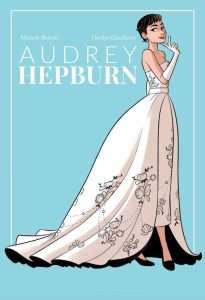 Michele Botton and illustrator Dorilys Giacchetto clearly take great joy in exploring the different eras of this icon in the appropriately named comic, Audrey Hepburn. Starting with the actress’ later years, the creators jump back to when Hepburn was 20 (after she had given up aspirations of becoming a professional ballerina) and move mostly chronologically through her life, hitting on the major film roles and relationships that would shape her career, occasionally stepping back to examine her childhood during World War II.
 American jazz history is full of big personalities, original sounding composers, and inspiring musicians. Few, however, loom as large in that history as Charles Mingus. Italian journalist Flavio Massaruto brings pieces of Mingus’s life to this story told in vignettes, broken-up with reinterpreted album covers done beautifully by artist Squaz (Pasquale Todisco.) This isn’t a straightforward biography, but rather a series of moments from a life that redefined a jazz movement. After reading you’ll have a sense of the size of the man, the volatile temper, the genius of the music, and heartbreak of his end.
 Charles M. Schulz’s name is as synonymous with comic strips as printer’s ink. His comic strip Peanuts moved beyond newspapers and into books, television, movies, and even products like snow cone machines. Peanuts’ lead character Charlie Brown has never kicked the football held in place by Lucy Van Pelt and that fact has been a consistent metaphor for Charlie Brown’s existence. Though Schulz (or “Sparky” to his friends) had a great deal more professional success as a cartoonist than Charlie Brown received at sports, there are many similarities between the cartoonist and his socially awkward, self-deprecating creation. Artist Luca Debus and writer Francesco Matteuzzi explore the parallels between Sparky and Charlie Brown in the biography Funny Things: A Comic Strip Biography of Charles M. Schulz, and in a format the icon known as Sparky would appreciate.
 Picking up right where
  boys are a mystery to both girls, but they are curious,. They decide to launch a project together to find out more: the Love Report.
 Sorceline travels to the Isle of Vorn to study cryptids under the tutelage of Professor Archibald Balzar alongside four other students. Sorceline quickly starts connecting with her fellow students, some more positively than others. In fact, Tara seems determined to outshine everyone, even going so far as to steal answers from Sorceline and present them as her own. During the first session, an unconscious and dehydrated gorgon is discovered and must be cared for. Unfortunately, Sorceline’s classmates start disappearing and the only clue left behind is a pile of glass. At the same time, Sorceline and her friends find some pixies that are acting like zombies and think they might be related to the disappearances.
 Leslie, described as a “simple pig girl,” is getting to the age that her government mandates coupling for procreation. All other forms of romantic relationships are banned, with “re-education” camps for offenders. This wouldn’t usually bother Leslie, except she keeps having steamy dreams… of a wolf man. She doesn’t know who the wolf is, but reality pales in comparison to the dream.
