A political allegory for the rise of dictatorship all framed through the anxious lives of… some pigeons?
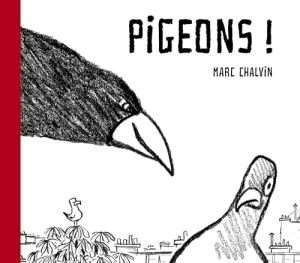
Street Noise Books delivers the English language edition of Pigeons! A Fable for Our Time from Marc Chalvin. The book opens boldly, introducing the reader to a vast number of hapless pigeons and the merciless crow who terrorizes and controls them.
The pigeons themselves are not known for complex thought. They eat poisoned seeds, walk in front of cars, and generally look for crow to give them instruction in every area of life. Simultaneously, the crow revels in this power, killing pigeons at will and toying with the living ones, safe in the knowledge that they will never object. Into this scene enters an idealistic seagull. She believes the pigeons are capable of more; the challenge is to convince them of that. The plan—stage democratic elections so that the pigeons can understand the concept of freedom and escape crow’s tyranny. The problem—the pigeons may prefer an iron claw to an uncertain world in which they make their own decisions.
While there is a clear narrative from start to finish, Chalvin balances story and character with a heavy emphasis on the political themes of the book. The pigeons often understand very little of what is happening around them, but the book intersperses debates between crow and seagull on topics such as democracy, control, and self-actualization which serve to bring the social and political topics to the forefront. In this way, things are a bit on the nose for readers who prefer subtler messaging. That being said, the book is far from a dry treatise on political thought. The pigeons banter and squabble, crow struggles to manage even the most basic interactions with the feathered populous, and seagull looks on in dismay as even the best intentions struggle in the face of reality. With dry humor and biting observations about humanity, Chalvin turns loose three factions in a struggle that feels immensely relevant to human history and the moment we live in today.
Chalvin’s art as well is simple, keeping the emphasis on the characters and the content over highly detailed scenes. With heavy line sketches and simple shading, there are stylistic touches of political cartoons while still allowing the book to take on its own shape and character. The wide-eyed pigeons are often indistinguishable, but Chalvin still imbues them with life amidst their fear and their naive joy as they wander their way through each new day. Most pages are broken into a simple four-panel layout while occasional scenes are given more space for detail and emphasis as key moments unfold at a larger scale. It’s a style that serves well, as Chalvin takes the simple visuals and fills them with personality and meaning.
There is some semi-graphic animal death throughout the book that is mitigated by both the style and the ironic humor that define the book. While the themes and questions are important, younger readers are likely to bounce off of this in favor of less overt political explorations. However, for older teens who are interested, and definitely for adults, Pigeons! is packed with sharp messaging and enough lingering complexity to give the reader something to contemplate once the book is done—rather than tying everything off in a bow that invites no further exploration. As a piece of social and political commentary, Chalvin delivers an excellent and tightly told fable here, and it’s a worthy addition and warning for any readership inclined to sit with it. And for any space looking to teach on the ideas the book contains, Pigeons! offers a very palatable entry point into subjects that can sometimes be dry in a purely academic context. In short, it’s not for everyone, but it’s a book well worth picking up for the right audience and an important book to see on shelves today.
Pigeons! A Fable for Our Times By Marc Chalvin Street Noise Books, 2025 ISBN: 9781951491505
NFNT Age Recommendation: Adult (18+), Older Teen (16-18) Creator Representation: French,
While not the first graphic novel to be written about the atrocities of the Holocaust (and surely not the last), Ginette Kolinka’s Adieu Birkenau approaches the subject with a surprising amount of levity and accessibility. The comic splits its time between the present (well, the present of 2020), in which the 95-year-old Kolinka re-visits the Auschwitz-Birkenau prison camp with a group of students, and the events of the past. Kolinka recounts her early life in France, her large family’s attempt to escape Nazi persecution, and most notably the experience of trying to survive in camp as she was being abused, humiliated, and dehumanized.
Kolinka and her co-writers J.D. Morvan and Victor Matet present her time in the concentration camp with a matter-of-factness that avoids the dramatic, emotionally-wrought approach one might expect of a Holocaust survivor’s story. This comes across less as objectivity and more so like a survivor who has almost curated her memories so as to not be incapacitated by them. Indeed, memories seem to be a major theme of Adieu Birkenau.
It’s difficult to read Adieu Birkenau without viewing it in the context of the great tradition of memoirs that use comics and graphic novels as a way to process extremely traumatizing events, such as They Called Us Enemy, Persepolis, March, and especially Maus. Like those books, Kolinka’s work is deeply concerned with memory, and how it plays a role in processing grief. Kolinka is exceedingly upfront about how her memory is unreliable and that her tendency to block out some of the most horrendous aspects allowed her to survive. This is cleverly conveyed visually, as figures in the camps are often depicted as dark, vaguely human-shaped clouds, as if Kolinka can only remember the slightest impression of them. In the back half of the book, panels often contain scenes from both the past and present, as if to remind the reader that these events long past are still very much alive today.
Artists Cesc and Efa bring a sense of whimsy and warmth to the art that seems more informed by the animation of Disney or Studio Ghibli than most comic illustration. Characters have soft, rounded features, and big, expressive eyes that give the reader an immediate glance into their thoughts and feelings. The playfulness of the line work contrasts greatly, however, with the subtle brown and gray tones that characterize much of the graphic novel and add to the dreariness and despair of recounting life in a prison camp.
Although Adieu Birkenau is recommended for adults, there is very little that would make it inappropriate for younger readers–especially if you’re looking for an accessible way to introduce them to the horrors of the Holocaust. There are brief depictions of nudity in recounting the ways the Nazis forced the prisoners to strip down in the camps, but it’s handled very carefully and clearly used to highlight the sense of embarrassment and dehumanization that Jewish prisoners were subjected to. The most gruesome imagery one might expect to find in a comic written by a Holocaust survivor is also not explicitly shown–which certainly ties into the way that Kolinka repressed the worst aspects of her experience just to survive.
If you like stories that put a human face on big, overwhelming tragedies, like the previously mentioned Maus, then Adieu Birkenau will be right up your alley. Kolinka approaches the subject matter with much more humor than, say, Art Spiegelman, but she doesn’t gloss over the ways that trauma sticks with survivors and how our memory plays an important role in processing such horrors. It is a worthwhile addition to the hugely important genre of comics by creators trying to make sense of real world horrors.
Adieu Birkenau By Ginette Kolinka, Jean-David Morvan, and Victor Matet Art by Ricard Efa and Cesc F. Dalmases SelfMadeHero, 2024 ISBN: 9781914224232
NFNT Age Recommendation: Adult (18+), Older Teen (16-18) Creator Representation: French, Jewish Character Representation: French, Jewish
Fans of Strange Tales may be familiar with Youtube personality MrBallen (real name John B. Allen). A former Navy SEAL, MrBallen doesn’t tell his stories of people’s actual accounts with the supernatural and fantastical on a set lit with black candles or a coffin sitting in the background. Instead, he wears a signature baseball cap and flannel shirt while sitting before a microphone. He doesn’t need Gothic ambience to pull his fans in; the stories themselves are enough. He, along with contributor Robert Venditti, seems to take that approach with his book MrBallen Presents: Strange, Dark, & Mysterious: The Graphic Stories, illustrated by Andrea Mutti.
The nine stories within this book are from around the world. Many of them are typically spooky stories that one would tell around a campfire; hence, the book’s front cover has MrBallen sitting behind a campfire surrounded by skulls (the closest he comes to Gothic trappings) while he locks eyes with the reader as he prepares to tell these stories. His first story involves a stretch of Canada’s Northwest Territories that has made many people disappear over centuries, a story which sets the tone for the rest of the book, while other tales include a man who disappears in an abandoned Spanish village where a witch met her end, a woman who has a very strange and visceral dream while camping, a man encountering a persistent tiger, and an actual giant encountered in the mountains of Khanadar, Afghanistan.
The stories MrBallen and Venditti share are stories that he has researched, stories he’s heard from others (the story of the giant is one he’d heard from a fellow soldier), or ones he’s experienced himself. The stories are presented as nonfiction but MrBallen doesn’t spend time delving into the history of these encounters or trying to prove or disprove their veracity; he’s simply there to tell a story and entertain his audience. The way these stories are presented also bank on another part of MrBallen’s appeal: his approachability. His stories aren’t told with the dry delivery of a folklore scholar, but of someone sharing this story with a friend in a not-too-crowded local bar.
Mutti’s art style also shows a distinct lack of ostentatious ambiance, which benefits the book. Mutti forgoes detailed images of many of these terrors, particularly the supernatural ones, and shows just enough to let the reader’s unsettled mind fill in the blanks. For settings, he only places the bare minimum within a scene to create the proper atmosphere, whether that be fog winding through a dark forest, or the terrified eyes of the people experiencing these stories. Even Mutti’s watercolor style artwork, with pale colors and realistic detail for the non-supernatural elements, complements rather than distracts from the stories’ elements.
In the public library nonfiction shelves lurk books about real-life hauntings and stories meant to raise hackles on unsuspecting adult patrons. The patrons who enjoy those books will enjoy MrBallen’s tales; perhaps they are even fans of his Youtube show. If they are not fans, they might discover MrBallen through reading the solidly spooky tales he has collected.
MrBallen Presents: Strange, Dark & Mysterious The Graphic Tales By John B. Allen Art by Andrea Mutti Ten Speed Press, 2024 ISBN: 9781984863430
NFNT Age Recommendation: Adult (18+), Older Teen (16-18)
“The night the last queen dies, the age of darkness will be upon us.” It’s a refrain repeated throughout Rochette’s quiet epic of humanity and nature which rings more true each time it is spoken.
From publisher Self Made Hero and the co-creator of Snowpiercer, Jean-Marc Rochette, The Last Queen spans more than 100,000 years of history, with the core story following Édouard Roux, a World War One survivor adrift in a new world rapidly chasing modernity.
The broader narrative follows the history of a people who have lived close to the land, defending the existence of the bears they revere even as wars and human powers encroach, demanding tribute, seizing resources, and targeting outsiders for witchcraft. It is this tradition Édouard was born into. After the war, seeking an artist who can sculpt him a new face to cover his violent disfigurement, he crosses paths with a woman named Jeanne Sauvage. Their passionate relationship grows, as Édouard inspires Jeanne to craft her greatest sculpture, a monument to vibrant and untamed nature. However, in a world that prizes progress and profit, Jeanne and Édouard find themselves facing forces that seek to tame nature itself, and neither of them may be strong enough to stand against the rising tide.
Rochette’s name has immediate selling power from a comic as iconic as Snowpiercer, but The Last Queen is quite a different story narratively. There are still plenty of big themes to explore, but this historical drama takes its time and reads quite intimately in places, even with the grand timeline of events. There is a great deal going on here, from romance to art to war and conflict. The story unfolds, in danger of spiraling out of control but managing to weave all of these distinct parts into a meditation on humanity’s relationship with itself and with nature. The ideas underlying the text are bold and clear, but never feel forced. The scope is quite large, but Rochette keeps the reader grounded as the text moves back and forth across the centuries. And even the ending—not tied up neatly in a bow as it might have been—feels more honest for finding connection between all these pieces without forcing them to fit too tightly together.
Along with this often melancholy narrative exploration, the art features a wide palate of muted colors and heavy use of inks. There are clear visual similarities to Snowpiercer, but Rochette shapes the visual style to the story. We get close-up panels full of detail, capturing the vulnerability of the characters at their most difficult moments. Pages later, the colors lighten and the view pulls back to impressive views of wide landscapes untouched by human expansion. Throughout the book, the imagery is compelling, with the visuals capturing the feelings of freedom and looming oppression which underly so much of the narrative.
The Last Queen seems aimed at a mostly adult audience. Mature elements include violence against humans and animals, as well as the aftermath, occasional strong language, and on-page sexual content without significant, clear detail. Additionally, with a relatively thematic and character-driven story, younger readers may not feel as interested in the events taking place. However, for those teen readers interested in a historical fiction comic with strong environmental themes, the content should not be so objectionable as to pose a major issue. Overall, this book leans more in appeal to what some might call readers of “literary” comics, but with a deft hand and compelling storytelling, Rochette has created a rich and rough narrative that leaves the reader with plenty to ponder after the pages themselves are finished.
The Last Queen Vol. By Jean-Marc Rochette Self MadeHero, 2024 ISBN: 9781914224195
NFNT Age Recommendation: Adult (18+), Older Teen (16-18) Creator Representation: French, Character Representation: Prosthesis,
In mid-90s Paris, eighteen-year-old Nina is struggling to find her path. The daughter of a Black Muslim from Gambia and a Polish Jewish woman whose family narrowly escaped the Holocaust, Nina feels out of place almost everywhere: the university she attends, the parties thrown by fellow students, and definitely her ballet classes, where she is told “You’re a great dancer, but Sleeping Beauty is not Black.” When her ballet teacher suggests that she is not a good fit because “the corps de ballet must appear uniform,” Nina quits, feeling more adrift and rejected than ever. But when she discovers track and field – and a coach who says she has great potential as a runner—Nina is intrigued. She’s also intrigued by Jackson, a handsome runner on the team.
Nina joins the team, works hard, and soon qualifies for the regional championships. Finally, people are celebrating her accomplishments. But then things take a turn: three other athletes sexually assault Nina in the locker room after the championships. She doesn’t tell anyone, but the trauma eats at her. Meanwhile her crush, Jackson, keeps giving her mixed messages. Nina starts smoking and drinking, getting into trouble at school and on the running team. Her family, her best friend, and the running team’s sympathetic doctor are worried. Can Nina find her way through these challenges to a bright future?
This book is an adaptation of a semi-autobiographical novel. The author, Rachel Khan, shares Nina’s heritage and went from classical dance to track and field at about Nina’s age. In a forward to the graphic novel, Khan calls it a coming of age story about trying to find your way when you “don’t look like anyone around” and are deeply aware of the “weighty history” of your family.
While the running element adds interest, the real focus is Nina’s emotional life. As the book goes on, she speaks out more: she snaps at her racially insensitive professor, argues with her running coach, and tells off a classmate for seeing her as “exotic.” Though her anger is usually justified—after all, she faces problems as serious as racism and sexual violence – she sometimes has reactions that may feel odd or surprising to readers. For instance, when the running team’s doctor admonishes her for using drugs, she responds “I don’t need any lectures from you, Karim. My father is the child of slaves who was then adopted. So I could care less about your team and its stupid honor.” In this case, even the doctor pushes back, asking “What’s that got to do with your getting high”.
Despite her struggles, Nina has good things going for her. She adores her family and her Jewish religious community. She has a supportive best friend and, by the end of the book, a new romance. Her success on the track also boosts her self-esteem and helps her finally feel like she belongs.
The scene when three other athletes sexually assault Nina is not explicit, nor does she ever recount the incident on the page, but readers see her trauma and physical injuries. The book has a little other violence, like pushing and hitting between Nina and a running team rival, and some swearing. There is no nudity, and nothing more intimate than a couple of kisses. Nina reflects on and discusses religion and race, which both feature heavily in her experiences.
The artwork is a simple but expressive cartoon style. The characters are dynamic and distinctive. There is a wide variety of settings: Nina’s home, her school, the track, and more. Some are drawn with detail and interest, while others are sketched in and simplified, keeping them firmly in the background. The color scheme supports the mood and feel of different scenes: cozy neutrals in Nina’s family home, sunny brights when she runs on the track, and so on.
Nina’s experience—drawn from the author’s own—will resonate with some readers and perhaps be illuminating for others. Though it is fictionalized, the book may appeal to fans of memoirs.
I Run to Make My Heart Beat By Rachel Khan Art by Aude Massot FairSquare Comics, 2024 ISBN: 9781960171054
Related media: Book to Comic
NFNT Age Recommendation: Adult (18+) Creator Representation: French, Gambian, , Character Representation: French, Gambian, Jewish ,
This graphic novel is a biographical account based on George Sand’s life, detailing the years of her early youth, her budding romantic relationships and her last years spent in Nohant, France, during the early nineteenth century.
George Sand was born Amantine Lucile Aurore Dupin and her parents were Maurice Dupin de Francueil and Sophie-Victoire Delaborde. During her childhood, George loved her parents dearly and was a bit of a wild child. The graphic novel mentions her close maternal relationship with her mother and especially grandmother, Marie Aurore whom owns a considerable fortune and the estate at Nohant.
The graphic novel features illustrations of characters that are hand drawn, in pen and ink. Although the publisher aims this novel for a teen audience, there are several prominent historical and literary figures and political themes mentioned in the novel, which would be better suited for a college aged readership.
The graphic novel goes into extensive detail of George Sand’s life as she develops into a prominent, outspoken writer, adopting a masculine identity when she goes out on the town and prefers to wear men’s clothing. There are candid scenes of George Sands romantic life, mentioning her various relationships with creative and artistic men including Jules Sandeau, Charles Didier, Frederic Chopin and others. This graphic novel is a fairly dense read and is best suited for readers whom are interested in French literature written during 19th century and can understand the rammifications of the French Revolution and Napoleon Bonaparte years altering the economic and socio-political landscape in France.
George Sand: True Genius, True Woman By Severine Vidal Art by Kim Consigny SelfMadeHero, 2024 ISBN: 9781914224201
NFNT Age Recommendation: Older Teen (16-18) Creator Representation: French, Character Representation: French, Bisexual,
Joanna Tan is a special kind of freelance agent. She is not a killer or a thief. She is one of a kind.
Known as Gun Honey, Joanna Tan is an expert in infiltration and smuggling. Specifically, she’s a gun runner, but also a specialist. If you’re an assassin and you need the right weapon for the right job, Joanna is the one who gets it for you and delivers it where it needs to be. No matter how impossible.
Over the course of her career, Joanna has smuggled a taser into the Vatican and a pistol onto a private yacht while wearing nothing but a bikini and a smile. Unfortunately, one of Joanna’s latest jobs had unintended consequences. The last gun she delivered led to a prison riot and a bombing, killing dozens of innocents. Now, recruited by the US government and partnered with FBI agent Brook Barrow, Gun Honey must track the man responsible or go to prison herself.
Joanna is a typical tough girl hero. She doesn’t get much definition outside of her work, apart from owning a cat. Despite this, she is likeable and sympathetic, despite her criminal background and self-serving attitude.
Gun Honey Vol. 1 is as neat a thriller as one would expect from Charles Ardai. His premiere novel, Little Girl Lost, was nominated for both the Shamus Award and the Edgar Allan Poe Award. His second novel, Songs of Innocence, won the Shamus Award. He’s also won the Edgar and Ellery Queen awards for his work on his Hard Case Crime imprint. It is no surprise he can write a good mystery, but it is something of a surprise he’s also a solid comic writer.
The artwork by Malaysian artist Ang Hor Kheng is as impressive as the writing . Kheng is an up-and-coming artist, but they showcase their skills throughout this first volume. The action sequences are all well blocked, with vivid detail. The effect is reminiscent of Mike Grell’s work on Warlord and Jon Sable: Freelance. Kheng does a fantastic job of highlighting the musculature of his characters. Unusually, he also depicts a variety of body types. Not all of the women have the same cookie-cutter perfect body and same face. Every characters looks distinctive and there is no chance of confusing the characters, even in the middle of a crowd shot.
Gun Honey is rated 17+ by Titan Comics. I believe that to be a fair assessment. There is a copious amount of violence, with several people being shot including being shot in the head. There are multiple bombings and the villain of this first volume is covered with scar tissue from multiple burns, which is vividly illustrated and appropriately disturbing. The most likely sticking point, however, is there is a lot of nudity and sexuality. Joanna is very free with her body and Is shown seducing a female prison guard in order to steal her ID. She also strips down completely to hide in a women’s spa, were she and several other women are pictured in detailed full-frontal nudity.
Gun Honey Vol. 1 By Charles Ardai Art by Ang Hor Kheng Titan, 2022 ISBN: 9781782763468
Publisher Age Rating: 17+
NFNT Age Recommendation: Adult (18+) Creator Representation: Malaysian, Character Representation: Singaporean, Bisexual,
“When you asked if you were bipolar, she was looking for a wolf, so she wasn’t going to find a fox.”
In her graphic memoir, A Fox in My Brain, Lou Lubie explores her experience with and diagnosis of cyclothymia bipolar disorder. After a depressive episode in high school, Lubie experienced drastic and confusing shifts in mood and energy. Therapists and others in her life often dismissed her concerns about her depression, saying that she was too young to be really depressed and that it will pass on its own. It was years before therapists took her concerns seriously, and she was able to find treatments and medications to help reign in the fox in her brain.
It would be difficult to discuss the illustrations and story separately. Lubie illustrates the book in a palette limited to shades of bright orange and gray. The simplified palate and illustrations help to highlight the personification of her shifts in mood and energy. Some of my favorite personifications are early in her depression, with swallowed pills dispersing a shadow of depression and in another depressive roots clinging to her while she attempts to pull it out. As the story progresses, her depression is more often illustrated as a menacing shadow with sharp eyes and teeth bearing down on her. It isn’t until a therapist starts to ask about her non-depressive moods when she is full of energy and feels invincible, that an orange fox starts to peep into the illustrations.
After talking with the therapists and a little digging on the internet, she came across the term cyclothymia, a temperament characterized by mood swings. It is at this point that she notices the fox in her brain. A mischievous (sometimes cute) creature with a dark side. Cyclothymia isn’t a disorder, but can become one when fed with stress, exhaustion, trauma, and in Lubie’s case, possibly antidepressants (which can trigger manic episodes). When classified as a disorder, it is considered a lesser form of Bipolar I or II. In the book at one point, she describes it as Bipolar II ½. Rather than the extreme and often long-lasting shifts of Bipolar I and II, bipolarity with cyclothymia is characterized by more frequent shifts. The moods exceed the typical, and can sometimes be triggered more easily than those with more drastic bipolar disorders.
Lubie’s diagnosis brought about insights into herself and her relationships with others, including friends and her boyfriend. Naming the fox in her brain, also aided in her ability to manage it. She began to see and acknowledge that the fox was there, and learned to feed it with moments of novelty while also keeping it on a leash. Cognitive Behavior Therapy combined with medication gave her back control of her life. Interspersed throughout her story are informative asides about the nature of depression, bipolarity, cyclothymia, and associated treatments, and she ends the book with letters from others experiencing this condition, offering her advice and validation.
There were a few frustrating moments in her informational asides with some fatphobia. While concerning, I think that the book as a whole is so powerful, well-written, and potentially validating, I can forgive those missteps. I am not a therapist, nor do I have a bipolar diagnosis, so I can’t speak directly to the accuracy of the information about the disorder and management. According to a letter in the end pages, she wrote this under the supervision of a therapist, to help provide the best information about cyclothymia bipolar disorder. She also notes that this book cannot take the place of a diagnosis or advice from a licensed therapist or psychiatrist.
Lubie suffers from suicidal ideation and is at one point voluntarily hospitalized for it. She personifies her suicidal thoughts through conversations with the grim reaper in the shadowy depths of a body of water. This could be triggering for some, and definitely worth noting when considering for purchase. However, I think it is a great exploration of a difficult topic, written in a way that is informative to anyone with or without bipolar disorders, and validating for those who do. This will be purchased for my high school collection, and I believe that many students will resonate with a story about struggling to identify and manage mental health.
A Fox in My Brain By Lou Lubie FairSquare Comics, 2024 ISBN: 9781960171108
Publisher Age Rating: 13-18 NFNT Age Recommendation: Older Teen (16-18), Teen (13-16)
Creator Representation: French, Bipolar Character Representation: French, Bipolar
Odette has a jellyfish in their eye. The doctors don’t have an answer. It’s a mild inconvenience until the day a second one appears.
A college dropout trying to navigate family pressures and an uncertain future, Odette works at a local bookstore, keeps their pet rabbit, and develops a crush on a woman named Naina which may turn into something more. Dodging uncomfortable interactions with their mother, going out to awkward parties with their best friend and his girlfriend—Odettte’s life is small enough, but it’s comfortable. It’s the jellyfish that are the problem. No one has an answer and no one seems particularly concerned about what it might mean. But as the jellyfish continue to multiply, Odette must decide who they will trust, who they will allow to get close, and how they will navigate a future that is not at all the one they expected to be facing as an increasing number of jellyfish begin to block out the things they once were able to see.
Pow Pow Press delivers The Jellyfish, written and illustrated by Canadian graphic novelist Boum and translated now to English. The initial premise has an absurdity to it that injects quiet humor into the writing. “You do indeed seem to have a jellyfish in your left eye,” is the first line delivered in the story. However, this declaration takes on unexpected weight across each section of this book, broken out across the changing of the seasons. Interwoven with snippets of headlines and online quizzes, this graphic novel is rooted in the deep tensions and trivialities of the perpetually online and interconnected existence of young adults in the modern age. From the opening sequence of Odette working in the bookstore to returning home to a nearly empty apartment, Boun captures mundane details that are familiar, engaging, and sometimes all too real, filling Odette with recognizable life in a very short span of time. From awkward parties full of strangers to the heightened emotions of new love, Boun’s portrayal of Odette is richly detailed and empathetic—and this subtle capturing of deep, complex emotion only becomes more recognizable as Odette finds themself facing increasingly dire challenges.
I’m dodging around too many specific plot details because the story is best experienced alongside Odette and those closest to them. Bringing each panel of the story to life, Boum’s delightful art is simple enough in clear shades of black, white, and gray. Emotions shift from humor to sorrow with a deft hand, spotlighting exactly the elements the reader should notice, while building out a richly detailed world with sometimes the simplest brush strokes. Forming a core element of the story, the titular jellyfish are never far from the panels, drifting across the visuals in the same way they drift across Odette’s vision. Entire sequences play out without dialog and the way each panel leads into the next remarkably captures the emotional state of Odette and those around them, each of whom has their own triumphs and tragedies to navigate in search of what it means to live in a complicated world. It’s a remarkable fusion of storytelling and art which quickly draws the reader into Odette’s life and expertly captures the highs and lows of their narrative and emotional experience.
Pow Pow Press does not assign The Jellyfish an age rating, but it’s best suited for older teens and adults due to some naturally-presented nudity, strong language, and overall thematic elements. The content isn’t particularly troubling, but it is a story aimed at older readers and the deep emotional themes pack quite a punch in the later portion of the story. Younger readers and anyone sensitive to narratives centered around degenerative disease should be mindful before diving into this one.
The Jellyfish is one of those stories where it is difficult to explain the experience of reading it in words. I don’t want to give away too much and waving a book around saying “read this” is either effective or it’s not. Visually and in writing, Boum has created a story full of diversity and rich in humanity. It’s crafted with immense care and talent, and in a relatively short span of pages, manages to take the reader on a deeply emotional journey that is absolutely worth the time it takes to experience. In the end, my review on this book is simply “read it.” You won’t be disappointed.
The Jellyfish By Boum Pow Pow Studios, 2024 ISBN: 9782925114307
NFNT Age Recommendation: Adult (18+), Older Teen (16-18) Creator Representation: Canadian Character Representation: Queer, Nonbinary, Disability
The advanced review copy of Dear Body, edited by Lea Bordier, that I read for this review states on its cover: “In Dear Body, 12 women and non binary describe their relationship with their own bodies in their own words.” As Bordier explains in the introduction, the twelve short pieces the volume contains are adapted from a video project that she created. The stories are translated from French, leading to some occasional awkward turns of phrase, but overall, it’s an easily digestible, thoughtful collection of women and non-binary folks’ stories about their bodies. Each story is illustrated by a different artist, offering a variety of voices and styles.
The stories contemplate topics such as pregnancy, rape, illness and injuries, feminine grooming and dressing, being fat, being Black, and being disabled. A common thread throughout several of the stories is how other people react to the bodies of the main characters, and how the words and actions of others towards their bodies contribute to the characters’ perception of themselves. It emphasizes how societal norms and ideals can affect our self-worth, especially when we defy those norms and ideals. Even more so, it questions why some people feel entitled to treat others a certain way based solely on their bodies. The main characters range in age, with some diversity among the dozen: one lesbian, one nonbinary person, one Black woman, and one Asian woman. One character, Camille, has cerebral palsy and uses a wheelchair, a walker, and crutches throughout her story.
The deep and introspective stories surprised me with a breadth of topics. Shonah struggled to be taken seriously by doctors and it took years to reach her diagnosis of Vestibulodynia. Blaise asks themself of feminine grooming rituals, “Am I doing this for them or for me?” Sophie took two bullets during a shooting and relates her slow recovery through surgery, physical complications, and Post-Traumatic Stress Disorder. Mathilde, a fat woman, gets called hurtful names and has trouble finding clothes that fit, but she also sings in a band, has a fun social life, and works out at the gym. Each story is told with lush, beautiful art. “Mathilde”, by Mademoiselle Caroline, reminds me of something you’d see in The New Yorker, with curving, painterly lines and bold pops of color. It also depicts a fat body naked in everyday scenarios such as lounging with a lover and showering at the gym, which complements the story well. “Sophie”, by Karensac, is drawn in a pleasant, cute cartoon style with an orange and blue color palette. Assigning a different artist to each story adds to each one’s unique feel.
The only minor issue with the collection is that the translation from French to English stumbles in some places. For instance, in “Aurelie”, the text reads, “I lost so much weight I had to be hospitalized. I didn’t attend my sophomore or junior year. I was pretty sheltered from comments because I was marginalized until I was 20,” (81). I think by marginalized, perhaps the author meant something closer to isolated. In “Mayalan”, the main character admits, “I had a lot of trouble accepting my body up until one day when I said: Enough!” (91). In the same story, Mayalan points out her faults on a diagram of her own body, with an arrow pointing to her ankles that reads “terrible hemline,” (89). Still, with Lea Bordier’s original video project in French, this may be as good as it gets for an Anglophone audience without French language proficiency.
Dear Body is a decent anthology with some lovely art and an array of themes, though Ivanka Hahnenberger’s translation is awkward at times. Consider it an optional purchase for adult graphic novel collections.
Dear Body By Lea Bordier Art by Carole Maurel, Karensac, Eve Gentilhomme, Lucille Gomez, Mademoiselle Caroline, Sybilline Meynet, Cy, Marie Boiseau, Anne-Olivia Messana, Mirion Malle, Mathou, Daphne Collignon FairSquare Comics, LLC., 2023 ISBN: 9798985927832
Publisher Age Rating: 16+ NFNT Age Recommendation: Adult (18+)

 Birkenau approaches the subject with a surprising amount of levity and accessibility. The comic splits its time between the present (well, the present of 2020), in which the 95-year-old Kolinka re-visits the Auschwitz-Birkenau prison camp with a group of students, and the events of the past. Kolinka recounts her early life in France, her large family’s attempt to escape Nazi persecution, and most notably the experience of trying to survive in camp as she was being abused, humiliated, and dehumanized.
 tell his stories of people’s actual accounts with the supernatural and fantastical on a set lit with black candles or a coffin sitting in the background. Instead, he wears a signature baseball cap and flannel shirt while sitting before a microphone. He doesn’t need Gothic ambience to pull his fans in; the stories themselves are enough. He, along with contributor Robert Venditti, seems to take that approach with his book MrBallen Presents: Strange, Dark, & Mysterious: The Graphic Stories, illustrated by Andrea Mutti.
 epic of humanity and nature which rings more true each time it is spoken.
 In mid-90s Paris, eighteen-year-old Nina is struggling to find her path. The daughter of a Black Muslim from Gambia and a Polish Jewish woman whose family narrowly escaped the Holocaust, Nina feels out of place almost everywhere: the university she attends, the parties thrown by fellow students, and definitely her ballet classes, where she is told “You’re a great dancer, but Sleeping Beauty is not Black.” When her ballet teacher suggests that she is not a good fit because “the corps de ballet must appear uniform,” Nina quits, feeling more adrift and rejected than ever. But when she discovers track and field – and a coach who says she has great potential as a runner—Nina is intrigued. She’s also intrigued by Jackson, a handsome runner on the team.
 budding romantic relationships and her last years spent in Nohant, France, during the early nineteenth century.
 “When you asked if you were bipolar, she was looking for a wolf, so she wasn’t going to find a fox.”
 Odette has a jellyfish in their eye. The doctors don’t have an answer. It’s a mild inconvenience until the day a second one appears.
 The advanced review copy of Dear Body, edited by Lea Bordier, that I read for this review states on its cover: “In Dear Body, 12 women and non binary describe their relationship with their own bodies in their own words.” As Bordier explains in the introduction, the twelve short pieces the volume contains are adapted from a video project that she created. The stories are translated from French, leading to some occasional awkward turns of phrase, but overall, it’s an easily digestible, thoughtful collection of women and non-binary folks’ stories about their bodies. Each story is illustrated by a different artist, offering a variety of voices and styles.
