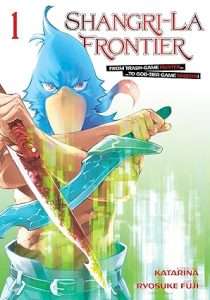
Set in a future where videogames are all virtual reality (VR) based, Shangri-La Frontier (SLF) is a multi-player fantasy game with lots of unique characters, scenarios, and items, making it stand out from other VR games that are not well-developed and full of bugs and broken mechanics. Sunraku is a player that tackles these terrible games as a challenge; however, he picks up SLF during summer break and discovers his own unique scenario that keeps drawing him back to the game. His unconventional choices come from his many hours playing broken games and wanting to maximize his fun.
In volume one, Sunraku skips the beginning tutorial town and almost dies from the area boss monster guarding the second town. Wanting to get ahead of most of the players, he goes back to exploring after purchasing some new gear. While exploring, he runs into one of the unique boss monsters of the game, which don’t respawn after being beaten by players. He puts up a good fight but is no match for Lycagon; however, the beast acknowledges the strength of the player by cursing Sunraku to not be able to wear armor on his torso or legs and lower-level monsters will avoid him. Shortly after that, Sunraku finds a unique scenario involving a vorpal rabbit leading him to a hidden area called Rabituza.
In volume two, Sunraku is targeted by a group of player-killers (pk’ers) after an image of him with the unique non-player character (NPC) vorpal rabbit Emul is posted to an online forum without his permission. One of the pk’ers is an old gaming buddy, so we learn more about Sunraku’s other gaming adventures with Pencilgon and Katzo, who joins the game later. Sunraku is saved from being pk’d by a player known as Psyger-0, the “Attack Master,” who’s a female classmate with a crush on him but is too shy to even say hello. Next, Sunraku goes back to Rabituza to tackle the unique training scenario he was offered. He must fight a total of ten bouts with monsters, using only vorpal weapons, and wearing an item that lowers the experience he earns.
Volume three shows Sunraku finishing the epic training scenario and Pencilgon deciding that her clan has failed her game aspirations, and she needs to form a new group who can help her. After helping him escape pk-ers a second time, Psyger-0 sends a friend request to Sunraku, which he accepts to be polite and because he didn’t want to offend such a high-level player. This is when Sunraku explores the world by going into the Prismatic Forest Grotto and observing the monsters that populate the area. Pencilgon explains her plan to Sunraku and Katzo to take down one of the unique NPCs, Wethermon. The rest of this volume and the fourth shows how they prepare for this epic fight as well as its beginning.
This series is a unique contribution to action manga that utilizes isekai tropes, explores multiple game settings, and the interactions of characters in the game as well as outside of it. Due to the on-page violence and use of adult language, this is firmly a teen and up series; however, it is not much different from videogames that this audience plays anyway. In fact, gamers are the target audience. Adult readers would also find a lot to enjoy, especially the extras found in between chapters. This is where you can find additional lore about the games, monsters, items, and characters. Sometimes it repeats information that was explained during the story but sometimes it is new information that wouldn’t necessarily be easy to convey in the story without interrupting the pacing but enhances the reader’s knowledge. The illustrations have great detail and add to the world building as well and are one of my favorite aspects of this series after character building.
There are currently fourteen physical volumes available to purchase with the fifteenth set to be released at the end of February. If you have access to a platform that provides digital manga, there are eighteen volumes available. Another note is that we featured this series in our recent anime column, Anime Club Picks. The first season of anime covers the first six volumes of manga while the second season picks up immediately where the first stopped. Patrons who want to read ahead of the anime as it airs will find plenty of material as will readers looking to learn more about the world presented.
Shangri-La Frontier Vol. 1-4 By Katarina Art by Ryosuke Fuji Kodansha, 2022 ISBN: 9781646514823
Volume
ISBN
2
9781646514830
3
9781646514847
4
9781646514854
Company Age Rating: 16+ Series ISBNs and Order Related media: Comic to TV
NFNT Age Recommendation: Adult (18+), Older Teen (16-18)
At five, Ivy learns that she is starless in her useless beast tamer skill. Because of this, her family distances themselves from her andeven sides with the village chief when he demands her sacrifice three years later in order to end their curse and make life better for everyone else in the village. With the help of her only friend, the village seeress, Ivy successfully runs away and makes her way toward the capital.
Ivy disguises herself as a boy, based on a vague feeling from a previous life, and survives by hunting and foraging for food and supplementing her supplies from the various trash piles she comes across on her journey.Ivy forms a bond with a very rare type of slime and a large cat monster. Not trusting people after how her village treated her, Ivy mostly keeps to herself; however, after she arrives at a new town, the captain and vice-captain take a liking to her and go out of their way to help her (all while thinking she is a boy).
Ivy learns that there are good people in the world but gets spooked when reports of others fleeing her village reach her. She decides to move on to continue her journey.This story is an isekai (someone from our world is reincarnated or summoned to another world-either with game-like mechanics or fantasy elements), but unlike in other isekai, Ivy doesn’t seem to remember any specifics from her previous life, just feelings or facts about that help her survive.
This story features a young girl under 10 disguised as a boy, which would appeal to younger, middle grade readers. And I would recommend putting it in your middle grade graphic novel collection. The only issue that might come up is that in later volumes (4 or 5) starts an arc that deals with child abduction into the slave trade. This arc is also included in the anime adaptation. If the anime followed the manga, then none of the violence against children is shown on screen. Most of the fifth manga volume is actually just discussion of events and possible solutions, including using Ivy as bait.I appreciated that the theme of the series seems to be on trust and building relationships with caution and kindness.
A nice departure from the more violent isekai that focus on beating monsters to level up. I also liked the world building aspects. There’s quite a few scenes devoted to money, banking, and trash clean up. Specifically, trash is collected in specified areas near town and monster tamers who bond with slimes travel around to dissolve the trash that can’t be reused. I don’t think readers will be put off by these bits of world building since they are sprinkled throughout the character building.The art style matched the story, whimsical and fluid, lots of small details to flesh out the characters and the world. And it’s consistent through the first five volumes as well. It softens the harsher discussions and themes. Each volume has also included a bonus comic and short story. There are six manga volumes out in English and volume eight of the original light novel was just released in December with volume nine planned to release in April 2025.
The Weakest Tamer Began a Journey to Pick Up Trash By Honobonoru500 Art by Tou Fukino Seven Seas, 2022 ISBN: 9781638584124
Volume
ISBN
2
9781638587323
3
9781685795429
4
9798888430477
5
9798888433973
Company Age Rating: Teen Series ISBNs and Order Related media: Book to Comic, Comic to TV
NFNT Age Recommendation: Middle Grade (7-11), Tween (10-13)
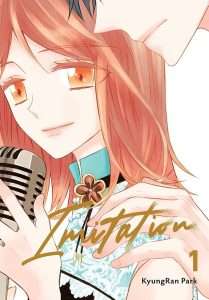
Maha Lee is an aspiring Idol. Her group, Tea Party, hasn’t hit the big-time yet, but she’s made a lot of friends on the circuit. Unfortunately, most of her fame to date is due to her amazing resemblance to solo singer La Lima. It wasn’t a huge issue, however, until Tea Party’s manager got them booked on Pop Idol Sports Games, alongside La Lima and Shax, the hottest boy band in South Korea.
An accident during the games leads to Maha Lee becoming the most hated woman on the Internet. This is partly due to the anti-fans dismissing her as a pathetic imitation of La Lima. Yet what concerns her most is the apparent hatred of Kwon Ryok, the bad boy of Shax, who is equally outspoken about his disapproval of wannabe Idols ripping off established artists. Unfortunately, fate and Maha Lee’s newfound popularity lead to her being offered more work. This includes her first acting role, opposite Kwon Ryok. This pushes Maha to prove to herself (and the world) that she has what it takes to make it big on her own merits and that she is more than just an imitation.
Originally published as a webtoon, Imitation was a smash hit on its original release. Indeed, it was adapted into a live-action series which ran on South Korean television from 2021 to 2023. This English translation does a masterful job of conveying both the story and K pop-culture to Western audiences. Notes in the back of the volume help explain the more subtle cultural references that are lost in translation. This includes a long list of foods Maha Lee must recite featuring various dishes that are considered old-fashioned by Korean hipsters. It is a small thing, but an important one. Thankfully, the general story is more universal, if born of the usual RomCom clichés and stock characters.
Maha Lee is the classic good girl, struggling to succeed in a competitive business. La Lima is the classic Mean Girl. Kwon Ryok is the typical harsh love interest who hides his sensitive side behind a rough facade. Thankfully, the supporting cast vary things up a bit. A good example of this is Yujin, Maha’s friend and lead singer of the boy band Sparkling, who seems to have a crush on Maha he dare not express. The usual love triangle elements are avoided, though Yujin does step in to defend Maha. This, in turn, inspires her bandmates to push her to stop talking to Kwon Ryok so they can guide her to the far kinder Yujin.
The artwork of KyungRan Park is like their writing – smooth and satisfying. There’s nothing visually outstanding about the artwork, but nor is there anything glaringly off. The strangest thing is that for all the talk of La Lima and Maha Lee resembling each other, the two have distinctly different designs apart from similarly shaped faces. Even when Maha instructed to straighten her hair to look more like La Lima, it does little to make her look that much like the elder Idol.
Imitation Vol. 1 is rated T for Teen. I consider that a fair rating. There’s no violence or bloodshed, apart from a staged strangling which leaves Maha Lee bruised and Kwon Ryok bleeding from where her nails dug into him. There’s also no sexual content, apart from one kiss, but that’s a given considering how strict Idol culture is about the Idols dating, much less going further. The end of this first volume, however, suggests more kisses will be inevitable as the series continues.
Imitation, Vol. 1 By KyungRan Park Yen Press, 2023 ISBN: 9781975367008
Company Age Rating: T Related media: Comic to TV
NFNT Age Recommendation: Older Teen (16-18), Teen (13-16) Creator Representation: South Korean, Character Representation: South Korean,
In a world where the enemy was defeated thirteen years ago, the Divine Dragon Rangers still have weekly Sunday showdowns with a monster and his minions. The general populace was never told that the main enemy was defeated and all that were left behind in the floating castle are low level “immortal” monsters. Forced to perform to the jeers of the masses week after week, one of these monsters is ready for change. Using his shapeshifting ability, the monster known as D, disguises himself as a potential ranger candidate. Unfortunately, he is found out rather quickly by low level candidates. This leads to a brief showdown in the nearby forest, where D discovers that he has something in common with Hibiki Sakurama. Hibiki also wants to tear down the rangers’ organization.
In volume two, we see what happens when D takes Hibiki’s place in the candidate training. D discovers that Hibiki was hiding a rogue monster in his dorm, Hibiki’s sister is one of the Divine Dragon Rangers, and Hibiki’s colleague, Yumeko Suzukiri, knows what D is and wants his help to steal the divine artifacts. Working together, D manages to steal one of the artifacts and deliver it to Yumeko; however, during the showdown with the Rangers, he appears to have been destroyed by another of the artifacts that can cancel D’s regenerative immortality.
In volume three, we learn that D not only survived his encounter, but he’s making strides in infiltrating his candidate class as they move to the next test phase meant to judge their teamwork abilities. But something doesn’t feel right, and D’s approach to just play along to get through is challenged by a hidden set of rules and a mysterious boss monster long thought dead.
This ongoing series was first released in English back in 2022, two years before the successful anime adaptation. Eleven volumes are currently available in English with more being translated. It’s an interesting twist on the power ranger genre and looks at what happens when the good guys are secretly the bad guys. This manga differs from other series in that it does not have distinct arcs (at least in the early volumes) that end with a particular volume. Most of the events overlap and evolve as the main character D learns about them, which means each volume ends on a cliffhanger that makes the reader want to reach for the next book.
The creator has a fantastic sense of motion and uses it to great effect, not only during action sequences but also for emotionally charged internal monologues and strained conversations. Although the manga is in black and white and features a large cast of characters to track, their distinctive profiles make it easy to follow along. I would highly recommend this series for any public library or collection accessible to teens and adults due to the amount of violence and heavy ethical questions probed throughout. The anime has been confirmed for a second season, currently set to air in 2025, so having the manga available should keep fans occupied while they wait.
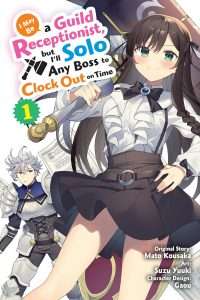
No one wants to work overtime—even if it takes facing a dragon singlehandedly in order to cut through the paperwork.
Alina Clover has a coveted job as a receptionist for the adventurer’s guild. She spends her days filing papers and assigning quests to dungeon-delving adventuring parties who battle enemies and collect treasure from progressively more dangerous labyrinths. However, Alina’s current problem comes when a particularly difficult enemy halts progress for the adventurers, leading to excessive paperwork as the heroes grind through the same challenges day after day, creating a backlog of forms. To spare herself the headache, Alina takes it upon herself, her cloak, and her magical hammer of immense power to clear the way for the adventurers to get on with things.
Unfortunately, her outburst (not the first of its kind) catches the attention of powerful figures, including the legendary adventurer Jade—who is determined to recruit the mysterious warrior to his party of warriors. Unfortunately for Alina, she’s comfortable in her employment and forbidden from taking on work outside of her receptionist duties. What started as a way to protect her position soon becomes the thing that may unravel it all as Alina finds herself caught between her day job and her secret life—a life that may also uncover secrets that will shake her world.
With I May Be a Guild Receptionist, but I’ll Solo Any Boss to Clock Out on Time, Vol. 1, Mato Kousaka delivers a fun and wildly entertaining introduction to a world based heavily in the lore and lingo of traditional Role Playing Game mechanics. With references to dungeon levels and raid bosses, this series, like a number of other recent manga titles, relies on a certain amount of reader understanding of RPG gameplay to form some of the underlying rules of the world. However, those rules only set the stage for a story that manages to carve out a unique tone of epic adventure and consistent humor. As Alina fights to maintain her comfortable life, she finds friend and foe in a colorful cast of characters who populate the wider world. The people who appear are memorable, the action is bold, and the visual humor is on point as this quiet receptionist carves her way through obstacles in an effort to pay off her mortgage and clock out on time. The writing knows exactly what story it’s there to tell and delivers beat after beat of engaging storytelling.
Capturing both the fantasy-adventure and the visual comedy, Suzu Yuuki brings the story to the page in bold fashion. The fantasy elements, action sequences, and individual characters are compelling from the start—and some of the best moments come when the unimposing Alina lets a bit of her power show as she threatens those who try to stick their noses into her business. Alina spends much of her time in the meek and respectful demeanor of many manga heroines—but when she summons a weapon the size of her own body as her face gets washed in shadow to match the threats she has no reservations making—the stark contrast and surprised terror of those around her never stops being funny. There’s minimal fan-service in the writing or visuals and Alina is largely given the space to become her own dramatic character, with party leader Jade appearing in a major supporting role as he chases down the mystery that he is sworn to solve.
Yen Press gives this title a Teen rating for language and violence and this fits well with the overall content. There are some colorful words as well as combat and death, but most of this is accompanied by a comedic tone. Teens will find plenty to appreciate here while there’s plenty to appeal to older readers as well. For audiences who like the power of Saitama in OnePunch Man or the daily life explorations of adventurers in titles such as Frieren, I May Be a Guild Receptionist should have plenty to offer. The manga is an adaptation of the light novel series and there’s expected to be an anime adaptation coming as well, so any fans of the work will have plenty of chances to spend time in this world. As much as the book draws from the rules of RPGs, it also does a fair job explaining concepts for the uninitiated. For those familiar with the genre and for those looking for an entry point into manga, this title is simple without being superficial, is delivered with skill, and is truly a fun read from start to finish. I look forward to seeing where Alina’s adventures take her next.
I May Be a Guild Receptionist, but I’ll Solo Any Boss to Clock Out Time Vol. 01 By Mato Kousaka Art by Suzu Yuuki Yen Press, 2023 ISBN: 9781975365769
Publisher Age Rating: T Related media: Book to Comic, Comic to TV
NFNT Age Recommendation: Older Teen (16-18), Teen (13-16) Creator Representation: Japanese
Thanks to the many superhero movies and shows that have flooded theaters and streaming services, people are by now well familiar with the superhero origin story. Once the hero is bitten by a radioactive animal, caught in a nuclear bomb explosion, or discovered they get powers while under a yellow sun, they choose a costume, a superhero moniker, and begin fighting crime. That’s the basic story of Night Club, Volume One; written by Mark Millar and illustrated by Juanan Ramirez, except this story includes an intoxicating, bloody blend of vampire tropes.
The hero in question is Danny Garcia, a high school student and future viral sensation who is gravely injured in a stunt gone wrong. Lying in the hospital with a series of broken bones, young Daniel is visited by a vampire who recruits the young man in a war with other, more murderous vampires. But Danny doesn’t want to be just a soldier in an immortal war. He can take being shot, climb walls, and transform himself into mist or a swarm of bats. All he and his friends Sam and Amy need are luchadore masks, and some extra clothing to keep out the sun, to become superheroes who save the day while recording their exploits to put up on social media.
Some might be familiar with Millar’s more out there works like Wanted and American Jesus, but Night Club, reflects a more traditional approach to its superheroes. Millar’s story relies on the tried and true formula of typical superhero origin stories. Once Danny discovers his powers, he and his friends (whom he recently turned into vampires) enjoy their superhuman abilities until they encounter a larger and deadlier threat, which is a family of older vampires who murder rather indiscriminately. Millar doesn’t reinvent the wheel here. He simply smashes vampires and superhero tropes together, but Millar, who has also written several superhero comics for Marvel, tells a fun superhero story.
That superhero energy is maintained thanks to the dynamic artwork of Ramirez, who depicts these teen heroes as leaping from car to car, exploding into a swarm of bats, and baring their teeth at criminals. That style, along with the designs of their superhero costumes, enforces the idea that this book is a superhero story that just happens to feature vampires. Being that these heroes are vampires, Ramirez also depicts the necessary amount of blood and violence to show that these heroic vampires are still vampires who drink blood and who tend to combust when exposed to sunlight.
This book will soon have a show on Netflix, but Millar and Ramirez’s book works well beyond being a media tie-in. Though this book happens to feature creatures of the night, this superhero story has more in common with Spider-Man than the Crow, less about revenge and more about teenage power fantasies. This book’s teeth might put it in the adult section, but it seems tailor-made for adult superhero fans who loved watching Spider-Man swing above the New York streets and who’ve watched vampire movies like The Lost Boys multiple times.
Night Club Volume One By Mark Millar Art by Juanan Ramirez Image, 2023 ISBN: 9781534399914
Publisher Age Rating: 16 years and up Related media: Comic to TV
NFNT Age Recommendation: Adult (18+), Older Teen (16-18)
What It’s About? It is the mid-Tokugawa era in Japan, and wandering samurai Manji’s body is infested with healing worms that make him extremely difficult to kill. This “gift” of immortality is actually a curse for his bloody history of killing 100 men, including his sister’s husband. He has been told by a mystic that the cure is to kill 1,000 evil men, so when a young woman by the name of Rin begs him for protection and vengeance against an upstart martial combat school, Manji and Rin’s paths become one. For the first omnibus or so, this is the gist of the series, but the cast, setting, and motivations blossom and take on lives of their own, and blessedly so.
By the end of the series, there are several perspectives separately driving the narrative, each applying different moral standards to the problems at hand. As the body count rises, cycles of vengeance are set in motion and allowed to drive characters to the point of obsession and mutilation. The initial “villain” of the series, Anotsu, seeks to break the established, relatively coddled order of peacetime sword discipline, attracting a motley crew of anything-goes killers. The Japanese government, in turn, hires agents and assassins to counter their movement, leading to Manji and Rin stumbling into conflicts far greater than they imagined. Selfishness, duty, ambiguity, ambition – watching characters clash as they pursue and escape one another is a perpetual highlight of the series. The story’s heights often involve pushing a conflict to its absolute boiling point then swapping to another scene and letting the reader’s dramatic irony detector in their brain go off like fireworks as the scenarios converge. The effect is downright Proustian and never gets old.
As the series goes on, there is a kind of a meta element in tracking Hiroaki Samura’s storytelling style and observing how he breaks out of his own conventions. Really cool sword fights as dramatic climaxes go a long way—Samura takes “swordsman passes by an opponent at the moment of evisceration” to a whole new level. As that effect becomes regular to the point of predictable, Samura sidelines the immortal Manji in order to focus on the motives and checkered pasts of ambitiously doomed characters, elevating the series to something admirable. Just about everyone is participating in a suicide squad of sorts for different reasons, and readers might find themselves rooting against Manji by the end. Shonen tropes like “fighting for my friends” or “proving I’m the best” sometimes apply, but character arcs also delve into how to let go of hatred or commit oneself to selfless acts.
Notable Notes Samura’s style is one of a kind, and tracking its evolution throughout the series is another joy. He dropped out of art school to make Blade of the Immortal, and he cites classic art in interviews about his inspirations.There are pages that set a scene just so, that are more exhilarating than the standout duels and close calls. Samura and his team are masters of using touches of white to create highlights across landscapes, rooms, and faces that will stop you in your tracks. A spot of moonlight in a starless sky, a slice of brightness on the edge of someone’s cheek, a glowing torch advertising safety off in the distance – the fights are fast and heavy, but the quiet moments know how to command attention, too.
Consider this series rated M with good reason, and it’s not just lopped limbs and four-letter words. Characters have sex, including with prostitutes, and one long-running sadistic antagonist in particular derives pleasure from raping while murdering. Women are not strictly victims in this series—several are skilled, principled fighters who absolutely hold their own—but there are nonetheless a lot of violated women.
Having said that, the drama and carnage sometimes serve as a backdrop that makes the chapters of traveling and humor utter delights. The series earns big laughs whenever it slows down to show characters commenting on their journeys thus far or airing rumors about characters they haven’t seen in a while. Manji, Rin, and the rest are prone to exclaiming out loud when a situation gets out of control or downright weird (such as having to retrieve Manji’s body parts following a fight), which is another humorous highlight.
The “Demon Lair” arc is one of the greatest sustained combinations of setup, confrontation, and payoff I’ve ever read in action manga. It’s the culmination of Blade of the Immortal’s unique mixture of realism, anachronisms, sci-fi, and horror. It will spoil your expectations for arcs to come, for slow-burn schemes in other manga, and even for D&D campaigns.
Significance Blade of the Immortal has been adapted into two different anime series, a live-action movie, and a novel. The series won Japan’s Media Arts Award in 1997 and an Eisner Award for Best U.S. Edition of Foreign Material in 2000.
Blade of the Immortal influenced Naruto’s creator, Masashi Kishimoto, in a number of ways, including his style, plotting, and character design.
As if you needed more proof this series came about in the 90s, the English release reads left to right! This is no simple mirror flip – a “cut and paste” method was used to manually move panels around. Each volume contains a deeper explanation of this as well as Samura’s sound effects and anachronistic dialog. Manji wears a giant Buddhist swastika on his back, and every volume of the series includes a lengthy disclaimer explaining the honorable history of the symbol and how it’s different from the Nazi swastika.
Appeal Uninitiated readers may gravitate toward the bloody sword action and Manji’s cocky attitude, but the picaresque plotting and elegant dramatic build-ups are what usher this manga into the Classic Fantastic.
Why Should You Own This? Each three-in-one omnibus is $22, which is a great deal for one of the best samurai manga ever made. And for the dedicated collector or librarian with money to spend, Dark Horse will be releasing a deluxe, hardcover omnibus edition in October of 2020, which will retail for $49.00.
Classic Fantastic: Blade of the Immortal By Hiroaki Samura
Volume
ISBN
Omnibus I
9781506701240
Omnibus II
9781506701325
Omnibus III
9781506701721
Omnibus IV
9781506705699
Omnibus V
9781506705675
Omnibus VI
9781506705682
Omnibus VII
9781506706559
Omnibus VIII
9781506708171
Omnibus IX
9781506708188
Omnibus X
9781506708195
Dark Horse, 2019 Publisher Age Rating: OT (16+) Series Reading Order: https://en.wikipedia.org/wiki/Blade_of_the_Immortal (Wikipedia or Goodreads)
Browse for more like this title NFNT Age Recommendation: Older Teen (16-18), Adult (18+) Character Traits: Japanese Creator Highlights: BIPOC Creator Related to…: Comic to Movie, Comic to TV
Hilda’s adventures continue in this latest installment. For readers new to the series, the events in the previous book are recapped at the beginning: Hilda’s yearning for adventure has once again gotten her in trouble and she breaks out at night for a dangerous adventure. Both she and her mother were caught up with the trolls on the mountain and barely escape, but the adventure ends with the mysterious swap of a baby troll and Hilda…
This new story begins with Hilda the troll fleeing through the woods, panicked and bewildered, pursued by the “mother” troll. As both Hilda and her human mother struggle to be reunited, they also learn more about themselves, their city, and the trolls that live outside the walls. Hilda yearns to be back with her mother, but can’t deny her inner longing for freedom and adventure, as well as the exuberant joy she feels in exploring the trolls’ wilderness. However, she is also frightened by the trolls’ often violent and seemingly emotionless life. When she learns more of their history, she has to make a difficult decision as to who to trust if she is going to be able to return to her human form. Hilda’s mother is equally challenged, trying to care for the troll-turned-human baby while searching for her daughter, and realizes that without help she is unlikely to ever see Hilda again. Both Hilda and her mother make decisions that will have a permanent effect on the citizens of their town and the trolls whose land they have taken.
Although there’s no hint that this is the final Hilda book, in many ways it feels like a final story, bringing together the many themes of outsiders, complex issues of ownership, and Hilda’s own struggle between love for her family and her desire for freedom and adventure. From the first book, Pearson has thoughtfully addressed the issues caused by humans moving into the land of the wild, magical creatures. This comes to a head in the increasingly dangerous relations between trolls and humans in this story. Pearson avoids having Hilda discover that trolls are “just like humans” and everything is a misunderstanding. In many ways, Hilda realizes the trolls are even more alien than she had thought after she becomes one of them. There’s no final happy ending where all live together in perfect harmony, but there is understanding and acceptance of their differences and needs.
As suits the darker, more intense plot of the book, the color scheme shifts to grays, browns, and a more washed-out, stony blue for Hilda’s hair. These are interrupted by violent red images in flashbacks to the trolls’ past, with red-tinged images of blocky stone figures moving across a seeming wasteland of bare earth and caves. Readers who have previously visited the series will recognize the earth colors of the town, beige, pale yellow, and light orange, as well as some familiar characters like the hairy nisse, Tontu, who can take different forms.
This book will appeal most to fans of the Hilda series who are already familiar with our blue-haired heroine, and the quick recap at the beginning will help them remember the most immediate preceding events. Readers new to the series can start with this title, but they will miss the build-up of the characters and their motivations and will find themselves confused by the sequence of events. This is a must-have for libraries who own the previous titles in the series, especially since it continues from the cliff-hanger of the previous book, Hilda and the Stone Forest. For readers who haven’t met Hilda yet, recommend this series to fans of Amulet, the Moomins, and those who enjoy a more gentle read with strange and wonderful characters.
Hilda and the Mountain King, Book 6 By Luke Pearson ISBN: 9781911171171 Flying Eye Books, 2019 Publisher Age Rating: 7 and up Series Reading Order
In a world where superheroes are depraved and immoral and require a group of people to keep them in line, welcome to the story of The Boys Omnibus, vol. 1 by Garth Ennis. The graphic novel is very reminiscent of The Watchmen by Alan Moore. Thinking of the line, “Who watches the Watchmen,” in this case, The Boys, made up of characters Billy Butcher, Hughie, The Frenchmen, Mother’s Milk, and The Female watch every move superheroes make and enact their brand of justice. Billy Butcher is the leader of the group and he has a very personal reason for why he seeks vengeance against the main superhero team, called The Seven.
The story kicks off with Hughie, who is enjoying a date with his girlfriend at a fair. They banter and share a tender kiss. As Robin pulls back from Hughie, she is run over by a superhero known as A-Train. A-Train shows no remorse, nor does he take responsibility for what he has done. He just speeds away from the scene and expects the police to sort it out. Hughie becomes distraught and is accosted by Billy Butcher, who recruits him to be part of The Boys.
The art of The Boys feels very drab to me. It gives a sense that it is a world that is dark, gritty, and devoid of any moral character. The characters themselves are average looking. It doesn’t feel like any of the female superheroes were made to look sexy or for the male gaze. The only exception comes a quarter of the way into the graphic novel wherein, as part of corporate marketing, Starlight is given a skimpy costume to show off her assets. The violence is very visceral: blood spraying out, bruised faces, and bloody limbs. There is frequent nudity, and illustrated sexual acts. Ennis likes to juxtapose violence and sex back to back. It makes neither act pleasurable, and every bit full of pain.
I don’t believe a typical recommendation can be given on this particular graphic novel. It comes down to a matter of taste, and your style. If you enjoyed Kick-Ass by Mark Millar, this is definitely up your alley. For libraries, you have to consider your audience, and where they stand on misogyny and homophobia. There may also be interest since Amazon has debuted a television series based on these graphic novels. I found many elements to be problematic and challenging for my sensibilities. For instance, I found the treatment of female characters to be upsetting. There is a female character called The Female who is part of The Boys team. She is a mute character, and other than killing, we get no sense of her personality. The newest member of The Seven, Starlight a.k.a. Annie, is made to endure humiliation and rape by the other superheroes as an initiation into the group.
Another aspect I found problematic is the gay jokes, and how homosexuality is made to be perverse and used as blackmail. One superhero is blackmailed because The Boys have a video of him and another man. The superhero has to out himself on live television or The Boys will release the footage. The superhero ends up losing his position as part of the group. This scenario is used frequently throughout the volume. The Boys Omnibus, vol. 1 earns its adult rating because of the content and use of gory violence and graphic sex. It might be suitable for some older teens, but I think they would need to receive trigger warnings before reading.
The Boys Omnibus, vol. 1 By Garth Ennis Art by Darick Robertson ISBN: 9781524108595 Dynamite, 2019 Publisher Age Rating: Adult
Browse for more like this title Related to…: Comic to TV
Even when they’re not fighting supervillains, the Teen Titans have some wild adventures! These three volumes of Teen Titans Go! see the young superheroes hosting a sleepover, prank-calling an alien warlord, accidentally bringing their video games to life, and getting overly competitive at the mini-golf course.
These fast-paced stories have funny, and usually low, stakes. Who has been stealing Cyborg’s sandwiches from the fridge? What is in the mysterious package delivered to Raven? Will the girls-only sleepover at Titans Tower result in Starfire getting engaged to marry a demon? Each of these questions is posed and answered in just nine pages—usually without the Titans ever leaving the Tower.
Though the stories are short, the personalities of the Titans come through. They may be silly and exaggerated, but the main characters do feel distinct from each other. Starfire is the cheerful alien who still doesn’t quite get Earth customs and speech patterns. Beast Boy and Cyborg are buddies and pranking co-conspirators. Raven is reserved and theoretically scary but actually obsessed with their universe’s version of My Little Pony. And Robin tries to be the serious leader type except for all the times when he forgets about that and gets caught up in the silliness. Their interactions create plenty of funny situations. We also get brief guest appearances from other DC universe characters like Bumblebee, Jinx, Trigon, Batman, and Riddler. Readers who don’t know these characters probably won’t be too confused, but those who do recognize them will enjoy the surprise cameos.
These three volumes can be read in any order. Each sturdy, colorful hardback contains two stories plus a glossary and a couple of pages of ‘Visual Questions and Writing Prompts.’ The visual questions are mostly aimed at helping young readers understand the techniques used in comics, asking about things like what the facial expressions or symbols in a panel might mean. The writing prompts are generally in the vein of, ‘What do you think happens next?’
The art is zany, angular, and colorful, and will be familiar to anyone who has watched the Teen Titans Go! TV show. The characters have comically over-the-top facial expressions and body language. The action is easy to follow, despite often being weird and wacky in the extreme. (Demon pizza monsters, anyone?) The arrangement of panels varies from page to page, adding visual interest to the story. In some Teen Titans Go! comics I have previously reviewed (Teen Titans Go! vols. 1-5), different artists bring their own styles to each volume. These three volumes are pretty consistent in their art style, perhaps because artist Jorge Corona worked on all of them. (Other artists joined him for two of the volumes.)
These wacky, fast-paced adventures pack enough action and humor to feel like watching a cartoon. They’re simple enough for young readers and short enough for those without long attention spans. There’s a small amount of silly, cartoonish violence, but nothing scary. Fans of the Teen Titans Go! TV show will likely get a kick out of these volumes, and fans of the DC Comics universe in general might enjoy seeing it in a silly light. Hey, where else can you find out what happens when you prank-call Batman?
Teen Titans Go! Food Fright and Par for the Course By Sholly Fisch, Merrill Hagan Art by Jorge Corona, Ben Bates ISBN: 9781496579935 But Games can Never Hurt Me and Sleep Over By Sholly Fisch, Merrill Hagan Art by Jorge Corona ISBN: 9781496579980 Prank’d! and Don’t Look By Sholly Fisch, Amy Wolfram Art by Jorge Corona. Lea Hernandez ISBN: 9781496579973 Stone Arch Press, 2019 Publisher Age Ranking: Reading Level: Grades 2-4; Interest Level: Grades 2-6

 Set in a future where videogames are all virtual reality (VR) based, Shangri-La Frontier (SLF) is a multi-player fantasy game with lots of unique characters, scenarios, and items, making it stand out from other VR games that are not well-developed and full of bugs and broken mechanics. Sunraku is a player that tackles these terrible games as a challenge; however, he picks up SLF during summer break and discovers his own unique scenario that keeps drawing him back to the game. His unconventional choices come from his many hours playing broken games and wanting to maximize his fun.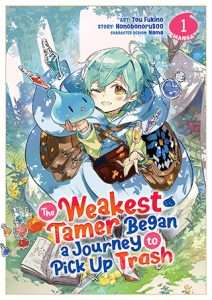
 Maha Lee is an aspiring Idol. Her group, Tea Party, hasn’t hit the big-time yet, but she’s made a lot of friends on the circuit. Unfortunately, most of her fame to date is due to her amazing resemblance to solo singer La Lima. It wasn’t a huge issue, however, until Tea Party’s manager got them booked on Pop Idol Sports Games, alongside La Lima and Shax, the hottest boy band in South Korea.
 showdowns with a monster and his minions. The general populace was never told that the main enemy was defeated and all that were left behind in the floating castle are low level “immortal” monsters. Forced to perform to the jeers of the masses week after week, one of these monsters is ready for change. Using his shapeshifting ability, the monster known as D, disguises himself as a potential ranger candidate. Unfortunately, he is found out rather quickly by low level candidates. This leads to a brief showdown in the nearby forest, where D discovers that he has something in common with Hibiki Sakurama. Hibiki also wants to tear down the rangers’ organization.
 No one wants to work overtime—even if it takes facing a dragon singlehandedly in order to cut through the paperwork.
 Hilda’s adventures continue in this latest installment. For readers new to the series, the events in the previous book are recapped at the beginning: Hilda’s yearning for adventure has once again gotten her in trouble and she breaks out at night for a dangerous adventure. Both she and her mother were caught up with the trolls on the mountain and barely escape, but the adventure ends with the mysterious swap of a baby troll and Hilda…
 In a world where superheroes are depraved and immoral and require a group of people to keep them in line, welcome to the story of The Boys Omnibus, vol. 1 by Garth Ennis. The graphic novel is very reminiscent of The Watchmen by Alan Moore. Thinking of the line, “Who watches the Watchmen,” in this case, The Boys, made up of characters Billy Butcher, Hughie, The Frenchmen, Mother’s Milk, and The Female watch every move superheroes make and enact their brand of justice. Billy Butcher is the leader of the group and he has a very personal reason for why he seeks vengeance against the main superhero team, called The Seven.
 Even when they’re not fighting supervillains, the Teen Titans have some wild adventures! These three volumes of Teen Titans Go! see the young superheroes hosting a sleepover, prank-calling an alien warlord, accidentally bringing their video games to life, and getting overly competitive at the mini-golf course.
