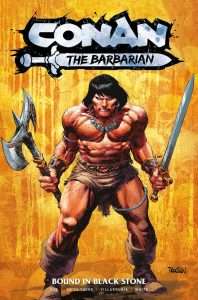
Conan the Barbarian. The name evokes many images. Some involve Arnold Schwarzenegger or Jason Momoa. Most feature a long-haired, muscle-bound man with a scantily clad (if clad at all) woman clutching his leg. This is somewhat unfair. For while the most popular images of Conan were born of film and fantasy art, his soul was born of a rich literary tradition and informed by historical epics.
Texan author Robert E. Howard wrote twenty stories and one novel featuring Conan, who was easily the most popular of his creations. Conan went on to live a second life under a succession of authors, most of them working in the comic book medium. That brings us to Bound in Black Stone—the first Conan volume published by Titan Comics since that publisher won the Conan license in 2023.
The prologue of Bound in Black Stone was originally published as a 2023 Free Comic Book Day special. It details a teenage Conan’s first experience as a warrior, joining his countrymen in raiding the fortress at Vernarium and killing the Aquilonian soldiers invading their land. This, and the sight of an elegant sword with strange markings, set the blacksmith’s son on the road south, to adventure and a legendary life.
The story picks up eight years later, by which point Conan has become an experienced mercenary and seen much of the nations immediately north, south and east of his native Cimmeria. Finding himself in north Aquilonia, and at liberty after punching his former commanding officer, Conan ponders a return to his home village and an end to his travels. Such thoughts are quickly forgotten, however, as an army of the dead attacks the tavern where Conan ponders his future while sampling the local ale. This leads to an unlikely alliance with a Pictish warrior—the sworn enemies of his people—and a battle with a dark power that reaches beyond time and space!
Jim Zub is rightly recognized as one of the best authors to work in modern fantasy comics, having written both his original series, Skullkickers, and various tie-ins for the Dungeons and Dragons and Pathfinder lines. He is also something of a Robert E. Howard scholar, and his love for the original Conan stories is apparent in his writing. Zub weaves subtle references to the Hyborian mythos into his stories, even as he spins ripping yarns that do credit to the legacy of Conan. As such, Bound in Black Stone is sure to satisfy Conan completists, while remaining accessible to new audiences.
Zub’s scripts are perfectly envisioned by Rob De La Torre. His style has invited comparison to other great Conan comic artists, like John Buscema and Barry Windsor-Smith, being vividly detailed yet crystal clear in their scope. Yet De La Torre’s style is all his own and a perfect fit for the Hyborian Age. The colors of José Villarrubia are also noteworthy, adding the perfect finishing touches to the artwork.
Titan Comics has rated this first volume of Conan comics for audiences 17 and up. I believe that is a fair assessment. There is blood. There are severed limbs. There are horrifying zombies with rotting flesh. There are also unclad women and, at one point, a bare-bottomed Conan. The nudity is not gratuitous and the one sex scene quite tasteful. Nevertheless, this is not the recent Marvel Comics Conan series. Indeed, it is even more intended for mature audiences than the Dark Horse Comics Conan of the early 21st century. Those audiences, however, will find Bound in Black Stone to be a thrilling tale of an age undreamed of.
Conan the Barbarian: Bound In Black Stone Vol. 1 By Jim Zub Art by Robert De La Torre Titan, 2024 ISBN: 9781787740143
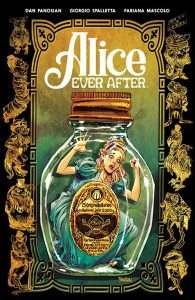
When she was a little girl, Alice visited Wonderland and had many wonderful adventures. She also made many friends. Unfortunately, as she grew older, Alice found it harder and harder to return to Wonderland. She also found more and more need to escape from the harsh reality of Victorian England, a distant father, and a family that only cares about her in regard to how she improves their social standing.
Alice’s need for something stronger than mushrooms to open the doorway to Wonderland leads to a life of crime and a growing addiction to strong drugs. This, in turn, leads Alice to commit herself to an insane asylum, not knowing her father was already considering such steps to cover up his own dark secrets. Unfortunately, the asylum holds new yet familiar dangers, leaving it uncertain that Alice will get the help she needs, or the permanent path to Wonderland she dreams of.
Alice Ever After is not the first graphic novel to offer a dark, twisted take on a classic Childrens’ story. It is not even the first graphic novel to offer a dark and twisted take on Alice in Wonderland. What it lacks in originality, however, it somewhat makes up in execution.
Best known for his work as an artist, Dan Panosian has been writing more in recent years. He provided some of the covers for Alice Ever After, and drew the intricate sequences set in Wonderland. For the most part, however, his duty here is to tell the tale and write the script.
There is a good deal of wit to the story, but Panosian does little to break the mold. One twist of note is that there are characters in the real world who correspond to Alice’s fantasy life in Wonderland, like her ever-smiling drug dealer becoming the Cheshire Cat. Curiously, there are also characters who are clear analogs of classic Wonderland characters, who are totally absent from Alice’s dreams. The corrupt head of the Asylum, for instance, is clearly meant to be the Queen of Hearts.
Unfortunately, little is done with this idea beyond suggesting that Alice’s adventures are the result of emotional neglect as a child and drug abuse as an adult. Panosian nails the execution, but the story is still sadly predictable, with no possibility that Alice really is traveling between worlds. Given that, I fear Wonderland enthusiasts are not likely to enjoy this story. The overall tone is more depressing than horrific. This is sadly true even in the later chapters, as the perils of the asylum are revealed, along with the dark secret that may have prompted Alice’s creation of Wonderland in the first place.
The artwork, at least, is well done. Giorgio Spalletta perfectly captures the mundane terrors of a Victorian asylum. And while I may quibble with Panosian’s story, I have no complaints about his art. Alas, that is not enough to save Alice Ever After. It is not a badly told tale, but it does nothing new with the Wonderland world and I question its ability to satisfy its target audience.
Boom! Studios has not given Alice Ever After an official age rating. I would suggest it is best read by Older Teens and Adults. While there’s little in terms of content to make it inappropriate for younger teens, I think the nuance of the horror elements are best appreciated by older audiences and readers who are wise beyond their years. Under no circumstances should this be read to children as a bedtime story!
Alice Ever After Vol. By Dan Panosian Art by Giorgio Spalletta BOOM! Studios, 2023 ISBN: 9781684158850
Related media: Classic to Comic
NFNT Age Recommendation: Adult (18+), Older Teen (16-18)
Character Representation: Addiction, Ambiguous Mental Illness
Junji Ito’s Mimi’s Tales of Terror is an adaptation of Hirokatsu Kihara and Ichiro Nakayama’s collection of urban legends, Shin Mimibukuro. Each of the tales in the original compilation is reworked by Ito and features Mimi, an original character. The book consists of nine stories featuring college student Mimi, a bonus tale introducing different protagonists, and two afterwords describing how he altered the tales. This is a treasure trove for those who are fans of Ito, horror, contemporary legends, and evocative and haunting illustrations.
The first tale “On the Utility Pole,” is only a few pages long and takes place in only a few minutes, during a car ride on a rainy dark night. It sets the stage for the spookiness that will follow in the rest of the collection. Several of the tales focus on Mimi’s various problems with her disturbing neighbours while offering relevant background about modern Japanese culture. In “The Woman Next Door,” Mimi is annoyed by her noisy neighbour, but soon realizes that the problem is much scarier than she anticipated. Mimi survives to feature in the next story, assuring the reader that she has moved to a different apartment building. The legend in this tale reminded me of the legend of “Teke Teke” because of the significance of the sound effects in both.
“Rustling in the Grass,” offers another horrific interlude for Mimi and her boyfriend, this time while they are walking in the woods. The story, like many legends, does not have a tidy conclusion…it just is! Mimi’s new apartment in the next tale, “Grave Placement,” also features an eccentric neighbour and an eerie setting. Obviously, Mimi needs to be more selective of her living arrangements. Mimi and her friends take a trip to the beach but, of course, things cannot be straightforward for her. In “Seashore” one of her friends is drawn to ghostly spectres that only he can see. One of the creepiest tales in the collection for me is “Just the Two of Us,” in which Mimi meets a child who is haunted by her mother’s burnt corpse. Through his illustrations and pacing, Ito conveys both dread and affection in this almost intimate tale. The next tale, “Scarlet Circle,” is also dreadfully affectionate, but not in a warm or comforting way. Mimi is the target of an extremely jealous classmate who wants Mimi’s boyfriend for herself. “Sign in the Field” is the final tale featuring Mimi and is the shortest one in the book. The images strongly echo those of the legendary Slender Man.
The first afterword is told through two pages of panels featuring Ito himself. It is followed by two coloured pages, one of which is the splash title page for the bonus story “Monster Prop.” Haunted house attractions can be very disturbing, but when it includes a very dubious monster prop, the attraction can be even more dangerous than anyone imagines. It is a perfect tale for Halloween and those who admire horror films. The collection concludes with a two-page written appreciation by Ito for the original material, the chance to introduce the bonus tale to the audience, and the work of art of the book itself.
I must admit that I purchased this hardcover volume for my personal collection. It is truly a work of art, perhaps macabre art, but a gorgeous example of book making. The red-covered minimalist cover and endpapers are wrapped in a dust jacket that contains numerous spooky visual references to the stories inside. The illustrations inside are striking, unsettling, and sinister. The characters are distinctive, the settings evocative and realistic, and the monsters truly chilling and horrific. The pacing is well organized, with the panels offering just enough information to foster anticipation and activate the reader’s imaginings.
The essence of these tales may be familiar to those who know the three folklore collections of Alvin Schwartz and Stephen Gammel’s Scary Stories to Tell in the Dark. Both this book and those by Schwartz and Gammel are sourced from urban legends that have been circulating for years and both were newly adapted and illustrated for a contemporary audience. Highly enjoyable for those who like their horror based on folklore and those who like to be creeped out by things that may go bump, not only in the night, but in their ordinary habitats. Recommended for older teens and adults.
Mimi’s Tales of Terror By Junji Ito VIZ Signature, 2023 ISBN: 9781974738519
Publisher Age Rating: T+ Related media: Classic to Comic
NFNT Age Recommendation: Adult (18+), Older Teen (16-18) Creator Representation: Japanese Character Representation: Japanese
Here we have a 1980s classic Transformers manga collection of three stories available for the first time in English. All written by the original author for the G1 series Transformer comic in Japan. The three stories, “Fight! Super Robot Life-Form Transformers”, “The Story of the Super Robot Life-Forms: The Star Transformers”, and “The Great Transformers War” tell us all about the origins of the autobots, decepticons, and how they face off with each other, on planet Earth. Despite these stories being written in the 1980s they do not feel dated, and could easily be enjoyed by children nowadays.
Each story is quite short and often features full page images, or battle scenes that involve a lot of action words and not a lot of genuine dialogue. The plot of each of these tales is very shallow and unfortunately, don’t expect to see the unique personalities that you may be familiar with from more recent Transformers television shows, or movies. Bumblebee isn’t driving around making joke after joke. Instead the robots are all serious about fighting each other. These stories take place in and around Japan, instead of America, and feature the human character, Kenji. A Japanese boy who is made into an honorary autobot as he helps fight the bad guys too. A lot of silly sounding “curse you’s” are thrown in, making it a fairly repetitive line throughout. Overall, the stories would be better enjoyed by younger audiences who aren’t looking for as much depth, and instead can enjoy the artwork and action.
Illustrator Magami, also known as the dynamic artist, did a wonderful job of creating action filled and exciting panels. These read from right to left, in typical manga fashion. Characters have expressive faces with typical manga style of large eyes and loud emotions. Action verbs explode out of panels. The book’s artwork starts off with a few glossy color pages explaining the basic background of who the transformers are, and ends with a large section of glossy pages featuring a mix of color and black and white images called Illustration Works. This features all kinds of magazine artwork from the mid to late 1980s. The three stories found in between this, are all in matte black and white. There are many scenes of the robots fighting each other, so do expect to see the transformer’s guns out, shooting bullets, airplanes getting shot down, etc. However it isn’t excessive, it is not gruesome, and it doesn’t contain anything more than what you would see on the animated television show or anime movie.
This is a well-done translation of the original Transformers manga produced in 1986 by Japan. The stories are silly, and shallow with beautifully done detailed artwork. This series is recommended for readers aged 12-17 but I would recommend it for the youngest of that age range only. The entire series is already out, so if you purchase this one I would recommend completing this Transformers: The Manga series by buying volumes two and three.
Transformers: The Manga Vol. 1 By Masumi Kaneda Art by Ban Magami ISBN: 9781974710560 VIZ Media LLC, 2020 Publisher Age Rating: 12-17 Series ISBNS and Order
Title Details and Representation NFNT Age Recommendation: Middle Grade (7-11), Teen (13-16), Tween (10-13) Creator Highlights: Japanese Related to…: Classic to Comic
The Manga Classics series has done it yet again with an excellent adaptation of Anne of Green Gables; turning the classic literature into an easy to read, and easy to understand story that put Prince Edward Island on the map. The book starts off with a beautiful quote, “Dedicated to all the children who dream…” and the family of original author, Lucy Maud Montgomery, provides their seal of approval with a foreword written by Montgomery’s granddaughter, Kate Macdonald Butler.
Marilla and Matthew Cuthbert are siblings who decide to adopt a boy to help them manage their farm, Green Gables. By accident, a girl; Anne Shirley is sent instead of a boy. Anne is full of wonder, flowery language, and so much excitement at the thought of being adopted that Matthew decides to overlook the mistake and brings her home with him. Initially, Marilla and Anne have many differences to overcome, giving the story tension and comedic points. Anne has been raised as an orphan and has never been taught the social graces expected of a lady. Nor has she ever had to reign in her wild and colorful imagination that flows continuously from her.
Crystal S. Chan works wonderfully with illustrator Kuma Chan by providing him with details of how certain scenes should be drawn to ensure their accuracy; including seating charts for where students are sat at Avonlea’s school. She includes an interesting section on this at the back of the book for readers to enjoy a bit of how a huge project like this came together. Kuma Chan’s style is true to manga style with this black and white book reading from right to left, and characters feature big eyes, small lips and dramatic hair; which is quite fitting for Anne’s famous red locks. The backgrounds are realistic and set to the time period of the story, keeping it more on the accurate side rather than the fantasy side, which is often the setting for manga novels. This would be appreciated by any reader who is looking for an adaptation that stays true to the original work.
This is a very well done adaptation of the original Anne of Green Gables story. The medium of manga allows for a different interpretation of what’s happening in the story as we have visuals featured more prominently than simply text. Thought bubbles are shown as characters are having conversations, which gives the reader a full experience of what’s going on in a particular social interaction. As the author rightly points out in her notes at the end of this novel, it aids events in making them more clear and vivid. As a lover of the original story, however, I do have to admit that the flow of flowery language that is what Anne’s character is loved so much for doesn’t quite have the same feeling as reading through the original book. I highly recommend enjoying this manga version paired with the original version to truly enjoy how magical this story is.
Manga Classics: Anne of Green Gables 20 By Crystal S. Chan Art by Kuma Chan ISBN: 9781947808188 Manga Classics, 2020 Publisher Age Rating: 13-16 Series ISBNS and Order
Title Details and Representation NFNT Age Recommendation: Middle Grade (7-11), Older Teen (16-18), Teen (13-16), Tween (10-13) Character Traits: Creator Highlights: Related to…: Classic to Comic
Betty and Veronica have come a long way in their 80 year history. From being each other’s biggest rivals, to now being each other’s BFFs, we have a whole new series of stories in this first original graphic novel. This series features a new artistic style, as well as brand new stories that haven’t appeared in any other ArchieComics.
Riverdale High School has a career fair that has all the students buzzing. Betty and Veronica initially have quite different strategies for tackling the day, but quickly find themselves so awe struck by all the amazing role models that they decide to take in the presentations together. Veronica, the affluent and well networked one had very low expectations for what the first speaker, a female senator, had to say. However, once she hears the incredible struggle she went through to get where she is today, she becomes excited to learn as much as she can. There are great lessons of challenging your expectations, not making assumptions, and taking risks to try out new ideas. The story takes fantastic turns as the girls are shown as actual politicians, singers, models, superheroes, and astronauts. It’s a positive story that emphasizes to young females especially, that they can do anything they set their mind to.
Illustrator Brittney Williams does an amazing job of reinventing the world of Riverdale. In this series, we find the town is full of a diverse population representing all different backgrounds. Betty and Veronica have big, dramatic eyes that are often used to emphasize emotions. There is a wide variety of panels to keep things aesthetically interesting, and functionally, to set the tone for that segment. Action scenes with words popping out of the page, sepia-toned memories from the past, and brightly colored story panels will keep readers engaged. Betty and Veronica do show off their bodies a bit. There are some short skirts, and cleavage included, as you would find to be typical of their outfit choices in other ArchieComics. There isn’t anything overtly sexual, the language is clean, and the fighting scenes when the girls are super heroes aren’t excessively violent.
This is an Archie comic, however it is quite a different style of writing and drawing from what you may be used to if you’ve read them in the past. There are a lot of modernizations added to this new version of the Riverdale gang, for example, cell phones, social media usage such as YouTube make-up tutorials, and The Hills (MTV television series that ran from 2006-2010) are thrown in. The illustrator does a wonderful job of including diverse characters that show different religious beliefs, races, and backgrounds. And, of course, the characters don’t just stick around Riverdale anymore, they get to explore outer space and all kinds of different roles that they wouldn’t have done before.
The only criticism I have is that the humor really fell flat or just wasn’t there. ArchieComics are known for being funny and this one just really wasn’t. This book does feature a lot of positive female characters who are in leadership positions, and in careers that are typically male dominated. Overall, if you are looking to add a comic book that showcases diversity and strong women, this would be a good series to start adding to your YA collection.
Betty and Veronica: The Bond of Friendship, Vol. 1 By Jamie Lee Rotante Art by Brittney Williams ISBN: 9781645769859 Archie Blue Ribbon, 2020 Publisher Age Rating: 12 – 17 Series ISBNS and Order
Title Details and Representation NFNT Age Recommendation: Older Teen (16-18), Teen (13-16) Character Traits: Creator Highlights: Related to…: Classic to Comic
Adaptations of classic literature seem to be a logical step in the normalization of graphic literature in education. Manga Classics has cornered the market on manga adaptations, and deservedly so. Though I am not typically a fan of many graphic novel adaptations, I was thoroughly impressed with the work of Manga Classics. Manga Classics are not just for the young adult reluctant reader. They are fun, engaging ways for all to experience favorite classic novels. With the intention of making classic literature more accessible, a small team of story adaptors and artists have worked tirelessly to bring this project to life and, quite frankly, it shows.
Let’s take a look at just four of the over sixteen titles currently adapted: The Jungle Book by Rudyard Kipling, adapted by Crystal S. Chan and illustrated by Julien Choy; Les Misérables by Victor Hugo, adapted by Crystal S. Chan and illustrated by SunNeko Lee; Hamlet by William Shakespeare, adapted by Crystal S. Chan and illustrated by Julien Choy; and A Midsummer Night’s Dreamby William Shakespeare, adapted by Crystal S. Chan and illustrated by Po Tse. The first noticeable similarity among all four volumes is the consistency and quality. The ability to adapt texts accurately and adequately across almost 300 years is a testament to Chan’s talent as a writer and story adapter.
Of these adaptations, Les Misérables and The Jungle Book are particularly impressive. That Chan manages to condense Les Misérables, a novel clocking in at over 1000 pages, into less than 350 pages, without losing any of the context or emotion of the original text is a great indication of the works yet to come from the Manga Classics team. The primary difference? A manga adaptation is much less daunting than the original, behemoth book. Similarly, Chan makes The Jungle Book, a relatively dense text for modern readers, charming, fun, and accessible to a new generation of readers.
Fans of manga, both of new generations and old, will certainly enjoy the artwork throughout Hamlet and A Midsummer Night’s Dream. The fantastical premises of these works, rife with ghosts, fairies, and mythological figures, lend themselves to visual interpretation. Julien Choy and Po Tse bring these works to life through vivid imagery and beautiful character drawings. Tse’s interpretation of A Midsummer Night’s Dream’s act two, scene one is nothing short of stunning. It takes a particular artistic skill to bring illumination and movement to black and white drawings, yet Tse is thoroughly successful. Choy is equally triumphant in bringing life to the ghost of Hamlet’s father. The artwork throughout all of these volumes is sure to appeal to manga fans everywhere.
I cannot recommend volumes from the Manga Classics series enough. These volumes are fun, easily digestible, and clearly made with care and intent. Though I only reviewed four volumes of this series, I am confident that any volumes your library system selects from this series are a good investment. These volumes will fit on the shelf perfectly next to the rest of your library’s manga collection.
Manga Classics: The Jungle Book, A Midsummer Night’s Dream, Les Miserables, Hamlet By Crystal S. Chan Art by Julien Choy, Po Tse, SunNeko Lee
Title Details and Representation NFNT Age Recommendation: Adult (18+), Older Teen (16-18), Teen (13-16) Character Traits: Indian Creator Highlights: Chinese-American Related to…: Classic to Comic
This book, created by Vancouver Opera, contains short retellings of fourteen operas in comic form. A note at the beginning explains that these comics were originally printed in Japanese and put out in Japanese newspapers to promote the opera to Vancouver’s Japanese population – the operas chosen for the project were those performed by Vancouver Opera in 2005 through 2010. They were then translated and colored, and this book was released to celebrate Vancouver Opera’s fiftieth anniversary.
There is, as you would expect, a lot of tragedy here: Carmen, Madame Butterfly, Rigoletto. But, if I can be forgiven a bit of facetiousness, the thing that really made me sad was how poorly the book was put together and edited.
One of the first things I noticed in reading this was that the creators failed to account for the gutter at all. This means that whole words are lost in the crack between the pages, and I became frustrated trying to force the book open wider so that I could read these bits. There are also rampant misspellings and, in a real triumph of oversight, the last five pages – one and a half opera stories – are simply repeated. The book goes from The Marriage of Figaro to Madame Butterfly to . . . the middle of The Marriage of Figaro, followed by Madame Butterfly!
Despite the name, the art is not all done in a manga style. It varies from story to story. Many are drawn in a kind of simplified manga style, with panel backgrounds empty or extremely spare and little detail in the characters; a few, however, are done in loose paint and pastel styles, and one is drawn in distinctly American-style cartoons. I find these to be more skillfully done than the manga ones, which feature a lot of stiff poses and awkward facial expressions.
The language has been updated, and characters speak in modern, casual phrasing. This helps to make the stories accessible; it also injects some humor that, while perhaps not always present in the original work, is a fun little addition.
Obviously, any faults with the stories’ plot cannot be laid at the doors of this book’s creators. Still, condensing the operas so much can make their events blunt and sudden, rendering complex tragedies almost funny. I’m not a huge opera buff, but I did know some of these stories already; as far as I can tell, the summaries do capture, on the most basic level, the events of the operas they cover. This could be useful for someone who wants to understand in just a few minutes what is going on in a particular opera. The brevity of each story does not, however, allow for much characterization or emotional impact.
There’s quite a bit of violence, as you might imagine, but nothing grotesque. If a reader doesn’t mind the blood-splattering suicide scene on the cover (um, spoilers for Madame Butterfly?), there’s nothing gorier inside. There isn’t much sexual content, either; plenty of kissing, but no nudity. Not that’s shown, anyway; Salome squeaks by with the placement of her hair and veils.
The concept behind this book is a neat one, not unlike the Manga Shakespeare titles. I am left disappointed that the poor execution of it is impossible to ignore.
Opera Manga by Todd Denis, Neil McBean, and Roy Husada Art by Roy Husada, Fiona Meng and Jerry Cai ISBN: 9781897548837 Arcana, 2010
Papercutz branches out from their graphic novel continuations of the classic Hardy Boys adventure, Undercover Brothers, with the New Case Files. As advertised in the press releases and in the publicity contained in the books, “legendary comics writer, Gerry Conway and artist, Paulo Henrique, take the world-famous teen sleuths in a bold new direction that’s sure to thrill and possibly shock all Hardy Boys fans!”
I happen to be one of those Hardy Boys fans, as a collector of boys’ adventure series. I also have plenty of Hardy Boys readers at my library, mostly boys and girls ages 9-11 who enjoy the original adventures. A few of them also like the Undercover Brothers series. But I would have a hard time handing them this new series.
Frank and Joe, now working for ATAC (American Teens Against Crime) aren’t such a good team anymore. Joe is tired of Frank’s insistence on being the leader, making plans, and never jumping into the action. Frank is tired – and worried – about Joe’s heedless plunges into situations he hasn’t studied and his impulsive and reckless behavior. They’re both rubbing each other the wrong way and spend more time arguing than solving, or at least investigating crimes.
In Crawling with Zombies, Frank and Joe go undercover to find out why teen flash mobs masquerading as zombies are apparently losing control of their minds. They split up after an argument and Joe and their friend Chet plunge into a flash mob, where they promptly come under the influence of the mysterious mind control. Frank and his friend Belinda meanwhile, have discovered the source of the mind control chemicals, although not the person behind it all, and Frank’s last-minute arrival saves Joe and the other teens.
In Break-Up, there’s still no final solution for the previous mystery, but the boys are already moving onto a new problem; who is causing the dangerous and even fatal accidents on the reality show Break-Up, where teams of siblings compete in dangerous stunts? Joe’s impulsive behavior gets them into trouble, but he manages to gather important information and the two work together to get themselves out of a deadly trap. However, the shadowy figure behind it all is still a mystery. The story ends with the boys’ parents insisting on more family time so the boys can stop arguing.
The art definitely has a manga influence, with exaggerated facial expressions when the boys get excited or surprised, big eyes, and long flowing hair, especially for Joe, whose hair seems to grow and shrink on its own. Aunt Gertrude, now Aunt Trudy, looks about fifteen and the attempt to match her traditional disapproval of the boys and old-fashioned ideas with a new, updated character strikes a ridiculous note. There’s quite a bit of action and movement throughout the stories, with races, stunts, zombie mobs, police, and criminals, but the stories are dominated by Joe and Frank’s interpersonal problems and most of the artwork reflects this in close-ups of their faces with varying emotions.
What I find most difficult to swallow in these new stories is the intended audience. The Hardy Boys has always been a middle grade series and repeated attempts to update and make the stories interesting to an older audience have mostly failed. These stories seem to be jumping on the bandwagon of superhero comics with their attempt to “shock” readers with startling new personalities and out-of-character adventures for well-known protagonists.
Both Joe and Frank seem younger than their traditional ages of 17 and 18 with Joe’s naïve attempts to attract girls and Frank’s shyness and obvious discomfort with the idea of a girlfriend. However, the level of violence and the overall atmosphere of the stories seems aimed at a teen audience; in Crawling with Zombies, one of the main suspects is shot in front of the boys and Break-Up ends with another suspect stabbed in the back. At times the boys and their friends seem very young, especially when they’re squabbling, but then Chet pops up with a diagnosis of the boys’ problems that makes him sound like an adult. While it’s easy to suspend belief and imagine a couple teens pursuing mysteries in the original stories, it’s much harder to believe in a contemporary secret organizations employing teens to fight crime – and a modern father who would allow them to do so.
I wouldn’t put these in a juvenile graphic novel collection because of the violence and more mature themes, but I have trouble picturing a teen interested in picking up an updated Hardy Boys graphic novel, especially one that has too much violence for readers looking for an emotional read and too much emotion for those looking for an action story. If your library has a lot of teen fans of superhero comics, Gerry Conway (who’s well-known in that area) might pull in readers, but otherwise I don’t see a strong audience for this series. Stick to the original Hardy Boys series for middle grade readers who want mysteries and the Undercover Brothers series from Papercutz for older readers who want a graphic novel version.
The Hardy Boys: The New Case Files, vol. 1-2: Crawling with Zombies and Break-Up by Gerry Conway Art by Paulo Henrique Vol. 1: Crawling with Zombies ISBN: 9781597072205 Vol. 2: Break-Up ISBN: 9781597072434 Papercutz, 2011

 Conan the Barbarian. The name evokes many images. Some involve Arnold Schwarzenegger or Jason Momoa. Most feature a long-haired, muscle-bound man with a scantily clad (if clad at all) woman clutching his leg. This is somewhat unfair. For while the most popular images of Conan were born of film and fantasy art, his soul was born of a rich literary tradition and informed by historical epics.
 Unfortunately, as she grew older, Alice found it harder and harder to return to Wonderland. She also found more and more need to escape from the harsh reality of Victorian England, a distant father, and a family that only cares about her in regard to how she improves their social standing.
 Junji Ito’s Mimi’s Tales of Terror is an adaptation of Hirokatsu Kihara and Ichiro Nakayama’s collection of urban legends, Shin Mimibukuro. Each of the tales in the original compilation is reworked by Ito and features Mimi, an original character. The book consists of nine stories featuring college student Mimi, a bonus tale introducing different protagonists, and two afterwords describing how he altered the tales. This is a treasure trove for those who are fans of Ito, horror, contemporary legends, and evocative and haunting illustrations.


 This book, created by Vancouver Opera, contains short retellings of fourteen operas in comic form. A note at the beginning explains that these comics were originally printed in Japanese and put out in Japanese newspapers to promote the opera to Vancouver’s Japanese population – the operas chosen for the project were those performed by Vancouver Opera in 2005 through 2010. They were then translated and colored, and this book was released to celebrate Vancouver Opera’s fiftieth anniversary.
 Papercutz branches out from their graphic novel continuations of the classic Hardy Boys adventure, Undercover Brothers, with the New Case Files. As advertised in the press releases and in the publicity contained in the books, “legendary comics writer, Gerry Conway and artist, Paulo Henrique, take the world-famous teen sleuths in a bold new direction that’s sure to thrill and possibly shock all Hardy Boys fans!”
