Amélie is a 16th century Dutch noblewoman fascinated by science and nature, but forced into an unhappy marriage by her impoverished parents. Her new husband, Hans, is dashingly handsome, loves animals, and is pleasant and outgoing in public. But in private, he belittles her and subjects her to sexual violence and humiliation. Her only respite occurs when Hans takes a business trip to Portugal, leaving her to freely study what fascinates her more than anything: flight.
Thinking of flight as both a glimmer of hope for escape and as a way to be closer to God, she studies the bones of birds, pours through books in her husband’s library, and crafts model flying contraptions. She ponders the way maple seeds spin in the air and is relieved to not hear a word from her husband for many months.
Things get complicated when Hans finally returns, accompanied by a beautiful young slave woman from an unknown place. He claims he saved her from a terrible fate and moves her into the house as his mistress. Amélie is both humiliated and fascinated by this woman, given the name Sahara by Hans after he acquired her. Hans is loving and tender with Sahara in stark contrast to his behavior with Amélie. She is quiet and cheerful, despite a deeply traumatic past, but tension develops between the two women. As they both adapt to life stashed away together in Hans’ house, they start to experience compassion and support for one another. They explore Amélie’s love of flight and begin work on a contraption that will change everything.
I am a complete sucker for historical dramas. I love a sumptuous setting, detailed costumes, and an exploration of life in a time that seems both unknown and absolutely familiar. Raging Clouds by South Korean author and illustrator Yudori ticks all those boxes for me. When I think of the art style, the first word that comes to mind is “exquisite”. I was absolutely captivated by every panel. There is so much attention to detail, particularly in the clothing. Yudori has a mastery over drawing the folds of fabric that really brings life to the art. There is detail everywhere, from the clothes, to furniture, to individual strands of hair. There are some historical inaccuracies here and there, but I can see due diligence was done to be true to the time period.
There is a lot of nudity in this work, but I really appreciate Yudori’s nuanced depictions. At times nudity is used to explore the beauty and desirability of the female form, while other times it’s employed to express dehumanization and subjugation, essentially the two extremes of being a woman under patriarchy. This is a deeply feminist work, and Yudori is not shy about showing the pain and trauma of being a woman under oppression.
The cover art and some errotic tension in the story might lure you into thinking this becomes a sultry queer romance, but as the author explains in an Instagram post, this is a story of failed attempts. As much as I love a queer romance, I also love a story of two women surviving through different aspects of patriarchy, seeing each other, and finding ways to lift each other up as the system tries to knock them down. It feels authentic and I want to see more stories featuring this kind of non-romantic love and compassion.
There are a lot of potential content warnings that librarians and readers might want to know about, some of which have already been mentioned, such as nudity and sexual violence, which includes rape and dubious consent. Several sexual acts are illustrated pretty clearly. There is also physical violence ranging from hitting to murder, although nothing very bloody is shown directly on the page. Amélie also experiences a lot of body image issues, which comes in the form of negative comments from others and negative self-talk.
As you might expect with a period piece, particularly one featuring people of color in Europe, there is casual and overt racism littered throughout the story and there are some historical terms for groups of people that are outdated by today’s standards. Sahara is a non-native speaker and her way of expressing herself could be interpreted as stereotyped. However, according to the author in another Instagram post, the inspiration for how Sahara speaks comes from her own experience as a non-native English speaker when she moved to the United States from Korea as a teenager.
There is also some animal harm at various points. A cat is the subject of a violent game among men and several dead animals are shown. There are no animal deaths, but as someone very sensitive to animal harm, the realism of the animals was slightly unsettling for me. It was balanced somewhat by an adorable pet cat doing very annoying (but still adorable) cat things, so the realism goes both ways.
While there are many challenging issues depicted in Raging Clouds, nothing feels out of place or unwarranted. This is definitely one for the adult collection, although some older teens might connect with it as well. I think it’s a beautiful and honest work exploring the lives of women in the past that is incredibly relatable to women of the present.
Raging Clouds By Yudori Fantagraphics, 2025 ISBN: 9798875001062
NFNT Age Recommendation: Adult (18+), Older Teen (16-18) Creator Representation: South Korean, Character Representation: Dutch,
Hayao Miyazaki needs no introduction to most anime fans. Even if his name is not known to most American fans of the artform, the odds are good that they’ve seen one of his movies. Nausicaä of the Valley of the Wind, My Neighbor Totoro, and Spirited Away are only some of the classic movies he’s directed. Indeed, the greatest challenge in assessing Miyazaki’s career is not debating his influence on the genre and other directors. It is deciding which of his great works might be considered his best.
The Worlds of Hayao Miyazaki does not try to answer this question or even offer fodder for that discussion. What author Nicolas Rapold does instead is look at Miyazaki’s influences, both in his life and his reading. Through this, and a series of essays, Rapold tries to find the source of the creativity of the man called the “godfather of animation in Japan.”
This might be seen by some as spoiling the magic. However, Rapold’s intent is not to prove the truth of C. E. M. Joad’s saying that “the height of originality is skill in concealing origins.” Instead, he uses this examination to show how Miyazaki’s genius lay in how he twisted the stories he loved as a child in new directions.
The first quartet of essays set the tone for what follows, as Rapold explores four of Miyazaki’s greatest influences. These are given as Lewis Carroll, Frances Hodgson Burnett, Homer, and Jules Verne. However, in discussing these, the essays spin out to cite other influences and common themes with books Miyazaki named as his favorites and why they relate to his work.
It is no intuitive leap to tie most of Miyazaki’s films to Carroll. Many of his protagonists stumble into strange worlds, much like how Alice Found Wonderland. Burnett’s The Secret Garden is an obvious influence on Howl’s Moving Castle and the secret garden hidden within it. Yet Miyazaki also comes back to that book’s theme of regrowth and the power of one person to heal the world and others.
Homer’s Odyssey informs the theme of the wandering stranger trying to get home, as does Gulliver’s Travels. And Verne’s advanced science may be reflected in the flying machines of Castle in the Sky. Yet his books also continue the recurring theme of motion and the power of the self-motivated individual.
However, Rapold also examines Hayao Miyazaki’s work through nonthematic avenues. There are essays and photos of the real-world locations that inspired his visuals. There are also looks at other creators who may have influenced him or were influenced by him. This includes an essay comparing Miyazaki and Stephen Spielberg.
This is all a bit academic for the children for whom Miyazaki made his works. Indeed, I was stunned by how much text there was contained within a book about a visual artist. This is not to say that there are no pictures from the movies, but they are shockingly small for a volume this size and there are few full-page images. Despite that oddity, I think most art history and anime history library collections would benefit from owning a copy of The Worlds of Hayao Miyazaki.
The Worlds of Hayao Miyazaki By Nicolas Rapold Frances Lincoln, 2025 ISBN: 9781836004813
NFNT Age Recommendation: Adult (18+), Older Teen (16-18)
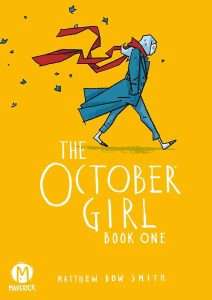
Eighteen-year-old Autumn is in her senior year of school and works in a coffee shop. It seems like a humdrum life, but what she’s going to do after graduation eludes her. Her dad left a couple years ago, and her mom doesn’t have any money to send her to college. So, her future holds just work, and for not enough to live on by herself. Is this all there is?
Then, a boy from her school (who owns a bookshop) and an imaginary friend from her childhood (who’s a… well, it’s not explained right away… ) pop back into her life through a series of increasingly unlikely events. Statues of animals in the park speak to her, tiny glowing fairy lights find her in the park, her hands start *glowing*, and a HUGE guardian troll named Fred finds her and then disappears! The coffee job suddenly seems soothingly boring after that. But strange people keep finding her. Just when a dark, purple-suited man with a Van Dyke shows up and threatens her, her MOM shows up and defends her! (With her same glowing hands and eyes!) Why won’t anyone tell Autumn what’s going on? All she keeps hearing is “not now”.
The art is sharp edged, with broad marker inking, and is somewhat two dimensional. Washes of color help portray the light values and keep the art more interesting. It reminds me a bit of Mike Mignola’s art, back in the first days of Hellboy, or his graphic novels of Leiber’s Fafhrd and the Grey Mouser. And just like those comics, this spooky tale starts with a teenager’s discovery that the world isn’t exactly what she thought it was. It’s filled with creatures, fae, and dark powers. Who IS Autumn? Who is her mom? Adolescent anxieties and rites-of-passage sync perfectly with this story, which flows smoothly and should interest teens and young adults. Autumn is challenged to decide who she wants to be. But she needs to figure it out soon, because Mr. Purple-Suit’s threats are getting louder and more powerful. (OTOH, isn’t it useful when the baddies just TELL you what nefarious plans they have? Bad call, Mr. Purple Suit. And stop the mansplaining, would you?)
No adult situations, and minimal violence. Suggested for the young adult section.
The October Girl, Book 1 By Matthew Dow Smith Mad Cave Studios, 2025 ISBN: 9781960578594
NFNT Age Recommendation: Adult (18+), Older Teen (16-18), Teen (13-16)
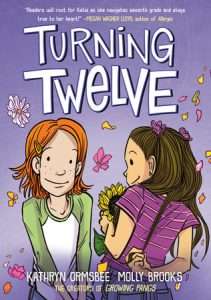
A lot of the graphics I’ve read recently are BIG stories: epic adventures, fantastic settings, or, in more realistic pieces, life or death stakes. It’s easy to make even a straightforward coming of age tale a BIG story with the angst, drama, and anxiety of even the most bog standard puberty. What’s hard is telling an entertaining small story, one that feels honest and real and intimate, something that at once feels universal and unique. Turning Twelve by Kathryn Ormsbee and illustrated by Molly Brooks is a small story. And it is completely lovely.
This follow up to Growing Pains by the same pair and released by Penguin Random House in October 2024, picks up with central character Katie as she turns twelve. Twelve is looking to be a big year for her: the threat of her first period is lurking around every corner, she’s going to her youth groups annual retreat, she gets to start babysitting, and she’s positive she’ll be cast as the lead in an upcoming musical. The Obsessive Compulsive Disorder that was central in the first book still buzzes in the background, but Katie is learning to accept that as part of how her brain works. Things turn sideways for Katie quickly—her best friends move out of town, she doesn’t get the lead in Annie, and things that felt natural and easy last year are filling her with questions and doubt. The biggest question is her new friend Grace. Grace is pretty. Really pretty. Really really pretty and nice and talented and makes her heart go thump thump thump. This is a big problem for Katie whose church makes it very clear that being gay is not okay.
Visually, Turning Twelve is nearly a perfect middle grade graphic. The art is cute and there are a few recurring visual themes that do a lot of story work, like the thumps of Katie’s heart or the buzzing bees of her anxious thoughts. The panels have a smooth, clean layout that moves the story along at a quick clip. This is a really quick read which is good because there isn’t really a lot going on in this story. Even in slow moments, the story doesn’t drag or meander. Katie is a very compelling character who breathes life into the story and gives the reader a solid anchor into the world of the story. Katie is so well developed in fact that the other characters don’t get much beyond a surface level treatment. Hazel, the would be new youth group friend, is never more than just there, and even Grace, the object of Katie’s confusing affection, doesn’t get a whole lot of characterization. The reader never really sees Katie’s parents so there’s no sense of how founding her stress in her awakening sexuality is. This is Katie’s story and Katie’s conflict and the other characters aren’t given much beyond her lens.
When I say Turning Twelve is small, that’s not to say it’s not saying big or important things. It absolutely is. But it’s not trying to solve those big important things. There are no big confessions or clear answers. Just like the mental health struggles Katie had in the first book, there are no fixes in this story because there is nothing to fix, just new ways for Katie to interact with her world and an acceptance of herself. The story ends with the hope that that world will be kind to our main character and that, while her road may still be bumpy ahead, Katie is going to be okay.
Turning Twelve Vol. 2 By Kathryn Ormsbee Art by Molly Brooks Penguin Random House, 2024 ISBN: 9780593650066
Company Age Rating: 8-12
NFNT Age Recommendation: Middle Grade (7-11), Tween (10-13) Creator Representation: Lesbian, Character Representation: Lesbian, Obsessive Compulsive Disorder (OCD)
In a world where supernatural being and humans tensely live in proximity to each other, a turf war between organized families of demi humans is the spark that will trigger a much larger conflict to come.
Gran Familia is the first serialized story from creator Louis Yamani and Titan Comics. The book introduces us to Leo, the somewhat haphazard but sincere manager of Goodfellas Bistro. Along with fellow employees Rose and Zach, Leo seems committed to keeping his head down and his spirits up as he runs a business amidst the growing threat of demi human attacks on humans across the city.
Through genetic mutation, these demi humans take a variety of forms—vampires, werewolves, mermaids, and more. It’s a bit like folklore meets superheroes. And whispers that a new family of demi humans is making a power play in the city have everyone tense. However, it’s not until this new family attacks a friend of Leo’s that readers learn the bigger picture; Leo is a part of the Gran Familia, the most powerful of the demi human families, and is a powerful vampire in his own right. But when Leo steps in to punish the upstarts who hurt someone he cared about, it sets off a series of consequences involving law enforcement and local criminals, all of whom have their own interests as well as a score to settle with a member of the Gran Familia.
Yamani balances episodic storytelling with a larger narrative in a way that serves the story well. Each section of the book finds Leo and friends caught up in the circumstances of the humans and demi humans that live around them. With each new adventure (or misadventure) readers learn more about the characters and the world as Leo can’t seem to stop himself from helping those in need around him even as he balances his demi human and human lives. At the same time, members of human law enforcement are on a quest to eradicate all demi humans, regardless of who they are.
As Leo’s interventions gain attention from unfortunate places, the narrative ups the stakes toward the inevitable confrontations. Overall, the idea of supernatural beings living alongside humans is not fresh, but this manga never makes the concept feel stale either. Leo’s clumsy affects do feel a bit like other manga characters we’ve seen before, but when the mask comes off and he leaps into action, he proves himself a hero worth following. Overall, the writing delivers an entertaining and packed first volume while putting plenty of pieces in place for these characters and the larger world.
Yamani’s art as well, is excellent. Sometimes sparse and sometimes full of fine detail, the visuals shift well from mundane sequences to highly stylized moments of supernatural action. There are a few rough moments where the visual sequence is a little hard to follow, but for the vast majority of the volume, the imagery is a treat to behold. Beyond the cityscapes themselves, some of the high points visually are when Leo and the other demi humans unleash their powers, changing form and dashing across the page—each character with their own distinct abilities and presentation. From start to finish, there’s a great deal to enjoy in the artistic storytelling, and Yamani shifts layouts and tones enough to keep that journey interesting.
Titan lists the age for the title as 15+. There’s some stylized but occasionally intense violence, scattered language, occasional mild fanservice, and some non-detailed nudity in nonsexual contexts. It’s nothing most older teens can’t handle, but definitely worth being aware of for those on the edge of that age range. As a first volume, Gran Familia isn’t necessarily doing anything groundbreaking, but it’s a whole lot of fun that manages to put its own touch on this blend of supernatural action and mafia-esque crime thriller. There’s humor to balance the more intense moments and a distinct cast of characters that propel each episode of the story along in a way that still manages to feel cohesive. There’s plenty here to delight readers of supernatural action manga, and the story is engaging but straightforward enough that this could be an excellent entry point for readers without much manga experience. Simply put, I had a fun time diving into this world and I hope to be there to see what trouble Leo gets himself into next.
Gran Familia By Louis Yamani Titan, 2025 ISBN: 9781787747135
Little Moon’s mother reads to her every night out of Grandma’s story book. Little Moon’s favorite story is about the scary monster the Shenk. Is it real? Then something horrible happens to her parents—luckily, some witches in hiding find her and help her understand the real purpose of Grandma’s book. But then, a spooky fairie librarian steals her book! Why? This opens the door to Little Moon learning about magic of all kinds—dark, light, helpful and tricky. Magic that is no longer allowed. She must get her Grandma’s book back! Thus starts Little Moon’s adventures, which take the form of spooky fairie stories. Think “fae” as in the old Gaelic tales, not the sanitized Disney version. It’s kind of Alice in Wonderland, with a gothic edge. Librarians and professors are portrayed as dark eyeless authoritarians and “keepers of the accredited institutions.” The first story explains how the Shenk came to be. Think of an origin story, somewhat like Thor and Loki, but as sisters.
The art is surrealistic (sometimes with no gutter or border, and sometimes with the gutters elaborately decorated with background actions) in grayscale, which is a shame, because the pencils are lush and textured and swirl every which way – it must have taken forever to layer them. This is an advance copy, though, and the back says, “vibrantly rendered in watercolors”. Colors would add to the fantastic weirdness. EVERY corner of every frame is crammed with swirling action and spooky visions. It’s a little hard with so much layered texture to determine what’s happening. The eye goes every which way and the story pacing suffers. It’s a challenging read. But the story is supposed to be creepy and disorienting—I get it. The lettering looks hand done. The book is marked for 14 and up, which I don’t think really fits. I might say 16 and up, because the parent’s disembodied heads are portrayed in the first few pages. Hiding who you are and refusing to listen to authority are also recurrent themes, better suited to older teens. The Book of Murmurs started as a web comic titled The Shenk. Webcomics are more of an older teen thing, I think. There are no adult themes, but there are lots of teeth, empty eyes, and skulls. Older teens should love it, difficult as it is.
The Book of Murmurs By Candice Purwin Fantagraphics, 2026 ISBN: 9798875001765
Company Age Rating: 14 and up
NFNT Age Recommendation: Adult (18+), Older Teen (16-18)
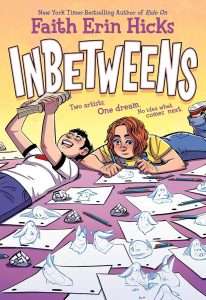
Twin sisters Sloane and Ash love to draw. For years, they have dreamed of becoming animators, working on movies like the Disney films they love. Now, at thirteen, they are taking the first step toward making that dream a reality: both girls have been accepted to a prestigious local animation summer program. Sloane is nervous, but she’s always nervous about starting new things and meeting new people. Ash can’t wait to learn from the pros—including the maker of her favorite animated movie, Monstrous.
Despite Sloane’s first-day jitters, both girls make friends at the program right away. But Ash soon finds herself struggling with the challenging animation assignments, and the creator of Monstrous isn’t the encouraging mentor figure she hoped for. Meanwhile, Sloane does well with the assignments, but is starting to question whether a career in animation is really what she wants. While Ash pushes herself hard to try and improve her craft, Sloane worries about how Ash will handle the idea of losing their shared goal.
The summer is teaching the twins a lot: about art skills, about different paths in animation (not all roads lead to Disney!), and about themselves. These discoveries are sometimes stressful, putting pressure on Sloane and Ash’s relationship. But if they listen to each other, their new friends, and an unexpected mentor from the animation program, then this could be a summer of exciting new possibilities.
These characters have a lot going on emotionally. Ash’s enthusiasm helps her connect to people, but can spiral into a stressful kind of overexcitement. Sloane struggles with discovering that art, her passion, feels more like a chore at animation camp. New friend Nisha used to bond with her grandmother over drawing, but is now losing that connection to her grandmother’s dementia. Two of the animation instructors provide an interesting contrast: Douglas Frye is has had exactly the kind of career Ash wants, working at Disney before starting his own studio. Ash is starstruck by him, but eventually comes to realize he’s an unhelpful teacher, a bit self-obsessed, and seems to unfairly favor male students over female ones. Film studies teacher Lisa Sato doesn’t have Frye’s celebrity sparkle, but she offers supportive advice and introduces her students to different styles of animation and career path possibilities.
Like author/illustrator Faith Erin Hicks, Sloane and Ash are aspiring young artists in Canada in what seems to be the 90s. (The exact year is never stated, but the characters watch VHS tapes, the newest film explicitly referenced came out in 1989, and anime is not yet mainstream in North America.) Hicks worked in the animation industry before switching to graphic novels, so she also has that experience to draw on (pun not intended but also not deleted) in creating the animation summer camp and its instructors.
The art style will be familiar to fans of Hicks’ work: a slightly cartoonified realism, expressive and dynamic, rich with detail. Given that animation is art plus movement, it is interesting to read a story centered on it in a medium that does not move. We see lots of drawing exercises from the summer program, like animating a bouncing ball or a person walking. We also see Sloane being introduced to anime, which she finds thrilling and inspiring in a time when she is struggling to reignite her passion for drawing. The book illustrates Ash and Sloane’s experience of spending a summer immersed in art.
Inbetweens shows us a fun, challenging, important summer in the lives of its young protagonists. It doesn’t tie up every little thing, like Ash’s trouble with overexcitement or Sloane’s questions about her future, but it ends in a happy and hopeful place. And after all, these characters are thirteen, so it makes sense that they don’t have everything figured out. Hand Inbetweens to fans of middle grade realistic fiction, especially those who like school stories or film and animation.
Inbetweens By Faith Erin Hicks Macmillan First Second, 2026 ISBN: 9781250838742
Steven Hollis left for Los Angeles with only a dream of becoming a screenwriter and a friend who wanted to act. Years later, Steven has a gambling problem, a drinking problem, and an eviction notice for his crummy apartment.
Thankfully, he also still has his friend Diedrich Ryan, who grew into one of the hottest actors in Hollywood. And despite his success and now speaking of himself in the third person, Diedrich has not forgotten the friend from high school who pushed him to apply to Julliard.
When Diedrich gets an invite to the bachelor party of wonderkid producer Benny Blevins, he’s all too happy to bring Steven as his “plus one.” It’s a golden opportunity for Steven to try and sell his screenplays to one of the most powerful players in Hollywood. Unfortunately for Steven, it is also a golden opportunity for crime boss Lucca Burlusconi.
Blevins, in addition to being a noteworthy producer, is also a notorious sexual predator. A gentleman gangster of the old school, Lucca Burlusconi would find this distasteful even if his own daughter were not one of Blevins’ victims. And while even his influence cannot touch Benny Blevins in Los Angeles, there is an unfortunate screenwriter who owes Lucca Burlusconi a lot of money. One who just got invited to a private party at a lavish mansion in Mexico City, where Benny Blevins will be celebrating his upcoming wedding.
Thus does Lucca Burlusconi’s problem of how to avenge his daughter become a problem for Steven Hollis to solve. It is only the start of Steven’s increasingly lengthy list of problems. One that will swiftly grow to accommodate fleeing the scene of a murder, evading a Mexican drug cartel, and somehow getting back to the United States without a passport. Compared to that, selling his screenplays while finding time to kill the man who can make his dream come true will be a cake walk.
Imagine The Hangover rewritten and directed by Quentin Tarantino, and you might wind up with something like The Loose End. There is an edge to Dave Dwonch’s writing that was clearly inspired by the indie heist movie boom of the 1990s. However, Dwonch parodies this aesthetic just as much as he homages it. This is particularly true in the second half of the story, as a group largely consisting of action movie stars enact increasingly outlandish plans they think will work because they saw it in a movie once. Ironically, their plans work just about as often as they do not, with one actor turning out to be an incredibly skilled sharpshooter despite only training in firearms to learn how to stand properly.
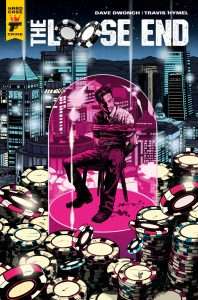
The artwork by Travis Hymel mirrors this tone. The style is reminiscent of many indie action comics of the time, and one could almost see this comic being done in black and white. But then we couldn’t have the colors off Geraldo Filho, which punctuates certain panels by rendering them with a single color. That, coupled with a shift between hot and cold colors, creates the feeling of a late 20th century grindhouse heist movie.
The Loose End is rated 15+ by Titan Comics and I consider that a fair ranking. There is considerable violence, drug use, and references to sex and sexual assault. Yet there is no nudity and no on-panel depiction of sexual assault. Surprisingly, there’s also no on-panel disrespect of women more extreme than Benny Blevins slapping the backside of one of the maids at the mansion he rented. Despite this, I would still recommend this one for an adult graphic novel collection, purely because older audiences are more likely to spot the references and tributes hidden throughout the comic.
The Loose End By Dave Dwonch Art by Travis Hymel Titan, 2025 ISBN: 9781787746442
Company Age Rating: 15+
NFNT Age Recommendation: Adult (18+), Older Teen (16-18)
Many science-fiction stories follow Mary Poppin’s advice of providing a spoonful of sugar to go with one’s medicine. While readers are usually enjoying the fantastic technologies and interdimensional shenanigans, they are also assimilating the story’s moral about universal problems that affects most everyone on earth, at least ideally. Sometimes, that’s a delicate balance. Too much sci-fi sweetness and the author’s message becomes lost, but too little and the audience becomes resistant to the author’s didactic delivery. Luckily, Acid Box, with its story provided by Sara Kenney and art provided by James Devlin, Emma Vieceli, and Ria Grix, manages that delicate balance.
This time travel adventure begins in 2026 with Jade Nyo, a Glasgow woman more interested in dancing and getting high (and taking care of her brother) instead of saving the world. During a trip to a seemingly normal restroom, however, she becomes acquainted with three women who call themselves Liminals, guardians of doorways through space and time. Jade becomes responsible for the Acid Box, a device that can potentially cause geological catastrophes. Jade and her companions, including her brother, go on a quest, traveling through space, time, and the 90’s rave culture scene to repair the Acid Box while hopefully not destroying the world.
As much as Kenney’s story is about environmental issues and humanity’s role in them, this story also serves as a love letter to rave culture and what music itself provides. Jade and the people she encounters on her journey serves as musical and historical tour guides through the ‘90s as the book explores the rave music genre along with historical events. Such a statement might sound like a synopsis from a PBS show about the power of music, but that’s not necessarily a bad thing. The main benefit of this musical genre, argued by Kenney’s story, is its power to connect people and unite them under a common cause. This trip through musical history also allows Jade to experience her own hero’s journey of self-discovery once she stops relying on recreational drugs to handle the mindbending time-travel narrative.
Complementing this mindbending journey is the visuals provided by the multiple artists that lend their talents to this book. There are many opportunities for these artists to be creative, from depicting natural disasters that seem to be sentient to trips through different time periods that take their toll on the body. Many of these panels take up whole pages, so the artists have a lot of canvas to show off their talents. Combined with Kenney’s story, the art is as vibrant and stirring as the music serving as the narrative’s heartbeat.
This book is ideal for librarians wanting graphic novels that take advantage of both the linguistic and visual aspects of the medium. Acid Box provides a visual feast for the eyes, a compelling protagonist, and a story that doesn’t dilute this message, the proper ratio of sugar and medicine.
Acid Box By Sara Kenney Art by James Devlin Not in listAvery Hill Publishing, 2025 ISBN: 9781917355056
NFNT Age Recommendation: Adult (18+), Older Teen (16-18) Creator Representation: British,
Baki Hanma has just upset the annual karate championship and sent shockwaves through the world of martial arts. This wide-eyed, 17 year old white belt newbie shouldn’t have been able to face off against more seasoned fighters, yet somehow he toppled them all to win first place. What’s going on with this kid?
Originally serialized for the magazine Weekly Shonen Champion in 1991, Baki the Grappler is among the best selling manga in Japan, however the still-ongoing manga has never been officially translated for English readers until now. A Netflix anime adaptation was released in 2020, but that series covers a later arc in the overall story. This is truly the first time the earliest part of Baki’s tale has been readily available to English speaking fans.
Coming fresh to the series, I expected this to be a one dimensional story about fighting and relentlessly beating opponents, and at first at first glance, that seemed true. Baki initially appears to just be an oblivious wunderkind with a lucky streak and a heart of gold. When asked directly, he can’t quite articulate his training goals, other than to say he’d like to become the strongest man on the planet. But there are hints that there’s more beneath the surface. Readers see him meticulously mark off photos of defeated opponents. His typically kind demeanor cools significantly when dealing with bullies, and betrays a cold and calculating side. There are also mysterious scars all over his body that strangely allow him to withstand even the most intense punches. He may even have ties to dangerous underground fighting rings. Clearly there’s much more going on with this seemingly happy-go-lucky kid. You don’t get all the answers in this volume, but I immediately wanted to crack open the second volume to see what makes Baki tick.
Almost every page is filled with action and the art is crisp and easy to follow. The manga style in this volume is a bit dated with rounder and softer lines than more recent iterations of the character, but it contributes to the classic feel of this manga. In terms of theme I’m reminded of other popular manga and anime series of the 1980s and 90s, such as Naruto and Dragon Ball, with their stories of (mostly) young men pushing themselves to be the strongest fighters in their community. There are no magical powers or fantastical elements for Baki, even if everyone’s muscles bulge just as unrealistically as Goku and Vegeta’s. Machismo practically drips off each page.
Other than the fighting that occurs in almost every panel, there are only a few content warnings. Some of the fighting turns more violent, with visibly broken bones and blood. There is a panel with teenage nudity and somewhat crude mentions of male anatomy. There is one awkward scene between 17 year old Baki and his attractive older landlady, where she is a little too eager to put her hands on him and he is visibly uncomfortable. The landlady and her teenage daughter are the only women in the first volume, and both are in supporting roles to the men.
The publisher rates this volume for older teens and I agree that’s probably where it fits best in a library collection. Adult readers might also enjoy it, and I could see it ticking the nostalgia box for fans of 80s and 90s manga and anime. While definitely aimed at a male audience, any reader that enjoys stories of perseverance, athleticism, and martial arts should give Baki the Grappler a try.
Baki the Grappler By Keisuke Itagaki Kodama Tales, Inc., 2024 ISBN: 9781966523000
Company Age Rating: Older Teen
NFNT Age Recommendation: Adult (18+), Older Teen (16-18) Creator Representation: Japanese,

 impoverished parents. Her new husband, Hans, is dashingly handsome, loves animals, and is pleasant and outgoing in public. But in private, he belittles her and subjects her to sexual violence and humiliation. Her only respite occurs when Hans takes a business trip to Portugal, leaving her to freely study what fascinates her more than anything: flight.
 odds are good that they’ve seen one of his movies. Nausicaä of the Valley of the Wind, My Neighbor Totoro, and Spirited Away are only some of the classic movies he’s directed. Indeed, the greatest challenge in assessing Miyazaki’s career is not debating his influence on the genre and other directors. It is deciding which of his great works might be considered his best.
 to do after graduation eludes her. Her dad left a couple years ago, and her mom doesn’t have any money to send her to college. So, her future holds just work, and for not enough to live on by herself. Is this all there is?
 stakes. It’s easy to make even a straightforward coming of age tale a BIG story with the angst, drama, and anxiety of even the most bog standard puberty. What’s hard is telling an entertaining small story, one that feels honest and real and intimate, something that at once feels universal and unique. Turning Twelve by Kathryn Ormsbee and illustrated by Molly Brooks is a small story. And it is completely lovely.
 demi humans is the spark that will trigger a much larger conflict to come.
 Shenk. Is it real? Then something horrible happens to her parents—luckily, some witches in hiding find her and help her understand the real purpose of Grandma’s book. But then, a spooky fairie librarian steals her book! Why? This opens the door to Little Moon learning about magic of all kinds—dark, light, helpful and tricky. Magic that is no longer allowed. She must get her Grandma’s book back! Thus starts Little Moon’s adventures, which take the form of spooky fairie stories. Think “fae” as in the old Gaelic tales, not the sanitized Disney version. It’s kind of Alice in Wonderland, with a gothic edge. Librarians and professors are portrayed as dark eyeless authoritarians and “keepers of the accredited institutions.” The first story explains how the Shenk came to be. Think of an origin story, somewhat like Thor and Loki, but as sisters.
 films they love. Now, at thirteen, they are taking the first step toward making that dream a reality: both girls have been accepted to a prestigious local animation summer program. Sloane is nervous, but she’s always nervous about starting new things and meeting new people. Ash can’t wait to learn from the pros—including the maker of her favorite animated movie, Monstrous.
 a gambling problem, a drinking problem, and an eviction notice for his crummy apartment.
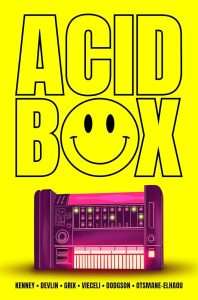 Many science-fiction stories follow Mary Poppin’s advice of providing a spoonful of sugar to go with one’s medicine. While readers are usually enjoying the fantastic technologies and interdimensional shenanigans, they are also assimilating the story’s moral about universal problems that affects most everyone on earth, at least ideally. Sometimes, that’s a delicate balance. Too much sci-fi sweetness and the author’s message becomes lost, but too little and the audience becomes resistant to the author’s didactic delivery. Luckily, Acid Box, with its story provided by Sara Kenney and art provided by James Devlin, Emma Vieceli, and Ria Grix, manages that delicate balance.
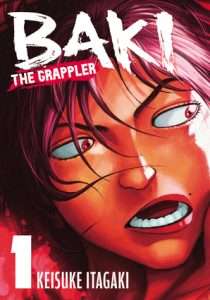 Baki Hanma has just upset the annual karate championship and sent shockwaves through the world of martial arts. This wide-eyed, 17 year old white belt newbie shouldn’t have been able to face off against more seasoned fighters, yet somehow he toppled them all to win first place. What’s going on with this kid?
