A near apocalypse at the hands of an Aztec Earth goddess has led to the impossible: Pablo Ortiz is popular again. Since the publication of the first Monster Locker in October 2024, Pablo and his friends Takashi and Maggie have been working to banish the demons and mythical creatures that use Pablo’s basement locker as a FastPass into the human world back into their own dimension. Most of our trio is burnt out with all of their monster fighting, but Pablo is feeling the rush of finally being seen in a good way again and is pushing his friends to keep the monster banishing and their social capital up. The problem with being seen, though, is sometimes the wrong things are looking.
Monster Locker: Nine-Tail Trouble, scheduled for release April 21, 2026, sees creators Jorge Aguirre and Andrés Vera Martínez diving back into the world of the first book with a new focus and an equally lovely story. While monster banisher Pablo still acts as the protagonist, this story is really about his friend, the charmingly unhinged Takashi Rosenberg. Takashi is not overly thrilled with their heavily monster focused schedule and has a lot on his mind. He wants to get back to RPGs and becoming a J-Pop sensation and worrying about his upcoming Bar Mitzvah and missing his mom in Japan. Like many children from different, distinct backgrounds, Takashi doesn’t know how to reconcile his Judaism with his Japanese heritage and vice versa. He feels out of place in both, a situation escalated by his parents divorce and his mother’s physical distance. And this also leaves him vulnerable when a new, dangerous monster threatens not just the trio’s school and popularity, but the roots of their friendship.
I loved the first Monster Locker when it came out but felt like the side characters, like Takashi, didn’t get a lot of fleshing out and it’s like Aguirre and Martínez were reading my dream journal. This second volume not only gives Takashi amazing depth and a massive struggle with identity, but pulls folkloric characters from both of his heritages into the story. While the first book was like an ode to Pablo’s Meso American ancestry and Aztec gods, Nine-Tail Trouble sees Kitsune (the Japanese nine-tailed fox trickster) and a Golem (an animated, humanoid chunk of clay from Jew folklore) doing battle, turning Takashi’s internal struggle into a visibly destructive one.
With the shift in focus comes a shift in artistic style. While the first Monster Locker took a lot of visual inspiration from Meso American art, this one pulls in references to Medieval Jewish art to draw in the Golem’s background and soft Japanese watercolor for the Kitsune. It’s lovely to look at and the emotional heft is clear without being overpowering. Takashi’s struggle is universal and makes a powerful framework for this story.As much as I love the focus on Takashi, much like the first Monster Locker, the other characters are not given much time to grow. The story sees many of the characters from the first book return but all, even Pablo, our protagonist, take a backseat. I would love to see more balance between the characters and their growth in future volumes.
Aguirre and Martínez have created a world that has some of my favorite things about graphic novels: the stories are fun and surprising, the characters are unique but grounded in real emotional stakes, and the art is gorgeous. This series continues to please and I can’t wait for more.
Monster Locker: Nine-Tail Trouble By Jorge Aguirre Art by Andrés Vera Martínez Macmillan First Second, 2026 ISBN: 9781250749765
Company Age Rating: 10-14
NFNT Age Recommendation: Middle Grade (7-11), Teen (13-16), Tween (10-13) Creator Representation: Colombian-American, , Character Representation: Japanese, Mexican-American, Jewish ,
Shy Cat and the Stuff-the-Bus Challenge by Dian Day and Amanda White teaches young readers about food insecurity through the story of Mila and her best friend Kit. Mila, a budding cartoonist, splits her time between her moms’ houses. Kit lives with his mom in an apartment. After bonding over being new kids at school, they are inseparable. Mila even gets to school early to join Kit for the school breakfast program since he doesn’t like to go alone. Between school, petting neighborhood cats, and DIY movie making, things are great between the two! Until Kit has a meltdown at school, setting the main story in motion.
The Stuff-the-Bus Challenge asks the students to bring goods to be donated to a local food bank. The challenge is simple – stuff the bus with food! The winning class gets their own pizza party. Students are excited to meet the challenge, when Kit discovers a dented can amongst the donated items. Who would donate something imperfect? Why do his classmates think it’s okay to give their dented cans to people who need food? This tipping point spurs Mila to better understand food insecurity and how close to home it can be.
Throughout the story, Kit’s hunger and how it affects him personally day to day is hinted at: headaches, crankiness, being secretive. Mila recounts a time she thought Kit was being rude upon quickly eating three bananas at her house. Her mom explains that “sometimes rude was just hungry” and it shouldn’t take away from Mila’s time spent with Kit. The story makes it clear that, even though she cares about Kit dearly, Mila struggles with her own emotions and how to be a good friend, even when your friend is being off-putting, because you don’t always know what they’re going through. In learning more about Kit’s situation, she’s forced to deal with and control her own emotions.
Shy Cat and the Stuff-the-Bus Challenge covers a lot within its pages. As Mila speaks with the adults in her life, there’s several pages that are fairly text heavy. These honest conversations are worthwhile. The graphic novel introduces different ways to fight food insecurity, including a great introduction to community gardening. Mila realizes the importance of speaking your mind and standing up for what’s right, something readers may find especially inspiring. The book includes some backmatter on the Hungry Stories project, which both author and artist are members of, for anyone looking to learn more about the topic at hand.
White’s art in Shy Cat and the Stuff-the-Bus Challenge is colorful, realistic, and cozy when it needs to be. Individuals of different races, abilities, and bodies are shown around Kit and Mila’s community. Lots of cats too! Mila’s Shy Cat comics are interspersed throughout the story, they become a way for her to express her emotions, almost like a graphic diary, and these work quite well in doing that.
Shy Cat and the Stuff-the-Bus Challenge would be a great choice for a middle grade book club or classroom read along. The Good Question Bus in the story, where students can ask questions anonymously, can even be adopted for individual classrooms. This graphic novel deals with topics that must be spoken about openly and honestly in a way that its intended audience can relate to.
Shy Cat and the Stuff-the-Bus Challenge By Dian Day Art by Amanda White Not in listSecond Story Press, 2026 ISBN: 9781772604450
Company Age Rating: 9-12
NFNT Age Recommendation: Middle Grade (7-11), Tween (10-13)
Shining a light on a lesser know story from the Civil War era, Legion M Entertainment and Stranger Comics bring together a talented creative team including creatives from Disney, Marvel, and DC, for Defiant, this first volume chronicling the life of Robert Smalls.
Born to an enslaved mother in the American South, Smalls dreamed of freedom. Beginning with his childhood, Defiant follows Smalls as he grows through education, love, and eventually into working as a sailor when war breaks out against the North. It is in this war that Smalls sees an opportunity at freedom, to steal the Confederate transport ship he worked on and escape to Union-controlled territory with some of his fellow crew and their families.
It was this escape that made Smalls famous, but his life’s work did not stop there. He continued as an influential figure throughout the war and beyond, including time serving in Congress. There are many today who do not know the details of Smalls and his life, and in the supplementary material that accompanies this graphic novel, the creators, as well as Smalls’s great great grandson, reflect on the power of legacy and the necessity of telling stories like this in order to remember the past and inform the future.
Defiant opens with a framing narrative depicting Smalls later in life as he takes his grandson fishing. It is here, as they wait for the fish to bite, that he begins to recount his story. Each section of the book captures key moments of Smalls’s youth and adulthood. It’s a significant length of time to cover, but the creators pace the story well, showcasing the experiences that formed Smalls’s character and the sense of defiance that would later drive him to risk everything in pursuit of freedom. The story is told with fondness and dramatic flair, but it doesn’t lose sight of the Smalls’s humanity or the horrors of US slavery at the time.
Balancing cinematic sensibilities with a desire to share a true segment of history, the writing effectively moves between interludes with the older Smalls and the larger narrative chunks leading up to his dramatic escape. The dialogue is straightforward and occasionally on the nose, but the book does an excellent job identifying important details to convey and moving the story along, while also bringing the reader into Small’s life along with the lives of those around him. It’s a story told with concern for historical truth, but also with acknowledgement that some liberties were taken and some factual gaps filled in to bring the story to life.
With these same cinematic sensibilities, the artistic team uses bold coloring and some dynamic layouts that quickly grab the reader’s attention. There’s a general sense of realism to the visual sequences, but the art takes some compelling creative liberties at times which help to elevate the themes and content of the story. There is one pivotal moment early in the book where Smalls, as a child, witnesses the violence and cruelty committed against the Black people around him. With use of light and shadow as well as distortions of faces that once seemed less threatening, the artists bring us into the experience of the moment and the realization of the evil inherent to the institution of slavery. Here and elsewhere, the art reckons with the realities of the time without the need to linger over pain and suffering. As the book progresses into the dramatic escape that Smalls is most known for, the visuals continue to bring the reader into the action, with effective choices in framing and dramatic moments that heighten both the tension and the heroism of what Smalls and the other achieved.
Stranger Comics lists Defiant as suitable for all ages. There are a range of areas in the content to be mindful of—violence and death in war and toward enslaved people, occasional slurs, briefly implied nudity, and some sequences of tension and threat which at times include children. However, none of these are presented for shock value or in graphic detail; even the creators state that their intention is not to linger over the violence and other horrors of the time. What detail we do see in the pages is relatively brief, maintaining focus on Smalls as a central figure and celebrating what he achieved without glossing over the reality that helped shape him.
As such, it’s a suitable read for older kids and upward, not only for the book’s sense of adventure, but also for the rich and important history it seeks to convey. In the afterword, writer Rob Edwards reflects on the importance of telling stories and why he sees such value in remembering the life of Robert Smalls. There is value, not only in the history recorded here, but in the discussions offered by Edwards and the others in this book who reflect on what it can mean for us today, to remember the bravery and steadfastness of those who have come before. In this way, Defiance is a perfect read for the current moment, and a great addition to shelves in schools, libraries, and home collections, especially with a movie also in production.
Defiant The Story of Robert Smalls By Rob Edwards Art by Sean Damien Hill Legion M and Stranger Comics, 2025 ISBN: 9781939834379
NFNT Age Recommendation: Teen (13-16) Creator Representation: Black, Character Representation: Black,
Serendipity, a perky middle schooler, is lucky, as readers will see in the first pages when she wins a radio contest (again) for free carnival tickets. As her day progresses, her usual good luck continues—good grades, the lead role in the school play, good scores on the basketball court, and a solid position as class president.
However, once she and her best friend Basil have an UNlucky run in with ZamZam, the carnival’s fortune-telling rabbit, her luck starts to change. It’s all ZamZam’s fault! Or is it? Serendipity is determined not to let anyone down, stop making mistakes, and handle everything on her own – but maybe she needs more help than the school’s unofficial wizard can offer and maybe even the best luck in the world won’t let her handle all the things she’s taken on.
Serendipity is a white girl with long brown hair that curls perfectly at the ends (usually). Unless she’s dressed up in a pink princess gown for the school play, she sports a purple shirt, short blue jumper, and yellow shorts. Her legs are drawn with long, thin lines. Her best friend Basil is also white, with short, orange hair and a heftier build. She is usually shown in shades of green, her preferred clothes being a green shirt and brown shorts. Serendipity’s vice president, Chel, wears a headscarf and there are students with varying skin colors on the periphery of her circle. There are a lot of pink accents in the art, from Serendipity’s cute strawberry hat, worn to disguise her unexpected bad hair day, to the pastel swirls of her thoughts. The carnival tent is deep pink and the night scenes are shown in dark purple shades.
This is a candy-pink, sweet as lollipops offering. It’s more fantasy than realistic—most modern middle schoolers would laugh at the idea of involvement in three activities being too much to take on and the dramatic play director and aggressive school election are old tropes that don’t usually appear in actual school life. However, the overall message is a thoughtful one and there are some especially good moments where Basil expresses her frustration with how easily everything comes to Serendipity—and her lack of appreciation and awareness for that privilege.
This will be a popular choice where Raina Telgemeier read-alikes are in high demand, especially for younger elementary school readers and those who aren’t interested in, or ready for, the more serious challenges they may meet in middle school.
Serendipity By Gabbie Benda Holiday House, 2026 ISBN: 9780823457892
He’s a trickster, a swindler, and a master manipulator skilled in the art of subterfuge and deception. At times insidious and other times resourceful, he straddles along the crossroads between good and evil, bending his will to orchestrate deeds that serve his intentions. He is none other than Loki, notorious Jotunn turned Aesir, adopted into the kinship of the Asgardians via his blood-brother Odin. In his third installment of Norse mythology, George O’Connor (Olympians series) reimagines one of the most manipulative and adroit characters that has evolved into a colorful icon in comics, movies, television shows, and videogames.
In this Asgardian series, Loki is pitted against a multitude of tasks that challenge his indefatigable problem-solving prowess and ingenuity. The first story introduces a master builder who proposes a wager to construct a fortifying wall around Asgard by winter’s end, and in exchange, win the fair Vanir goddess Freyja as his prize. Can Loki prevent her from being gifted to a stranger? In another tale of wit and strength, he challenges the ferocious wolf Fenrir to break free from a series of binds, each one stronger than the next. Will he outsmart the monstrous canine in a cunning battle of strength and tenacity? Then on his way to pay off a debt, he sets his eyes upon the golden apples from the tree of Idunn, Aesir goddess of youth, that grant Asgardians longevity.
Each tale highlights Loki’s ingenuity and resourcefulness, offering a glimpse into his manipulative mind—whether for good or evil, self-preservation or self-aggrandizement—always in devotion to a predicated cause engineered by deliberate scheming. Interludes break up the stories, detouring into the lives of other characters within the Norse mythos, some of whom indirectly or inevitably intersect with Loki’s exploits. Origin stories revolve around side characters like Hodr, blind brother of Baldr and Hel, dark queen who rules over the realm of the dead. Well-crafted dialogue infuse each character with a unique persona as they cross paths with each other. Foreboding moments unfold through strategically paced panels, some consisting of individual shots that build mounting tension, increasing a threatening sense of dread.
The final tale concludes with ominous overtones, centered on a challenge of chance—triggered in part by Loki—between Hodr and Baldr. Haunting repercussions reverberate, suggesting that something far worst is yet to come, presumably in a future volume. Once again, O’Connor revivifies a most conniving and mercurial deity from Norse mythology, supplementing middle graphic novel collections with vibrant adaptations of world myths.
Asgardians: Loki By George O’Connor Macmillan Roaring Brook, 2025 ISBN: 9781250760814
Orange Grove Junior High just held its graduation ceremony, and now it’s officially summer vacation. For some of the newly-minted rising ninth graders, the summer is off to a rocky start. Rose is disappointed to realize that she went through junior high without making much of an impression—no one seems to even remember her name. Best friends Juhi and Liv just had a huge fight—maybe even a friend breakup. Paul just wants to game and be left alone, but his parents are making him attend a pool party thrown by classmate Dustin. Paul’s popular cousin Maya will be there, too—her mom is forcing her to go and apologize for semi-accidentally humiliating Dustin in a viral video.
Dustin thought inviting the whole graduating class to a pool party might help him shake off his reputation as a loser. But it seemed like no one was interested, and then Maya’s video came out and made Dustin feel worse than ever. Now he just wants to hide. Then guests start arriving: Paul and Maya, plus a gaggle of Maya’s friends. Juhi and Liv, who are still fighting. Rose, who is determined to finally make an impression on her classmates. Emotions are high, and Orange Grove’s recent graduates are running wild. For some of them, what happens at this party will change everything.
Last Day Pool Party reads like watching a summery tween movie. The characters have enough unusual details to keep them from being flat, but they are familiar: the social outcast looking to prove himself, the wallflower desperate to be noticed, the best friends rocked by a major fight, the popular girl wondering if she’s become someone she doesn’t want to be. The focus shifts between these characters, following them from the pool deck crowded with an audience of fellow students to the living room where Paul is determined to ignore everyone and play video games to Dustin’s bedroom for an impromptu makeover scene to a bathroom where two characters go to hide and end up having a heart-to-heart. The characters’ stories start out separate but eventually converge in a cinematically dramatic climax, then stay mingled together as they sort things out afterward.
The art is fun, vibrant, and colorful. The cast features a variety of races and body types as well as wildly different personalities, which are highlighted by their expressive faces and dynamic body language. The main setting—Dustin’s house, inside and out – is well established and feels solid and consistent, like the set of a play, with the same locations hosting different characters throughout the party. Bright colors add to the sunny, summery feel.
This is a funny and ultimately optimistic story exploring lots of topics of interest to young readers: making and keeping friendships, discovering and developing your own identity, apologizing and forgiving. It is also a bouncy, quick read with lots of slightly over-the-top but relatable characters. Hand it to middle schoolers who want a fun romp with drama, humor, and heart.
Last Day Pool Party By Emma Steinkellner Labyrinth Road, 2026 ISBN: 9798217031429
Company Age Rating: 8-12
NFNT Age Recommendation: Middle Grade (7-11), Tween (10-13)
There are many people who take a good night’s sleep for granted while others would do anything to have it. In a world where caffeine is plentiful, doomscrolling is the number one activity behind pickleball, and anxiety is seemingly a cornerstone of our society, a good night’s sleep, for many, seems to be more unattainable by the day. Graphic storyteller Maureen Burdock has dealt with insomnia for much of her life and chronicles her journey in Sleepless Planet: A Graphic Guide to Healing from Insomnia, a book that’s part memoir, part self-help book, and part good sleep manifesto.
Burdock has suffered from insomnia since childhood. As an adult, she sought out doctors and specialists for quick fixes, including drugs and machines to help her breathe properly while sleeping. She eventually comes across a more holistic approach that includes diet, exercise, spirituality, and realizing how our culture of consumerism and progress are detrimental to our own mental health and even the health of the planet.
Far from a simple how-to-sleep manual, Burdock introduces a lot of concepts that don’t initially seem connected. The book can swing wildly from biography to environmental studies to dream studies and mediation. However, there is a slow and steady progression of ideas that are well-researched, according to the footnotes at the end of the book. Burdock’s work is broken up into four chapters, which helps break up the information she presents into manageable chunks and each chapter feels like its own separate book on better sleep. By labeling each chapter as one of the four elements (air, fire, earth, and water), Burdock also creates a mystical, dreamlike aesthetic that suits a book presenting an overall holistic approach to getting better sleep.
That dreamlike aesthetic is only reinforced by Burdock’s artwork, which, while eschewing color, presents a vivid landscape where slices of life are intertwined with symbolic imagery. Presenting information within comic panels along with pictures can often be more accessible, whether those pictures use illustration to demonstrate an idea in action or simply to create a sense of whimsy, what Mary Poppins would call a “spoonful of sugar” that helps the didactic text blocks be remembered. Burdock presents a lot of whimsy in the form of talking koalas, inanimate objects with expressive faces, and an anthropomorphic representation of menopause that smothers the author much in the same way an MMA fighter smothers an opponent.
Adult services librarians interested in purchasing this book should reconsider simply sticking this book in your library’s Graphic Novel collection. Consider putting it in your library’s nonfiction section with other books on diseases and how to cure them. It will improve the chances of a person in need of a good night sleep (and in need of advice from someone who’s lived with insomnia) finding it.
Sleepless Planet A Graphic Guide to Healing from Insomnia By Maureen Burdock Graphic Mundi, 2025 ISBN: 9781637790939
Mika Song’s repertoire includes both picture book illustration and the Norma and Belly graphic novel series. She returns to the world of tasty food in her newest graphic novel, Night Chef.
In a gourmet kitchen, when the chefs leave, Night Chef takes over. A small raccoon, she ties on her blue apron, recites her chef mantras, and gets to work. Her latest creation needs an egg and fortunately there’s one almost within reach… When her ingredient hatches a noisy baby bird, Night Chef ends up going on a journey with her new responsibility. Along the way, she will cook new dishes, encounter new friends, and discover secrets about her own past.
Song’s work is instantly identifiable. Her lush watercolors create a night world of dark greens and blues, a cozy waterfront diner with simple browns, and a unique cast of characters. Rounded green frogs with headbands mingle with a sharp-eyed grey shrew and a pink-hued possum. Night Chef herself is unique – when she first appears, sneaking olives from the humans, she’s a small round bundle, her cheeks bulging. In her own world, she stands on her hind feet, sporting a neatly tied blue apron with handy pockets and carrying a large spatula. At one point in her travels, she meets a crowd of other raccoons, “The Pats” and stands out from their round, brown bodies with her own larger size, gray fur, and oval head. The villain of story, although treated with understanding, is a flurry of brown and white feathers and snapping, angry beak.
The book ends with a fun little comic of Night Chef making “fly frittata,” and the same recipe tweaked for more human tastes. Song also includes the character development of Night Chef, from rough sketches to completion.
This is lengthier, with more space for a deeper plot and character development, than Song’s earlier works. Although the story is a simple one, readers will feel the courage and dedication of Night Chef as she steps out into a scary world, leaving the only place she’s ever known, but keeps following her calling as a chef no matter where she goes. Squeamish readers may not enjoy the plentiful servings of worm-related food at the waterfront diner, but Song’s art makes everything look tasty.
This will be a sure bet for fans of Mika Song’s earlier works but will also appeal to readers who like reflective animal stories like One and Only Ivan as well as funny-food based stories like Stick Dog. It’s a great choice for encouraging young readers to explore different styles of art and graphic storytelling and even includes a timely message about the consequences of poisoning “pests” in the wild. Readers will root for Night Chef all the way to the satisfying ending.
Night Chef By Mika Song Penguin Random House Graphic, 2025 ISBN: 9780593303153
NFNT Age Recommendation: Middle Grade (7-11) Creator Representation: Filipino-American,
Of Swamp & Sea is a delightful series by super spousal team Mia Jay Boulton and Laurel Boulton. It originally premiered as a comic on Web Toon, and Macmillan picked it up for printing. It follows the story of Mercy Harding, a young woman trying to confront the fact that she might not be human any more. A monster hunt gone wrong has lead her to being possessed by a creature simply referred to as “the wolf.” She finds herself partnered up (and maybe pining for) Jonah, the hunter who led her to her current state. In his guilt, he offers to try to rid her of the curse, but feelings of all sorts arise and Mercy isn’t so certain about what she wants anymore.
I don’t know how controversial a statement this is, but here goes: High fantasy and romances are hard sells for me. Of course, your mileage may vary, but for me, I think a lot of it boils down to how the story is told. I am not opposed to formulaic storytelling, but both romance (the exploration of feelings) and high fantasy (world building, magic systems, etc.) tend to rely on a lot of information, but the narrative does not have time to really dig in and explain.
Of Swamp & Sea, at least the second volume, manages to navigate this challenge in a way that is very balanced and satisfying without sacrificing pacing. For me, this title is an example of an ideal fantasy romance.
The art tends to stay pretty tight, allowing the panels to focus on characters and individual emotions. Not to say there is no atmosphere, but this is definitely more about the characters than the overall world. I am impressed with the gestural facial expressions and emotive body language. The color palette is soft and limited from page to page, but not restrictive. In presentation, not content, the art resembles the Critical Role animated series. The characters are diverse in their appearance, the story moves well, and there are many fascinating fantasy creatures and myths that are explored. Vol. 2 is an overall speedy and interesting read.
The book does not contain anything particularly graphic, but I would say there is some violence and some horror-adjacent moments. Recommended for readers aged 12 & up.
It looks like the entire series is no longer available through Web Toon, so Macmillan is the way to go if you want to read more (and I hope you do).
Of Swamp & Sea, Vol. 02 By Mia Jay Boulton and Laurel Boulton Macmillan, 2025 ISBN: 9781250387004
NFNT Age Recommendation: Teen (13-16), Tween (10-13) Creator Representation: Queer,
Have you ever felt like you needed to talk but the words just wouldn’t come out? How about wanting to be social, outgoing, and funny but finding yourself overwhelmed at the prospect? Aron Nels Steinke’s Speechless is a middle grade graphic novel about Mira, a sixth grader who can’t always find her voice and what she wants to say, no matter how hard she tries at it.
Mira doesn’t talk in school; it started years ago when she was little and it just… hasn’t stopped. But this year, it’s time for middle school and time for her to finally speak at school! Except, by this point, her classmates are used to her not talking, so they fill in for her and thus begins another school year of being speechless. Mira retreats to her sanctuary, her bedroom, where she spends her free time creating stop motion animated films for her channel Danger Cat Studios. Filmmaking is a safe place where she can be herself, as loud as she wants to be.
Throughout the book, and the first year of middle school, Mira attempts finding her confidence and voice. She makes a new friend, develops her first crush, and deals with her former best friend suddenly being inescapable. (Literally, she moves in with Mira’s family!) Her personal struggles lead to school struggles and disappointing grades. Her parents learn she hasn’t been speaking at school and start her in therapy, where she learns more about herself.
Speechless is a welcome addition to any graphic novel bookshelf. With everything going on in Mira’s life throughout the story, Steinke keeps the story light enough that readers will find it enjoyable and still relatable. Her therapy visits and subsequent diagnoses are just another aspect of who Mira is, rather than overtaking her sixth grade story. Learning she has selective mutism and social anxiety leads to Mira better understanding herself. She struggles with the intensity of her emotions and often jumps to the worst possible scenario. Readers facing their similar anxiety will see it’s just one aspect of who they are, along with a lot of other wonderful things about them, and that they’re not alone in how they feel.
Throughout Speechless, Steinke shows Mira’s crafting process in detail, with specifics of how she made her creations out of everyday objects. Her filmmaking process is shown in smaller panels to better appear like a stop motion animation film. With social media being so prominent in readers’ lives and often presented in other books, it’s fun to see the internet being used as a place of creativity and originality in this particular graphic novel.
Steinke’s art is colorful and realistic, there’s lots for readers to pick apart in certain panels. It reflects Mira’s mood and current situations too. When she’s angry, the pages are darker and busier. When she’s feeling trapped in a classroom and not able to speak, there’s more movement from other characters, leading the reader to feel like they’re right there alongside her.
Readers of Steinke’s Mr. Wolf’s Class series should enjoy this standalone graphic novel, as will fans of middle grade stories centered on fitting in, new struggles, and embracing what makes you you. Like other popular middle grade graphic novels, Steinke’s own experiences inform the story he tells. He also includes an afterward with his experiences and recommended resources. Readers who’ve enjoyed similar graphic novels are sure to enjoy this one too.
Speechless By Aron Nels Steinke Scholastic GRAPHIX, 2025 ISBN: 9781338849325
Company Age Rating: 8-1
NFNT Age Recommendation: Middle Grade (7-11), Tween (10-13) Creator Representation: , Anxiety Character Representation: Mute, Jewish , Anxiety

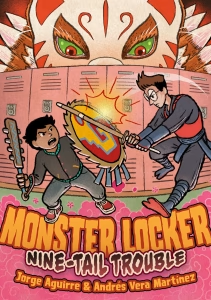 of the first Monster Locker in October 2024, Pablo and his friends Takashi and Maggie have been working to banish the demons and mythical creatures that use Pablo’s basement locker as a FastPass into the human world back into their own dimension. Most of our trio is burnt out with all of their monster fighting, but Pablo is feeling the rush of finally being seen in a good way again and is pushing his friends to keep the monster banishing and their social capital up. The problem with being seen, though, is sometimes the wrong things are looking.
 story of Mila and her best friend Kit. Mila, a budding cartoonist, splits her time between her moms’ houses. Kit lives with his mom in an apartment. After bonding over being new kids at school, they are inseparable. Mila even gets to school early to join Kit for the school breakfast program since he doesn’t like to go alone. Between school, petting neighborhood cats, and DIY movie making, things are great between the two! Until Kit has a meltdown at school, setting the main story in motion.
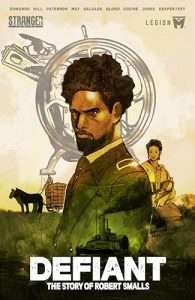 creative team including creatives from Disney, Marvel, and DC, for Defiant, this first volume chronicling the life of Robert Smalls.
 carnival tickets. As her day progresses, her usual good luck continues—good grades, the lead role in the school play, good scores on the basketball court, and a solid position as class president.
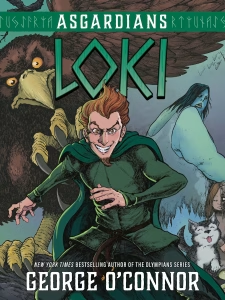 resourceful, he straddles along the crossroads between good and evil, bending his will to orchestrate deeds that serve his intentions. He is none other than Loki, notorious Jotunn turned Aesir, adopted into the kinship of the Asgardians via his blood-brother Odin. In his third installment of Norse mythology, George O’Connor (Olympians series) reimagines one of the most manipulative and adroit characters that has evolved into a colorful icon in comics, movies, television shows, and videogames.
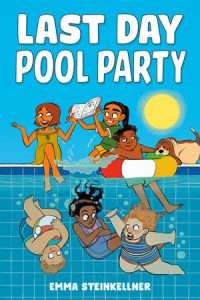 rising ninth graders, the summer is off to a rocky start. Rose is disappointed to realize that she went through junior high without making much of an impression—no one seems to even remember her name. Best friends Juhi and Liv just had a huge fight—maybe even a friend breakup. Paul just wants to game and be left alone, but his parents are making him attend a pool party thrown by classmate Dustin. Paul’s popular cousin Maya will be there, too—her mom is forcing her to go and apologize for semi-accidentally humiliating Dustin in a viral video.
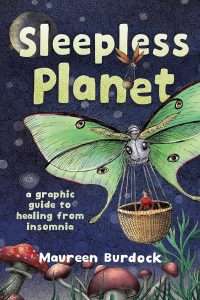 There are many people who take a good night’s sleep for granted while others would do anything to have it. In a world where caffeine is plentiful, doomscrolling is the number one activity behind pickleball, and anxiety is seemingly a cornerstone of our society, a good night’s sleep, for many, seems to be more unattainable by the day. Graphic storyteller Maureen Burdock has dealt with insomnia for much of her life and chronicles her journey in Sleepless Planet: A Graphic Guide to Healing from Insomnia, a book that’s part memoir, part self-help book, and part good sleep manifesto.
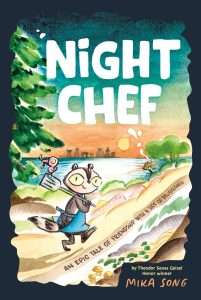 Mika Song’s repertoire includes both picture book illustration and the Norma and Belly graphic novel series. She returns to the world of tasty food in her newest graphic novel, Night Chef.
 Mercy Harding is a monster.
 but finding yourself overwhelmed at the prospect? Aron Nels Steinke’s Speechless is a middle grade graphic novel about Mira, a sixth grader who can’t always find her voice and what she wants to say, no matter how hard she tries at it.
