
Mixed-Up
Stella is excited to start fifth grade with her two best friends, Emiko and Latasha. Their new teacher is super nice. Plus, fifth graders are 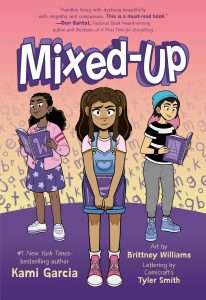 always assigned a cool creative project, and Stella is eager to find out what it will be this year. To top it all off, there’s a big announcement coming soon about Stella, Emiko, and Latasha’s favorite show, Witchlins. The girls can’t wait!
But things quickly go from exciting to overwhelming. Fifth grade requires a lot more reading than Stella is used to, and reading has always been hard for her. Unable to finish assignments in time, she starts falling behind. She’s disappointed to learn that the fifth grade project is to write stories for a Young Authors competition—writing is almost as hard for Stella as reading. And the Witchlins news turns out to be the release of a new online gaming universe based on the show, which would be thrilling, except the game is practically impossible unless you read the guidebook… which is not an easy read.
Stella is embarrassed to admit that reading is so hard for her, so she makes excuses not to talk about any of the things she’s struggling with, including the Witchlins game and the fifth grade project. Soon, she’s barely talking to her friends at all. Her teacher notices that Stella is struggling, and she calls in Stella’s parents. With some testing, they discover that Stella has dyslexia. It’s a relief to know what’s going on and to get some help and support to make reading easier. Now, if she can just fix things with Emiko and Latasha…
An author’s note explains that Stella is inspired by the author’s daughter, who also has dyslexia, and by the author’s experience as a teacher and reading specialist. Stella’s experience is portrayed with empathy, and there are clear, nonjudgmental explanations of what dyslexia is and how people who have it can make reading easier. The story is ultimately hopeful and positive, with Stella finding lots of support from people around her and learning to work with her dyslexic brain.
Stella’s friendship with Emiko and Latasha feels playful and lived-in, making it especially sad when Stella starts withdrawing from the other two. Their shared love of the show Witchlins is well-established, so it’s easy to understand why Stella would feel so frustrated and left out when she is unable to play the new Witchlins game.
The art is colorful and energetic. The characters are distinct and expressive, and the cast is racially diverse and includes characters with visible disabilities, as well as Stella’s invisible one. The backgrounds are appropriately detailed, but don’t pull attention from the characters. We get to see some of the graphic novel that Stella draws for her fifth grade project, which is in a simpler, more childlike style (though still pretty good for a fifth grader!).
This is a realistic story, compassionately told. Certainly hand it to young readers who are navigating dyslexia or other neurodivergence. It will also fit neatly into the ranks of realistic middle-grade graphic novels, many of which follow a protagonist’s specific struggles (e.g. the dental drama central to Raina Telgemeier’s Smile) but which appeal to audiences well beyond those affected by similar problems.
Mixed-Up
By Kami Garcia
Art by Brittney Williams
Macmillan First Second, 2025
ISBN: 9781250840882
Company Age Rating: 8-12
NFNT Age Recommendation: Middle Grade (7-11), Tween (10-13)

