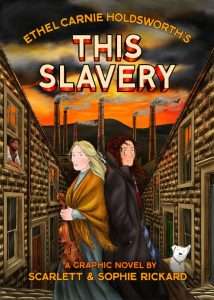
This graphic novel adaptation of Ethel Carnie Holdsworth’s romance novel is about sisters, Hester and Rachel, who grew up in poverty and learned how to fight for justice. The original novel was released in 1925 and was based on Ethel’s own experiences in a mill, but was not well received at the time of release. Now Scarlett and Sophie Rickard have adapted the novel into a new format during a time when the world could use reminding that human rights and dignity are inherent, not earned.
The sisters work in a Lancashire textile factory where their mother and grandmother worked. Rachel is full of energy and willing to confront the men in her town telling her she’s worthless, but Hester has a fragility that doesn’t allow for that type of action. Instead, Hester chooses to take a marriage offer from a wealthy mill owner in order to try and better her situation in life while her sister becomes an activist.
Normally, I would not pick up a story like this one as my personal preference leans toward fantasy or escapism from reality. This historical account hits home on many levels of commentary that address the issues of the time but are relatable today to a modern audience. Although this is not a word-to-word adaptation, the creators made sure to include aspects of the original (e.g. accents and colloquialisms). Likewise, the illustrator took care to represent the time period through the clothing and architecture renditions. The color helps distinguish characters, mood, and poverty level by using darker, neutral tones to make everything dark and dirty and saving the brighter and lighter colors for the upper class and their frivolity.
This book is best suited for academic libraries with strong English literature programs or adult collections with patrons interested in historical (or romance) graphic novels. Although this book addresses prostitution, there is no on-page sex. Just a little kissing. Both a foreword and author’s note explain that the slavery indicated by the title is not referring to the horrific trans-Atlantic slavery that is most often acknowledged by history but instead refers to the powerlessness of women and laborers.
This Slavery By Ethel Carnie Holdsworth, Sophie Rickard Art by Scarlett Rickard SelfMadeHero, 2025 ISBN: 9781914224355
Little Moon’s mother reads to her every night out of Grandma’s story book. Little Moon’s favorite story is about the scary monster the Shenk. Is it real? Then something horrible happens to her parents—luckily, some witches in hiding find her and help her understand the real purpose of Grandma’s book. But then, a spooky fairie librarian steals her book! Why? This opens the door to Little Moon learning about magic of all kinds—dark, light, helpful and tricky. Magic that is no longer allowed. She must get her Grandma’s book back! Thus starts Little Moon’s adventures, which take the form of spooky fairie stories. Think “fae” as in the old Gaelic tales, not the sanitized Disney version. It’s kind of Alice in Wonderland, with a gothic edge. Librarians and professors are portrayed as dark eyeless authoritarians and “keepers of the accredited institutions.” The first story explains how the Shenk came to be. Think of an origin story, somewhat like Thor and Loki, but as sisters.
The art is surrealistic (sometimes with no gutter or border, and sometimes with the gutters elaborately decorated with background actions) in grayscale, which is a shame, because the pencils are lush and textured and swirl every which way – it must have taken forever to layer them. This is an advance copy, though, and the back says, “vibrantly rendered in watercolors”. Colors would add to the fantastic weirdness. EVERY corner of every frame is crammed with swirling action and spooky visions. It’s a little hard with so much layered texture to determine what’s happening. The eye goes every which way and the story pacing suffers. It’s a challenging read. But the story is supposed to be creepy and disorienting—I get it. The lettering looks hand done. The book is marked for 14 and up, which I don’t think really fits. I might say 16 and up, because the parent’s disembodied heads are portrayed in the first few pages. Hiding who you are and refusing to listen to authority are also recurrent themes, better suited to older teens. The Book of Murmurs started as a web comic titled The Shenk. Webcomics are more of an older teen thing, I think. There are no adult themes, but there are lots of teeth, empty eyes, and skulls. Older teens should love it, difficult as it is.
The Book of Murmurs By Candice Purwin Fantagraphics, 2026 ISBN: 9798875001765
Company Age Rating: 14 and up
NFNT Age Recommendation: Adult (18+), Older Teen (16-18)
A political allegory for the rise of dictatorship all framed through the anxious lives of… some pigeons?
Street Noise Books delivers the English language edition of Pigeons! A Fable for Our Time from Marc Chalvin. The book opens boldly, introducing the reader to a vast number of hapless pigeons and the merciless crow who terrorizes and controls them.
The pigeons themselves are not known for complex thought. They eat poisoned seeds, walk in front of cars, and generally look for crow to give them instruction in every area of life. Simultaneously, the crow revels in this power, killing pigeons at will and toying with the living ones, safe in the knowledge that they will never object. Into this scene enters an idealistic seagull. She believes the pigeons are capable of more; the challenge is to convince them of that. The plan—stage democratic elections so that the pigeons can understand the concept of freedom and escape crow’s tyranny. The problem—the pigeons may prefer an iron claw to an uncertain world in which they make their own decisions.
While there is a clear narrative from start to finish, Chalvin balances story and character with a heavy emphasis on the political themes of the book. The pigeons often understand very little of what is happening around them, but the book intersperses debates between crow and seagull on topics such as democracy, control, and self-actualization which serve to bring the social and political topics to the forefront. In this way, things are a bit on the nose for readers who prefer subtler messaging. That being said, the book is far from a dry treatise on political thought. The pigeons banter and squabble, crow struggles to manage even the most basic interactions with the feathered populous, and seagull looks on in dismay as even the best intentions struggle in the face of reality. With dry humor and biting observations about humanity, Chalvin turns loose three factions in a struggle that feels immensely relevant to human history and the moment we live in today.
Chalvin’s art as well is simple, keeping the emphasis on the characters and the content over highly detailed scenes. With heavy line sketches and simple shading, there are stylistic touches of political cartoons while still allowing the book to take on its own shape and character. The wide-eyed pigeons are often indistinguishable, but Chalvin still imbues them with life amidst their fear and their naive joy as they wander their way through each new day. Most pages are broken into a simple four-panel layout while occasional scenes are given more space for detail and emphasis as key moments unfold at a larger scale. It’s a style that serves well, as Chalvin takes the simple visuals and fills them with personality and meaning.
There is some semi-graphic animal death throughout the book that is mitigated by both the style and the ironic humor that define the book. While the themes and questions are important, younger readers are likely to bounce off of this in favor of less overt political explorations. However, for older teens who are interested, and definitely for adults, Pigeons! is packed with sharp messaging and enough lingering complexity to give the reader something to contemplate once the book is done—rather than tying everything off in a bow that invites no further exploration. As a piece of social and political commentary, Chalvin delivers an excellent and tightly told fable here, and it’s a worthy addition and warning for any readership inclined to sit with it. And for any space looking to teach on the ideas the book contains, Pigeons! offers a very palatable entry point into subjects that can sometimes be dry in a purely academic context. In short, it’s not for everyone, but it’s a book well worth picking up for the right audience and an important book to see on shelves today.
Pigeons! A Fable for Our Times By Marc Chalvin Street Noise Books, 2025 ISBN: 9781951491505
NFNT Age Recommendation: Adult (18+), Older Teen (16-18) Creator Representation: French,
While not the first graphic novel to be written about the atrocities of the Holocaust (and surely not the last), Ginette Kolinka’s Adieu Birkenau approaches the subject with a surprising amount of levity and accessibility. The comic splits its time between the present (well, the present of 2020), in which the 95-year-old Kolinka re-visits the Auschwitz-Birkenau prison camp with a group of students, and the events of the past. Kolinka recounts her early life in France, her large family’s attempt to escape Nazi persecution, and most notably the experience of trying to survive in camp as she was being abused, humiliated, and dehumanized.
Kolinka and her co-writers J.D. Morvan and Victor Matet present her time in the concentration camp with a matter-of-factness that avoids the dramatic, emotionally-wrought approach one might expect of a Holocaust survivor’s story. This comes across less as objectivity and more so like a survivor who has almost curated her memories so as to not be incapacitated by them. Indeed, memories seem to be a major theme of Adieu Birkenau.
It’s difficult to read Adieu Birkenau without viewing it in the context of the great tradition of memoirs that use comics and graphic novels as a way to process extremely traumatizing events, such as They Called Us Enemy, Persepolis, March, and especially Maus. Like those books, Kolinka’s work is deeply concerned with memory, and how it plays a role in processing grief. Kolinka is exceedingly upfront about how her memory is unreliable and that her tendency to block out some of the most horrendous aspects allowed her to survive. This is cleverly conveyed visually, as figures in the camps are often depicted as dark, vaguely human-shaped clouds, as if Kolinka can only remember the slightest impression of them. In the back half of the book, panels often contain scenes from both the past and present, as if to remind the reader that these events long past are still very much alive today.
Artists Cesc and Efa bring a sense of whimsy and warmth to the art that seems more informed by the animation of Disney or Studio Ghibli than most comic illustration. Characters have soft, rounded features, and big, expressive eyes that give the reader an immediate glance into their thoughts and feelings. The playfulness of the line work contrasts greatly, however, with the subtle brown and gray tones that characterize much of the graphic novel and add to the dreariness and despair of recounting life in a prison camp.
Although Adieu Birkenau is recommended for adults, there is very little that would make it inappropriate for younger readers–especially if you’re looking for an accessible way to introduce them to the horrors of the Holocaust. There are brief depictions of nudity in recounting the ways the Nazis forced the prisoners to strip down in the camps, but it’s handled very carefully and clearly used to highlight the sense of embarrassment and dehumanization that Jewish prisoners were subjected to. The most gruesome imagery one might expect to find in a comic written by a Holocaust survivor is also not explicitly shown–which certainly ties into the way that Kolinka repressed the worst aspects of her experience just to survive.
If you like stories that put a human face on big, overwhelming tragedies, like the previously mentioned Maus, then Adieu Birkenau will be right up your alley. Kolinka approaches the subject matter with much more humor than, say, Art Spiegelman, but she doesn’t gloss over the ways that trauma sticks with survivors and how our memory plays an important role in processing such horrors. It is a worthwhile addition to the hugely important genre of comics by creators trying to make sense of real world horrors.
Adieu Birkenau By Ginette Kolinka, Jean-David Morvan, and Victor Matet Art by Ricard Efa and Cesc F. Dalmases SelfMadeHero, 2024 ISBN: 9781914224232
NFNT Age Recommendation: Adult (18+), Older Teen (16-18) Creator Representation: French, Jewish Character Representation: French, Jewish
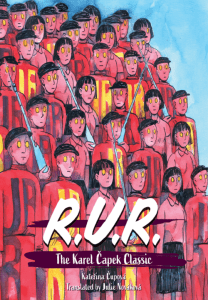
The thought of robots may conjure images of memorable characters featured in The Terminator, Star Wars, or even Futurama, but Katerina Cupová’s adaptation of Karel Capek’s unappreciated play offers an intriguing view of automatons (and our place among them) from the perspective of an early 20th century Czech playwright.
R.U.R. primarily follows the exploits of Helena Glory, head of the League of Humanity and daughter of a powerful president, who infiltrates the island factory of Rossum’s Universal Robots, where robots are manufactured in order to improve the lives of humans. Helena believes that robots have the same rights as humans and should be liberated from their servitude, a view not shared by the humans running the factory—including Harry Domin, the dismissive and naive general manager of Rossum’s Universal Robots, who reveals that the origins of robot manufacturing are rooted in greed (shocker). Harry eventually forces Helena into marriage, and over the next decade, robots become more pervasive throughout the world. We soon discover (as is common in stories of robot oppression) that they are in fact more human-like than expected. Needless to say, things quickly go south for Helena, Harry, and the other humans of R.U.R., as the robots seek freedom.
Between Cupová’s prescient plot and Cupová’s energetic, playful art, it’s genuinely surprising that the original play was written in 1920. Capek touches on themes that have become so central to science fiction in the century following R.U.R. that they’re practically cliche: the dehumanization of workers due to advances in technology, the freewill of machines, the dangers of playing God, and the steep sacrifices of so-called “progress.” Recent questions surrounding the use of Artificial Intelligence suggest that the ideas addressed by Capek are even more timely today than a century ago.
Flipping to any page of R.U.R. will reveal Cupová’s loose, expressive style that perhaps belies the themes of conformity, automation, and the loss of the human spirit. The artist relies on bold, primary colors, an ink wash/watercolor-like aesthetic, and simplified figures that evoke both newspaper comic strips and picture books. By sticking to a limited palette, Cupová’s is able to draw your eye to important characters, especially during scenes in which bright, yellow-tinged humans are surrounded by a sea of nearly identical blue robots. She seems averse to preciseness (and rulers), making it very clear that a human being produced this comic—an interesting decision that seems very deliberate in light of the story’s concerns about the devaluation of humanity. Indeed, she is noticeably un-robotic and un-clinical. Particularly unusual is Cupová’s use of word balloons, which, in addition to being jagged and seemingly haphazard, tend to snake around the page, stretch across whole panels, and intertwine with each other. Despite pushing 300 pages, R.U.R. moves quickly, relying on only the most necessary of dialogue and letting the beautiful imagery do most of the storytelling.
At times, R.U.R. verges on the melodramatic, as the bleeding heart Helena looks further into the tragic ways profits and productivity are favored over freedom and individuality, but it’s executed so well and so undeniably accurate in its assessment of contemporary capitalist society that it’s easy to forgive. Of course, if any of R.U.R.’s themes seem banal, it’s only because of how overwhelmingly they have invaded so many popular science fiction narratives of the 20th and 21st centuries.
Although R.U.R. deals with some heavy ideas, there’s very little within its pages that would be inappropriate for younger readers. Anyone seeking a robot rebellion that resembles a bloodbath will simply not find it here, as much of the violence is either implied, happens between scenes, or is presented in such a cartoonish way that it feels completely removed from real world suffering. If younger YA readers of sci-fi are looking for something a little more thought-provoking, R.U.R. would certainly be a great entry point, especially if they’ve already been introduced to some of the complicated ethical questions surrounding A.I.
R.U.R. is a highly under-discussed classic of science fiction, so I suspect fans of the genre will enjoy seeing where so many of the tropes and themes of robot fiction originated. Unfortunately, despite R.U.R.’s almost incalculable influence on pop culture, there are so few ways to experience Capek’s play, but Cupová does an excellent presenting the source material in a way that’s surprisingly breezy and accessible without shying away from big, philosophical, and often uncomfortable ideas within the original text. If you’re into Blade Runner, the 2004 Battlestar Galactica reboot, Fritz Lang’s Metropolis, or Asimov’s I, Robot then the questions raised by this comic will feel extremely familiar and have you rethinking not only the consequences of unhindered technological advancement, but what it means to be a human being.
R.U.R. Rossum’s Universal Robots By Katerina Cupova Art by Kateina Cupová Rosarium Publishing, 2024 ISBN: 9798986614687
NFNT Age Recommendation: Adult (18+), Older Teen (16-18), Teen (13-16) Creator Representation: Czech,
Set in a stunningly depicted 1931 Harlem, writer/artist Mikaël’s third entry in his “New York Triptych” dives headfirst into the harmful ways racism intersects with capitalism, while still delivering an intense crime drama. Harlem follows Stéphanie St. Clair (also known as Queenie), a Caribbean, French-speaking crime boss who runs a highly profitable and highly illegal street lottery that provides a source of hope for desperate Harlemites as much as it drains their pockets. Complicating her situation is rival gangster Dutch Schultz and a corrupt police force that is in league with the white mafia. Queenie does everything to support her struggling community while staying one step ahead of the law, but as you might expect, that’s far easier said than done.
Queenie, a fictionalized version of historical figure Stephanie St. Clair, becomes increasingly fascinating and nuanced over the course of the story because Mikaël isn’t afraid to look beyond stereotypes and portray her as a surprisingly sympathetic figure. Although she is embroiled in the world of crime, her charitable acts and history of providing financial opportunities to poor, disenfranchised African Americans highlights the institutional inequality that she and her associates must deal with every day. Notably, she creates jobs and gives loans to those excluded from the white-dominated economy, and in the process demonstrates that sometimes, seemingly shady activities come about out of necessity. As a self-made immigrant woman of color, Queenie is as much a model for the American Dream as she is a powerful racketeer, and to be honest, it’s hard not to root for her.
Although Queenie’s journey is at the center of Harlem, some of the most impactful moments come when Mikaël offers wordless panels depicting New York, allowing the reader to truly linger in the setting. Mikaël’s New York is not glorified, though. It’s rainy, grimy, and lived-in. This certainly brings to mind the works of Will Eisner (especially A Contract with God and New York: Life in the Big City), in which the city is its own character and just as important as the people in the story. While many of these images lack accompanying text, their intricacy forces the reader to slow down and really take in all the little details. These contrast with the brighter, more expressionistic depictions of dancing and live music that are sprinkled throughout.
Mikaël is very deliberate in his color choices, filling his panels with drab browns and grays, making the splashes of color during joyful moments or dreamlike flashback scenes even more resonant. This seems to reflect a consciousness of the fact that while brilliant, uplifting achievements were occurring as the result of the Harlem Renaissance, it’s important not to gloss over the suffering that was happening concurrently.
While Harlem is technically part of a loose trilogy that also includes the graphic novels Giant and Bootblack, it can be easily enjoyed on its own (but if you like Harlem, definitely go back and read the other two). It is suggested for mature readers, which seems appropriate for its rather intense depictions of sex and hard drug use, although the violence is not particularly over-the-top. Overall, Harlem is an engaging mix of historical fiction, crime drama, celebration of Black accomplishment, and astute critique of how racism impacts the lives of actual human beings in ways both overt and subtle. Fans of beautifully detailed cityscapes, discussions about the complexities of race and capitalism in America, or comics that have a 1930s crime/noir vibe (like Sandman Mystery Theatre or The Good Asian) will find plenty to like about Harlem.
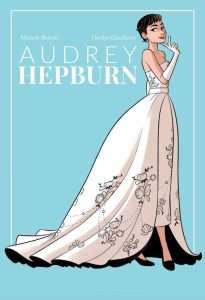
From movie star to wartime nurse to mom to UNICEF ambassador, Audrey Hepburn lived a storied life, and author Michele Botton and illustrator Dorilys Giacchetto clearly take great joy in exploring the different eras of this icon in the appropriately named comic, Audrey Hepburn. Starting with the actress’ later years, the creators jump back to when Hepburn was 20 (after she had given up aspirations of becoming a professional ballerina) and move mostly chronologically through her life, hitting on the major film roles and relationships that would shape her career, occasionally stepping back to examine her childhood during World War II.
The back cover features a quote from Hepburn’s son, Luca, that seems to inform every aspect of the comic: “Everyone has their own Audrey.” Indeed, the book’s greatest strength seems to be how the creators depict the multifaceted identity of such a major figure of popular culture. The character is in a constant rotation of hairstyles and attire, suggesting her desire to continually push and reinvent herself. This is reinforced by the chapter title pages, which depict full body images of Hepburn in different poses and outfits, as if she is changing costumes or personas as the story progresses. Botton and Giacchetto see Hepburn as a woman of many dimensions, and take every opportunity to express this visually.
Giacchetto revels in big gestures and facial expressions, bringing a strong sense of cartooning to Audrey Hepburn that is both playful and exceedingly legible. A biography about an actress doesn’t offer over-the-top action, but the artist nonetheless finds subtle ways to infuse movement into the storytelling by relying on dynamic poses that give an energy to scenes that would otherwise feel rather static. Giacchetto’s characters have large eyes, emotive hands and faces, and evoke that classic cartooning style that will be immediately recognizable to even the most casual of Disney fans.
The book is a breezy read, which is usually good, but it also seems to gloss over some of the more intriguing and perhaps less discussed years of Hepburn’s life, notably her time volunteering as a nurse in a field hospital during World War II, as well as her later career as an ambassador for UNICEF. I suspect dwelling too much on these moments, however, would have weighed down an otherwise intentionally upbeat book, so I can’t say their omission is a surprise.
Audrey Hepburn falls into some of the expected pitfalls of biographies, in that sometimes it feels more like a list of historical occurrences rather than a carefully crafted story, but if you enjoy mostly straightforward, step-by-step accounts (or biographies, of course), this comic will feel extremely familiar. If you’re looking for a deeply critical analysis of the complex cultural icon that is Audrey Hepburn, you will not find it in this comic, but what Botton and Giacchetto have done is create a book that has fun in highlighting the successes of an exceptional woman who probably doesn’t get the credit she deserves as an artist and performer.
Audrey Hepburn Vol. By Michele Botton Art by Dorilys Giacchetto NBM Publishing, 2024 ISBN: 9781681123462
NFNT Age Recommendation: Adult (18+), Older Teen (16-18), Teen (13-16) Creator Representation: Italian, Character Representation: British,
At a slim 160 pages, Brittle Joints presents the story of disabled queer artist, Maria Sweeney, as she navigates her day-to-day world. Sweeney has Bruck Syndrome, a rare autosomal disease due to multiple congenital joint contractures. It presents itself with bone fragility and recurrent fractures which is also known as brittle joints.
Sweeney’s elegant drawings and poignant story telling gives life to her struggles as a disabled person maneuvering an able-bodied world with her cane or wheelchair. She points the reality where doors are not wide enough for her chair, or no ramps available to get into the building, or steps too wide apart for safe footing. As an able-bodied person, these are not things I think about when I’m out and about. It does not cross my mind if the door is wide enough for me to get through of if no ramp is available for me to get from point a to point b. For Sweeney, these are things she battles with anytime she leaves her home.
(Sweeney points out how the world can benefit from universal design which is the composition of an environment that can be accessed by anyone regardless of their age, ability, or size. Universal design applies to both physical and virtual environments. An example of universal design is dropped curbs that allow wheelchairs and other mobility devices easier access from the road to the sidewalk.)
Sweeney’s vignettes are dated but are not in consecutive order so her adoption to American parents (Sweeney was born in Moldova) comes after a recent trip to a specialist. I think most of us are used to a linear story line and that something that doesn’t follow a logical sequence can be confusing but not in Brittle Joints. I didn’t find myself perplexed with the time jumps, I thought it added to the cohesiveness of her story. Some days she feels good, and the world is a beautiful place while others she’s in constant pain and even getting out of bed is a struggle. Sweeney bookends these events so that her story feels fully formed rather than disconcerting.
As someone who has arthritic flare-ups in my right ankle, I felt empathy with Sweeney when she documents that she’s been on various pain killers for so long, they no longer help. Discovering pot in college, there is relief from her pain that prescription drugs can no longer touch. She’s dependent on obtaining pot from friends and friends of friends until New Jersey finally allows those with musculoskeletal pain to obtain medical marijuana cards. But even with the long list of documentation, Sweeney fights for the right to get the pain relief she needs and the hoops she needs to jump such as driving several hours away to the closest dispensary.
But even with Sweeney’s trials and tribulations of day to day living, she peppers her story with the beauty of the world from petting her dog Bambi to the sun on her face on a beautiful day or the vulnerability she shares with her partner, Eros. Sweeney makes clear that life is more than just pain and suffering; that the in-moment events can provide a balm to a painful experience.
Sweeney is originally self-taught but honed her craft in illustration at the Moore College of Art & Design in Philadelphia where she graduated with her BFA. Her illustrations are muted and she uses a darker palette when she draws about her pain and brighter colors when she is expressing joy. In a recent interview, Sweeney was asked about the use of nature as primary motif in her work, and she responded that the nature gives her everything she needs and that water is healing for her. “I am the most free in nature when my body is supported by gentle waters.” (27) (This is something I recognize that I feel the most whole when I’m also in water swimming or just floating around.)
If you’ve been following my reviews, I’ve been concentrating on books from marginalized writers and artists. Brittle Joints is a wonderful example of a life that is different (living with a debilitating disease) and yet also relatable (exploring the joy of living even amidst chronic pain). Brittle Joints gives a worldview that is at the same time educational and passionate. Highly recommend.
Brittle Joints By Maria Sweeney Street Noise Books, 2024 ISBN: 9781951491260
NFNT Age Recommendation: Adult (18+)
Creator Representation: Moldovan-American, Chronic Illness, Character Representation: Moldovan-American, Chronic Illness,
Against the backdrop of a small (and small-minded) town in Kansas that has laid claim to The Wizard of Oz, Anderson and Sack’s My Fairy Godfather uses the coming-of-age/fish-out-water framework to explore how prejudice impacts both teenagers and adults.
When high school junior Billie loses both of her parents in a car crash, she is sent (against the wishes of her conservative aunt and uncle) to live with her gay godfather, Adam, and his sassy partner, Steven. As Billie adjusts to her new life, Adam has to learn how to take care of a teenager while trying to keep his struggling independent movie theater afloat in a town that has not historically been kind to him. Along the way, Billie befriends a lesbian Dorothy Gale impersonator named Clara, and a potential love interest, Dylan, whose desire to be an ally is at odds with his friends and family.
Over the course of the comic, Anderson and Sack tell a pleasantly grounded story about the intricacies of LGBTQIA+ life showing that the challenges of growing up and parenting are not limited to so-called “traditional” families. The creators don’t shy away from big, direct statements about equality and allyship (the final scene, for example) but they’re at their best during the small, personal moments in My Fairy Godfather, when the reader is really brought into the characters’ struggles and is shown the toll that hate takes on human beings. The character of Adam, in particular, is usually portrayed as much more reserved than those around him, but he often exhibits subtle changes in facial expressions that hint at internal conflict and changing perspectives. The scenes in which he is figuring out how to enforce rules with Billie or discussing his insecurities with Steven really demonstrate this, and are among the most engaging and impactful of the entire comic.
Artist Jon Sack utilizes clear, definite linework set against flat colors, not dissimilar to the works of Daniel Clowes or Charles Burns. It’s a style that compliments the matter-of-fact approach to the everyday stressors of the characters, and leads to an accessible reading experience. The style visually aligns the book much more closely to the tradition of “real world” independent comics like Clowes’ Ghost World or Adrian Tomine’s Summer Blonde. The artist’s emphasis on clarity of storytelling over detail also helps with the book’s quick pacing, which is appreciated considering the often heavy and upsetting subject matter.
My Fairy Godfather is an excellent comic if you’re looking for books that humanize LGBTQIA+ characters and put their worries, insecurities, and mistakes on full display. On the surface, it looks like the familiar “teenager thrown into an uncomfortable new environment” type of narrative, and on some level it is, but the creators put in the legwork to make Adam’s story as important, if not more so, than Billie’s. By taking us through the ways Billie and Adam’s personal challenges intersect, Anderson and Sack remind us that families are not one-size-fits-all and that a desire to connect with others cuts across differences in sexual orientation, age, and gender. It’s clear that they’re deeply concerned with the idea of chosen family, and when characters connect with each other, it’s genuinely touching. As far as I can tell, the intended audience for My Fairy Godfather is adults, however, the exploration of family dynamics and teen relationships would make this book just as palatable for YA readers– especially if they’ve already read Flamer but aren’t quite ready to tackle Fun Home.
My Fairy Godfather By Robert Mailer Anderson Art by Jon Sack Fantagraphics, 2024 ISBN: 9781683969808
NFNT Age Recommendation: Adult (18+), Older Teen (16-18)
This graphic novel is a biographical account based on George Sand’s life, detailing the years of her early youth, her budding romantic relationships and her last years spent in Nohant, France, during the early nineteenth century.
George Sand was born Amantine Lucile Aurore Dupin and her parents were Maurice Dupin de Francueil and Sophie-Victoire Delaborde. During her childhood, George loved her parents dearly and was a bit of a wild child. The graphic novel mentions her close maternal relationship with her mother and especially grandmother, Marie Aurore whom owns a considerable fortune and the estate at Nohant.
The graphic novel features illustrations of characters that are hand drawn, in pen and ink. Although the publisher aims this novel for a teen audience, there are several prominent historical and literary figures and political themes mentioned in the novel, which would be better suited for a college aged readership.
The graphic novel goes into extensive detail of George Sand’s life as she develops into a prominent, outspoken writer, adopting a masculine identity when she goes out on the town and prefers to wear men’s clothing. There are candid scenes of George Sands romantic life, mentioning her various relationships with creative and artistic men including Jules Sandeau, Charles Didier, Frederic Chopin and others. This graphic novel is a fairly dense read and is best suited for readers whom are interested in French literature written during 19th century and can understand the rammifications of the French Revolution and Napoleon Bonaparte years altering the economic and socio-political landscape in France.
George Sand: True Genius, True Woman By Severine Vidal Art by Kim Consigny SelfMadeHero, 2024 ISBN: 9781914224201
NFNT Age Recommendation: Older Teen (16-18) Creator Representation: French, Character Representation: French, Bisexual,

 This graphic novel adaptation of Ethel Carnie Holdsworth’s romance novel is about sisters, Hester and Rachel, who grew up in poverty and learned how to fight for justice. The original novel was released in 1925 and was based on Ethel’s own experiences in a mill, but was not well received at the time of release. Now Scarlett and Sophie Rickard have adapted the novel into a new format during a time when the world could use reminding that human rights and dignity are inherent, not earned.
  Shenk. Is it real? Then something horrible happens to her parents—luckily, some witches in hiding find her and help her understand the real purpose of Grandma’s book. But then, a spooky fairie librarian steals her book! Why? This opens the door to Little Moon learning about magic of all kinds—dark, light, helpful and tricky. Magic that is no longer allowed. She must get her Grandma’s book back! Thus starts Little Moon’s adventures, which take the form of spooky fairie stories. Think “fae” as in the old Gaelic tales, not the sanitized Disney version. It’s kind of Alice in Wonderland, with a gothic edge. Librarians and professors are portrayed as dark eyeless authoritarians and “keepers of the accredited institutions.” The first story explains how the Shenk came to be. Think of an origin story, somewhat like Thor and Loki, but as sisters.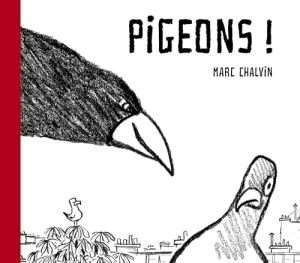
 Birkenau approaches the subject with a surprising amount of levity and accessibility. The comic splits its time between the present (well, the present of 2020), in which the 95-year-old Kolinka re-visits the Auschwitz-Birkenau prison camp with a group of students, and the events of the past. Kolinka recounts her early life in France, her large family’s attempt to escape Nazi persecution, and most notably the experience of trying to survive in camp as she was being abused, humiliated, and dehumanized.
 Katerina Cupová’s adaptation of Karel Capek’s unappreciated play offers an intriguing view of automatons (and our place among them) from the perspective of an early 20th century Czech playwright.
 into the harmful ways racism intersects with capitalism, while still delivering an intense crime drama. Harlem follows Stéphanie St. Clair (also known as Queenie), a Caribbean, French-speaking crime boss who runs a highly profitable and highly illegal street lottery that provides a source of hope for desperate Harlemites as much as it drains their pockets. Complicating her situation is rival gangster Dutch Schultz and a corrupt police force that is in league with the white mafia. Queenie does everything to support her struggling community while staying one step ahead of the law, but as you might expect, that’s far easier said than done.
 Michele Botton and illustrator Dorilys Giacchetto clearly take great joy in exploring the different eras of this icon in the appropriately named comic, Audrey Hepburn. Starting with the actress’ later years, the creators jump back to when Hepburn was 20 (after she had given up aspirations of becoming a professional ballerina) and move mostly chronologically through her life, hitting on the major film roles and relationships that would shape her career, occasionally stepping back to examine her childhood during World War II.
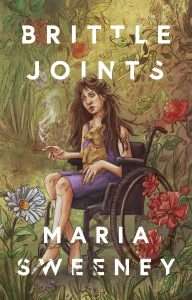 day-to-day world. Sweeney has Bruck Syndrome, a rare autosomal disease due to multiple congenital joint contractures. It presents itself with bone fragility and recurrent fractures which is also known as brittle joints.
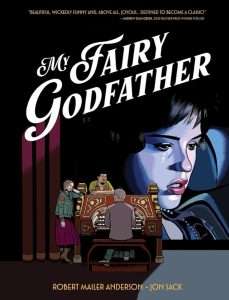 Against the backdrop of a small (and small-minded) town in Kansas that has laid claim to The Wizard of Oz, Anderson and Sack’s My Fairy Godfather uses the coming-of-age/fish-out-water framework to explore how prejudice impacts both teenagers and adults.
 budding romantic relationships and her last years spent in Nohant, France, during the early nineteenth century.
