Before Superman and superheroes came to dominate American comics, there was an age undreamed of. Pulp fiction was gaining in popularity, and it occurred to advertising agent Joseph H. Neebe that there might be a market for comic strips based on action and adventure rather than comedy. He approached Edgar Rice Burroughs (who had just set up shop in what would become Tarzana, California) about licensing his Tarzan character as a comic strip. Burroughs, who was already aiming to make movies based on the Lord of the Jungle agreed, but this still left the question of who would draw the comic.
Enter Harold “Hal” Foster—a Canadian illustrator who had little interest in drawing comics. However, with times being tough (and about to become tougher when The Great Depression hit), Smith got the comic off the ground by drawing the daily strip in 1929. He would later return, reluctantly, to draw a full-color Sunday strip in 1931. And yet, over the next few years, Smith began to believe he could take the comics he crafted and turn them into the high art he’d wanted to create.
However, Foster grew increasingly dissatisfied with the quality of the scripts he was given. He was also unhappy with the increasingly inadequate flat fee he was paid when the writers were given a percentage of the profits. He eventually left Tarzan for a more lucrative deal with King Features, where he was given more money, creative control, and the ability to write and draw his own adventure comic, the equally revolutionary Prince Valiant.
This history is detailed in the introduction to Hal Foster’s Tarzan. The Complete Sunday Comics 1931-1937. However, it understates just how important these comics were to the medium. Legends like Frank Frazetta, Wally Wood, Bernie Wrightson and Jack Kirby all cited Hal Foster as a major influence on their own comics. And without the success of the first Tarzan newspaper comics fueled by Foster’s work, it is possible that the action/adventure comics and the later comic books might never have come about. For that reason alone, this volume is well worth studying on a scholarly level.
Another reason is Foster’s command of anatomy, which was impressive and unlike anything appearing in the funny pages at the time. Foster took his research seriously and lamented that some of the writers he worked with failed to consider things like what kind of trees were likely to line an African river. Alas, his dedication was not appreciated by his employers and one of the chief reasons Burroughs considered Foster the best artist to handle Tarzan was that he was very good at drawing attractive women. (This skill, it might be noted, was honed by Foster’s work as a commercial artist, drawing women in lingerie in catalogs in the days before photography became inexpensive.)
On that note, there is no publisher rating for this collection. The amount of sex and violence within it was shocking for its time, but there’s nothing that would be inappropriate for a teenage audience today. There are a few bare male backsides and one naked boy who comes to Tarzan’s aid in one story, but nothing more overtly sexual than various queens of lost cities informing Tarzan that he is now theirs.
It should also be noted there is some material in these comics that has not aged well. There are multiple instances of the white goddess trope, with superstitious African natives taking in a white woman as their leader. Thankfully, Smith does not present these characters as the offensive caricatures that were commonplace in other comics of the time, but the four-color recreations for this book do feature some Asian characters with dimly yellowed skin.
One final warning. At $200 this volume may be a bit expensive for a library collection. Serious collectors of Tarzan lore and comics history should consider this a must-have. However, unless one’s library has a special collection devoted to Platinum Age comics or something similar, this one may be a bit of a budget breaker.
Hal Foster’s Tarzan: The Complete Sunday Comics 1931-1937 By Dian Hanson Art by Hal Foster TASCHEN, 2026 ISBN: 9783754402641
Related media: Book to Comic
NFNT Age Recommendation: Adult (18+) Creator Representation: Canadian,
In a world very like our own, despite fox-headed doctors and three eyed people being utterly ordinary, people know what happens after death. Crow gods meet the souls approaching purgatory, advising them how to cross harsh plains to reach the Gate of Rebirth. As a parting gift, they create a delicious dough that will last the 49 days the journey takes. Once the living learned of this practice they began to make funeral desserts for their loved ones. This manhwa follows two clients seeking special cakes for the recently dead from Margot’s bakery. Her interviews pull out essential characteristics of the deceased, then she and her assistant Miro—who appears as skeletal arms emerging from a sheet with eyeholes as she kneads dough—procure specialty ingredients, infuse words and emotions into the cake, and create a perfect, lovely dessert that lets their clients find a bit of peace as they continue on their own difficult grief journeys.
The first client is an author who helped a chronically ill blind woman love life again by reading her work in progress to her, whereas the second is a young woman who is unsure how well she knew her mother because the schedules of a truck driving vampire and high school student were nearly opposite.
This is an excellent title to entice fans of Japanese and Korean healing fiction novels such as Marigold Mind Laundry by Jungeun Yeun or The Curious Kitten at the Chibineko Kitchen by Yuta Takahashi. Even if they aren’t graphic novel fans already, they’ll be familiar with episodic tales tucked within frame stories beautifully exploring the bittersweetness of love and loss, the exploration of perspective power to temper regret, and the importance of finding people who understand.
It’s illustrated gorgeously, primarily in black and white but often incorporating shades of red to stunning effect, whether it’s a lovely pink sunset highlighting melancholy or a deep red fruit filling dripping from a cupcake. Many panels are intricately detailed, whether in the sense of emotion drenched portraits or full of tiny elements that expand the world building subtly. The dialogue is occasionally a little clunky or repetitive, presumably to match the original speech bubbles, but the prose on expository pages is uniformly lovely, creating a craving to know even more of this world. The perfectly plotted story is tender and sweet, despite the sadness that coats both women’s journey and readers will be eager to arrive at the reveals about why Margot engages in this work.
I’d certainly recommend this for any library collection, but especially for libraries engaging in book clubs or programming such as death cafes of grief support groups. As previously mentioned, this should be a good crossover title between prose and graphic literature. The story is likely best suited for adults, though loss is certainly something people can experience at any age. While people don’t need the grief experience to appreciate these stories, I believe that the experience adds an extra layer to the narrative. It’s an exploration of why and how everything matters, without pushing definitive answers or advice on readers.
With volume two releasing June 23rd, now is the perfect time to start the series.
Purgatory Funeral Cakes By Sanho Dark Horse, 2025 ISBN: 9781506751351
NFNT Age Recommendation: Adult (18+) Creator Representation: South Korean,
Lindsey Cheng is like most college freshmen, trying to find herself even as everyone is trying to tell her who she should be. This includes everyone from her overbearing and very traditional Chinese mother to her best friends and bandmates. It seems like everyone has an opinion on who Lindsey should be and where her attention should be focused, be it the band or her studies.
The sole exception to this is Jason—the super-chill lead-singer of a different band, who stuns Lindsey by calling her his girlfriend as he tries to give her a gift while shopping for old records. This stuns Lindsey, who barely started dating Jason and never had a boyfriend before. This makes her anxious to be everything a good girlfriend should be. More, she wants to be cool enough to be the girlfriend of a cool guy like Jason. But is Jason really the best thing to ever happen to her? Or is she just stunned at the idea of any boy being interested in her after a sheltered childhood?
The early press for Lindsey Cheng Dates a White Boy described it as “perfect for fans of Bryan Lee O’Malley and Mariko Tamaki.” I can see why it might draw comparison to the Scott Pilgrim series. It is based around young adults and indie band culture in the early 21st century and Asia Miller’s art shares a certain aesthetic. The general plot even emulates the lessons of that comic, albeit through the female lens. However, it dramatically oversimplifies the story to write Lindsey Cheng off as an older Knives Chau, who has the good sense to realize that Jason is scum before it is too late.
What really sets this comic apart—and indeed inspires the need for a sequel—is the final chapter. This is told from the perspective of Lindsey’s friend and bandmate Mel; a fierce romantic who loves love. It is she who first gets an inkling of who Jason really is but puts on a false face because she wants to support her friend. At the same time, Mel copes with her growing attraction to their third bandmate, V, and the hint that V (who loves video games and hates boys) might return her feelings.
The opening of the book focused on Lindsey does deliver an important message upon the dangers of repressing yourself for the sake of a relationship. And yet, the chapter with Mel is the strongest and feels the most genuine. Personally, I’d love to read a comic about the awkward romance between tomboy V and girly girl Mel as a follow-up to Lindsey’s hard lessons regarding her first love.
There’s no official publisher rating for Lindsey Cheng Dates a White Boy!!! I would personally consider it appropriate for most teen audiences and indeed perfectly suited for that audience given the ultimate moral of the story. There is no sex or even so much of a mention of it. The closest we get is Lindsey taking off her T-shirt to reveal her bra while hanging out with Jason while lounging on his bed. There’s no violence or nudity and no language worse than what might be heard on broadcast cable.
Lindsey Cheng Dates a White Boy!!! By Asia Miller Andrews McMeel, 2026 ISBN: 9798881605827
NFNT Age Recommendation: Adult (18+), Older Teen (16-18), Teen (13-16) Creator Representation: Chinese-American, Queer, Character Representation: Chinese-American, Bisexual,
Tripping Over You, Volume 2, from Suzana Harcum and Owena White, picks up not long after the first graphic left off, showing unlikely couple Liam and Milo navigating their maturing relationship. This slice of life romantic comic was adapted from real life couple Harcum and White’s webtoon in February and promises more volumes to come. Fresh out of high school, the pair are growing into young adults and trying to allow their relationship to grow with them. Liam and Milo are in a very interesting phase, kind of semi-out to their families (who bring their own baggage into their relationship) and striving to make room for each other as their lives grow fuller. Liam doesn’t know what he wants out of his future and Milo seems plagued with self doubt, but they keep circling back to find comfort in each other. This volume catches our couple at a very real, very vulnerable time where a high school relationship can evolve into an adult one or where it can flounder under the weight of growing up.
This is a sweet story that young readers can easily connect with. The art is incredibly cute with Harcum and White using a style that hits me as a kind of Disneyified Manga: characters with big eyes and bold lines in a world of saturated color. It is very easy to read and honestly just pretty. Liam and Milo give classic black cat/golden retriever energy and seem hyper aware of the struggles that can come with relationships where people have different needs and communication styles. While this comic does show a growing young adult relationship and the intimacy that comes with it, there’s nothing explicit on page or even suggested and I would probably recommend it as young as 6th or 7th grade, depending on the reader. There are a couple of shirtless scenes and implied sex and Liam still hasn’t kicked his smoking habit from book one. But with that, their relationship maintains an innocence that will keep it accessible to a wide range of readers.
The plot beats were a bit of a hang up to me. The small domestic moments of our couple meeting new people, fighting to find time together, struggling with demanding families, and eventually moving in together feel almost like filler, like all of these moments are leading towards conflict in a future volume. The most striking of these involve Milo’s new friend Hebert, an American theater student. There isn’t immediate conflict but there is definitely unresolved tension and Hebert’s motives are questionable at best. Many of the plot points feel unresolved. Liam still does not have a clear career path and Milo still seems uncertain in aspects of their relationship. All of these things made this feel less like a step in their story and more like laying groundwork for the next book.
But honestly, I don’t know if I care. It was still a lovely read. The characters are ones you want to spend time with and their relationship is easy to invest in. It’s sweet and loving and a ready made next read for my Heartstopper fans. Parts of it do come off as wish fulfillment, particularly the moment where Liam comes out to his father. But queer kids deserve as much wish fulfillment as they can get. I can’t help but worry that these boys will have a tough time ahead of them, but my fingers are crossed for a happy ending.
Tripping Over You, Volume 2 By Suzana Harcum Macmillan First Second, 2026 ISBN: 9781250330734
Company Age Rating: 14-18
NFNT Age Recommendation: Middle Grade (7-11), Older Teen (16-18), Teen (13-16) Creator Representation: Lesbian, , Character Representation: Queer, Jewish ,
It is All Hallows’ Eve. It is a night of foreboding, even without a storm brewing. Some believe it is a night when the boundaries between life and death are thinner, and evil things walk abroad.
The date means little to highwayman Dick Turpin, and his partner in crime, Tom King. They already live a life where the boundaries between life and death are thin. And they think there’s no evil things about but them.
They may be wrong.
When an accident overturns the carriage that was their quarry, Tom is quick to enact a new scheme. He poses as a nobleman, with Dick as his manservant “Richard,” hoping to secure the nobles’ luggage and ride off with it untroubled.
However, the scheme goes overlong, as the two parties join to seek shelter and soon find a seemingly abandoned monastery. Alas, whether it is due to the night in question or whether their presence awoke it, some ghostly presence takes exception to the intruders. Soon the scoundrels are facing closing walls, stinking clouds and swarms of rats. To say nothing of the deadly touch of the specter clad in plague doctor’s garb…
Dick Turpin and the Vengeful Shade is an interesting blend of historic fiction and horror. Of course, there is no record of the infamous British thief ever fighting a ghost. Yet writer Steve Tanner pays as much attention to historical accuracy as he does craft in spinning a ripping yarn.
The story draws upon two main conflicts. The first is that between the Church of England and the Catholic Church. The second is Plague of 1563. History buffs will appreciate this attention to detail and how it plays into the ghost story to make it a little more grounded. Not that this matters much to Dick Turpin himself, who spends most of the story wishing he could shoot something. He’s also none too choosy about it being the ghost, Tom King (who takes a bit too much pleasure in playing the noble and bossing him around) or the various nobles and servants annoying him. This adds humor, which offsets the horror, along with a noble lady who speaks of the stories of Dick Turpin ravaging the women he encounters and then being a bit slow in agreeing with her husband in finding the prospect dreadful.
The artwork is of similar craft and quality. Roland Bird, best known for his work on Legion of Super-Heroes, is in fine form here. He proves equally adept at drawing animals, period costumes and supernatural strangeness. He is well-backed by the color art of Brett Burbridge, which adds an evocative and somber aura to the finished artwork.
As with their recent reprint of Dick Turpin and the Crimson Plague, Time Bomb Comics does not offer a rating for Dick Turpin and the Vengeful Shade. However, despite a lack of nudity or any sexual content beyond references to ravaging, I’d still suggest this one be kept in the adult collection. While the horror elements and bloodshed might be acceptable for most teenagers, I feel the historical elements and slow-boiling story will appeal more to adult audiences.
Dick Turpin and the Vengeful Shade By Steve Tanner Art by Roland Bird Time Bomb, 2020 ISBN: 9781916465343
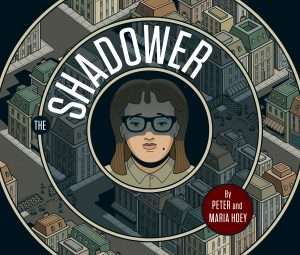
There is a city, divided by civil war. The name of the city is unimportant, as is the name of the country. It could be any city or nation, at any time. It may be the past. It may be the future. It could be right now.
Regardless, in this city, there is a quiet drama student named Nadia. Her mother was a great stage actress. Her father was a playwright and director, whose book on how to capture the essence of a character and become someone else is still used by theatre teachers all over the world. They were both active in politics, until an attack by the Opposition killed her father and horribly burned her mother.
Nadia has not thought much about this, beyond navigating the checkpoints and random violence in her hometown. Instead, she has focused on her studies and her crush on a fellow actor. However, after her performance in Ibsen’s A Doll’s House, she is approached by man with The Party. A man who knew her father, who has an opportunity for her to serve the cause with her unique talents.
It seems that Nadia looks a lot like a waitress named Miriam, who lives in the part of the city controlled by the Opposition. Miriam is something of a recluse, with no friends or family. She is only of interest to the Party because an Opposition leader named O’Brien spends several hours a day at her café. The Party will take care of making Mariam disappear and, for seven days, Nadia will take her place. She will place a bug that will record O’Brien’s conversations. She will then hide it in a trash can on the way to work the next morning.
Nadia is assured it will be an easy mission. She is assured that there is no real risk to her. She agrees it will be the ultimate test of her talents. However, things suddenly change, requiring an alteration to the plan. And suddenly the only thing Nadia is certain of is that this mission will be far from easy…
The Shadower is unlike any espionage thriller I’ve ever read. Indeed, I’m not sure it can properly be called an espionage thriller, despite that being the main thrust of the story. The actual plot, however, is a Kafkaesque psychodrama built around issues of identity. The ambiguity of the setting reflects this, as it is uncertain precisely when or where the story takes place. It is reminiscent of 1984 in that respect. (Indeed, the villain using the alias O’Brien is an in-universe shout out to the story, as he ironically chose his alias in reference to Orwell.)
The artwork by Marie and Peter Hoey flows along with the script. The overall style reminds me of various Daniel Clowes works. The general vibe is more surreal, with a bit of body horror as Nadia gets more and more in tune with her role. The colors are muted, adding to the dull and drab feeling of the mundane world. Even the moments of excitement are rendered with a certain sense of ennui that suits the story.
Top Shelf Productions voluntarily rated The Shadower as a book for Mature Readers. I think that’s a fair assessment, though there is little in the way of offensive content. There is no sex, as such, and only a brief bit of bared buttock as Nadia gets dressed in the morning. There is a threat of violence, but little of it takes place on the page. The consequences are shown, but the actual scenes of violence are left up to the imagination. However, there is one tense scene involving a traitor who is executed by the Opposition in the street and their body is left to rot on the sidewalk. I think the Mature Readers rating is appropriate, however, given that younger audiences may not be able to appreciate the historical significance of the story or the existential horror that is the core of the book.
The Shadower By Maria Hoey, Peter Hoey Top Shelf, 2026 ISBN: 9781603095853
There are many tall tales about the highwayman Dick Turpin. The actual history, as is usually the case, is somewhat more muddled. Such is the way of legends.
Unlike the more internationally famous Robin Hood, we know for certain there was a Dick Turpin. He was born in 1706 and died by hanging in 1739. What he did in between and whom he associated with is somewhat more debatable. It is agreed, however, that he spent the last few years of his life as a horse thief and highwayman, after several years as a house-robber, poacher, and smuggler.
Dick Turpin and the Crimson Plague is more concerned with romantic fiction than solid fact. Nevertheless, this updated and expanded edition of the original 2011 graphic novel concludes with a decent overview of the real history. This is noteworthy, given how the stories contained within this volume are as unlikely as the account of Turpin riding 200 miles in a single night.
The main story, The Crimson Plague, finds Dick Turpin and his fellow thief, Tom King, enjoying their ill-gotten gains in London. After watching another unfortunate’s execution, the two decide to have some fun at the local brothel. However, it becomes apparent that there is a dark secret within the bawdy house’s basement. Soon, the two thieves become monster-slayers, fighting to save London from a vampire invasion!
The new edition of Dick Turpin and the Crimson Plague colorizes what was originally a black-and-white comic. The color art by Gavin Ross is decent enough. However, there are many pages I think might have hit harder in monochrome. Indeed, there are some pages where the colors seem to obscure the original inks of Graeme Howard’s artwork.
This new edition also contains an original short comic. Subtitled “The Crawling Terror,” this tale finds Dick Turpin and Ton King making camp in a cave. Unfortunately, the depths of the cave contain monsters that seem more appropriate to a Conan comic than a Dick Turpin story. Still, the artwork for this chapter by Roland Bird and Brett Burbridge is stronger than the main event.
All in all, I found Dick Turpin and the Crimson Plague to be an amusing read. I enjoy a good story of supernatural horror and stories about reluctant heroes. This is both. I also enjoyed the history provided at the end, which adds some context to what came before.
Time Bomb Comics does not offer a rating for Dick Turpin and the Crimson Plague. I would suggest that any librarian interested in this place it in the adult collection. First, because there is considerable bloodshed and Steven Tanner’s scripts do not skimp on adult language and sexual content. The only nudity in the book is a corset that slips to reveal one sex worker’s nipples at one point.
Another note for librarians: the only place I believe this new edition hardcover is available is the Time Bomb Comics website. The edition currently listed on Amazon and GoodReads under the provided ISBN is for the 2011 original.
Dick Turpin and the Crimson Plague By Steve Tanner Art by Roland Bird Time Bomb Comics, 2025 ISBN: 9780956182241
Anima. Lisa Storm. Vera Vicious. Morgaine La Fey. Gaia.
Five different women, both friends and rivals. Five women among the hottest and wildest girls to be found cruising the Sunset Strip. They make the scene. They go backstage. They enjoy the drugs and the bands just passing through. Every night is a new party. Every party is a new adventure.
That changed with the arrival of The Moon Show—a band on the verge of becoming the next big thing. The girls are there when a major label signs them. They go on the road with the band as they go on-tour. And for a while they are living the dream in style.
However, the girls start noticing something is wrong. Other women the band picks up go missing. And some of the girls start seeing strange things while they’re high. Visions of some darkness behind The Moon Show. Something that calls for blood!
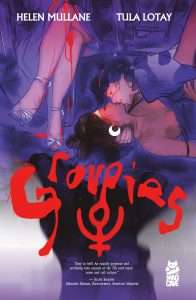
Groupies is a hard comic to quantify. It is horror, but it is a slow-boiling horror story where the terrors are more existential than gory and largely left to the imagination. There is a mystery, but the big secret of the story is telegraphed early and somewhat predictable given stories about musicians selling their souls are common enough. (The label that signs The Moon Show is called Asmodeus Records, for crying out loud!)
Thankfully, that’s not really what Groupies is about. The mystery and horror are just background dressing to the true focus of the comic. Namely, the stories of five different women trying to find meaning in their lives amid the sex, drugs, and rock and roll culture. And their vastly different reactions to everything around them.
Lisa Storm, for instance, enjoys the scene, but still dreams of finding true love with The Moon Show’s front-man, Si, despite knowing deep down he’s a dog. Gaia and Morgaine work together to bring rock stars into bed, yet both would rather spend time with alone with one another. The irony is they are both fearful of saying anything for fear of ending what they have. And then there’s Vera Vicious, who for all her blunt talk and complaints about other women trying to steal her man of choice, is the first to realize there’s something strange about the people from “the label” and something sinister going on. All in all, Helen Mullane does a fantastic job of developing these characters and putting the reader inside their heads.
Similarly, Tula Lotay turns every chapter into a different sort of visual journey. It does the artwork a disservice to describe it as merely psychedelic. Oh, there are shifts in the artwork as the characters get high, but there are different alterations to the style and colors depending on the drug. The dark visions Gaia has after taking datura, for instance, are different than the shared hallucination the women enjoy as they drop acid before going for a walk in the woods and start imagining themselves as dryads.
Groupies is rightly recommended for Mature readers. There is cursing. There is nudity. There is everything one would expect in a story devoted to exploring the dark side of sex, drugs, and rock-and-roll. And that’s before you bring in all the murder, assault and demons. In short, this is one to put in the adult collection of the public library and one to keep away from the kids and teens.
Groupies By Helen Mullane Art by Tula Lotay Mad Cave Studios, 2026 ISBN: 9781545821268
Company Age Rating: 18+
NFNT Age Recommendation: Adult (18+) Creator Representation: British, Character Representation: Bisexual,
Hayao Miyazaki needs no introduction to most anime fans. Even if his name is not known to most American fans of the artform, the odds are good that they’ve seen one of his movies. Nausicaä of the Valley of the Wind, My Neighbor Totoro, and Spirited Away are only some of the classic movies he’s directed. Indeed, the greatest challenge in assessing Miyazaki’s career is not debating his influence on the genre and other directors. It is deciding which of his great works might be considered his best.
The Worlds of Hayao Miyazaki does not try to answer this question or even offer fodder for that discussion. What author Nicolas Rapold does instead is look at Miyazaki’s influences, both in his life and his reading. Through this, and a series of essays, Rapold tries to find the source of the creativity of the man called the “godfather of animation in Japan.”
This might be seen by some as spoiling the magic. However, Rapold’s intent is not to prove the truth of C. E. M. Joad’s saying that “the height of originality is skill in concealing origins.” Instead, he uses this examination to show how Miyazaki’s genius lay in how he twisted the stories he loved as a child in new directions.
The first quartet of essays set the tone for what follows, as Rapold explores four of Miyazaki’s greatest influences. These are given as Lewis Carroll, Frances Hodgson Burnett, Homer, and Jules Verne. However, in discussing these, the essays spin out to cite other influences and common themes with books Miyazaki named as his favorites and why they relate to his work.
It is no intuitive leap to tie most of Miyazaki’s films to Carroll. Many of his protagonists stumble into strange worlds, much like how Alice Found Wonderland. Burnett’s The Secret Garden is an obvious influence on Howl’s Moving Castle and the secret garden hidden within it. Yet Miyazaki also comes back to that book’s theme of regrowth and the power of one person to heal the world and others.
Homer’s Odyssey informs the theme of the wandering stranger trying to get home, as does Gulliver’s Travels. And Verne’s advanced science may be reflected in the flying machines of Castle in the Sky. Yet his books also continue the recurring theme of motion and the power of the self-motivated individual.
However, Rapold also examines Hayao Miyazaki’s work through nonthematic avenues. There are essays and photos of the real-world locations that inspired his visuals. There are also looks at other creators who may have influenced him or were influenced by him. This includes an essay comparing Miyazaki and Stephen Spielberg.
This is all a bit academic for the children for whom Miyazaki made his works. Indeed, I was stunned by how much text there was contained within a book about a visual artist. This is not to say that there are no pictures from the movies, but they are shockingly small for a volume this size and there are few full-page images. Despite that oddity, I think most art history and anime history library collections would benefit from owning a copy of The Worlds of Hayao Miyazaki.
The Worlds of Hayao Miyazaki By Nicolas Rapold Frances Lincoln, 2025 ISBN: 9781836004813
NFNT Age Recommendation: Adult (18+), Older Teen (16-18)
Steven Hollis left for Los Angeles with only a dream of becoming a screenwriter and a friend who wanted to act. Years later, Steven has a gambling problem, a drinking problem, and an eviction notice for his crummy apartment.
Thankfully, he also still has his friend Diedrich Ryan, who grew into one of the hottest actors in Hollywood. And despite his success and now speaking of himself in the third person, Diedrich has not forgotten the friend from high school who pushed him to apply to Julliard.
When Diedrich gets an invite to the bachelor party of wonderkid producer Benny Blevins, he’s all too happy to bring Steven as his “plus one.” It’s a golden opportunity for Steven to try and sell his screenplays to one of the most powerful players in Hollywood. Unfortunately for Steven, it is also a golden opportunity for crime boss Lucca Burlusconi.
Blevins, in addition to being a noteworthy producer, is also a notorious sexual predator. A gentleman gangster of the old school, Lucca Burlusconi would find this distasteful even if his own daughter were not one of Blevins’ victims. And while even his influence cannot touch Benny Blevins in Los Angeles, there is an unfortunate screenwriter who owes Lucca Burlusconi a lot of money. One who just got invited to a private party at a lavish mansion in Mexico City, where Benny Blevins will be celebrating his upcoming wedding.
Thus does Lucca Burlusconi’s problem of how to avenge his daughter become a problem for Steven Hollis to solve. It is only the start of Steven’s increasingly lengthy list of problems. One that will swiftly grow to accommodate fleeing the scene of a murder, evading a Mexican drug cartel, and somehow getting back to the United States without a passport. Compared to that, selling his screenplays while finding time to kill the man who can make his dream come true will be a cake walk.
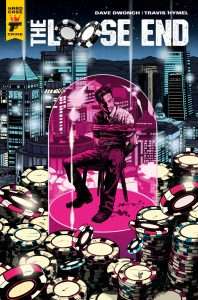
Imagine The Hangover rewritten and directed by Quentin Tarantino, and you might wind up with something like The Loose End. There is an edge to Dave Dwonch’s writing that was clearly inspired by the indie heist movie boom of the 1990s. However, Dwonch parodies this aesthetic just as much as he homages it. This is particularly true in the second half of the story, as a group largely consisting of action movie stars enact increasingly outlandish plans they think will work because they saw it in a movie once. Ironically, their plans work just about as often as they do not, with one actor turning out to be an incredibly skilled sharpshooter despite only training in firearms to learn how to stand properly.
The artwork by Travis Hymel mirrors this tone. The style is reminiscent of many indie action comics of the time, and one could almost see this comic being done in black and white. But then we couldn’t have the colors off Geraldo Filho, which punctuates certain panels by rendering them with a single color. That, coupled with a shift between hot and cold colors, creates the feeling of a late 20th century grindhouse heist movie.
The Loose End is rated 15+ by Titan Comics and I consider that a fair ranking. There is considerable violence, drug use, and references to sex and sexual assault. Yet there is no nudity and no on-panel depiction of sexual assault. Surprisingly, there’s also no on-panel disrespect of women more extreme than Benny Blevins slapping the backside of one of the maids at the mansion he rented. Despite this, I would still recommend this one for an adult graphic novel collection, purely because older audiences are more likely to spot the references and tributes hidden throughout the comic.
The Loose End By Dave Dwonch Art by Travis Hymel Titan, 2025 ISBN: 9781787746442
Company Age Rating: 15+
NFNT Age Recommendation: Adult (18+), Older Teen (16-18)

 ordinary, people know what happens after death. Crow gods meet the souls approaching purgatory, advising them how to cross harsh plains to reach the Gate of Rebirth. As a parting gift, they create a delicious dough that will last the 49 days the journey takes. Once the living learned of this practice they began to make funeral desserts for their loved ones.
 to tell her who she should be. This includes everyone from her overbearing and very traditional Chinese mother to her best friends and bandmates. It seems like everyone has an opinion on who Lindsey should be and where her attention should be focused, be it the band or her studies.
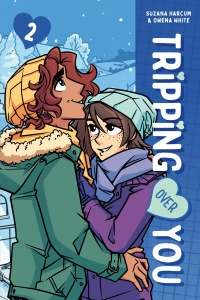 couple Liam and Milo navigating their maturing relationship. This slice of life romantic comic was adapted from real life couple Harcum and White’s webtoon in February and promises more volumes to come. Fresh out of high school, the pair are growing into young adults and trying to allow their relationship to grow with them. Liam and Milo are in a very interesting phase, kind of semi-out to their families (who bring their own baggage into their relationship) and striving to make room for each other as their lives grow fuller. Liam doesn’t know what he wants out of his future and Milo seems plagued with self doubt, but they keep circling back to find comfort in each other. This volume catches our couple at a very real, very vulnerable time where a high school relationship can evolve into an adult one or where it can flounder under the weight of growing up.
 any time. It may be the past. It may be the future. It could be right now.
 Such is the way of legends.
 They make the scene. They go backstage. They enjoy the drugs and the bands just passing through. Every night is a new party. Every party is a new adventure.
 odds are good that they’ve seen one of his movies. Nausicaä of the Valley of the Wind, My Neighbor Totoro, and Spirited Away are only some of the classic movies he’s directed. Indeed, the greatest challenge in assessing Miyazaki’s career is not debating his influence on the genre and other directors. It is deciding which of his great works might be considered his best.
 a gambling problem, a drinking problem, and an eviction notice for his crummy apartment.
