Before there were ideas, symbols, rituals, and worship, witchcraft must have come from somewhere. The question is: from where?
While there are hundreds of books that answer that question, there is also opinion on what witchcraft means. What if there was a simple and graphic way to tell that history without being overwhelming or confusing.
This is where Witchcraft: A Graphic History comes in.
Written by Lindsay Squire, who runs the popular Instagram and Facebook account @thewitchintheforest, she takes this question head on. With art by Italian artist Lisa Salsi, Witchcraft: A Graphic History takes the reader through the basics of the history of witchcraft using a younger alternate Lindsay as she interviews Biddy Early, one of the first, if not the first, witches recorded in Irish history.
Our story begins at the turn of the 19th century where young Lindsay meets Biddy Early in the forest. At first trepidatious on meeting Biddy, Lindsay’s family are very conservative church goers and do not want Lindsay around Biddy, Lindsay learns that a witch is in fact many things including a herbalist, medicine woman, and healer. Using their education of the natural world (primarily plants and flowers), these women referred to as witches were who you went to if you were feeling ill, needed medical attention, or needed a tonic. Because these women (mostly women) were independent, refused to conform, and knowledgeable about the natural world, they were seen as a threat to the local populace. Many of these women were beaten, killed, or banned from their homes.
Biddy Early tells the history of witchcraft to Lindsay as they gather plans in the forest. Witchcraft stretches back into time and there have always been witches. While most were treated badly, many were treated as goddesses in their own right.
As the history lesson continues, we have a secondary plot of the village’s thoughts on Biddy. Biddy has helped many villagers with their aches and pains but the local pastor wants to see her at least banned from the village if not eventually put to death. As Lindsay learns more about the natural world, and witchcraft itself, we watch the drama unfold around them. In the end, Biddy’s home and life are restored and Lindsay has taken on the role of Biddy’s assistant, wanting to be one of these women who help the world around them.
While the basic history of witchcraft is told, with Biddy at the center, the history of Biddy and witchcraft are scant. While the reader learns about different types of witches (green witch, hedge witch, solitary practitioner, and more) and the tools of their trade (cauldron, grimoire, besom (broom)), we do not learn that Biddy married four times or that she would live a very long life. The graphic novel is short (only 130 pages) and more details and history could easily have been added without adding fluff to the story.
I could not find much about Lisa Salsi other than she has an Instagram account, has worked on other books, and writes her Instagram captions in Italian. But! Despite the lack of information on the artist, her work caught my eye immediately. Salsi’s work presents the story in a calm and understated manner. To be sure, I would have thought given the subject the colors would be wild, deep, and colorful but no, the palette is neutral, colors are muted, and the application is watercolor like.
The language is written at roughly an 8th grade level and is very direct and not superfluous. While there is no grade or reading level attached, this graphic novel could easily be assigned and understood by a young adult. What is told in the book is enough to whet the appetite for a deeper understanding of witchcraft, herbalism, botany, Biddy herself, and other witches from Ireland and across Europe.
Witchcraft: A Graphic History Vol. By Lindsay Squire Art by Lisa Salsi Leaping Hare Press, 2024 ISBN: 9780711295254
NFNT Age Recommendation: Adult (18+), Older Teen (16-18)
In Volume 1 of the Cardboard Kingdom (), we’re introduced to neighborhood kids who use play as their gateway to deal with growing up. In their kingdom, the kids can be anything they want to be from sorceress and rogues to gargoyles and princes. The play is inclusive and while it may take some time for some of the kids to find their way, everyone is indeed welcome.
In Volume 2, Roar of the Beast, the school year has started and the kids are getting excited for Halloween! Volume 2 is very much a book on the transitioning from small kid to big kid.
What does Volume 3 bring?
It’s the winter break and The Cardboard Kingdom neighborhood is gearing up for snow fights, sculptures, hot chocolate, and forts. One day, they meet three kids from Parkside, the neighborhood across the park, who the kids think come as rivals when what they really want to do is play with the Kingdom. Things go downhill fast as each side thinks they are sabotaging the other. It’s up to Trini, The Investigator, and the Science Squad to solve the crimes!
The theme in Snow and Sorcery is about change and transition. We learn that Trini’s Grandpa J forgets things. A lot. It’s scary when someone you love is changing before you and you can’t stop it. We also have Roy, whose parents are divorcing, moves across the park to Parkside. His life has also changed a great deal. He lives with his mom now in a new apartment that doesn’t quite feel like home and with his mom always working, Roy feels out of place and lonely, As Roy adjusts to his new living situation, he does not forget his best friend Peter and the rest of The Cardboard Kingdom. Roy’s friendliness with the Parkside crew seems a bit suspicious to The Cardboard Kingdom at first but just because you meet new friends, it doesn’t mean you lose your old friends.
Another theme that shows up in a few stories is the role of girls in the 21st C. Connie’s mom is not a fan of Connie when Connie is a robot while Connie’s dad encourages it. How to navigate your parents when they have difference of opinions, is presented here with finesse. Connie’s mom learns that letting Connie play and express herself rather than what society expects from her is far healthier way for Connie to grow up. In Sophie’s vignettes, Sophie’s MeeMaw comes to visit but she’s not a fan of Sophie as The Big Banshee (girls should be quiet and ladylike) or feels that Raven, Sophie’s mom’s girlfriend, is appropriate for Sophie’s mom. Like Connie’s mom, MeeMaw learns that loving relationships come in all sorts of shapes and sizes, and she accepts the changes in her daughter’s, and Connie’s, life with aplomb.
What I love about The Cardboard Kingdom series is how each of the vignettes plays out an important aspect of growing up without being too heavy handed. The series is a good primer for moving through a young life and the obstacles they can overcome from new relationships to learning people skills to navigate something tricky such as divorce.
While each vignette has its own writer (whose vignette draws from their childhood), Chad Sell remains the primary artist. His art is so fun and engaging, even when there are only action panels, you do not miss out on a thing. Whoever the colorist is (one is not listed in the about section) does a fabulous job on creating a lighthearted atmosphere even when the conversation or scene is tough.
Even if you’re not a kid, or have kids, The Cardboard Kingdom series teaches something to everyone. Highly recommend.
The Cardboard Kingdom: Snow and Sorcery, Vol. 3 By Chad Sell Art by Chad Sell Knopf, 2023 ISBN: 9780593481615
At a slim 160 pages, Brittle Joints presents the story of disabled queer artist, Maria Sweeney, as she navigates her day-to-day world. Sweeney has Bruck Syndrome, a rare autosomal disease due to multiple congenital joint contractures. It presents itself with bone fragility and recurrent fractures which is also known as brittle joints.
Sweeney’s elegant drawings and poignant story telling gives life to her struggles as a disabled person maneuvering an able-bodied world with her cane or wheelchair. She points the reality where doors are not wide enough for her chair, or no ramps available to get into the building, or steps too wide apart for safe footing. As an able-bodied person, these are not things I think about when I’m out and about. It does not cross my mind if the door is wide enough for me to get through of if no ramp is available for me to get from point a to point b. For Sweeney, these are things she battles with anytime she leaves her home.
(Sweeney points out how the world can benefit from universal design which is the composition of an environment that can be accessed by anyone regardless of their age, ability, or size. Universal design applies to both physical and virtual environments. An example of universal design is dropped curbs that allow wheelchairs and other mobility devices easier access from the road to the sidewalk.)
Sweeney’s vignettes are dated but are not in consecutive order so her adoption to American parents (Sweeney was born in Moldova) comes after a recent trip to a specialist. I think most of us are used to a linear story line and that something that doesn’t follow a logical sequence can be confusing but not in Brittle Joints. I didn’t find myself perplexed with the time jumps, I thought it added to the cohesiveness of her story. Some days she feels good, and the world is a beautiful place while others she’s in constant pain and even getting out of bed is a struggle. Sweeney bookends these events so that her story feels fully formed rather than disconcerting.
As someone who has arthritic flare-ups in my right ankle, I felt empathy with Sweeney when she documents that she’s been on various pain killers for so long, they no longer help. Discovering pot in college, there is relief from her pain that prescription drugs can no longer touch. She’s dependent on obtaining pot from friends and friends of friends until New Jersey finally allows those with musculoskeletal pain to obtain medical marijuana cards. But even with the long list of documentation, Sweeney fights for the right to get the pain relief she needs and the hoops she needs to jump such as driving several hours away to the closest dispensary.
But even with Sweeney’s trials and tribulations of day to day living, she peppers her story with the beauty of the world from petting her dog Bambi to the sun on her face on a beautiful day or the vulnerability she shares with her partner, Eros. Sweeney makes clear that life is more than just pain and suffering; that the in-moment events can provide a balm to a painful experience.
Sweeney is originally self-taught but honed her craft in illustration at the Moore College of Art & Design in Philadelphia where she graduated with her BFA. Her illustrations are muted and she uses a darker palette when she draws about her pain and brighter colors when she is expressing joy. In a recent interview, Sweeney was asked about the use of nature as primary motif in her work, and she responded that the nature gives her everything she needs and that water is healing for her. “I am the most free in nature when my body is supported by gentle waters.” (27) (This is something I recognize that I feel the most whole when I’m also in water swimming or just floating around.)
If you’ve been following my reviews, I’ve been concentrating on books from marginalized writers and artists. Brittle Joints is a wonderful example of a life that is different (living with a debilitating disease) and yet also relatable (exploring the joy of living even amidst chronic pain). Brittle Joints gives a worldview that is at the same time educational and passionate. Highly recommend.
Brittle Joints By Maria Sweeney Street Noise Books, 2024 ISBN: 9781951491260
NFNT Age Recommendation: Adult (18+)
Creator Representation: Moldovan-American, Chronic Illness, Character Representation: Moldovan-American, Chronic Illness,
Bipolar is often a misunderstood disease. 1-3% of the US population have bipolar of some form with a near equal split between the born male and female sex. This mental illness, unfortunately, has the highest suicide rate with around 50% of those with bipolar will attempt at least once. 19% will succeed.
Representation of mental illnesses in fiction and graphic novels has increased tenfold in the last five years yet bipolar is rarely depicted. (Not to toot my own horn, okay I am, but I’m writing a romance novel about a woman who is bipolar and getting back into the dating life. The first 5,000 words were submitted to Harlequin, a well-known publishing house, for a contest searching for stories from underrepresented groups.) When I came across Ellen Forney’s work, I made grabby hands and quickly bought her books. Here was someone who is bipolar representing the disease in a new and accessible way minus the complex language and medical jargon.
Her first graphic memoir, Marbles, is about her diagnosis, reaction, and living with the disease. Her second book, the subject of this review, is Rock Steady, where nearly a decade after Marbles, Forney writes about what has helped her, the advice she found has worked, as well as digging deep into available options from therapy options to mental and physical exercises. She also includes information on coping skills, triggers and tools. Additionally, she provides reliable resources for her information, a bibliography, and other resources that may be helpful.
The book does not need to be read in chronological order. I, however, read it in chorological order.
The first chapter, Basics, breaks down the key things needed for stability. These things are different from person to person, just as bipolar presents differently in those who have it. Forney sums all of this up with her own acronym: SMEDMERTS! And she even drew a mascot for it.
SMEDMERTS stands for Sleep, Meds, Eat, Doctor, Mindfulness, Exercise, Routine, Tools, and Support System. Forney zeros in that while everyone is different, the two key, key things are getting enough sleep and taking your meds (if meds are part of your treatment). I cannot agree enough! My meds are time based (some in the morning, others before bed) and recently I missed two days within the last seven. While there were days in between my meds were taken, those missed days impacted my daily life. On the second day I missed, I only slept 30 minutes that nights and felt fine the following day due to the oncoming mania. I self-corrected the next night, took my meds on time, and felt a lot better since.
What those with any mental illness want, and not just bipolar, is for stability. When using all the tools at your disposal, is possible. (I’ve been stable for eight years.) How someone defines stability is of course not the same for everyone, but I do like that Forney included it here because it gives a basic guide for the person and their support system. Sometimes it’s hard to discern the difference between what is the disease and what is a normal human emotion or reaction. Having a description on the ways stability presents goes a long way towards better knowledge about the disease.
Forney also recommends giving yourself merit badges, she includes them at the end of every chapter, for committing to taking care of yourself and has a pledge:
“I’m not alone, things get better and worse, I can do it. SMEDMERTS!” She also suggests a kiss on the back of your hand for “self-appreciation and respect.” I can get behind that!
Each chapter covers some version of her acronym such as Therapy, Coping Tools, Meds, and finding others like you. All of these are important skills.
I really appreciate the information under coping skills because I recognized some of my own skillsets and learned new ones. The therapy chapter also introduced other forms of therapy I was not aware of.
I know this is a review site for graphic novels, but Rock Steady isn’t a graphic novel in so much a help book with drawings. There is no color palette to speak of or line art to comment on. It’s a book with lots of quick drawings, illustrations, and doodles. Forney uses her art to illustrate her thoughts and ideas so on some pages, when she is being serious, the work is more serious and complex while on her lighter content, the drawings and illustrations are more whimsical. See the mascot she made for SMEDMERTS. I’d wear that on a shirt!
Rock Steady is perfect for anyone who is curious about mental illness, and specifically about bipolar. It’s also a great tool for those who are diagnosed so they can learn about the disease from someone who has it and is stable, and it is especially a great guide for those who know someone who is bipolar and want more information. Forney includes a list of reputable resources at the end of the book as well as she includes a bibliography for additional reading. The content of Rock Steady comes from Forney’s experience as well as interviews with mental health professionals and those who are bipolar or know someone who is bipolar. I must stress that Forney makes very clear this is not a “how to” guide but rather a book to share experiences from someone who is bipolar.
The language of Rock Steady is accessible and written in digestible bits. Forney does away with complicated language and makes the language short and to the point. It is because of its accessibility that books like Rock Steady are sometimes hard to come by, and representation is important, and necessary. It’s also perfect for displays for Mental Health Month (May) and World Bipolar Day (March 30).
If you or someone you know is bipolar, the Depression and Bipolar Support Alliance (https://www.dbsalliance.org/), National Alliance on Mental Health (https://www.nami.org/), and bpHope.com have loads of information available from symptoms to where to get care. If you or someone you know is contemplating suicide, please call 988. Help is available.
Rock Steady Brilliant Advice From My Bipolar Life By Ellen Forney Fantagraphics, 2018 ISBN: 9781683961017
Crazy Like a Fox: Adventures in Schizophrenia tells the story of Fox Foxerson who moves to the big city from Kansas. Fox goes to a party he finds from a flier and meets Teddy, Snake, and Dodo. Fox has a good time and becomes friends with all of them. He even has a crush on Snake.
As Fox navigates his new life, things begin to happen. He drinks a lot when he’s in crisis, but he doesn’t recognize the crisis. He begins to imagine that the creature he sees in the mirror is scary, his non-existent friend Spider has drunk all his beer, and he also believes that everyone is out to get him.
Fox’s friends, and family, understandably want him to get well. They have him committed to the psych hospital several times but Fox refuses to attend therapy, doesn’t take his meds, and thinks the doctors don’t listen to him. This behavior cycles until chapter 15, “Looking for a Hero,” when Fox comes to his own realization he needs help, he doesn’t want to die, and he’s willing to accept that help. He friends drive him, dressed as a superhero and with a blue star over one eye he drew with an eyeliner, to the hospital. This hospital is different from the others. Here, Fox is placed with others who have schizophrenia so now he has peers who can relate with him. Therapy also teaches him art and music which helps Fox get a handle on his emotions and thoughts. He also learns that not only can he ask for help, but he can also talk about the side effects of his meds and have them changed something that was never mentioned in the past hospitalizations.
In chapter 16, “Flowers for Buddha,” his support team says he’s well enough to go home! Fox discovers the beauty in the world, one that he thought was lost to him, as he walks home. When he gets there, he sees his friends have kept his apartment in top form as well as taking care of his cat, Cat. Fox learns that it’s okay to have strong feelings and emotions and that there is always help if he’s in crisis.
I purposely skipped summarizing chapters 1-14 because while I gave a brief synopsis of the book, I want the reader to discover Fox’s story as it unfolds. I want you to laugh, cry, and feel Fox’s life as he cycles through his illness. It’s incredibly important for the reader to understand the pain Fox is going through, and that there is a light at the end of the tunnel.
The writer and artist Christi Furnas has schizophrenia. In a Q & A with the publisher, Christi says that creating the characters as animals will, “give us all a little emotional distance from my life. The creatures were a way to make me laugh.” What someone with mental illness wants, and I can say this with authority as I’m bipolar, is to be understood and while the diagnosis can be scary, we can live normal and healthy lives.
And it is a thing worth noting that seeking and getting help for a mental illness is a complicated process. Sometimes you are denied help, or it just never comes and Furnas captures this beautifully. When I was in crisis years ago, I sat in the waiting room at a community clinic for seven hours. When I finally checked in to see when I could be seen, the therapists had already gone home but no one every told me. Sometimes getting the right help can takes months or even years.
While Furnas’ is a trained artist, and sometimes work in oils, this work is strictly line drawings. No color. No shading. You might dismiss them as too simplistic, which honestly, I did the first time I read the book, but it’s not. Her work conveys a lot of emotion and humor as Fox’s story, and himself, unravel.
Representation matters, especially in mental illness. I’m only aware of two graphic novels out about being bipolar Marbles: Mania, Depression, Michelangelo, and Me: A Graphic Memoir (2012) by Ellen Fornay and the follow-up, Rock Steady (2018). Christi Furnas’ visibility about her illness in such a public forum gives me hope that mental health will hopefully be further destigmatized. And if other books like Crazy Like Fox get published, the future seems brighter that will happen.
I, without any reservation, wholly recommend this book for collections. Patrons should have access to titles from marginalized groups and if any title meets that goal, it’s Crazy Like a Fox.
I want to end this review with a quote from Furnas at the end of the book, “For those who live with a disability or illness, in the times you feel tired or beaten down, know that you’re strong. Life is worth the effort. Your self-awareness is powerful, and you are your own best witness.” (261)
If you are in crisis, call or text 988 to get support and help.
Crazy Like a Fox: Adventures in Schizophrenia By Christi Furnas Street Noise, 2024 ISBN: 9781951491284
NFNT Age Recommendation: Adult (18+) Creator Representation: Queer, Schizoaffective Disorder

 from where?
 deal with growing up. In their kingdom, the kids can be anything they want to be from sorceress and rogues to gargoyles and princes. The play is inclusive and while it may take some time for some of the kids to find their way, everyone is indeed welcome.
 day-to-day world. Sweeney has Bruck Syndrome, a rare autosomal disease due to multiple congenital joint contractures. It presents itself with bone fragility and recurrent fractures which is also known as brittle joints.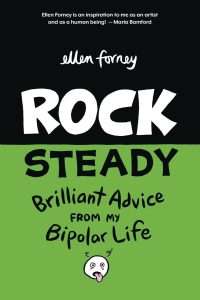
 Crazy Like a Fox: Adventures in Schizophrenia tells the story of Fox Foxerson who moves to the big city from Kansas. Fox goes to a party he finds from a flier and meets Teddy, Snake, and Dodo. Fox has a good time and becomes friends with all of them. He even has a crush on Snake.
