From Old Country Bumpkin to Master Swordsman, Vol. 1: My Hotshot Disciples Are All Grown Up Now, and They Won’t Leave Me Alone may be long winded, but as a title it actually does a great job telling you everything about this book.
While there is certainly more nuance inside the storytelling, the title gives you 80 percent of the book up front. Beryl took over the teaching duties at his father’s dojo out in the country, only to then be badgered about giving him grandkids. After years of training students, one of them comes to bring him out of the country and into the capital to train knights. The only problem is Beryl has no self-confidence and believes that he really is only good enough to train people in sword self defense in a backwoods dojo. To his surprise he learns many of his disciples have become the most powerful knights in the kingdom.
Former disciple Allusia has become commander of the Liberion Order, overseeing the kingdom’s most elite knights. She still carries the sword he gave her when she graduated, and she still carries a torch for him in her heart. Unknown to Beryl she swore long ago to bring him into the light so he would get the credit he was due as the greatest swordsman alive. She rose higher and higher in the ranks until she was able to secure a position for master Beryl as Special Instructor to the Liberion Order. Knowing he wouldn’t accept it as an offer, she constructed a plan to have him specially appointed by Imperial Order so he can’t refuse.
While Beryl might feel like an imposter, he still has a sense of duty and complies. When he arrives at the capital, feeling quite overwhelmed by the size and scope of the city, he is awed by the size of the fighting force and their capabilities. They soon run into another former disciple, Serena, who is a member of the Black Adventurers Guild and also incredibly powerful. Serena and Allusia are rivals and both want Beryl’s attention. At this point we get the first real indication of Beryl’s abilities and throughout the rest of the book there will be moments where the audience learns that his reputation is earned. He’s fast, instinctual and strong. Beryl earns the respect of the city knights and seems to be settling into the idea that he could do some good here. The book closes by introducing a mysterious magic user who is interested in Beryl and may or may not have ties to him as well.
The art in this story is really enjoyable and a highlight of the book. The characters are all distinct and easy to identify. The world is clear and detailed, without any panel ever feeling too busy or muddy. There are hallmarks of fantasy storytelling in the layout of the world, like the characters’ dress and the buildings, but it doesn’t feel like a retread of other story locations. The place and people all feel intentional and distinct, which helps keep the reader invested and intrigued.
Yen Press has this book rated ages 13 and up, which feels about right. There isn’t anything overtly objectionable in this book for younger readers, but they likely wouldn’t keep up with the pace or context. This volume contains only sword fighting as dueling, violence wise, but I imagine that expands in future volumes as the world and conflict around them grows. There are currently two more volumes slated for English translation, so more of this series will be available soon.
From Old Country Bumpkin to Master Swordsman Vol. One By Shigeru Sagazaki, and Tetsuhiro Nabeshima Art by Kazuki Sato Yen Press, 2024 ISBN: 9798855401899
Company Age Rating: Teen
NFNT Age Recommendation: Adult (18+), Older Teen (16-18), Teen (13-16) Creator Representation: Japanese,
Every city fears becoming Jeju Island—a paradise now overrun with monsters when heroes failed to close their gate in time. In this alternate Earth, portals to deadly dungeons began spawning without reason across the world.
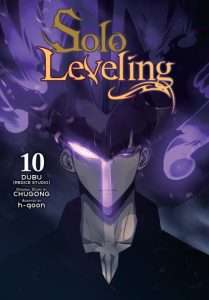
Simultaneously, some people manifested special powers. It is incredibly rare for their power level to change, leading to a classification system of hunters used to triage dungeons most effectively. This brings us to Jin-woo, known to be the weakest of them all. Still, as long as he survives, dungeon work is lucrative so he can pay his comatose mother’s medical expenses and support his sister. When he somehow survives an unexpectedly deadly dungeon, he gains the ability to level up and soon surpasses everyone else.
In these kinds of stories, it’s easy for the protagonist to feel overpowered and boring, but ten volumes in and Solo Leveling is going strong. The tension stays high because his increasing abilities are leading him to greater threats that no other hunter is even aware of. While he does sometimes come into conflict with other hunters, this usually ties more to the secondary tension – is Jin-woo’s humanity the cost for power? The kindness that was his defining feature seems colder as the volumes continue.
The reveals come just this side of excruciatingly slowly, creating the perfect sort of agonizing anticipation that must be shared with friends through theories about what is actually going on. These come with a charming cast of characters we hope Jin-woo will continue treating well as his journey changes him. Battles are, of course, frequent and can be both brutal and, occasionally, funny.
As with most manhwa releases, the volumes are entirely full color art peppered with breathtakingly gorgeous panels. The illustrator, Dubu, has such skill at detailed work, when the story beats call for it. These are most frequently used for creating realistic, awe inspiring monsters, but his skills for setting and faces are just as great. Of course, most of the art doesn’t require quite that level of detail, but is still gorgeous nonetheless. The fight scenes are drawn with care so are rarely confusing and employ techniques to elevate them beyond standard fare.
The series is obviously great for gamers, who will be unbothered by level-up screens, but they’re tucked into the story well enough that lack of video game knowledge is no barrier. It’s all perfectly acceptable for a teen audience, despite Jin-Woo’s adult age. There is violence but no sex or nudity, only occasional swearing, and isn’t covering controversial topics. That said, Jin-woo’s concerns are adult enough to keep general adult audiences engaged. This (and the occasional severed limb) is probably why Ize Press rates the series as older teen. Right now is an excellent time to drop into the series because the latest volume, ten, had major revelations about the purpose of the gates and Jin-woo’s special ability. Additionally, the anime was popular enough to have the first two episodes of season two run in theaters in anticipation of the January release. This is definitely a must-have series for people looking to get into manhwa – personally, it was one of the two that started my addiction!
Solo Leveling By Chugong , h-goon Art by DUBU Yen Press, 2024 ISBN: 9798400902536
Volume
ISBN
9
9798400901935
8
9798400901072
7
9798400900488
6
9798400900266
5
9781975344382
4
9781975337247
3
9781975336516
2
9781975319458
1
9781975319434
Company Age Rating: OT
NFNT Age Recommendation: Older Teen (16-18) Creator Representation: South Korean, Character Representation: South Korean,
The seven children of the wealthy Shiunji family are the talk of their town. Numbering five girls and two boys, with two sets of twins in the middle, they are unmistakable when they go out. All the Shiunji siblings are good-looking and gifted, with the majority of them being talented scholar athletes. The girls all have their own fan clubs and students from other schools travel out of their way to watch them from afar.
All of this is an annoyance to Arata, the oldest of the two Shiunji boys. While many boys are jealous of him for being surrounded by such grace and beauty, the reality of living with five girls your own age is a far cry from the sister fetish stories other boys obsess over. His older sisters bully him. His younger sisters tease him. And worst of all is his twin, Ouka. Given that, and his fears of introducing his crush into the mix, it is no wonder the 16-year-old Arata has never had a girlfriend, despite being the most eligible young man at their school.
That changes on the night of the youngest Shiunji sibling, quiet Kotono, turning 15. It is then that their father confesses to a secret that he kept hidden from his children all their lives. Namely, that all of them are adopted and that apart from the younger set of twins, Minami and Sion, none of them are blood relatives.
This changes nothing for Arata, who is determined to protect the girls as a big brother should. Unfortunately, the girls he thinks of as his sisters all start showing signs that they might be viewing him in a different light. Even Ouka!
In the afterword of The Shiunji Family Children Vol. 1, creator Reiji Miyajima says they were inspired to write a story about sibling relationships because they had no chance to do so in their earlier series, Rent-A-Girlfriend. Because Siblings can be your best friends and your worst enemies. It is a fascinating dichotomy which they wanted to explore.
Your enjoyment of The Shiunji Family Children will likely depend upon how much you enjoy that dichotomy and harem manga. Because make no mistake, that is what The Shiunji Family Children is, despite Arata’s frequent protests that his life is NOT a light novel. Even as his youngest sister hugs him while naked, his second oldest sister mounts him in her bed clothes, his second youngest sister calls him sempai, and his older sister jokes about having a date with him.
Reiji Miyajima’s artwork remains excellent, however, with each of the siblings having a distinctive appearance. They also have unique personalities, moving beyond the usual stereotypes of “smart science girl” and “sporty tomboy” as the first issue goes on. This helps distinguish the book from other harem manga that are only concerned with the sexy bits.
On that note, Yen Press has rated The Shiunji Family Children as OT for Older Teens, 16 and up. I consider that a fair assessment. There is full nudity from the side of the 15-year-old Kotono and a lot of discussion of sexual content. There is no actual sex, however, but given the subject matter this book is rightly aimed at older audiences who can appreciate the emotional issues involved. Amazingly, these issues are treated seriously even as most of the comedy is born of Arata’s discomfort with the conflicting feelings that he and his sisters are dealing with.
The Shiunji Family Children, Vol. 1 By Reiji Miyajima Yen Press, 2023 ISBN: 9781975371418
Company Age Rating: OT
NFNT Age Recommendation: Adult (18+), Older Teen (16-18) Creator Representation: Japanese, Character Representation: Japanese,
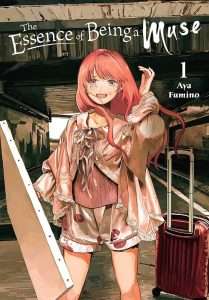
Miyuu Seno had dreams of becoming an artist. Those dreams were shattered when her application to art school was rejected. With no other plan for her life after high school, she submitted to her mother’s plan for a safe and secure life.
Five years later, Miyuu is completely miserable. She’s working the safe office job her mother always dreamed of, wearing the clothes and makeup her mother picks out, and trying to attract the handsome young accountant her mother pegged as prime husband material. Ironically, that plan goes south when Miyuu gets him alone and he says that he likes her… because she is “a pale, pitiful imitation.”
Incensed and outraged, Miyuu leaves her mother’s house with nothing but the clothes on her back and a blank canvas—the last one she had from her teenage years. Now, homeless but hopeful, Miyuu hopes to make her dreams come true at last, becoming a real artist, getting accepted to art school, and finding a boyfriend who appreciates her true self.
The Essence of Being a Muse is a perfect opening to what promises to be a wonderful slice-of-life series. Aya Fumino does a fantastic job of establishing the setting. More importantly, she firmly sets Miyuu up as a protagonist we want to root for and see succeed.
Miyuu is immediately sympathetic, trying her best to succeed at being a dutiful daughter and competent office worker. When she seemingly fails at that, she questions everything in her life and concludes that she’d rather fail being happy and authentic than endure another day aspiring to mediocrity. Granting that this is standard RomCom fodder, Fumino largely avoids the usual tropes… at least until the last chapter.
It is here that the narrative shifts to Kairi Nabeshima, the accountant whose harsh words inspired Miyuu to abandon her life. We see the earlier scenes play out from his perspective and learn of his own shattered dreams of becoming a male model. Far from being sympathetic, however, he views Miyuu as being like him—a wannabe who never will be, which makes him like her.
In a lesser series, this would set up an immediate romantic subplot. Instead, Kairi’s half-hearted efforts to ask Miyuu out after she starts to find success in her new life are rightly shot down. This is a welcome change from the romance manga where the heroine can’t move on from her old flame and starts to see something decent in him.
The artwork is of similarly high quality to the scripting. For the most part, Aya Fumino’s art fits the standard Shojo aesthetic. There are novel touches, however, such as the perspective and pencils becoming jittery whenever Miyuu is upset. This is most apparent during the fight with her mother but comes up for a few panels later when she is trying to sketch something for the first time in years and starts crying. It is almost as if Miyuu is drawing the comic herself but cannot steady her hand or see clearly through her tears.
This volume is rated T for Teen, meaning audiences 13 and up only. I believe that to be a fair rating. There is no violence or bloodshed, beyond some vivid shouting matches and Miyuu cutting her feet after leaving her home barefoot. There is no nudity, though Miyuu does go home with Kairi and he opens her blouse before she tells him she seriously just wanted to talk before their all too honest conversation. All in all, there is nothing inappropriate for a teenage audience, who will benefit from the book’s themes of following your dreams, being true to yourself, and not entering into a relationship just to be with someone.
The Essence of Being a Muse, Vol. 1 By Aya Fumino Yen Press, 2023 ISBN: 9781975360979
Company Age Rating: T Related media:
NFNT Age Recommendation: Adult (18+), Older Teen (16-18), Teen (13-16) Creator Representation: Japanese, Character Representation: Japanese,
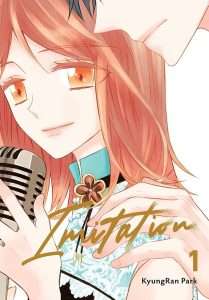
Maha Lee is an aspiring Idol. Her group, Tea Party, hasn’t hit the big-time yet, but she’s made a lot of friends on the circuit. Unfortunately, most of her fame to date is due to her amazing resemblance to solo singer La Lima. It wasn’t a huge issue, however, until Tea Party’s manager got them booked on Pop Idol Sports Games, alongside La Lima and Shax, the hottest boy band in South Korea.
An accident during the games leads to Maha Lee becoming the most hated woman on the Internet. This is partly due to the anti-fans dismissing her as a pathetic imitation of La Lima. Yet what concerns her most is the apparent hatred of Kwon Ryok, the bad boy of Shax, who is equally outspoken about his disapproval of wannabe Idols ripping off established artists. Unfortunately, fate and Maha Lee’s newfound popularity lead to her being offered more work. This includes her first acting role, opposite Kwon Ryok. This pushes Maha to prove to herself (and the world) that she has what it takes to make it big on her own merits and that she is more than just an imitation.
Originally published as a webtoon, Imitation was a smash hit on its original release. Indeed, it was adapted into a live-action series which ran on South Korean television from 2021 to 2023. This English translation does a masterful job of conveying both the story and K pop-culture to Western audiences. Notes in the back of the volume help explain the more subtle cultural references that are lost in translation. This includes a long list of foods Maha Lee must recite featuring various dishes that are considered old-fashioned by Korean hipsters. It is a small thing, but an important one. Thankfully, the general story is more universal, if born of the usual RomCom clichés and stock characters.
Maha Lee is the classic good girl, struggling to succeed in a competitive business. La Lima is the classic Mean Girl. Kwon Ryok is the typical harsh love interest who hides his sensitive side behind a rough facade. Thankfully, the supporting cast vary things up a bit. A good example of this is Yujin, Maha’s friend and lead singer of the boy band Sparkling, who seems to have a crush on Maha he dare not express. The usual love triangle elements are avoided, though Yujin does step in to defend Maha. This, in turn, inspires her bandmates to push her to stop talking to Kwon Ryok so they can guide her to the far kinder Yujin.
The artwork of KyungRan Park is like their writing – smooth and satisfying. There’s nothing visually outstanding about the artwork, but nor is there anything glaringly off. The strangest thing is that for all the talk of La Lima and Maha Lee resembling each other, the two have distinctly different designs apart from similarly shaped faces. Even when Maha instructed to straighten her hair to look more like La Lima, it does little to make her look that much like the elder Idol.
Imitation Vol. 1 is rated T for Teen. I consider that a fair rating. There’s no violence or bloodshed, apart from a staged strangling which leaves Maha Lee bruised and Kwon Ryok bleeding from where her nails dug into him. There’s also no sexual content, apart from one kiss, but that’s a given considering how strict Idol culture is about the Idols dating, much less going further. The end of this first volume, however, suggests more kisses will be inevitable as the series continues.
Imitation, Vol. 1 By KyungRan Park Yen Press, 2023 ISBN: 9781975367008
Company Age Rating: T Related media: Comic to TV
NFNT Age Recommendation: Older Teen (16-18), Teen (13-16) Creator Representation: South Korean, Character Representation: South Korean,
Wake up in a strange place. Immediately get attacked by horrific monsters. Quickly realize that you’ve somehow gotten caught up in a world-changing series of events that you barely understand. This is Dark Souls.
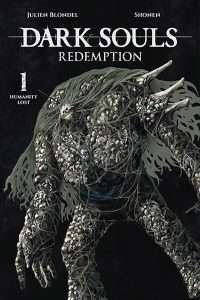
Published by Yen Press, Dark Souls: Redemption begins an original story set within the familiar world of the Dark Souls games created by FromSoftware. At story’s open, a lit flame serves as an omen of things to come. A woman wakes amidst the dead with no memory of who she is or where she came from. In a world that quickly proves hostile, she encounters a secretive protector who is sworn to her defense but refuses to reveal the secrets of her past. And these are secrets that will prove to be important as humans and monsters alike begin to converge, all seeking the woman for whatever forgotten role she plays in this wider world.
French writer Julien Blondel provides the story, immediately showcasing the aesthetic and narrative ambiguity that defines Dark Souls. There is death and magic and angry monstrosities. The reader—alongside our nameless lead character—is dropped into a world with little initial explanation other than clues that emerge as new pieces of the world come into focus. However, one challenge of translating Dark Souls into written form is that narrative ultimately begins to move into the forefront. Though plenty of mysteries remain, Blondel delivers an unfolding story of a woman who has forgotten how important she is to the world and competing factions that either wish to see her return to power or see her destroyed forever. Even with this heavier focus on narrative, this first volume leaves a lot unanswered as sudden revelations and escalating threats push the characters from one conflict to the next. The individual moments are easy enough to follow, but readers who like their answers quickly may be frustrated by the need to wait for further volumes before all of this begins coming together.
Blondel’s story is given life in the detailed black and white illustrations of Shonen. A core aspect of Dark Souls is the large and intricate world, and the art quickly gives age, grime, scale, and history to this dangerous world. A significant portion of the storytelling unfolds through the visuals and action sequences, and Shonen clearly holds value for the aesthetic of the original games. Though a bit of clarity gets lost in the pacing and action at moments, it is largely a pleasure to see new pieces of this world unfold across the pages alongside misshapen abominations and dark heroes locked in ongoing conflict.
The series is rated for Older Teens, offering rough but often bloodless violence, monstrous imagery, and non-sexual partial nudity on the part of the main character. Nothing in the content should be surprising to those who are already fans and teens on the older end of the spectrum should have no issue picking up the series. Overall, this first volume should appeal to established fans but, at least without subsequent volumes to carry the story deeper, may not prove the strongest entry point for those without some familiarity with the games. It’s clearly made with deep affection for the source material, but I’d need to see more before making a final decision on the strength of the storytelling here.
Dark Souls: Redemption Vol. 01: Humanity Lost By Julien Blondel Art by Shonen Yen Press, 2024 ISBN: 9798855405712
Related media: Game to Comic
NFNT Age Recommendation: Older Teen (16-18) Creator Representation: French,
Imagine living a spoiled, petty life that ends in execution—but moments before your death you discover your timid stepsister masterminded your downfall. She meant to make you a brat, a bully, a villain so no one would believe your innocence when it mattered. You were awful, but apparently deserve a second chance because you wake up as your younger self with knowledge of what’s to come.
Aria Roscent’s story follows many beats of the common manhwa reincarnation type stories. Her tragic future gives her knowledge to change the past and a maturity far beyond her young years. The titular hourglass is a fun twist as it allows Aria to rewind time on a small scale—while retaining her memories—to get an even greater edge on her adversaries. However, what makes the series stand out is the way Aria truly changes because of her special knowledge.
In similar manhwa series, such as The Abandoned Empress, the protagonist may stumble into character growth purely because she fled the doomed path. Relationships and different perspectives grow organically from new experiences. It’s still incredibly engaging, but Aria takes a different path. She is dead set on revenge and gears her every action towards it. She’s methodical in who she meets and befriends, careful with all her words and actions.
The first volume may not be to everyone’s taste. It can be difficult to empathize with Aria because the reader is in her head, seeing that she’s not truly a kinder person. It’s just that her older mind now understands that reputation matters. If she is to succeed in destroying her stepsister, she must ensure people think kindly of her. She stops tormenting her servant. She works to appear humble for her teacher and society. She tries to make her stepfather see her as useful, yet biddable. But everything is an act.
Instead of temper tantrums and high handedness, she works at manipulation and trickery. She’s quite simply, mean. But quietly so. While readers may feel her need for revenge is justified, they’re also confronted with her young stepsister before she’s grown into a mastermind. She’s a foolish, young girl taught to be prejudiced and jealous. Does she deserve the fury Aria has for an older version of her?
As the volumes continue, Aria’s schemes force her to grow into a stronger, more intelligent person. Her older self realizes that she was never stupider than her siblings, only less educated. And that can fixed. She starts to struggle with remembering that she’s using people because some of them genuinely care for her and she can’t help but begin to return the feeling. She makes herself into someone important to aid her reputation and revenge, but realizes she’s doing work she cares about. And, in the latest volumes, maybe begins to fall in love.
Sansobee’s character work creates a fantastic tension for readers who must wonder if Aria’s quest for revenge will continue or whether she’ll make a kinder life for herself. Just when readers believe she’s softened, however, she will utterly destroy an enemy from her old life. There’s needless, if not wholly unjustified, death. Will Aria grow beyond revenge and learn some mercy? Or will she keep her anger and a cruel streak? Can a villain have a happy ending? These questions are compelling enough to pull readers through the occasionally strange pacing and the crueler events.
As with many of Ize Press’ manhwa, the art is stunning. Antstudio clearly loves illustrating items of luxury. There is so much detail added to dresses, jewelry, carriages, and hair. Otherwise, backgrounds tend to be softly out of focus so as not to draw attention away from carefully crafted embroideries and filigrees. This is also sometimes the case for the men, many of whom are outfitted in a far more subdued manner with similar hairstyles.
The layout is often dynamic as is the lettering. For instances, villainous remarks tend to be in striking dark and bold text. They even cleverly add nuance to speech bubbles to convey emotion and clarity. This works well with Antstudio’s expressive, if washed out – presumably to create unblemished beauty – faces.
Ize rates this as a teen title and it’s appropriate. It’s not an explicit title in the least. Deaths tend to be fade to black or text. There’s no sexual content and the majority of the characters are at least in teen bodies. Though Aria’s soul is in her twenties, she ddn’t have the opportunity to truly mature in her prior life so she still feels as strongly as a YA character. The main draw is the will she-won’t she of the revenge plot, rather than the (so far) bland romance.
While this isn’t the first manhwa series I would recommend for a graphic novel collection, it is solid enough for a new collection. It has enough uniqueness to stand apart from similar titles and the just released fourth volume clearly ends a strong story arc. Readers will eagerly await the revelations volume five will surely bring.
The Villainess Turns the Hourglass By Sansobee Art by Antstudio Yen Press, 2024 ISBN: 9798400901829
Volume
ISBN
3
9798400901003
2
9798400900983
1
9798400900808
Publisher Age Rating: T
NFNT Age Recommendation: Adult (18+), Older Teen (16-18), Teen (13-16)
Monthly in the Garden with My Landlord by Yodokawa, translated by Stephen Paul, is a slice-of-life manga about Asako Suga. The 26-year-old manga editor decides to move to a new home for a fresh start after breaking up with her girlfriend. Little does she know, her 19-year old landlord Miyako Kitano is a former idol. The naive and friendly Miyako resides in the attic of the home as a “live-in landlord”. It helps to know something about idol culture to understand what Miyako’s life has been like up until now. “Idols” are famous pop stars (J-Pop and K-Pop) who perform in groups and are trained by and represent their recording labels or companies. They craft carefully controlled images and hone their performance-related talents. Young musicians and dancers covet and compete for idol status. (I know this from listening to the audiobook XOXO by Axie Oh).
Presumably, the story will continue with some explanation of why Miyako abandoned her successful career and retreated into a mundane life as well as offering backstory about Asako’s failed relationship. With the first volume, the story unfolds as a slice-of-life about Asako and Miyako getting to know each other and becoming roommates, even friends. Miyako hails from the Kansai region and speaks in a style that reads as rural or country. She calls Asako “Onee-san” which means “big sister”, and Asako calls Miyako “Landlord-san”. There is the potential for a romance to develop, but Miyako is so child-like that I find the idea a little off-putting. For teen readers who are closer in age to the main characters, the romance might be more appealing.
The art in the story is familiar to any manga reader, even a novice like myself. In grayscale with the panels reading from right to left, top to bottom, it shows the characters doing everyday things, mostly at home with simple backgrounds. Sound effects punctuate the panels as Japanese characters with tiny anglicized and translated captions. The characters have large eyes and occasionally exaggerated facial expressions. They are attractive and wear stylish clothes. In keeping with the slice-of-life genre, the tone is gentle, calm and soothing. The cover art represents the feel of the interior artwork very well.
As of July 2024, there are three volumes in print of Monthly in the Garden with My Landlord. This is a good title for teen readers who appreciate a gentle slice-of-life story with little action but the potential for some queer romance and drama. Some readers might prefer a more sophisticated story, but this should hit the spot for those who enjoy simple comfort reads with queer characters.
Monthly in the Garden with My Landlord Vol. 1 By Yodokawa Yen Press, 2023 ISBN: 9781975362652
NFNT Age Recommendation: Teen (13-16) Creator Representation: Japanese, Character Representation: Japanese, Lesbian, Queer,
Newly single and ready to live on her own, Asako rents a charming house that “comes with a landlord.” When it’s too late to break the contract she discovers it comes with a beautiful landlord… living in the attic.
Though the volume begins with Asako’s harsh breakup, she has little time to wallow in sadness. The mangaka she edits for immediately points out her girlfriend was awful, but Asako is a sucker for a pretty face and someone in need. Asako can’t deny this. When she later spots a rental ad that’s too good to be true it sparks a desire to reset her life and prove she can be independent. Meanwhile, all around her, people are gossiping about a an idol group’s lead singer unexpectedly retiring before immediately retreating from the public eye.
A visit to the house cements Asako’s desire to start over, even if she has to tell herself not to be swayed by her prospective landlord’s pretty face. As she’s planning her move, she discovers her landlord, Miyako, crashing in the attic. Backing out now would be far too much trouble and Miyako has a sob story and an obvious secret to go along with the looks Asako can’t resist.
What follows are primarily gentle episodes about eating, shopping, and spending time together that highlight how well Miyako’s naivety and spontaneity work with Asako’s thoughtfulness and logic. They find their rhythm as roommates. Miyako refers to Asako as big sister, not seeing how Asako denies her attraction to Miyako.
Both the artwork and writing are charming, though it doesn’t offer much new to the genre. That isn’t a flaw, however, as it contributes to an overall cozy feeling. There are occasional moments of tension – a potential stalker, Miyako possibly being forced to leave, etc. – but these are blips in a sea of soft humor, sweet moments, and blushes.
This is a story of people finding their place in the world – probably with each other. I don’t think we can have too many stories like this. Even when the characters fit into well-known archetypes, their personalities vary enough to give new people a chance to feel seen. In this case, while they fit into a common serious vs. goofy dynamic, both characters are dealing with their own types of co-dependence and hopefully learning how to create a healthy relationship with each other.
While the publisher rates the title teen, it’s likely more interesting for an adult audience. Both characters are adults – 26 and 19, respectively – and are primarily dealing with adult issues. However, this is a chaste volume with no violence beyond face grabbing. Older teens may be interested in the themes dealing with finding your own place, growing comfortable with new roommates, and finding confidence in yourself.
It’s lighter, so far, than series such as Doughnuts Under a Crescent Moon and She Loves to Cook, She Loves to Eat, but will appeal to fans of both. A second volume released in March and the third arrives in August, so now is a great time to start reading and recommending.
Monthly in the Garden with My Landlord By Yodokawa Yen Press, 2023 ISBN: 9781975362652
Publisher Age Rating: T
NFNT Age Recommendation: Adult (18+) Creator Representation: Japanese, Character Representation: Japanese, Lesbian,
Mismatched relationships, chance encounters, and unforeseen circumstances unravel in the short story collection of Toryumon Takeda’s One More Step, Come Stand by My Side as random twists of fate populate these intriguing tales of wonder, subterfuge, and duplicity.
A young princess, abducted, blindfolded, and held against her will, opens up the collection in “When the Time Comes.” Her pensive caretaker, a hulking sentinel whose silence surpasses his strength, guards her like a precious gem. They navigate through a delicate terrain of uncertainty and trust while fostering an unspoken harmony of mutual understanding. What might they be attempting to communicate?
In another story, the tenuous relationship between a woman and her tied-up stalker reveal shifting dynamics of gender and power in “Ten Minutes Later, The Cops Showed Up.” In a space of just ten minutes, unexpected connections form between the two shortly before the police arrive, detonating a series of flirtatious overtones in this unusual exchange.
In “Paradise,” misconstrued interpretations across cultural barriers arise between a pair of explorers and a tribe of natives in a secluded jungle. They behold their peculiar practices and experience discomforting silences that alienate them in this bizarre encounter.
What might they be attempting to communicate? In “The Wife Whom I Loved Dearly,” a devoted husband traverses the landscapes of grief with his increasingly distant, cancer-stricken wife as they grapple with impending mortality and the fragility of life. How does one cope with this inevitability in light of the fleeting moments threatening to sever their relationship?
Nuanced scenarios between characters gradually unfold across shifting yet skillfully crafted plots in the stories of Toryumon Takeda. Wordless panels capture subtle shades of meaning, emotion, and actions among characters, culminating in serendipitous plot twists that confound and surprise, dissecting the complicated wonders of human behavior and idiosyncrasies. From muted relational connections and deceptive lies exchanged not only between characters but also with readers, Takeda conveys unspoken interactions through wispy line character designs and subtle gestures and facial expressions whose facades belie their ulterior motives.
The ephemeral and protracted dimensions of time intersect these stories of human relationships, filling a niche in short fiction manga collections aimed at older teens and adults. The afterword contains anecdotal insights that inspired these intricately designed stories. Eschewing formulaic-driven plots, Takeda illuminates surprising sides of humanity with profound depth and care infused with a range of emotional resonance.
One More Step, Come Stand by My Side By Toryumon Takeda Yen Press, 2023 ISBN: 9781975376871
Publisher Age Rating: 16+
NFNT Age Recommendation: Adult (18+), Older Teen (16-18) Creator Representation: Japanese,

 Alone may be long winded, but as a title it actually does a great job telling you everything about this book.
 alternate Earth, portals to deadly dungeons began spawning without reason across the world.
 the middle, they are unmistakable when they go out. All the Shiunji siblings are good-looking and gifted, with the majority of them being talented scholar athletes. The girls all have their own fan clubs and students from other schools travel out of their way to watch them from afar.
 other plan for her life after high school, she submitted to her mother’s plan for a safe and secure life.
 Maha Lee is an aspiring Idol. Her group, Tea Party, hasn’t hit the big-time yet, but she’s made a lot of friends on the circuit. Unfortunately, most of her fame to date is due to her amazing resemblance to solo singer La Lima. It wasn’t a huge issue, however, until Tea Party’s manager got them booked on Pop Idol Sports Games, alongside La Lima and Shax, the hottest boy band in South Korea.
 Wake up in a strange place. Immediately get attacked by horrific monsters. Quickly realize that you’ve somehow gotten caught up in a world-changing series of events that you barely understand. This is Dark Souls.
 stepsister masterminded your downfall. She meant to make you a brat, a bully, a villain so no one would believe your innocence when it mattered. You were awful, but apparently deserve a second chance because you wake up as your younger self with knowledge of what’s to come.
 Monthly in the Garden with My Landlord by Yodokawa, translated by Stephen Paul, is a slice-of-life manga about Asako Suga. The 26-year-old manga editor decides to move to a new home for a fresh start after breaking up with her girlfriend. Little does she know, her 19-year old landlord Miyako Kitano is a former idol. The naive and friendly Miyako resides in the attic of the home as a “live-in landlord”. It helps to know something about idol culture to understand what Miyako’s life has been like up until now. “Idols” are famous pop stars (J-Pop and K-Pop) who perform in groups and are trained by and represent their recording labels or companies. They craft carefully controlled images and hone their performance-related talents. Young musicians and dancers covet and compete for idol status. (I know this from listening to the audiobook XOXO by Axie Oh).
 late to break the contract she discovers it comes with a beautiful landlord… living in the attic.
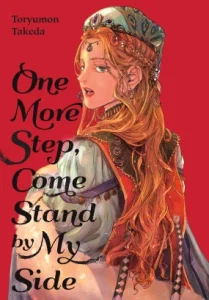 Toryumon Takeda’s One More Step, Come Stand by My Side as random twists of fate populate these intriguing tales of wonder, subterfuge, and duplicity.
