The rules of the game are simple: don’t get tagged, don’t cross the Uphill/Downhill dividing line, and no adults allowed. If you get tagged, you’re immediately placed in the other side’s jail (until the streetlights come on, until the school year starts). Passed down through generations, everyone in Lakeside knows these rules are integral to keeping this decades long capture the flag game going. Newcomers must complete a puzzle in order to show their responsibility and be sworn into the game. When Fred’s family moves to Lakeside, he spends his summer playing The Endless Game, a summer he and the town will never forget.
The Endless Game, written by J.D. Amato with art by Sophie Morse, is a new middle grade graphic novel focusing on Fred’s first summer in his new town. He’s not happy his family’s moved again but almost immediately meets his fellow Downhill kids. After passing the entry test, Fred is sworn in as a member of the Downhill by the Council of Homeschooled Kids and quickly learns all about Lakeside’s infamous game. There’s DIY castles, root beer speakeasies, and bike races, plus years of lore and history to catch up on. As the summer flies by, Fred learns that the game always takes priority, even if winning never seems fully possible.
At home, Fred’s mom is glad he’s made friends and has finally fit in somewhere. She deals with her own job hunting struggles, something hinted at off page and in larger spreads, but not a main focus of Fred’s energy. His dad’s absence, however, is strongly felt throughout the story. Fred just wants his dad to finally move to Lakeside to be with his family, a move being held up by his work situation. They’re all tired of having to uproot their lives for his dad’s job and just want him to be home with them in this new place they love. Amato weaves the more emotional family touchpoints into more of a background plot, while still being a crucial element of Fred’s summer.
The Endless Game reads like the best kind of kids summer movie from the 80’s or 90’s but written for the kids of today, giving it a very timeless feeling. It takes place in a pre-cell phone time, seemingly the 90’s, without constant references to cultural touchpoints of the time, making it enjoyable and welcoming for readers of all ages. The kids of Lakeside are diverse, one benefit of this modern graphic novel over some existing classic “kids in summer” stories, and many young readers will see someone similar to themselves.
Morse’s art is lively, full of motion and movement, an excellent complement to the action-packed story. The colors are warm summer tones to go along with its seasonal setting. The characters are very expressive. One particular highlight is the spreads at the beginning of each chapter, which often feature quick looks into Fred’s life and family beyond the game.
The Endless Game is a fast-paced graphic novel full of summer fun for middle grade readers. It will appeal to readers looking for slice of life graphic novels and those looking for exciting action in their graphic novels. While it is intended for ages 8 to 12, it has appeal beyond that in both directions, as well as older readers as well. It is an excellent summertime read.
The Endless Game By J.D. Amato Art by Sophie Morse Simon & Schuster Books for Young Readers, 2026 ISBN: 9781665927154
Company Age Rating: 8-12
NFNT Age Recommendation: Middle Grade (7-11), Tween (10-13)
Wei has always wanted to be a lion dancer. His father was part of a championship-winning lion dance team, and Wei dreamed of doing athletic stunts like him. He joined a team, where he and his friend Hung danced together in the two-person lion costume: Wei as the head, and Hung as the tail. But when Wei’s father died and Hung started making fun of lion dancing, Wei quit.
Two years later, in middle school, Wei is unhappy as a benchwarmer on the basketball team. When he learns about a local junior lion dance team, he decides to join. Lion dancing again feels great, and Wei is making new friends. The only problem? Hung is on the team, and he wants Wei out.
This fun story offers a fascinating look at some techniques and traditions of lion dancing. The team consists of not just the dancers inside the lion costumes but also drummers and cymbalists who accompany the dance. All members of Wei’s junior team are trained on drums and cymbals as well as dancing, and they sometimes switch out during long performances, since the dancing can be exhausting. The team does a variety of performance types, from dancing onstage to roaming through crowds on the street at Lunar New Year to being hired to bless shops and restaurants.
Like many sports stories, this book includes a competition aspect: the senior team captains are observing the junior team to decide which members will participate in an upcoming competition. Wei and Hung both desperately want to be chosen. Both currently dance as lion “heads,” and both are skilled, though Hung is better because Wei has not been dancing for the last two years. However, Wei is improving quickly, and Hung faces a frustrating problem: he wants to keep performing as a head, but he has the stronger, heavier build of a tail. When a lion jumps or rears up during a performance, the person dancing as a tail must lift their partner, and it is becoming hard for Hung’s tail to lift him. Wei is smaller, ideally built for a head. When he joins the team, Hung is furious, fearing that he will once again be made a tail to Wei’s head. This leads to much of the book’s conflict and drama. While the story mostly follows Wei, we get a few scenes from Hung’s point of view as well.
The art is clear, dynamic, and expressive. The characters have a cartoon style, but still fit with the highly detailed lion costumes and backgrounds. The movements are natural and easy to follow, even when the characters are in their lion costumes. The costumes themselves are beautifully illustrated and become highly expressive with the dancers’ movements. The characters’ facial features are sometimes similar, but distinctive hairstyles make it easy to tell them apart. At the beginning of each of the book’s eight chapters, a lion dance move or tradition is illustrated and explained. This adds interesting context to the story. Readers may be inspired to look up some lion dance performance videos!
The conflicts in this story are Wei versus Hung and Wei versus his own self-doubt. There is some middle-school meanness, but no physical violence. Wei has a lot of self-doubt, and he misses his dad, but he has a loving grandmother and one good friend even before he joins the team, so there is support in his life.
This is a lively story featuring a highly athletic sport/performance art that may be unfamiliar to many readers. It will appeal to fans of middle school stories featuring unusual sports, like Roller Girl by Victoria Jamieson, and to anyone interested in learning about a cool dance tradition.
Lion Dancers By Cai Tse Simon & Schuster Books for Young Readers, 2024 ISBN: 9781665927239
The arrival of a new pet, especially a rambunctious puppy, disturbing the life of a more mature animal, is a popular topic in early and intermediate graphic novels and Tysoe throws in a fun little twist to this theme in this new series.
Truffles, a fluffy orange cat, is completely taken aback when his human, Sasha brings home a box which contains… Puptective! Puptective is a little white puppy with mouse-like ears, a “detective hat” and boundless enthusiasm. She sets out immediately to “puptect” and quickly annoys Truffles with her noise, enthusiasm, and proven innocence in the matter of smashed flowerpots. Truffles tries to get Puptective into trouble, trap her, and finally, when all his efforts fail, sets in motion a diabolical plan to get rid of Puptective forever!
But… maybe he actually kind of likes the little puppy? Can Puptective’s detective lessons help Truffle put things right and bring his new friend back home?
There are instructions for young readers to draw the two main characters at the end of the book. Tysoe, while sticking to the familiar formula of an excitable puppy and annoyed, older cat, presents the story with a fresh perspective. She flips the gender stereotypes that usually go with pets, cats being female and dogs male, and Puptective’s naive but surprisingly effective detection skills are portrayed with heart and humor.
The art is heavy on comic circles, with big eyes, wide pupils, and emotions conveyed with some skillful placement of eyebrows. Puptective prances through the story surrounded by exclamation points as she bounces with excitement, shock, interest, and delight. Although in galley format, the finished book will be in full color and the examples of the final art primarily show panels without borders. They are defined by simple colored backgrounds against a white page, making the characters and their word bubbles pop. Periodically, the story expands into a full page colorful setting, but the action mostly moves from one simple panel to the next. The text is simple and in a large, easy-to-read font.
While there are plenty of similar titles like Dear Beast,Pepper & Boo, Peanut, Butter, & Crackers, and Doggo & Pupper, this new series has an additional touch of humor with the detective theme and there is always room for another funny, animal-themed beginning graphic novel series. Elementary school libraries and public libraries with a large population of beginning readers will definitely want to add this one to their shelves.
The Great Puptective By Alina Tysoe Simon & Schuster Books for Young Readers, 2024 ISBN: 9781665938242
NFNT Age Recommendation: Easy Readers (5-9), Middle Grade (7-11)

 line, and no adults allowed. If you get tagged, you’re immediately placed in the other side’s jail (until the streetlights come on, until the school year starts). Passed down through generations, everyone in Lakeside knows these rules are integral to keeping this decades long capture the flag game going. Newcomers must complete a puzzle in order to show their responsibility and be sworn into the game. When Fred’s family moves to Lakeside, he spends his summer playing The Endless Game, a summer he and the town will never forget.
 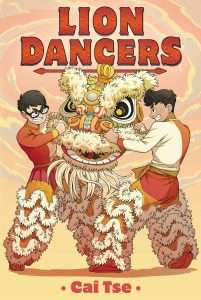 dreamed of doing athletic stunts like him. He joined a team, where he and his friend Hung danced together in the two-person lion costume: Wei as the head, and Hung as the tail. But when Wei’s father died and Hung started making fun of lion dancing, Wei quit.
 early and intermediate graphic novels and Tysoe throws in a fun little twist to this theme in this new series.
