Amu Hinamora sometimes feels like an anxious mess, but seen from the outside, she’s popular and cool. It helps that she’s one of the Guardians: rare kids who have tiny magical companions called Guardian Characters, which grant special powers. In fact, where most Guardians have a single Guardian Character each, Amu has four. Perhaps it’s no surprise that she is chosen for a special mission: unraveling a mystery at a prestigious but strange middle school called Arcana Academy.
In the world of Shugo Chara!, every child has an egg in their heart that represents an ideal version of themselves that they want to be. Most children never discover their eggs, but some rare eggs hatch into tiny chibi people called Guardian Characters. Guardian Characters mostly hang around offering commentary, but they can also help their Guardians transform into powered-up versions of themselves.
Arcana Academy has a problem: students are losing confidence in themselves, which can turn their eggs into X Eggs. These hatch into not heroic and helpful Guardian Characters but mischievous and dangerous X Characters. As a Guardian, Amu specializes in restoring X Eggs. That’s her main mission at Arcana Academy, but she also has a secret assignment: to learn about the Academy’s powerful treasures, the Arcana Jewels.
This is a cute adventure with lots of humor. Amu is an entertaining protagonist: since readers can see her thought bubbles, we know when, beneath her Cool Girl exterior, she’s confused or panicking or paying less attention to her mission than to her crush’s cute school uniform. Her four Guardian Characters can also see her thoughts, and they have lots to say about them, which is often funny.
Guardian Characters are a fun element: each one represents an aspirational version of their Guardian, often in an over-the-top way. For instance, Amu’s crush has a princely, chivalrous personality; his Guardian Character is an actual king who gives him the ability to transform into a monarch in full regalia and use a defensive power called Holy Crown. Amu’s four Guardian Characters have personas ranging from artistic to athletic, and enable her to transform into four different superpowered versions of herself.
The supporting cast adds to the fun. There’s Amu’s crush, whose sweet personality contrasts humorously with his tyrannical Guardian Character. Another Arcana student, Niya, is a video streamer with a pair of cat ears (thanks to his Guardian Character being an anthropomorphic cat), lots of silly energy, and a crush on Amu. Amu’s new roommate is so shy and quiet that for awhile Amu doesn’t realize there is another person in her room at all.
The Guardians’ transformations and magical powers have major magical girl vibes, complete with elaborate outfits. The art throughout the manga is rich with detail, from the gothic architecture of Arcana Academy to the flowers, stars, bubbles, and sparkles sprinkled through the backgrounds. Playing card suits are a major theme: Arcana Academy’s four dorms are Heart Tower, Diamond Tower, Spade Tower, and Clover Tower, and are decorated with the corresponding symbols (“clover” being clubs). The four suits also appear on Amu’s four Guardian Characters and seem to be connected to the Arcana Jewels.
At the end of this volume is a collection of translation notes to clarify elements of the story that are otherwise hard to translate. For instance, the headmaster of Arcana Academy uses a Japanese counting word that implies that Guardian Characters are objects, while everyone else counts them using the word that is used for people. The notes offer a fascinating glimpse into the differences between Japanese and English and the ways translators try to bridge them.
There is a brief introduction to the main cast and the concept of Guardian Characters at the beginning of the book—a helpful reference, especially for readers new to Shugo Chara! With a new setting and largely new cast, this volume can stand alone or serve as an entry point to the series, though new readers may get a sense they are missing a little bit of context. Still, the story holds up well on its own as a light, fun magical-girl-style adventure.
Shugo Chara! Jewel Joker By Peach-Pit Kodansha, 2026 ISBN: 9798888777107
Set in a future where videogames are all virtual reality (VR) based, Shangri-La Frontier (SLF) is a multi-player fantasy game with lots of unique characters, scenarios, and items, making it stand out from other VR games that are not well-developed and full of bugs and broken mechanics. Sunraku is a player that tackles these terrible games as a challenge; however, he picks up SLF during summer break and discovers his own unique scenario that keeps drawing him back to the game. His unconventional choices come from his many hours playing broken games and wanting to maximize his fun.
In volume one, Sunraku skips the beginning tutorial town and almost dies from the area boss monster guarding the second town. Wanting to get ahead of most of the players, he goes back to exploring after purchasing some new gear. While exploring, he runs into one of the unique boss monsters of the game, which don’t respawn after being beaten by players. He puts up a good fight but is no match for Lycagon; however, the beast acknowledges the strength of the player by cursing Sunraku to not be able to wear armor on his torso or legs and lower-level monsters will avoid him. Shortly after that, Sunraku finds a unique scenario involving a vorpal rabbit leading him to a hidden area called Rabituza.
In volume two, Sunraku is targeted by a group of player-killers (pk’ers) after an image of him with the unique non-player character (NPC) vorpal rabbit Emul is posted to an online forum without his permission. One of the pk’ers is an old gaming buddy, so we learn more about Sunraku’s other gaming adventures with Pencilgon and Katzo, who joins the game later. Sunraku is saved from being pk’d by a player known as Psyger-0, the “Attack Master,” who’s a female classmate with a crush on him but is too shy to even say hello. Next, Sunraku goes back to Rabituza to tackle the unique training scenario he was offered. He must fight a total of ten bouts with monsters, using only vorpal weapons, and wearing an item that lowers the experience he earns.
Volume three shows Sunraku finishing the epic training scenario and Pencilgon deciding that her clan has failed her game aspirations, and she needs to form a new group who can help her. After helping him escape pk-ers a second time, Psyger-0 sends a friend request to Sunraku, which he accepts to be polite and because he didn’t want to offend such a high-level player. This is when Sunraku explores the world by going into the Prismatic Forest Grotto and observing the monsters that populate the area. Pencilgon explains her plan to Sunraku and Katzo to take down one of the unique NPCs, Wethermon. The rest of this volume and the fourth shows how they prepare for this epic fight as well as its beginning.
This series is a unique contribution to action manga that utilizes isekai tropes, explores multiple game settings, and the interactions of characters in the game as well as outside of it. Due to the on-page violence and use of adult language, this is firmly a teen and up series; however, it is not much different from videogames that this audience plays anyway. In fact, gamers are the target audience. Adult readers would also find a lot to enjoy, especially the extras found in between chapters. This is where you can find additional lore about the games, monsters, items, and characters. Sometimes it repeats information that was explained during the story but sometimes it is new information that wouldn’t necessarily be easy to convey in the story without interrupting the pacing but enhances the reader’s knowledge. The illustrations have great detail and add to the world building as well and are one of my favorite aspects of this series after character building.
There are currently fourteen physical volumes available to purchase with the fifteenth set to be released at the end of February. If you have access to a platform that provides digital manga, there are eighteen volumes available. Another note is that we featured this series in our recent anime column, Anime Club Picks. The first season of anime covers the first six volumes of manga while the second season picks up immediately where the first stopped. Patrons who want to read ahead of the anime as it airs will find plenty of material as will readers looking to learn more about the world presented.
Shangri-La Frontier Vol. 1-4 By Katarina Art by Ryosuke Fuji Kodansha, 2022 ISBN: 9781646514823
Volume
ISBN
2
9781646514830
3
9781646514847
4
9781646514854
Company Age Rating: 16+ Series ISBNs and Order Related media: Comic to TV
NFNT Age Recommendation: Adult (18+), Older Teen (16-18)
Reformed troublemaker Yan is on his way to the employment exam for the Spellbook Library when he casually stops some bullies from shaking down a smaller boy. That boy, Tohru, is also on his way to the employment exam, and now he wants to be friends. When they find themselves paired up to work on the challenging exam, it seems they might actually make a good team. But who exactly is Tohru, and why does he want to work for the Spellbook Library?
As a child, Yan was rescued from a dangerous wild spellbeast by one of the elite Spellbook librarians, heroes who capture magical creatures inside books. That’s why he wants to join the library now. But when he asks what made Tohru apply for the job, the other boy is evasive. He also seems to have a strange magical power, perhaps linked to a mysterious necklace he wears. Tohru is a good friend to Yan, but what is he hiding?
In addition to sealing dangerous creatures into books, Spellbook librarians are responsible for crafting those books, keeping them in good repair, researching spellbeasts . . . and doing PR and education for the public. Yan has no interest in PR – he wants to be out bravely capturing spellbeasts. But the head of the PR department, who also happens to be a princess of the realm, runs the employment exam. Can Yan and Tohru impress her enough to get jobs?
There are lots of fun worldbuilding elements in this volume. Spellbeasts range from cute little critters to enormous dragons. Once sealed into Spellbooks, they can be let out again if desired. The library is full of these sealed-up creatures, some of which can be loaned to members of the public for use as mounts, messengers, and so on. Others are highly dangerous, and the librarians keep them sealed to protect the kingdom. Besides the creatures and the magic, we also get glimpses of a society with distinct upper and lower classes: Yan is a “commoner,” while Tohru seems to be from a wealthy background.
While this isn’t a comedy, there is humor sprinkled through. Yan sometimes struggles to maintain his new upright citizen persona – at one point, he punches a bully in the face while declaring “I’ve promised myself I’ll stop beating people up. Starting tomorrow.” The princess who runs the library’s PR department is comically deadpan most of the time, but does things like assign Yan and Tohru to wrangle a bunch of visiting schoolchildren while dressed, inexplicably, in rabbit costumes.
There is a little on-page violence, mostly in the form of Yan beating up bullies. (There is also a little swearing, mostly from those bullies and Yan, adding to their rough-around-the-edges vibe.) We do see a few dangerous spellbeasts, including a creepy one that can talk and take hostages. However, there is no death or serious injury in this volume, and no sexual content.
The art is detailed and fanciful, with interesting creature designs and intricate architecture. The characters are distinctive, which is helpful given that they spend much of the book all wearing the same uniform. The art is active and dynamic, supported by lots of variation in the panel layouts. I occasionally found it a little hard to know who was speaking, which can sometimes be tricky given that manga speech bubbles often do not have tails pointing to their speakers.
This volume is part of a new English-first manga series (though the panels still read right to left). Its creator is Japanese, but the manga will be released in English in the US before coming out in a Japanese edition. In a friendly note at the end of the book, the author describes being asked to write their first shonen manga (their background is in shojo and seinen) for American audiences, despite never having left rural Japan. There are also some fun character design sketches.
This new title features friendship, puzzling challenges, and interesting worldbuilding. Hand it to fans of fantasy shonen.
The Spellbook Library By Uta Isaki Kodansha, 2024 ISBN: 9798888772935
NFNT Age Recommendation: Older Teen (16-18), Teen (13-16) Creator Representation: Japanese, Nonbinary ,
In a world where the enemy was defeated thirteen years ago, the Divine Dragon Rangers still have weekly Sunday showdowns with a monster and his minions. The general populace was never told that the main enemy was defeated and all that were left behind in the floating castle are low level “immortal” monsters. Forced to perform to the jeers of the masses week after week, one of these monsters is ready for change. Using his shapeshifting ability, the monster known as D, disguises himself as a potential ranger candidate. Unfortunately, he is found out rather quickly by low level candidates. This leads to a brief showdown in the nearby forest, where D discovers that he has something in common with Hibiki Sakurama. Hibiki also wants to tear down the rangers’ organization.
In volume two, we see what happens when D takes Hibiki’s place in the candidate training. D discovers that Hibiki was hiding a rogue monster in his dorm, Hibiki’s sister is one of the Divine Dragon Rangers, and Hibiki’s colleague, Yumeko Suzukiri, knows what D is and wants his help to steal the divine artifacts. Working together, D manages to steal one of the artifacts and deliver it to Yumeko; however, during the showdown with the Rangers, he appears to have been destroyed by another of the artifacts that can cancel D’s regenerative immortality.
In volume three, we learn that D not only survived his encounter, but he’s making strides in infiltrating his candidate class as they move to the next test phase meant to judge their teamwork abilities. But something doesn’t feel right, and D’s approach to just play along to get through is challenged by a hidden set of rules and a mysterious boss monster long thought dead.
This ongoing series was first released in English back in 2022, two years before the successful anime adaptation. Eleven volumes are currently available in English with more being translated. It’s an interesting twist on the power ranger genre and looks at what happens when the good guys are secretly the bad guys. This manga differs from other series in that it does not have distinct arcs (at least in the early volumes) that end with a particular volume. Most of the events overlap and evolve as the main character D learns about them, which means each volume ends on a cliffhanger that makes the reader want to reach for the next book.
The creator has a fantastic sense of motion and uses it to great effect, not only during action sequences but also for emotionally charged internal monologues and strained conversations. Although the manga is in black and white and features a large cast of characters to track, their distinctive profiles make it easy to follow along. I would highly recommend this series for any public library or collection accessible to teens and adults due to the amount of violence and heavy ethical questions probed throughout. The anime has been confirmed for a second season, currently set to air in 2025, so having the manga available should keep fans occupied while they wait.
Boys Run the Riot is unique for a slice-of-live manga. It tells the story of a transgender high schooler named Ryo Watari. When we first see him, he’s switching out of his school uniform and into his gym clothes in a train station bathroom. He hates his uniform for more than the usual reasons—his uniform is a girl’s uniform and reminds him daily that he was born female.
Ryo navigates the pitfalls of high school with the added stress and complications that come with being transgender. Besides the uniforms, the social situations are fraught. The guys tell him he’s a girl and needs to hang out with girls, and the girls call him a slut for hanging out with boys all the time. He doesn’t fit in. And in Japan, “the nail that sticks out, gets hammered down.”
The only time Ryo feels like himself is in his street clothes. He’s fascinated by fashion and he can indulge himself by dressing as masculine as he likes with no judgement (besides his mother’s). Suffering from body dysphoria, lonely, and unsure of himself—how to act, whether to come out at school, at work, not to mention what changing room to use—he feels alone.
Enter transfer student Jin. He presents himself with an air of confidence that makes Ryo jealous, with unconventional hair and piercings (a big no-no in Japanese high schools). But these two outsiders find each other in a clothing boutique seeking out the newest fashion label.
It’s an unsurprising plot that these two form an unlikely partnership and decide to make their own fashion brand in the first volume of the series. Writer and artist Keito Gaku has created charming, honest characters in a tightly paced, well plotted manga that will hook its readers.
Rather than instant success and smooth sailing, these young entrepreneurs will face adversity. But they will not do it alone. They add to their ranks with a photographer, as well as a social media influencer. They will meet dubious adults who scoff at the idea of teens running a fashion brand, and deal with their own doubts and insecurities as well. They meet those challenges with a plan, some guts, and a little bit of luck.
Gaku is transgender himself and his heartfelt insight is all over the page. Ryo’s story is dramatic, yes, but punctuated with humor and humanity. The amazing part of the production of this manga is that the entire English translation and localization team at Kodansha Comics are transgender as well, a dream team that is creating work that will resonate with any reader.
I was blown away by the first two volumes in this series and can’t wait to see how far Ryo goes. The publisher rates this series for older teens (16+), which makes perfect sense for the age of the characters. The translation notes provide information not only on Japanese culture, but on transgender issues like binding, as well.
This series needs to be on high school and public library shelves everywhere.
Boys Run the Riot, Vols. 1-2 By Keito Gaku Kodansha, 2021 Vol 1 ISBN: 9781646512485 Vol 2 ISBN: 9781646511198
NFNT Age Recommendation: Older Teen (16-18)Publisher Age Rating: 16+
Creator Representation: Japanese, Gender Nonconforming Character Representation: Japanese, Gender Nonconforming,
As a child, Thorfinn sat at the feet of the great Leif Ericson and thrilled to wild tales of a land far to the west. But his youthful fantasies were shattered by a mercenary raid. Raised by the Vikings who murdered his family, Thorfinn became a terrifying warrior, forever seeking to kill the band’s leader, Askeladd, and avenge his father. Sustaining Throfinn through his ordeal are his pride in his family and his dreams of a fertile westward land, a land without war or slavery … the land Leif called Vinland.
(Publisher Description)
Vinland Saga By Makoto Yukimura ISBN: 9781612624204 Kodansha, 2013 NFNT Age Recommendation: Adult (18+) Volumes available: 11
Cute girl wizard Lucy wants to join the Fairy Tail, a club for the most powerful wizards. But instead, her ambitions land her in the clutches of a gang of unsavory pirates led by a devious magician. Her only hope is Natsu, a strange boy she happens to meet on her travels. Natsu’s not your typical hero—he gets motion sickness, eats like a pig, and his best friend is a talking cat. With friends like this, is Lucy better off with her enemies?
(Publisher Description)
This title has not (yet) been reviewed by our staff, but it is a title that we highly recommend for the majority of libraries building collections for this age range.
Fairy Tail By Hiro Mashima ISBN: 9781612622767 Kodansha, 2013 NFNT Age Recommendation: Teen (13-16) Volumes available: 63 (Series complete)
At Granbell Kingdom, an abandoned amusement park, Shiki has lived his entire life among machines. But one day, Rebecca and her cat companion Happy appear at the park’s front gates. Little do these newcomers know that this is the first human contact Granbell has had in a hundred years! As Shiki stumbles his way into making new friends, his former neighbors stir at an opportunity for a robo-rebellion … And when his old homeland becomes too dangerous, Shiki must join Rebecca and Happy on their spaceship and escape into the boundless cosmos.
(Publisher Description)
This title has not (yet) been reviewed by our staff, but it is a title that we highly recommend for the majority of libraries building collections for this age range.
Edens Zero By Hiro Mashima ISBN: 9781632367563 Kodansha, 2018 NFNT Age Recommendation: Teen (13-16) Volumes available: 11
Shoya is a bully. When Shoko, a girl who can’t hear, enters his elementary school class, she becomes their favorite target, and Shoya and his friends goad each other into devising new tortures for her. But the children’s cruelty goes too far. Shoko is forced to leave the school, and Shoya ends up shouldering all the blame. Six years later, the two meet again. Can Shoya make up for his past mistakes, or is it too late?
(Publisher Description)
This title has not (yet) been reviewed by our staff, but it is a title that we highly recommend for the majority of libraries building collections for this age range.
Silent Voice By Yoshitoki Oima ISBN: 9781632360564 Kodansha, 2015 NFNT Age Recommendation: Teen (13-16) Volumes available: 7 (Series complete)
Tsukimi Kurashita has a strange fascination with jellyfish. She’s loved them from a young age and has carried that love with her to her new life in the big city of Tokyo. There, she resides in Amamizukan, a safe-haven for girl geeks who regularly gush over a range of things from trains to Japanese dolls. However, a chance meeting at a pet shop has Tsukimi crossing paths with one of the things that the residents of Amamizukan have been desperately trying to avoid—a beautiful and fashionable woman! But there’s much more to this woman than her trendy clothes! This odd encounter is only the beginning of a new and unexpected path for Tsukimi and her friends.
(Publisher Description)
This title has not (yet) been reviewed by our staff, but it is a title that we highly recommend for the majority of libraries building collections for this age range.
Princess Jellyfish By Akiko Higashimura ISBN: 9781632362285 Kodansha, 2016 NFNT Age Recommendation: Older Teen (16-18) Volumes available: 9 (Series complete)

 Guardians: rare kids who have tiny magical companions called Guardian Characters, which grant special powers. In fact, where most Guardians have a single Guardian Character each, Amu has four. Perhaps it’s no surprise that she is chosen for a special mission: unraveling a mystery at a prestigious but strange middle school called Arcana Academy.
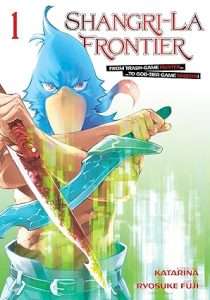 Set in a future where videogames are all virtual reality (VR) based, Shangri-La Frontier (SLF) is a multi-player fantasy game with lots of unique characters, scenarios, and items, making it stand out from other VR games that are not well-developed and full of bugs and broken mechanics. Sunraku is a player that tackles these terrible games as a challenge; however, he picks up SLF during summer break and discovers his own unique scenario that keeps drawing him back to the game. His unconventional choices come from his many hours playing broken games and wanting to maximize his fun.
 Reformed troublemaker Yan is on his way to the employment exam for the Spellbook Library when he casually stops some bullies from shaking down a smaller boy. That boy, Tohru, is also on his way to the employment exam, and now he wants to be friends. When they find themselves paired up to work on the challenging exam, it seems they might actually make a good team. But who exactly is Tohru, and why does he want to work for the Spellbook Library?
 showdowns with a monster and his minions. The general populace was never told that the main enemy was defeated and all that were left behind in the floating castle are low level “immortal” monsters. Forced to perform to the jeers of the masses week after week, one of these monsters is ready for change. Using his shapeshifting ability, the monster known as D, disguises himself as a potential ranger candidate. Unfortunately, he is found out rather quickly by low level candidates. This leads to a brief showdown in the nearby forest, where D discovers that he has something in common with Hibiki Sakurama. Hibiki also wants to tear down the rangers’ organization.
 Boys Run the Riot is unique for a slice-of-live manga. It tells the story of a transgender high schooler named Ryo Watari. When we first see him, he’s switching out of his school uniform and into his gym clothes in a train station bathroom. He hates his uniform for more than the usual reasons—his uniform is a girl’s uniform and reminds him daily that he was born female.


