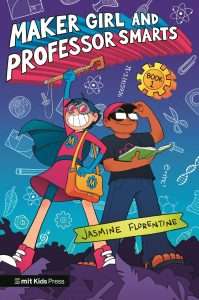
Jesus “Chuy” Reyes, age 12, starts the story by introducing himself and his best friend, Yael Levy or Yaya. Chuy is super smart and fascinated by all things intellectual—Yaya is a hands-on inventory and can make anything, even if she is a bit goofy at times. When a comet strikes earth and people gain mysterious powers, Chuy is super bummed – not only do these powers not conform to scientific laws, but he didn’t get any! When one of the second-rate supervillains of New Bork City ruins their ice cream, Yaya makes up her mind – they will become superheroes! With Chuy’s smarts and Yaya’s maker skills, the two take on Mr. Anti-Freeze, who is threatening to slimerize all the ice cream in New Bork City!
Florentine’s illustrations are bright and cheery, with lots of primary colors and drawn with clean, sharp lines. Chuy has brown skin, heavy eyebrows that move dynamically to indicate his exasperated moods, including up onto the outside of his pink baseball cap, and square glasses. He’s a tall, sturdy kid who gets a little excited about intellectual pursuits, but otherwise is mostly dragged along by the exuberant Yaya. Yaya, a skinny kid with short blue-black hair, is wildly enthusiastic about everything from superheroing to ice cream, despite the more cautious Chuy’s warnings and her younger brother’s embarrassment. Her family home is decorated to show her Jewish culture and Yoel, her younger brother, wears a kippah. Their villain has brown skin and pink hair.
The story is fairly simple, interspersed with lots of helpful (and random) facts from Chuy and step-by-step guides to making things from sorbet to grappling hooks from Yaya. The story ends with character studies and links to websites with guides for young makers.
Superhero take-offs like this tend to be cheesy, but this story is fully aware of its silliness and plays it for all it’s worth. Chuy’s repeated complaints that he’s NOT a superhero, the ridiculous villain, and Yaya’s wild enthusiasm will make readers giggle along with the author and maybe catch the making bug, even if they don’t want to put on a costume or have a super-powered bag to hold all their tools. While this is unlikely to satisfy readers who want “real” superheroes, it will certainly please younger readers who like funny stories and are interested in hands-on building. A must have for libraries and schools that include a maker space.
Maker Girl and Professor Smarts Vol. By Jasmine Florentine Candlewick, 2025 ISBN: 9781536239584
NFNT Age Recommendation: Easy Readers (5-9), Middle Grade (7-11)
“This book might seem very normal on the surface but like in any relationship once you get to know it you’ll realize this book is actually quite weird.”
This quote from the book How To Love: A Guide to Feelings and Relationships for Everyone describes the book perfectly—this is indeed a weird little book. Bursting on the scene with its bright pink cover and characters that look a bit like Easter egg-colored frogs, this book doesn’t exactly offer much guidance. It manages to feel a bit like a hug, nevertheless, with it’s affirmative language and assurance that there is no one-size-fits-all way to find love.
Alex Norris is known for their internet comic series, Webcomic Name, in which every comic has three panels and ends with “oh no” after a realization or complication. The formula sounds simple, but the comics have gained notoriety for being funny, profound, and relatable. How To Love contains a similar kind of humor—lighthearted with a darkly humorous core. But while Webcomic Name owes a lot of its humor to reflecting on our preoccupation and dependence on technology as well as our imminent destruction, How To Love takes a more hopeful, informative approach.
How To Love bills itself as a, “very different guide to relationships of all shapes and sizes,” which is accurate. What’s different about it is that the comics collected here offer quick lessons from a fully inclusive spectrum, discussing straight and queer relationships of all kinds, including asexuality and poly relationships. This feels almost unheard of; while none of these relationship types are given a deep dive, the mere mention is notable. Norris’s comics even brush upon the radical notion that someone can be happy as a single person and not lacking in any way, which is deeply validating to hear in a culture bent on—and even rewarding of—coupling up.
The book covers a wide range of subjects from crushes to consent in a concise package, tackling many different issues that arise when you are dating, starting to date, or trying to maintain a relationship. Among simple and silly illustrations is solid advice that mostly boils down to: you don’t have to do what you think you should do but do what is right for you. While not groundbreaking, it’s an affirmative little book.
Whimsical and wise, How To Love is reminiscent of Nathan Pyle’s Strange Planet, Hyperbole and A Half, the Sarah’s Scribbles books by Sarah Anderson, and other short, Instagrammable comics. As it does cover mature topics, it’s best for older teens and adults.
How To Love A Guide to Feelings & Relationships for Everyone By Alex Norris Candlewick, 2023 ISBN: 9781536217889
Publisher Age Rating: 14+ NFNT Age Recommendation: Adult (18+), Older Teen (16-18)
Maggie Thrash has spent basically every summer of her fifteen-year-old life at the one-hundred-year-old Camp Bellflower for Girls, set deep in the heart of Appalachia. She’s from Atlanta, she’s never kissed a guy, she’s into Backstreet Boys in a really deep way, and her long summer days are full of a pleasant, peaceful nothing . . . until one confounding moment. A split-second of innocent physical contact pulls Maggie into a gut-twisting love for an older, wiser, and most surprising of all (at least to Maggie), female counselor named Erin. But Camp Bellflower is an impossible place for a girl to fall in love with another girl, and Maggie’s savant-like proficiency at the camp’s rifle range is the only thing keeping her heart from exploding. When it seems as if Erin maybe feels the same way about Maggie, it’s too much for both Maggie and Camp Bellflower to handle, let alone to understand.
(Publisher Description)
This title has not (yet) been reviewed by our staff, but it is a title that we highly recommend for the majority of libraries building collections for this age range.
Honor Girl By Maggie Thrash ISBN: 9780763673826 Candlewick, 2015 NFNT Age Recommdnation: Teen (13-16)
She’s a Capulet. He’s a Montague. But when Romeo and Juliet first meet, they don’t know they’re from rival families — and when they find out, they don’t care. Their love is honest and raw and all consuming.But it’s also dangerous. How much will they have to sacrifice before they can be together?In a masterful adaptation faithful to Shakespeare’s original text, Gareth Hinds transports readers to the sun-washed streets and market squares of Shakespeare’s Verona, vividly bringing the classic play to life on the printed page.
Romeo and Juliet By William Shakespeare Gareth Hinds Art By Gareth Hinds ISBN: 9780763668075 Candlewick, 2013 NFNT Age Recommendation: Teen (13-16)
Yvain: The Knight of the Lion is a graphic adaptation of Chrétien de Troyes’s epic poem about King Arthur and his knights. The plot is fairly simple: Yvain avenges his cousin by fighting Sir Esclados. When Esclados dies an accidental death after battle, the maid Lunette convinces Lady Laudine to marry Yvain, as he is clearly a worthy knight for who will fight for honor. Yvain falls in love with Laudine and then leaves her to pursue more battles. When he misses Laudine’s imposed deadline for his return from battle, she closes her heart to him and Yvain is left to fight back for his love as well as his honor.
For the most part, Yvain’s qualities make him a hero in today’s world as much as they did in Arthurian legends. Yvain doesn’t turn away from a fight if he thinks it’s for the right reason. Also, his loyalty to Laudine is mirrored in his lion companion’s loyalty to him, suggesting that loyalty inspires more loyalty (and in the lion’s case, a distinct fighting advantage, too.)
At the same time, author M.T. Anderson and illustrator Andrea Offermann illuminate the characters who are left out from a narrow definition of loyalty. In a society where social capital and jurisprudence are carried out by fighting, women have no option other than to rely on men to represent their best interests. The narrow scripts of fighting, winning, losing, and defending one’s honor that create male heroes are the same ones that imprison females.
Offerman’s settings are surreal and wispy, further emphasizing the ways these stories occupy the imaginations of readers past and present. Some settings are filled with lush greens and reds while others are pale and bleak. The fights are bloody without being gory, and at times the artwork bursts out of panels, gutters, and captions so that the story can tell itself.
Within the story are the stories that the characters tell each other, and these stories are cleverly, if somewhat confusingly, depicted as tapestries. At one point readers see the chained female slaves who are responsible for making these story tapestries. These slaves are robbed of the rewards of understanding or appreciating the expansive artwork they create. Though these female slaves are of past fiction, they serve as a reminder to today’s readers to think about the circumstances of a story’s creation and telling and to be sensitive to the unseen creators whose stories are not told.
I strongly recommend this fast-paced text to mature middle school and high school readers. It has a worthy place in a school library and could be easily included in any unit that covers medieval Europe, myth, heroes, or Arthurian legends.
Yvain: The Knight of the Lion by M.T. Anderson Art by Andrea Offermann ISBN: 9780763659394 Candlewick, 2017 Publisher Age Rating: (10+)
In this recent retelling of Snow White set in 1930s New York, not only is Snow White’s father responsible for the misfortune of many, he is also responsible for making her life miserable, as he remarries the “Queen” of the Ziegfeld Follies, who of course needs to be the fairest of them all.
In this version of the story readers with knowledge of the historical time period may make the connection between Snow’s father, the King of Wall Street, and the Great Depression. Meanwhile the Queen reads printouts from an old-timey stock ticker to find out who is the fairest of them all. What a commentary on the connection between capitalism and vanity!
Matt Phelan is a reader favorite for his focus on children and young adolescent protagonists and his use of watercolors. Phelan knows that some of the best stories for children and teens are felt rather than read, and he has mastered placing gestures and images first. Dialogue is minimalistic and takes a back seat to drawing out the story.
Phelan’s color palette and pacing contributes to the overall bleakness of the time period. By using mostly grey colors and by judiciously alternating between full-page images and sequences with generous white spaces, Phelan is able to play with his story. The Queen often appears in full-page spreads, giving a sense of how much power she wields. On the other hand, Snow White often appears in thin, narrow strips, emphasizing her smallness and innocence.
Unfortunately, character development and complexity gets a little lost in the service of a full-on creepy and fast-paced story. We don’t get much about the Queen besides her full lips and her habit of lingering in the shadows. We also don’t learn much about “the Seven” who rescue and protect Snow White from evil outsiders. And we don’t learn much about my favorite character, Mr. Hunt, aside from the fact that he knows he made a lust-filled deal to pursue Snow White.
I was also [spoilers ahead!] disappointed by Phelan’s faithfulness to Disney endings, and I felt that this faithfulness to a “Happily Ever After” was not only abrupt, it also undermined what was otherwise a creepy cautionary tale about greed.
Snow White by Matt Phelan ISBN: 9780763672331 Candlewick, 2016 Publisher Age Rating: 10-14
We all know the story of Romeo and Juliet. Young lovers from warring families cannot be together in life, united only by untimely death. Many famous lines from the play have entered our general lexicon: “a rose by any other name,” “parting is such sweet sorrow,” and “a plague o’ both your houses.” Most retellings of this tragedy preserve its plot, but they don’t always include the original language, often updating or simplifying the text in the name of accessibility. In this regard, Gareth Hinds’ version is a great compromise.
As he explains in the author’s note, Hinds’ Romeo and Juliet does not contain the full text of the original play, but retains its best-known phrases and a great deal more of the Bard’s beautiful prose. Confession: I didn’t even realize the text had been abridged until I read Hinds’ note. Though I’m no Shakespeare scholar, I think this says something about the smoothness of Hinds’ editing and the sense of authenticity in this tremendously accessible graphic novel.
Hinds’ detailed full-color drawings lay out the events of the play, making them easy to follow. While the art is an effective storytelling device, it’s also fun to look at; its colors are bright and lively with a watercolor feel. The background of each scene adds richness to the story, whether it is couples dancing at the Capulets’ ball or the herb gardens of Friar Laurence. The setting remains period Verona, its architecture elaborate and beautiful. Hinds admits to tweaking the city’s geography—notably, bringing architectural points of interest closer together in order to produce more dramatic landscapes.
Hinds depicts the Capulets as Indian and the Montagues as African, noting that he drew the characters this way to reflect the racial diversity of our world, not to explore any specific real-world conflict. The families also dress in different colors: the Capulets wear red, the Montagues blue. The characters are distinctive, their appearances reflecting their personalities: tough-guy Tybalt is heavily tattooed, while playful Mercutio wears his hair twisted into peaks reminiscent of a jester’s cap.
The characters’ actions, expressions, and postures support the text, most of which is spoken by the characters as befits an adaptation of a play. An occasional footnote clarifies a potentially confusing word, but otherwise, the images provide all the context necessary to follow the story. Even metaphors and flights of fancy are illustrated, such as Mercutio’s description of Queen Mab visiting dreamers in her chariot. Not only do the drawings clarify the meaning of the text, they add to its emotional power and the excitement of the action scenes.
Hinds has clearly put a lot of thought into this adaptation. The author’s note provides full context for his decision-making, discussing everything from anachronisms like Tybalt’s tattoos to small details like the species of plants in herbalist Friar Laurence’s garden. I would happily hand this book to any middle or high school student who is studying Romeo and Juliet or anyone who is a fan of Shakespeare.
Romeo and Juliet by Gareth Hinds, William Shakespeare ISBN: 9780763668075 Candlewick Press, 2013
Andrew Ryan is your typical fifth grader. Like all the other kids in town, he hero-worships the Defender, greatest hero the world has ever known. He daydreams about being a hero himself: Sparrowhawk! But real life isn’t so heroic. He’s picked on by bullies, daydreams in class, and at home he’s often stuck with his teenage brother Tommy, who’s not going gracefully into the teen years. Then he accidentally gets Defender’s powers. Just when he’s starting to think this whole superhero thing might be pretty cool, he realizes it comes with some major downsides, and we’re not just talking about an upset stomach after a few loop-de-loops. Nicknamed “Smash” by the media, Andrew tries to figure out what it really means to be a hero and if he even wants to try. Along the way he’ll battle villains, meet possible allies, and learn some of the hidden perils of being a superhero (like flying into a flock of pigeons). But Andrew better figure out what he’s doing fast, because Defender’s old arch villain Magus isn’t the only one who wants a piece of the new superhero in town…
The ARC I was given for review was in gray shades and really didn’t do a good job of showing the final art. I went online to find some samples of the original webcomic to get an idea of the final art. While the art in the galley is confusing and seems to have muscle-bound superheroes and villains and identical kids, the full color art gives very different pictures. The lines are smoothed out, the color pops off the page, and there’s a lot more expression and nuance to the action in the finished artwork.
The plot isn’t particularly new or unique. There are plenty of stories about a daydreaming kid who gets powers and then has to figure out how to use them, but it’s told very well and the art is certainly attractive. There are a couple really good moments, like Andrew’s interactions with his divorced father, and the evil scientist is very funny, in a completely serious way. This story is mostly set-up for the rest of the series. We meet the characters, get Smash’s origin story, and get an idea of what he’s up against both at home and in the super world. It’s a little more serious than some similar books (Daniel Boom AKA Loud Boy by David Steinberg, Hyperactive by Scott Sava, etc.) with one use of “crap” and quite a few really perilous situations, but nothing that a middle grade reader used to superhero comics would notice. Fans of superheros will enjoy the familiar tropes and humor and look forward to finding out what happens next.
SMASH: Trial by Fire by Chris A. Bolton Art by Kyle Bolton ISBN: 9780763655969 Candlewick, 2013
The sleepy life of 1908 Muskegon, Michigan gets a jolt when a vaudeville troupe comes through on its way to a summer layover in the coastal town of Bluffton. Our young protagonist, Henry, has never seen a vaudeville show, but his fascination with the actors knows no bounds. Every chance he gets, he takes the trolley to Bluffton for pickup baseball games with the youngest actors, to listen to the tales of the seasoned performers, and to get up to all kinds of mischief with his new best friend, a young vaudevillian called Buster.
Nostalgia abounds in this elegant historical fiction, whether it is the nostalgia for small towns, the fun filled days of childhood summers, the semi-glamorous days of vaudeville, or the classic days of trains, trolleys, and white-washed picket fences. While nothing is hurried in the book, the pace does not feel slow, especially since it is peppered with jokes, pranks, and crazy inventions.
Not paying attention, I did not pick up on the presence of Buster Keaton until I read the ending and author’s note. While Henry and the Muskegonites are fictional, the vaudeville cast is the genuine article: well-researched depictions of actual people. Readers would not need to know anything about Keaton to enjoy the book. Nor would it be necessary to know much about vaudeville. Henry, as an audience stand in, asks a long-time actor about it early on in the book and he is willing to fill in the details.
Phelan’s artwork always draws me into his books. His beautiful, dynamic watercolors perfectly portray the time period, with seamless transitions between the elegant depictions of the early 1900s and the pratfalls and comedy of the Actors’ Colony. Though faces are often just a couple sweeping lines and a few dots, they still manage to be expressive and full of emotion. The scenery serves as a dreamy stage for the characters, though I’d never imagined a prank-rigged outhouse to be the focus of a watercolor painting!
Perhaps it’s my own summer connections with the area, or my ever-growing fascination with vaudeville, but this is my favorite work of Phelan’s to date. The wistful mood serves as an undercurrent, while the main story oscillates between comedic stunts, fun, and some hints of the serious issues of the day like child labor or education. I look forward to future offerings from Matt Phelan, as well as to the Buster Keaton marathon he just inspired at my house.
Bluffton by Matt Phelan ISBN: 9780763650797 Candlewick Press, 2013
With the publication of Jules Verne’s Around the World in 80 Days in 1873, people the world over became fascinated with the feasibility of this impressive feat. Many adventurers have attempted the journey to varying degrees of success. In his full-color graphic novel Around the World, Matt Phelan presents the true stories of three disparate individuals who completed a circumnavigation of the globe by various means: Thomas Stevens, who left his job as a miner to explore the world on the newly invented bicycle; Nellie Bly, who undertook the feat as a challenge, hoping to complete the journey in 74 days, while sending reports to the newspaper where she was employed; and Joshua Slocum, a retired sea captain who became the first person to sail around the world alone. As he explains in the author’s note, Phelan presents each of these adventures as stand-alone stories, exploring both the public journey, what was portrayed to the world, and the private journey, the motivations and personal history behind each of their trips.
Each of the journeys outlined in the book gives a fascinating peek into both the quirky personalities of the highlighted individuals and the social and cultural mores of the late 19th century. While these little-known historical figures may not be the usual fare for students, teachers, and other readers, the book can certainly serve as a starting point for discussions about exploration, individualism, feminism, the 1800s, transportation methods, and more, particularly for ages 9 through 12.
Phelan’s beautiful illustrations elevate the already interesting subject matter to an exquisite work of art. The artwork has a sketched quality, colored with pastel, muted tones that give the impression of a hand-drawn travelogue from the era. He also has an impeccable eye for composition, varying the panels in perspective, size, and orientation. Highlighting this skill are many wordless sequences that keep the stories moving along and convey great emotion. The one flaw in visual presentation is the choice of typefaces for the lettering — a more hand-written look would have added to the sketchbook quality of the novel.
Overall, this graphic novel would make a fine choice for both casual and classroom reading. It should appeal to its target middle grade audience, but will also delight readers of any age with its timeless story of exploration and adventure and its superlative illustration.
Around the World: three remarkable journeys by Matt Phelan ISBN: 9780763636197 Candlewick Press, 2011 Publisher Age Rating: 9-12

 fascinated by all things intellectual—Yaya is a hands-on inventory and can make anything, even if she is a bit goofy at times. When a comet strikes earth and people gain mysterious powers, Chuy is super bummed – not only do these powers not conform to scientific laws, but he didn’t get any! When one of the second-rate supervillains of New Bork City ruins their ice cream, Yaya makes up her mind – they will become superheroes! With Chuy’s smarts and Yaya’s maker skills, the two take on Mr. Anti-Freeze, who is threatening to slimerize all the ice cream in New Bork City!
 “This book might seem very normal on the surface but like in any relationship once you get to know it you’ll realize this book is actually quite weird.”

 Yvain: The Knight of the Lion is a graphic adaptation of Chrétien de Troyes’s epic poem about King Arthur and his knights. The plot is fairly simple: Yvain avenges his cousin by fighting Sir Esclados. When Esclados dies an accidental death after battle, the maid Lunette convinces Lady Laudine to marry Yvain, as he is clearly a worthy knight for who will fight for honor. Yvain falls in love with Laudine and then leaves her to pursue more battles. When he misses Laudine’s imposed deadline for his return from battle, she closes her heart to him and Yvain is left to fight back for his love as well as his honor.

 Andrew Ryan is your typical fifth grader. Like all the other kids in town, he hero-worships the Defender, greatest hero the world has ever known. He daydreams about being a hero himself: Sparrowhawk! But real life isn’t so heroic. He’s picked on by bullies, daydreams in class, and at home he’s often stuck with his teenage brother Tommy, who’s not going gracefully into the teen years. Then he accidentally gets Defender’s powers. Just when he’s starting to think this whole superhero thing might be pretty cool, he realizes it comes with some major downsides, and we’re not just talking about an upset stomach after a few loop-de-loops. Nicknamed “Smash” by the media, Andrew tries to figure out what it really means to be a hero and if he even wants to try. Along the way he’ll battle villains, meet possible allies, and learn some of the hidden perils of being a superhero (like flying into a flock of pigeons). But Andrew better figure out what he’s doing fast, because Defender’s old arch villain Magus isn’t the only one who wants a piece of the new superhero in town…


