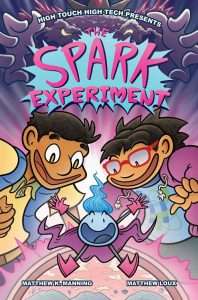
The story opens with David, a brown-skinned, lanky middle-schooler, imagining the “spark” of creativity and ideas as a cute little cartoon creature. He arrives home and meets up with his neighbor Marta, a lively homeschooled 2nd grader with red-rimmed glasses and the two investigate an explosion in David’s basement. It turns out his mom has successfully created a tool to shrink herself down so she can travel between dimensions into a “micro universe.” Unfortunately, she’s left the tool behind.
David and Marta go on a brief adventure to rescue David’s mom and, while in the microscopic dimension, encounter the blue spark of David’s imagination. It’s pictured as a blue ball with a purple cape, gloves, and boots on it’s stick-like arms and legs and a splash of blue “hair.” Together, with the help of David’s experiments, they rescue his mom from a crowd of purple creatures like Spark that seem to be sucking her creativity.
Inspired by Spark and their adventure, David tries again to start a Science Club and gets more interest this time. With the enthusiastic participation of Marta, he demonstrates how to make “space mud” at the club’s first meeting in his backyard and even gets the interest of a girl, Lisa. She’s shown wearing tights, a long skirt, and a loose jacket with curly black hair and a blue knit cap. David’s audience includes a kid with long blonde hair in a wheelchair.
However, the story is far from over – Spark isn’t the only creature that came through the portal from the microscopic universe and David’s mom is working on a new project in their basement that could mean disaster! David will have to bring out his trusty experiments and depend on Marta’s inexhaustible energy to save the day with science and keep the spark of inspiration alive.
There’s not a lot of variation in body types pictured, but that’s due more to Loux’s art style than a studied lack of diversity. Loux’s characters all have long, thin, flexible limbs and show exaggerated emotions with their wide mouths, heavily-drawn eyebrows, and the rapid changes in their eyes. The science experiments have a few illustrations, but these are mostly part of the story – the instructions are primarily in the text.
The other dimension is colored in orange-hued pinks, pale purples, and yellows with lots of ripples, creatures with multiple legs, and speech bubbles that look like tropically patterned easter eggs. This contrasts with the everyday suburb where David lives with blue skies and green trees and lawns.
The story includes 18 simple science experiments, from slime to a straw rocket and there is a QR code that has videos to accompany each experiment. The book is sponsored by a science organization called High Touch High Tech which creates fun science experiences.
There is some disconnect in the story – David is supposed to be a middle schooler, but the science experiments are more something an elementary student, like Marta, would enjoy doing. They do somewhat interrupt the flow of the story. As Marta points out, they’re running from monsters so why didn’t David just bring a compass instead of magnetizing a needle in the middle of a chase? However, the story is mostly a vehicle to carry the science experiments and a younger audience will enjoy the light story and be interested in trying the different projects. Manning is an experienced author who is used to creating nonfiction/fiction graphic novel scripts and the plot moves smoothly despite the sometimes jarring science elements. Older readers who like Matthew Loux’s art and are interested in the science-fiction genre are more likely to enjoy his own graphic novel series, The Time Museum.
The Spark Experiment By Matthew Manning Art by Matthew Loux Andrews McMeel, 2026 ISBN: 9798881601928
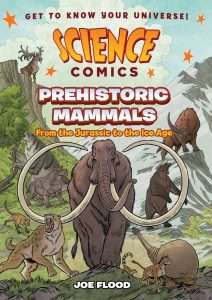
Science Comics is a long-running series, which invites a wide variety of skilled creators to explore different scientific subjects. All of the titles in the series have a certain amount of narrative story holding the information together, but some definitely lean more towards the expository, which is the case in this title
A prose introduction from Emily Lindsay, a paleontologist who works at La Brea Tar Pits, gives some context for the book, explaining the rise and extinction of megafauna and prehistoric mammals and the importance of large mammals today. Flood begins the narration with an iconic sequence of panels showing a line of mammoths tramping across a glacier in Siberia, where they are then attacked by a pack of cave lions and one young mammoth plunges into the icy water below.
He uses this sequence to kick off the basic concepts being introduced in the book, showing the modern relatives of mammoths and cave lions – elephants and African lions – and then jumping back to the origin of mammals and their gradual development over millions of years. These pages are filled with neatly drawn charts of evolution and cartoon creatures in bright colors who comment on each other’s adaptions with jokes.
Flood helps readers follow the evolutionary development of mammals with a yellow diapsid, “Dia” and a red synapsid, “Sid.” Eventually, Dia evolves into the dinosaurs, eyeing Sid hungrily, while Sid evolves into the early mammals, brownish-yellow, blue, and purple creatures. In the next big extinction, Dia’s survivors shrink down to a feathery yellow bird while Sid returns to his red, basic mammalian form. Flood’s color-coded animal adaptations make it easy for young readers to follow the complex concepts of evolution and adaptation over the huge periods of time represented.
The story next moves on to the Cenozoic, the age of mammals. Flood illustrates the early mammals in soft browns and grays with faint black patterns, setting them amidst lush green jungles and forests. This morphs into the more colorful variety of mammals we’re more familiar with today, as well as gradually diversifying plant life, with colorful flowers, birds, insects, and more. Dia and Sid continue to show up—Dia staying in her yellow bird form while Sid changes frequently, although generally keeping to a four-footed, small red mammal shape.
Flood continues the story, showing how the changes in climate and habitat prompted evolutionary changes in mammals and drawing more and more parallels between prehistoric and modern creatures as evolution progresses. The original red of Sid the synapsid shows up again here, in the arrows and charts, while extinct animals are generally shown in plain greys and browns, allowing the animals who have contemporary survivors to show up more clearly in the artwork.
Sid shows up again, illustrating the evolution of herbivores from small to large, to survive the large carnivores. Dia flies along above a fleeing Sid, making comments on the predator and prey racing about. The two follow along as the story nears the modern day, showing the niche animals that evolved on the now-distinct continents and the convergent evolution of different species. When the narration reaches the ice ages of the Pleistocene, Flood steps away from animals in a spread to illustrate the climate changes with blue and green diagrams and a fiery sun shooting rays of orange and red toward earth.
The narrative begins to return to the introduction, showing the migration of mammoths and describing the La Brea Tar Pits, as well as introducing the evolution of a new mammal – humans. Sid and Dia show up again, watching the arrival of humans. Flood illustrates the changing evolution of different human species, showing a variety of darker skin colors, postures, and hair textures. He has a distinctive style when drawing human faces and this begins to show up in this last section of the book, with larger eyes, square, blocky hands, and thick lips. The story ends with a discussion of the current extinction event we are living through and the effect it has on mammals, including humans.
Flood has written or illustrated several other Science Comics titles and his blocky, simply style with lightly humorous touches and clear, simple diagrams is well-suited to the series. He does an excellent job in this title of connecting the complicated and wide-ranging topic together, moving between epochs and eras and tying the exposition together with narrative touches from beginning to end. The text is very readable, although the number of Latin species names may daunt some young readers. However, those who are interested in prehistoric life will be generally familiar with the nomenclature and the text is very understandable even if readers stumble over some of the names. This is another excellent entry in a strong series that should be represented in all public and school libraries.
Prehistoric Mammals From the Jurassic to the Ice Age By Joe Flood Macmillan First Second, 2026 ISBN: 9781250868428
NFNT Age Recommendation: Middle Grade (7-11), Tween (10-13)
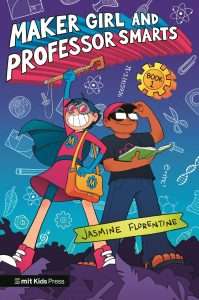
Jesus “Chuy” Reyes, age 12, starts the story by introducing himself and his best friend, Yael Levy or Yaya. Chuy is super smart and fascinated by all things intellectual—Yaya is a hands-on inventory and can make anything, even if she is a bit goofy at times. When a comet strikes earth and people gain mysterious powers, Chuy is super bummed – not only do these powers not conform to scientific laws, but he didn’t get any! When one of the second-rate supervillains of New Bork City ruins their ice cream, Yaya makes up her mind – they will become superheroes! With Chuy’s smarts and Yaya’s maker skills, the two take on Mr. Anti-Freeze, who is threatening to slimerize all the ice cream in New Bork City!
Florentine’s illustrations are bright and cheery, with lots of primary colors and drawn with clean, sharp lines. Chuy has brown skin, heavy eyebrows that move dynamically to indicate his exasperated moods, including up onto the outside of his pink baseball cap, and square glasses. He’s a tall, sturdy kid who gets a little excited about intellectual pursuits, but otherwise is mostly dragged along by the exuberant Yaya. Yaya, a skinny kid with short blue-black hair, is wildly enthusiastic about everything from superheroing to ice cream, despite the more cautious Chuy’s warnings and her younger brother’s embarrassment. Her family home is decorated to show her Jewish culture and Yoel, her younger brother, wears a kippah. Their villain has brown skin and pink hair.
The story is fairly simple, interspersed with lots of helpful (and random) facts from Chuy and step-by-step guides to making things from sorbet to grappling hooks from Yaya. The story ends with character studies and links to websites with guides for young makers.
Superhero take-offs like this tend to be cheesy, but this story is fully aware of its silliness and plays it for all it’s worth. Chuy’s repeated complaints that he’s NOT a superhero, the ridiculous villain, and Yaya’s wild enthusiasm will make readers giggle along with the author and maybe catch the making bug, even if they don’t want to put on a costume or have a super-powered bag to hold all their tools. While this is unlikely to satisfy readers who want “real” superheroes, it will certainly please younger readers who like funny stories and are interested in hands-on building. A must have for libraries and schools that include a maker space.
Maker Girl and Professor Smarts Vol. By Jasmine Florentine Candlewick, 2025 ISBN: 9781536239584
NFNT Age Recommendation: Easy Readers (5-9), Middle Grade (7-11)
This simple, informational comic starts the story on the endpages, with a small pink crab tumbling into the ocean. It falls on a small larva, who introduces itself. The larva is looking for a home and the crab is ready to get out of the boring bay – but agrees to show the larva around first. They meet kelp, anemones, and more inhabitants of the bay and finally become friends as well as figuring out the larva’s identity.
The plot is a little weak —Crab never really explains why it wants to leave and the “story” is mostly just there as a placeholder to move the characters around the bay and meet different creatures. However, with a younger audience this is fine and it’s a nice way to introduce the different inhabitants, which is the real point of the book. The short chapters, filled with puns and silly jokes, are divided by longer explanations of the different sea creatures the two meet and sometimes by interludes of puns, like a series of thumbnails of seagulls (one is a “trian-gull).
Information is included both in the general story, as when the two meet a group of mussels who explain that they are sessile, or when a sea urchin, sea cucumber, and sea star start an argument about the relative merits of their digestive systems, and in informational sections, narrated by the crab, which give more detailed information about behavior and habits.
Curll’s art style is very cute, with lots of blues and greens, picked out with brighter pinks and oranges. A red-lipped clam waxes philosophical about being the measure of happiness, with dramatic changes in its cartoon eyes. Kelp strands, some wearing old-fashioned glasses, gossips about their gas bladders and pokes the feet of littering humans. Two groups of opposing anemones, one orange, one yellow, wave their tentacles and zap each other and everything passing by, leading to a blue page with the heading “Pardon the interruption. We are experiencing tentacle difficulties.”
The final end pages show the crab passing readers on to the next habitat exploration, a fern forest with their guide, Fern. Curll has a fun, squiggly style that matches well with her pun-filled text. Young readers will enjoy exploring the underwater world with crab and larva, painlessly learning about the different underwater inhabitants, and giggling at the puns and wordplay. A strong choice for elementary school libraries and public libraries that serve this age group, with special interest for those located in the Pacific northwest.
Barnacle Bay By Jana Curll Greystone Books, 2025 ISBN: 9781778401022
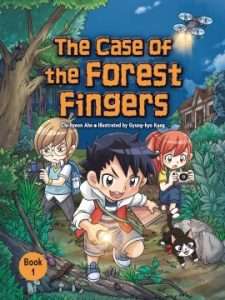
Lerner Graphic Universe often produces interesting graphic novels in translation and this informational series starter, translated from Korean, is a fun addition to their catalog. Illustrated in manga style, in full color and translated for Western readers to read left to right, it offers a fun mystery with a spooky element as well as some scientific facts.
Kihan Shin, a 5th grader, is the leader of the Mystery Science Detectives and always eager to investigate. Hannah Kang is their photographer and, more importantly, their muscle. Terry, a 4th grader, is just there to relax, but he’s willing to help out with his technological expertise as well as fly his drone to check out their investigations. They’ve even got a mascot, a cute black and white cat named Kkami. Their first mystery begins when Yunjin Ryu, a baseball player, comes to tell them that he lost his signed ball in the spooky woods on the hill behind the school. While searching for it, he had several terrifying encounters, including what appeared to be zombie fingers!
Kihan enthusiastically insists the team set out to investigate immediately, even though its nearly dark. As they explore the forest, there are frequent dramatic pauses in the narrative for entries in their case notebook, highlighting facts about forest ecosystems and the creatures they encounter there including Yunjin’s “zombies.” Clues and quizzes are included along the way, so readers can review what they’ve learned and try to figure out the mystery on their own. The story ends with a report on what they learned, a teaser for their next case, and a short comic from the artist.
The characters have the big eyes, spiky hair, and exaggerated expressions readers have come to associate with manga. However, this is clearly aimed at a middle grade audience since the characters differ mostly in hair color and style – they have realistic child-shaped bodies and the jokes that make them blush are mostly bathroom humor. Even the jump scares are child-appropriate. They’re drawn with dramatic dark colors, creepy shadows, and the characters drip nervous perspiration. However, scary things are quickly explained in a couple pages as natural phenomena, usually followed by case notes or activities. Kihan spends a lot of time grinning smugly, his mouth wide open to display prominent front teeth while fourth grader Terry tries to project a laid-back attitude with his blase face, despite his often obvious nerves. Hannah is fairly equal with Kihan, having a reasonable amount of time on the page and showing off her strength as well as her photography skills throughout the story, but although her high red ponytail never has a hair out of place she’s shown with a variety of emotions throughout the story.
This is a good introduction to manga conventions for younger kids as well as a great addition to STEM-themed graphic novels and a good choice for kids who want to read a comic that’s not TOO scary.
The case of the Forest Fingers By Chi-hyeon Ahn Art by Gyung-hyo Kang Lerner Graphic Universe, 2024 ISBN: 9798765627525
NFNT Age Recommendation: Middle Grade (7-11) Creator Representation: Korean, Character Representation: Korean,
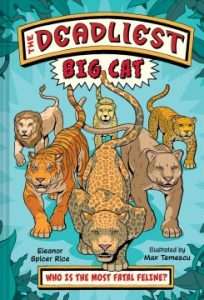
Eleanor Spicer Rice, an entomologist, has only recently started publishing books for juvenile readers. Starting in 2023 with Unseen Jungle, an informative and hilarious book about microbes, she’s teamed up with illustrator Rob Wilson to create accessible and interesting nonfiction titles. Her newest series, The Deadliest debuted in 2025 with two exciting titles that combine her inimitable prose with the lively art of Max Temescu. The two debut titles focus on very different creatures—spiders and big cats—and combine comic panels, anecdotes, game-show style art, and interesting facts for a fun and engaging reading experience.
Both titles begin with a basic introduction and safety tips for interacting with these creatures, including not keeping big cats as pets and not disturbing spiders. In Big Cat, readers learn about the basic species of cats and the seven that are considered “big cats.” In Spider we learn what defines a spider and meet six spiders that are considered the most dangerous from the brown recluse to the mouse spider. In both books readers learn about the creatures’ interactions with humans, how they can be dangerous, why they might attack a human, and potential scenarios of their attacks. A spinner at the end shows the ranked creatures from “What’s the big deal?” to “Say Goodbye” and we learn which of the species we learned about is most deadly. The answers will be surprising! But the story doesn’t stop there. Rice continues to explore the importance of each creature to its ecosystem, compares them to other natural and man-made hazards, and includes some fun activities.
Max Temescu’s art is a great complement to Rice’s lively text. Sleek cats and carefully detailed spiders roam the pages and the books’ layout is busy but not cluttered. He combines comic panels, info boxes, layers of different fonts and colors, occasional speech bubbles, and action shots to keep readers’ interest focused on the facts and narrative. The humans pictured have diverse skin tones and body types and the spiders, especially are shown as cute and friendly instead of frightening.
These are a step up in reading level from Pallotta’s popular Who Would Win easy nonfiction series and with the added bonus of Temescu’s art they are sure to become a favorite series for elementary-age students, as well as older readers who want to learn the truth about animals who are supposed to be “deadly.” Additional titles will be released throughout the year and they are an strong choice for most public and school libraries.
The Deadliest Spider; The Deadliest Big Cat By Eleanor Spicer Rice Art by Max Temescu Norton Young Readers, 202
Volume
ISBN
Big Cat
9781324053736
Spider
9781324053712
NFNT Age Recommendation: Easy Readers (5-9), Middle Grade (7-11)
The odd-couple trope in children’s books is most often seen in early readers and beginning chapters, from Elephant and Piggy to Pizza and Taco. Plots tend to shift towards a single protagonist or a group as they grow more complex, so it’s a clever creator who can maintain this dynamic in a graphic novel aimed at elementary-age students.
Pablo, a tall, skinny penguin, is perfectly happy living in the cold and snacking on krill pops. Splash, a short round penguin with a hat and scarf, is NOT. She wants to explore other places, preferably somewhere warm! She wants to go on… a vacation! When they fall into an underground lab and are captured by Professor O’Brain, they attempt to escape. A helpful “robot” invites them to hide inside of it… and turns out to be a time machine! Splash gets her vacation in a warm place after all – but it’s not what she imagined at all! She and Pablo will have to work together, combining Pablo’s patience and smarts and Splash’s enthusiasm and can-do attitude, if they’re going to make it home in one piece – and discover the secret plan of Professor O’Brain.
Dempsey’s art is bright and colorful, a good fit for her light-hearted and humorous story. The two penguins, with their unique body types, zip and bounce through the stark blue and whites of Antarctica, the warm underground yellows and browns of O’Brain’s lab, and the bright greens of their tropical destination. Time Bender, the time-traveling machine, is a round white orb, with a suspiciously grinning face and bland delivery of its lines, shown in an old-fashioned type. Professor O’Brain typifies a mad scientist, with a wild swirl of pink hair, pointed chin, and big goggles. She shows up at first in an ankle-length shirt dress, fuzzy slippers, and tool belt, and appears to be a villain, but by the end of the book her true colors show as she explains her plan with a friendly smile.
There is a lighter amount of text in this graphic novel, but it’s fairly complex, with puns, snarky jokes, and the penguin’s favorite exclamation, “for cod’s sake!” There’s also back matter with more in-depth and factual information about penguins, their time-travel destination, and Antarctica. Young readers who are fairly fluent, can handle different typefaces, and are comfortable with a thicker book but who prefer lighter, simpler storylines will be delighted to discover this goofy pair. This is also a good choice for kids who are reluctant to try longer or harder stories as the humor, fun illustrations, and rapid action will draw them into the story and encourage them to build their reading skills to decipher the story.
Pablo and Splash By Sheena Dempsey Bloomsbury, 2024 ISBN: 9781547616176
Company Age Rating: Matheson Memorial Library (public library, open to the public since June 2020)
NFNT Age Recommendation: Easy Readers (5-9), Middle Grade (7-11)
Look! It’s another entertaining edition of Science Comics, making science easier to understand!
This time around, Charlie the seahorse takes a deep-sea ride with Ryder, one of his over 700 kids! Charlie’s wife has bought him a “Freaky Fish of Filmland” cruise adventure, and the witty comments and weird deep-sea creatures don’t stop. Have you ever heard of the Bloodbelly Comb Jelly? Or the Viperfish? How about the Phronima Amphipod? Charlie and Ryder meet all these unusual deep-sea creatures and learn how they survive way down in the dark—at least until the tour guide’s boat conks out and they must ask for help!
The pages are sharp and brightly colored, and like all Science Comics pack a LOT of information into 132 pages. Ryder must conquer his fear of the ocean so he can grow up to be a strong seahorse. The panels are well paced and arranged. Science Comics are really popular in my library, and they’re priced low at $13.99 for paperback. My homeschooling moms love them too.
The work is appropriate for kids 5-12 years of age. Kids who like weird creatures and unusual alien types will probably like this book.
Science Comics: Deep Sea Creatures Adapting to the Abyss By Mike Lawrence Macmillan First Second, 2025 ISBN: 9781250841285
What “counts” as a graphic novel or comic? It’s an interesting question, especially with the proliferation of the graphic style into a number of different formats and genres. It’s easy to identify some nonfiction as being a graphic, especially those that have a strong narrative like memoirs, history, or the Science Comics series, which use a fictional narrative structure. It gets a little more confusing when it comes to illustrated nonfiction, like Lindsey Leigh’s latest book, but I, personally, stick by what I tell the kids—if it has speech bubbles, it’s a comic!
If we stick with that, Leigh’s book is definitely a comic as not only does it include speech bubbles it also divides information up into panels with something of a narrative structure. Her previous comic-style nonfiction book explored the depths of the ocean and this title explores the depths of the earth and the strange life-forms to be found in caves.
After introducing the concept of caves, the bulk of the book explores the three different types of cave animals, troglobites, troglophiles, and trogloxenes. Leigh then gives an overview of memorable caves around the world, and finishes up with the human history of interaction with caves and the need for conservation efforts around caves. The book ends with an index of the creatures introduced.
The spread on olms, a troglobite and blind salamander found in European caves, is a good example of Leigh’s work. The background colors are a swirling mix of deep purples and greens. Against these, the lavender olms, with pink, filly gills, stand out well. Two panels on the first page introduce them and their habitat, showing them zipping through a cave habitat. Below the panels, two olms are shown cuddled together, saying “Time for an olm cuddle puddle!” The following page includes another set of panels, demonstrating the olm’s ability to go dormant for long periods, and the spread finishes with a comparison of olms and axolotls, with the two declaring “We don’t wanna grow up!”
The olms are drawn in a curvy, comic style, managing to look cheerful even without facial features other than a hint of a curving mouth. Leigh plays with lettering to great effect, using an ornate, slightly spooky font for the heading, a bold uppercase font with letters picked out in purple for the speech bubbles, and a lightly curved, smaller font for the larger blocks of text.
Readers more accustomed to nonfiction presented in blocks of text, rather than the more graphic-style layout of the text being fully incorporated into the artwork, may struggle with the colored backgrounds and tracking down all of the different speech bubbles, short paragraphs, and sections of information. However, kids who are used to the comic format will have no problem devouring this new style of nonfiction and will easily remember the cool facts they learn about caves throughout the book.
It’s always been ideal to have a mix of formats for kids to experience reading and gathering information and the growth of graphic formats in nonfiction is just one more tool for librarians and teachers to impart information. Leigh’s humor, fun artwork, and presentation of information, helpfully reinforcing key points, makes her work a must-have for most library and school nonfiction collections.
The Dark! Wild Life in the Mysterious World of Caves By Lindsey Leigh Penguin Random House, 2024 ISBN: 9780593662595
The most successful shift between formats and audiences I’ve seen in authors is the transition of picture book creators to graphic novelists. Many picture books already incorporate some of the basics of comics, from word balloons to panels, and creators used to telling a story in a few pages, largely via their art, seem to do well in storytelling in the graphic novel format. Murguia’s debut graphic novel is a good example of this, as she produces a delightful and attractive book for young readers after over ten years of creating a fun variety of picture books.
The story features two main characters, Thunder, a short-haired, hound-type dog, and her young human Sage, who has short purple hair and a big imagination. The story is told from the viewpoint of Thunder and begins with the highlight of her day, the arrival home from school of Sage. The blissful reunion of their little pack is interrupted by Sage’s interest in a magazine that has arrived in the mail. Thereafter, while Sage pursues the goal of getting a magic cloak and seeing enchanted creatures, Thunder interprets her human’s actions in her own doggy fashion. Things get more complicated when the wolf from Thunder’s ancestry shows up—and the things she tells Thunder to do get her into a lot of trouble! The story moves briskly through Thunder’s simple adventures, the battle between her training and instincts, and Sage’s eventually realization that Thunder is all the enchanted creature anyone could need. Between chapters, Murguia includes one-page comics of “Pack Manners,” which demonstrate the behavior Thunder is using to bond her pack, but which sometimes backfires.
Murguia’s soft wash of watercolors, focusing on lavender and sage green, make the rusty brown of Thunder’s coat pop off the page. Her interactions with her inner wolf, as she learns about her history and instincts, are colored in deeper purples and grays, while more modern feelings and interactions with humans swirl with soft yellows and oranges. Sage appears to be elementary-school age, young enough to imagine finding a unicorn, but old enough to sew a magic cloak and care for a dog. The story can be poignant, brushed with soft grays and lavenders as Thunder’s tail droops, then brightening as she bounces into hilarious contretemps, tail whipping back and forth, tongue lolling, and action lines surrounding her wild movements. A history of dogs and “in-FUR-mation” about dog behavior is included in the back.
This lands in that sweet spot between readers who are finished with easy readers and beginning chapters but not quite ready to tackle a full-length chapter book. Dogs are a perennial interest for kids and the smooth blend of fiction and nonfiction is very well done. Sage is a relatable character, not least because she is a secondary character to the story, which focuses on the dog’s feelings, actions, and choices, and allows kids to imagine how their dogs—real or desired—view them. This will definitely be popular with fans of animal-themed comics like the PAWS series by Nathan Fairbairn, Animal Rescue Friends, and a plethora of animal-themed beginning chapter books.
The Adventures of Thunder and Sage Vol. 1 By Bethanie Murguia Macmillan Roaring Brook, 2024 ISBN: 9781250908735
Publisher Age Rating: ages 6-10 NFNT Age Recommendation: Easy Readers (5-9), Middle Grade (7-11)

 The story opens with David, a brown-skinned, lanky middle-schooler, imagining the “spark” of creativity and ideas as a cute little cartoon creature. He arrives home and meets up with his neighbor Marta, a lively homeschooled 2nd grader with red-rimmed glasses and the two investigate an explosion in David’s basement. It turns out his mom has successfully created a tool to shrink herself down so she can travel between dimensions into a “micro universe.” Unfortunately, she’s left the tool behind.
 titles in the series have a certain amount of narrative story holding the information together, but some definitely lean more towards the expository, which is the case in this title
 fascinated by all things intellectual—Yaya is a hands-on inventory and can make anything, even if she is a bit goofy at times. When a comet strikes earth and people gain mysterious powers, Chuy is super bummed – not only do these powers not conform to scientific laws, but he didn’t get any! When one of the second-rate supervillains of New Bork City ruins their ice cream, Yaya makes up her mind – they will become superheroes! With Chuy’s smarts and Yaya’s maker skills, the two take on Mr. Anti-Freeze, who is threatening to slimerize all the ice cream in New Bork City!
 larva, who introduces itself. The larva is looking for a home and the crab is ready to get out of the boring bay – but agrees to show the larva around first. They meet kelp, anemones, and more inhabitants of the bay and finally become friends as well as figuring out the larva’s identity.
 Korean, is a fun addition to their catalog. Illustrated in manga style, in full color and translated for Western readers to read left to right, it offers a fun mystery with a spooky element as well as some scientific facts.
 Jungle, an informative and hilarious book about microbes, she’s teamed up with illustrator Rob Wilson to create accessible and interesting nonfiction titles. Her newest series, The Deadliest debuted in 2025 with two exciting titles that combine her inimitable prose with the lively art of Max Temescu. The two debut titles focus on very different creatures—spiders and big cats—and combine comic panels, anecdotes, game-show style art, and interesting facts for a fun and engaging reading experience.
 and Taco. Plots tend to shift towards a single protagonist or a group as they grow more complex, so it’s a clever creator who can maintain this dynamic in a graphic novel aimed at elementary-age students.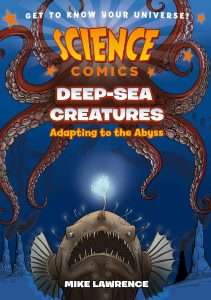
 style into a number of different formats and genres. It’s easy to identify some nonfiction as being a graphic, especially those that have a strong narrative like memoirs, history, or the Science Comics series, which use a fictional narrative structure. It gets a little more confusing when it comes to illustrated nonfiction, like Lindsey Leigh’s latest book, but I, personally, stick by what I tell the kids—if it has speech bubbles, it’s a comic!
 The most successful shift between formats and audiences I’ve seen in authors is the transition of picture book creators to graphic novelists. Many picture books already incorporate some of the basics of comics, from word balloons to panels, and creators used to telling a story in a few pages, largely via their art, seem to do well in storytelling in the graphic novel format. Murguia’s debut graphic novel is a good example of this, as she produces a delightful and attractive book for young readers after over ten years of creating a fun variety of picture books.
