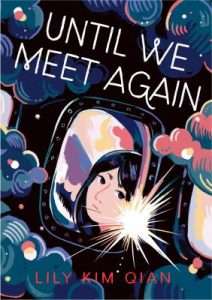
Memoirs often capture memories frozen in time, yet over the years, these memories can become reshaped, remixed, and even distorted. After all, facts become scattered but the truth behind the experiences endures. In her introspective memoir Until We Meet Again, Lily Kim Qian wrestles with deeply ingrained truths as she recounts her earliest memories leading to the estranged relationship between her parents, setting her on a path to discovery and inner healing.
The story begins in a jumbled dream-like state as Lily, a daughter of Chinese Canadian immigrant parents, sorts through a mixture of forgotten and remembered childhood memories—baby pictures, birthday parties, walks on a frozen lake, sizzling fried eggs made by her PoPo—which abruptly shifts to a darkened room where she watches her mother in a deep slumber. The scene later segues into a two-page spread where a tidal wave sweeps into a bedroom, signifying violent verbal battles between her parents that rage like a relentless tsunami. Narrated in vignettes, each story illustrates a moment in time, highlighting intimate details as she grapples with the gradual decline of her mother spiraling into the throes of mental illness. Segmented into chapters labeled after family members and locales spanning from Toronto to Shanghai, the plot runs the gamut of turbulent family dynamics converging through time and place as Lily constructs shattered fragments of her childhood to forge a new identity. From affectionate moments of her mother giving her a bath and dining over a meal of fried rice to outbursts of anger erupting between her warring parents, she navigates the ebbs and flows of fractured relationships in search of meaning and stability.
Bold and vivid line streaks infused with flecks of color paint the emotional landscape of each story. A variety of layouts—dynamic double-page spreads, a collage of photos, full-page scenes of places and characters—showcases a compelling assortment of visual compositions and storytelling prowess. Most striking is how the artwork translates metaphors into concrete images, which ranges from Lily somersaulting through recursive panels to illustrate her constant displacement from one home to another to a tangled ball of yarn symbolizing the mass confusion in the triangular relationship with her parents.
A memoir that reveals episodes of inherited trauma encompassed by the stigma of mental illness in Asian cultures, this story unearths poignant experiences dredged up from private memories. Much like how the brain functions when bombarded by a barrage of memories, Lily’s stories, or rather her recollection of them, unravels through a kaleidoscopic series of fractured moments that form a complex mosaic. Until We Meet Again adds a deeply intimate voice to young adult collections, exploring the complex emotional landscape of dysfunctional family dynamics in a beautifully rendered visual memoir from an Asian Canadian perspective.
Until We Meet Again By Lily Kim Qian Macmillan First Second, 2026 ISBN: 9781250884237
Company Age Rating: 14-18
NFNT Age Recommendation: Teen (13-16) Creator Representation: Canadian-American, Chinese, Depression Character Representation: Canadian-American, Chinese, Depression
“How long would it be like this? Would I get out? Or just stay fucked up?” (116).
So asks Glenn Head in his autobiographical Chartwell Manor, a chronicle of the physical, sexual, and emotional abuse that Head and his classmates suffered at the eponymous boarding school.
In 1971, Head’s family sends their teenage son to the English-style boarding school in New Jersey run by serial pedophile Terence Michael Lynch. Lynch (known as “Sir”) spanks, paddles, and canes the minors in his care, and he tells bedtime stories while he sexually abuses the boys. The other adults at the school, including his wife, normalize the abuse by treating Lynch’s behavior as business as usual (49).
Head attempts to confide in his parents, but right away we see that his weak, strained relationship with his parents sets the family up for a communication failure. Disgusted by her son’s wild, reckless behavior, his mother literally turns her back on the clearly troubled young man (119). Head thinks to himself, “This can’t be talked about,” (103). Even many years later, Head’s mother does not open up to hear his experiences, and his father has dementia and cannot receive it either. Both parents vocalize a “the past is in the past” mentality. After graduation, Head ends up in Brooklyn, dealing with the trauma and subsequent fallout. This manifests as drug and porn addiction, sexual dysfunction, relationship problems, and suicidal ideation.
One good thing that happens at Chartwell Manor is that budding artist Head draws his first comic there (69). The alternative, or underground, comics (comix) that Head was exposed to-Zap Comix, Mad Magazine, and Weirdo Magazine—inspired his style. Head’s black and white artwork is dense and heavily inked with a lot of bizarre, psychedelic imagery. The people are cartoonishly stylized and the environments are finely textured and patterned. The book is incredibly enticing visually. Head pulls no punches in depicting sex, prostitution, violence, substance use, and other adult content. The busy, cluttered style and the tragic subject matter pair well. At first, both seem like too much to take in, but the reader who persists reaps the reward of seeing Head’s progress. On the final page, Head is with his daughter, thinking about just letting go. “Holding onta stuff yer basically…much better off lettin’ go of…Maybe I’ll work on that,” (236).
This dark and disturbing adult memoir is a deeply candid story with wonderful artwork. Memoirists and aspiring cartoonists will benefit from reading Chartwell Manor, while those readers who would struggle with the content should of course skip it. Graphic memoir is an overflowing genre and it can be hard to pick out a worthwhile book, so consider this an easy win.
Chartwell Manor A Comics Memoir By Glenn Head Fantagraphics, 2021 ISBN: 9781683964254
NFNT Age Recommendation: Adult (18+) Creator Representation: Addiction, Depression, Post-Traumatic Stress Disorder Character Representation: Addiction, Depression, Post-Traumatic Stress Disorder
Zoe Thorogood received multiple award nominations for It’s Lonely at the Centre of the Earth, including 2023 Eisner Awards in the Best Graphic Memoir and Best Writer/Artist categories, Forbes’ “The Best Graphic Novels of 2022” list, and she won the 2023 Russ Manning Most Promising Newcomer Award at the Eisner’s. Her art is evocative, engrossing and layered, grabbing readers immediately.
Zoe herself, however, is an entirely different story. She is certainly layered and complex, but she’s also self-conscious, shy, self-described as pathetic and suicidal. It’s Lonely at the Centre of the Earth is her attempt to record a six month span of her life and try to make sense of how and why she is mental and emotionally in the place she finds herself. A large portion of the story takes place during the Covid-19 lockdown period of 2021 and the sense of isolation many of us experience then is personified by Zoe, who was lonely long before then.
There is a lot of fourth wall breaking as Zoe directly addresses the reader in this book. Very early on she admits that she’s recently had suicidal thoughts, but she’s had them since she was 14 so it is nothing new for her. She is also quick to admit that this book may be an exercise in narcissism or it might help someone else, but it certainly is a selfish act. She’s hoping to bring us along on her journey to America for her first big comic convention she’s been invited to and her hope is the trip itself might be a journey of self-discovery. During the course of the story we’ll meet 14 year old Zoe back in 2013 and see what it was like for her to try and survive in school, watch Zoe meet her best friend in college and have her heart broken in America.
We see Zoe struggle with personal interactions in public with strangers, fans of her work, her parents and at time her friends. She illustrates her depression as a monster that follows her, a giant looming specter waiting just behind her. She illustrates multiple versions of herself and her personality in varying styles so that we can better see how she transitions in and out of comfort and confidence to stress and fear. I’ll point out here that the art in this book is phenomenal and truly aids every facet of the storytelling. There are times it is told in just black and white, other times with splashes of color and some pages are collage with photocopy and photographic elements. I was completely captivated throughout the book.
It is bold for a 22 year old to write a memoir as there is usually not much life experience to draw from, but this book didn’t suffer from a lack of self-awareness there. Zoe explores themes of isolation, self-worth and perception while pointing out to herself how wildly indulgent and vain it is. While it may not have provided a neat, tidy ending where all ends ‘happily-ever-after’, we did see a lot of personal growth from Zoe even as she simply engages with the idea that her younger self would see her current art as successful and fulfilling. She ends the story in a better place than we found her at the beginning saying, “Loneliness makes it hard to see the bigger picture. It makes you self-obsessed; not out of narcissism but because your own self is all you have. Your flaws, quirks, regrets, and mistakes begin to engulf you. Your own self begins to overshadow that bigger picture, but there is always a bigger picture.”
Image Comics rates this book as Mature and I would agree for the sake of placement inside a library. Suicide is already a tough subject to tackle with younger readers, but Zoe depicts (and comments on) her casual drug use and there is profane language sprinkled throughout. I wouldn’t tell older teens not to pick this up, it’s clear why it was nominated for so many awards, but for them especially I would point out Zoe’s disclaimer inside the cover about talk of suicide and her confrontations with it. I hope for her sake it was as cathartic to write as it is to read. Her frankness and honesty was compelling and I found myself rooting for her.
It’s Lonely at the Centre of the Earth By Zoe Thorogood Image, 2022 ISBN: 9781534323865
Publisher Age Rating: Mature
NFNT Age Recommendation: Adult (18+) Creator Representation: Anxiety, Depression
High school is a time of transition. A time for coming of age. Relationships change. Both family and friends. Some end, others evolve, and new ones emerge. You begin to see yourself in a new light. It’s a time when many are suspended in limbo. For Deb JJ Lee, a Korean-American author and illustrator, their high school years were a time of tumultuous self-discovery. In Limbo is Lee’s graphic memoir chronicling the choppy waters of adolescent relationships and sense of self.
Lee struggles to find their place at home and at school. After emigrating from South Korea as a young child, they struggle with their identity and being other, not really Korean but not really American.
The memoir navigates relationships and emotion with great care and depth. After years of playing the violin, Lee comes to the realization that their passion is art, not music. The transition is difficult. Friends are in the orchestra and their parents invested so much time and money in lessons. This limbo between music and art is the theme throughout their freshman and sophomore year. And, as with the other themes of transition throughout the book, there are moments of dread and moments where the weight is lifted and Lee feels happiness or at least some peace. This is clearly communicated through the changing imagery in Lee’s illustrations. Their posture and facial expressions transition from feelings ranging from bored through sadness and loneliness to contentment if not happiness. During the lowest of lows, the panels fill with black smoke, drowning out everything else. But as they emerge from limbo with greater peace, the illustrations begin to shift as well. Rather than focusing on illustrations, Lee begins to find beauty in the details of every day. The pages turn into intricately drawn slice-of-life illustrations. But the peace is temporary, as they continue to navigate life transitions.
Lee’s story will be validating for many. Childhood friendships evolve and no longer seem to fit, and even new brighter friendships sometimes start to fade. These feelings are both devastating and almost universal for teenagers.
From the beginning it is also clear that the mother and child relationship is strained, another very personal and universal experience. However, as the memoir unfolds, it is clear that this mother is abusive, and that the strain in the relationship is far from universal. There are moments when the mother seems to begin to understand her child. When transitioning from music to art, Lee’s mother supports and encourages them, knowing that she must support what her child’s passions are, not what she wants them to be. However, that moment is more of an exception than a rule.
At one point in the memoir, Lee suggests that their mother avoided scrutiny from CPS because of “tiger mom” stereotypes of Asian mothers. Lee’s relationship with their family is complicated. Lee at times fears their mother, but at other times feels loved and supported. The dad is mostly sympathetic and warm but allows the abuse to continue. The complexity of the family dynamics unfold in the narrative as teenage Lee begins to unpack their trauma, a choice that invites the audience to acutely feel the betrayal.
The story will be validating for many. Lee is honest about their struggles and journey with relationships and mental health as a teen. There are no clear-cut solutions or fulfilling peace in the end, but there is therapy and the sense that they are on their way to self-acceptance.
In Limbo is not an easy book to read. The pace of this memoir is slow and deliberate. It focuses on Lee’s arc as a teen coming into themselves, rather than the events of their high school years. The content is also heavy. The book includes depression, abuse, and suicide attempts. However, for those who find their way to this memoir, it is a rewarding experience. I will highly recommend it to students who are fans of Tillie Walden, weighty memoirs, or anyone who needs reminding that the comic medium is a literary art form worthy of acclaim.
In Limbo By Deb JJ Lee Macmillan First Second, 2023 ISBN: 9781250252661
Publisher Age Rating: 14-18 NFNT Age Recommendation: Older Teen (16-18), Teen (13-16) Creator Representation: Korean-American, Nonbinary, Depression Character Representation: Korean-American, Depression

 Memoirs often capture memories frozen in time, yet over the years, these memories can become reshaped, remixed, and even distorted. After all, facts become scattered but the truth behind the experiences endures. In her introspective memoir Until We Meet Again, Lily Kim Qian wrestles with deeply ingrained truths as she recounts her earliest memories leading to the estranged relationship between her parents, setting her on a path to discovery and inner healing.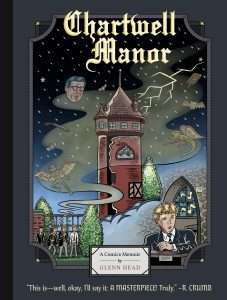
 the Best Graphic Memoir and Best Writer/Artist categories, Forbes’ “The Best Graphic Novels of 2022” list, and she won the 2023 Russ Manning Most Promising Newcomer Award at the Eisner’s. Her art is evocative, engrossing and layered, grabbing readers immediately.
 High school is a time of transition. A time for coming of age. Relationships change. Both family and friends. Some end, others evolve, and new ones emerge. You begin to see yourself in a new light. It’s a time when many are suspended in limbo. For Deb JJ Lee, a Korean-American author and illustrator, their high school years were a time of tumultuous self-discovery. In Limbo is Lee’s graphic memoir chronicling the choppy waters of adolescent relationships and sense of self.
