Oh, sure, we’ve all been there. We bust our butts using our super powers and gadgets to save the school and our friends and loved ones just don’t show us any appreciation whatsoever! So, we gotta take the appreciation where we can find it, even if we have to make it ourselves.
Leon: Worst Friends Forever: A Graphic Novel is the follow-up to Leon the Extraordinary. This story explores the fallout of his initial victory against a villain called The Monocle. It turns out that doing heroic deeds doesn’t automatically make you likable. Leon finds himself at odds with his superhero mother as well as his friends at school; his interests have swayed much more into the direction of what he perceives to be acts of heroism at the cost of what it means to simply be a decent person. He’s beginning to let his friendships slip away, his relationship with his mother is becoming strained and difficult, but he fails to grasp the larger implications of these changes.
This is what makes getting through the book difficult: Leon is not particularly likable. The “worst friends forever” component of the story refers to a plot line where Leon has an argument with his good friend Carlos that does get resolved eventually, but it certainly takes its time, and on top of that, the overarching conflict of Leon taking matters into his own hands too rashly and too often is still very present. The final action of the comic sees someone trying to contact Leon’s superhero mother, who is absent, and Leon volunteering to help in her place. This is met with an angry reply of “But I didn’t ask for your help!” Leon ignores the shout, and proceeds in the way he thinks is best. There is a planned third volume and I am hoping that this conflict will be better explored and resolved.
The narrative in Leon: Worst Friends Forever is extremely dependent on the world-building that took place in the previous book. If you are planning on purchasing this, please be aware that it is the second volume in a series of two (so far) and I personally feel that it is not suitable as a standalone narrative. Certainly, more mature readers are going to pick up on context clues about the overall story, but I think younger readers might be a bit confused about some of the smaller details: who exactly knows about Leon’s identity as a hero (other supers, kids and adults alike, flaunt their powers and some don’t – I’m not sure what the delineation is), what his specific powers are (he does not have any – it is not mentioned in this specific volume), who his friends are, how his mother fits into all this, etc. The art is big, blocky, and punchy with a lot of bright colors set against flat and busy compositions – it very much reminds me of a kids’ cartoon.
Leon is hard to like right now, but this is a middle volume, so the story is probably just in its awkward stage.
Leon: Worst Friends Forever: A Graphic Novel By Jamar Nicholas Scholastic GRAPHIX, 2024 ISBN: 9781338744200
Company Age Rating: 8 – 13
NFNT Age Recommendation: Middle Grade (7-11), Tween (10-13) Creator Representation: African-American, Character Representation: African-American,
I knew of the Books of Doom mini-series by reputation, though I had never read it. Coincidentally, I started seeking out the original comics or the TP collection at my local comic shop’s end-of-the-year sale, before spying the new reprint one merry Wednesday several weeks later. I am happy to report that the story lives up to its status as the best retelling of Victor Von Doom’s origins ever.
The 2025 Doctor Doom: Books of Doom collection opens with an introduction by author Ed Brubaker. In it, he discusses the inspiration for the series; a Doctor Doom story from Astonishing Tales #8, written by Gerry Conway with art by Gene Colan. This story revealed that, once a year, Doctor Doom did battle with the demon that claimed the soul of his sorceress mother. Every year, he failed to save her.
I think Astonishing Tales #8 may be the single-most influential comic regarding modern interpretations of Doctor Doom. The same story clearly set up Triumph and Torment – the team-up with Doctor Strange in which Doom asked the Sorcerer Supreme to aid him in this battle. Both stories portray Victor Von Doom as a noble demon. He is a man who may use questionable means, but whose ultimate goals are noble and pure.
Books of Doom says otherwise.
Certainly this is how Doom sees himself, as he dictates the story of his life in his own words to a journalist. This recollection is interrupted with interviews with those who were there for the events Doom describes. Their view of things is different than that of the Latverian monarch. Yet it cannot be definitively said that their viewpoint is the true one either.
Brubaker’s script builds upon the original Doctor Doom origin envisioned by Stan Lee and Jack Kirby. He inspires sympathy for the devil but does not allow us to forget for one moment what sort of man Victor Von Doom is. For all his talk of building a better tomorrow, he is trapped in the past. From his obsession with saving his mother, to his belief that Reed Richards sabotaged his experiments, he cannot move on from avenging the slights inflicted upon him. Whether or not he was wronged is immaterial. He cannot advance in either case.
The artwork by Argentinian artist Pablo Raimonid shows similar depth and complexity. One particularly noteworthy point is his use of shadow, which hints at the inner darkness of Doom’s soul and the world of espionage into which he is drawn as a young man. Raimonid also offers one of the strongest designs for Doctor Doom’s armor ever envisioned.
Marvel Comics rates this collection T+, for readers 13 and up. I believe this to be a fair assessment. There is violence and death in this series, and we are not spared the horrific details of how Doctor Doom was forever burned and scarred by a lab accident. There is some sexual content, with Doom depicted naked in bed after being reunited with his first love, Valeria. Nothing is shown, however, and their brief love scene is shrouded in shadows and limited to two panels. There is nothing here that is inappropriate for a teen audience, and I think most libraires would benefit from having a copy of this volume in their collection.
Doctor Doom: Books of Doom By Ed Brubaker Art by Pablo Raimond Marvel, 2025 ISBN: 9781302964733
Company Age Rating: T+
NFNT Age Recommendation: Adult (18+), Older Teen (16-18), Teen (13-16) Creator Representation: Argentinian, Character Representation: Romanian,
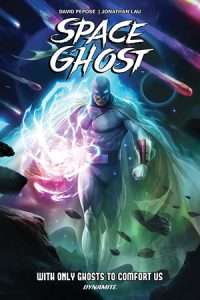
In the future, a great Galactic Federation unites hundreds of worlds across the galaxy. But in the dark space between the stars and civilized worlds, evil flourishes. Pirates. Slavers. Mad scientists. Doomsday Cultists. All manner of evil-doer who seek to prey on those innocent settlers of remote worlds who cannot defend themselves.
Yet the final frontier is not completely lawless. For there is a vigilante who stands for those forced to bend a knee to oppression. He is a grim spectre who disappears as quickly as he appears. The tales of his deeds are many, yet his origins are a mystery. The one thing that is agreed upon is his name—Space Ghost!
Some say he is a lawman who abandoned his post to confront those criminals his bosses would ignore. Others say he is a literal shade, back from the dead to seek revenge on those who destroyed his homeworld. The only ones who know even a fraction of his true story are Jan and Jace, two orphans the Phantom of the Spaceways adopted. Two children, with a super-intelligent test monkey named Blip, who may come to know the heart of a hero, and in time, help to mend it.
Space Ghost was one of the most popular of the superhero cartoons created by Hanna-Barbera. Designed by the legendary Alex Toth, Space Ghost was unusual in that he was never given an official original story. He also enjoyed impressive longevity in reruns, with his original show only numbering 20 episodes. He is somewhat more famous (or perhaps infamous) as the star of Space Ghost Coast to Coast, a 1990’s talk show made with recycled animation, which set the stage for Cartoon Network’s Adult Swim block of absurdist cartoons for adults.
David Pepose stays true to the spirit of the original animated series, while updating the general tone for modern audiences. This is no grim-and-gritty reboot, thank goodness. If anything, the comic sticks closer to its core concept of “Batman in space” than the original cartoons did.
This is a comic that runs with its science-fiction superhero premise and explores the intricacies of its universe in detail. Pepose does not shy away from the evil or insanity of the villains, but neither does he make them evil for evil’s sake. Even the mad mantis Zorak, reimagined here as a cultist who seeks to bring about the apocalypse, has a method to his madness. Despite this more mature tone, nearly every issue has a lesson to impart to the reader as Jan, Jace and even Space Ghost learn something from their latest adventure.
The artwork of Jonathan Lau is similarly detailed and driven. The action sequences where we first see (and then don’t see) Space Ghost are truly intense and magical. The designs of the many villains are clearly modeled on Toth’s work, but with subtle changes that make them into something new and generally horrifying. The color art is also amazing throughout.
Dynamite Entertainment rates this volume as appropriate for Ages 12 and up. I agree with that assessment. There is no sex or nudity in this book, unsurprisingly. There is considerable violence, however, and some truly intense moments. There is nothing inappropriate for a teen audience, however. Indeed, I think this book will mostly appeal to those fans of superheroes and science fiction looking for a step away from Batman. There’s broad appeal to both genders, as well, with Jan being the better marksman of the siblings and Jace being more comfortable piloting the Phantom Cruiser.
Space Ghost Vol 1: With Only Ghosts to Comfort Us By David Pepose Art by Jonathan Lau Dynamite, 2024 ISBN: 9781524126858
Company Age Rating: 12+ Related media: TV to Comic
NFNT Age Recommendation: Adult (18+), Older Teen (16-18), Teen (13-16)
Character Representation: Post-Traumatic Stress Disorder
The superhero Captain Amazing is getting older, and he could use some help on the job. When he announces hisplan to hold auditions for a sidekick, no one is more excited than his own pets, Roscoe the dog and Fluffy the hamster. Their beloved human is always out saving the city, and they miss him at home. Becoming his new sidekick would mean spending lots of time with him, and Roscoe and Fluffy are both determined to audition. Even Captain Amazing’s brand-new pet, a chameleon named Shifty, is interested in trying out.
Roscoe is a large dog with his own superpowers. Shifty can at least use his chameleon camouflage to sneak around. But Fluffy has never demonstrated any special abilities, and, well, he’s a hamster. Still, he won’t give up. Fluffy and Shifty team up to practice fighting crime… and find an unexpected ally who helps them learn how to be heroes. And they’ll need all the help they can get, because some major supervillainy is afoot.
This is a fun romp with cool powers, crime-fighting action, humor, and heart. Captain Amazing’s pets have very different personalities: Roscoe is bossy and impatient, Fluffy is determined and clever, and Shifty is nervous and excitable. There is also Manny, the jaded superhero cat who becomes Fluffy and Shifty’s mentor. What they all have in common is courage and caring about each other, even if they don’t always know how to express it. As the pets learn how to be heroes, they also learn how to be a family.
The art uses color, texture, lighting, and perspective to create a rich world that feels three-dimensional, like moving through a video game. The human characters are detailed and on the realistic end of the cartoon spectrum, while the animal characters are more caricatured. They are also partially anthropomorphic: their front paws are hands with opposable thumbs, Fluffy and Shifty walk on their hind legs, and all the animals have very human facial expressions. The artist makes good use of superhero-comic visual tropes like action lines, midair poses, and dramatic rooftop silhouettes. There is a wide and dynamic range of panel layouts, especially during action scenes, which adds visual interest and increases the sense of movement and drama.
This volume was originally published in 2011. This 2024 edition includes sixteen new pages at the end, which hint at an intriguing connection between Captain Amazing, Manny, and certain other characters. (No spoilers!) The art style in these pages is different: both appear to be created digitally, but the original art has a smoother, more painted-looking style, while the new art has sharp, fine black outlines and more visible digital “brushstrokes,” making it feel more like a drawing than the immersive, three-dimensional looking original art.
Like most superhero stories, this one involves some peril and violence. No one dies, but there are some close calls and injuries. The main supervillain, in the big final showdown scene, is quite menacing.
This book will already be familiar to some readers from its 2011 version, but the new edition presents an opportunity to hand it to a new crop of young readers who like superhero and action stories with heart. Fans of the original will also be happy to learn that this new edition is Book One in a series, with three sequels in the works.
Sidekicks Book One, Vol. 1 By Dan Santat Scholastic GRAPHIX, 2024 ISBN: 9781338879155
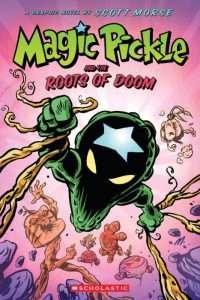
Weapon Kosher may not be the hero we deserve. He may not be the hero we need. But he is the hero who comes in brine. In the latest installment of Scott Morse’s middle grade graphic series, Magic Pickle and the Roots of Doom, our bread and butter superhero faces his biggest challenge yet.
While fighting three villainous candies, the Tricky Treats, Magic Pickle (Weapon Kosher if we’re being formal) accidentally creates two new sentient vegetables. First, Herb Cloveson (aka Strong Scent), a clove of garlic suddenly thrust into complex awareness who just wants a friend and guidance. Despite the part he -unintentionally- played in Herb’s creation, Magic Pickle immediately rejects the allium’s attempts at friendship and is quickly overwhelmed by his powerful, garlicky punch.
The other new vegetale villain is Square Root, a power hungry turnip who will stop at nothing on the path to world domination. Square Root offers Herb the friendship Magic Pickle denied, even if he is just using the bulbous baddie for his powers. This becomes a very big dill for Magic Pickle when he loses his powers to Square Root and must face off against a bushel of tuberous terrors. Can Magic Pickle move past his half-sour disposition to find strength in unexpected places and rely on others, like his sidekick/partner/assistant JoJo?
This graphic continues Morse’s track record of engaging, silly content that the intended reader will love. Nearly overflowing with pickle based puns, Magic Pickle and the Roots of Doom is a bright, funny, quick read with decent deeper messages. Herb doesn’t know how to push back when he feels like his new friends aren’t the kind of tubers he can root for. Magic Pickle doesn’t know how to ask for help or what to do when he finds himself in a… well, pickle. These are concepts that tween readers can definitely connect to, folded into the familiar traps and tropes of a traditional comic. Yes, it’s a silly book about a pickle. And yes, there’s the potential for life lessons between the salty puns.
Guy Major’s vibrant colors enhance Morse’s bright, dynamic illustrations and make this a very easy graphic to look at. Morse’s background in animation is evident, letting the characters jump and move across the page. There are segments, however, where the panels lose their natural flow, usually in action-based moments. This makes some pages a little messy, to the point where small, green directory arrows are included as visual clues for reading as opposed to the action directing the reader’s eyes. This only pops up on a few pages, but it does muddle the flow of those pages a little. Additionally, there are no built-in chapter breaks in this book. While this is a quick read, given the publisher’s target reader is 8-12 years-old, having action breaks to allow for a break in reading would be handy.
Despite these small points, this is a great book. It doesn’t require any previous knowledge of the Magical Pickle universe and it’s just a fun read. This is an easy pick for readers who have aged out of Dog Man or The Bad Guys and who would relish a new hero.
Magic Pickle and the Roots of Doom Vol. By Scott Morse, Guy Major Scholastic GRAPHIX, 2024 ISBN: 9781338188066
Classic Fantastic is our series of features on the classics of the format—please check out our other picks for the most important titles, in terms of appeal, innovation, and storytelling, that every library should own.
What’s it about?
In the DC universe, Leonard Snart was once the supervillain known as Captain Cold, a prominent villain, or rogue, who clashed with the superfast superhero The Flash. With his cold gun, he could freeze the so-called fastest man alive in his tracks, but that was a while ago. Now, Leonard is out on parole. Having served his time in prison, Leonard endures a parole officer who’s a jerk and a steady paying job that doesn’t respect him in his quest to stay on the straight and narrow, until he’s finally had enough. He’s just learned of an epic score that could set him and his fellow Rogues up for life, so he’s getting the crew back together for one last heist.
Joining Snart are a list of once feared villains who have suffered from addiction, dead-end jobs, and the endless cycle of prison and rehabilitation. Golden Glider, Trickster, Magenta, Bronze Tiger, and Mirror Master have, in one way or another, been kicked in the teeth by life and now want to kick back. All involved are looking to reclaim their glory days of going toe-to-toe with superheroes.
It’s the heist itself that gets a little tricky. Before these rogues can enjoy their score, they must break into the mysterious Gorilla City, a city hidden away from civilization that boasts a populace of superintelligent gorillas and is ruled by Grodd, a gorilla with both a keen intellect and a savage disposition.
When they get to Gorilla City, it isn’t the city that they expected and obviously the heist doesn’t go according to plan, but what heists in these kinds of stories ever go to plan?
Notable Notes
While DC villains like Lex Luthor and the Joker get all the accolades for their dirty deeds, Flash villains, calling themselves Rogues, are more blue-collar. Not interested in taking over the world or somehow sending the Earth crashing into the sun, all these villains care about is the next big score, and Snart has often emerged as the leader of this group among its various members. This mentality of simply wanting to make a living being bad makes them the perfect protagonists for a heist storyline. Fans of the Suicide Squad, a typically more adult themed team of supervillains who are enjoying a bit of a resurgence in popularity, should like this depiction of villains doing villainous things. Writer Joshua Williamson has worked on several DC superhero projects like “Green Arrow” and “Justice League,” and he demonstrates his familiarity for DC’s superhero universe, but he also tells a grittier, more grounded story.
That grittier and more realistic tone is emphasized by illustrator Leomacs, who did the artwork for adult horror and fantasy comics like “Basketful of Heads” and “Ghostlore.” Most of the characters in this story don’t necessarily look like big-time supervillains with steely gazes and spandex-squeezed muscles; Snart is older, thinner, and balding while a freshly sprung from rehab Mirror Master is typically portrayed with wide, glazed eyes that shows he might be more committed to getting his next fix. Even Gorilla City gets a grittier makeover in an unusually fantastic way, looking more like a Las Vegas run by the mob than a lost city full of gold.
Significance
“The Flash” series completed its ninth and final season in 2023 while a 2021 Suicide Squad movie starring Idris Elba and Margot Robbie helped people forget the less-than-successful Suicide Squad movie in 2017. This proves that superheroes are not only a part of popular culture, but they remain ripe for reinvention. The Flash made his debut in 1956 and is still running thanks to his appearances in different media, but his villains, the Rogues, have the potential to steal the spotlight, thanks to the Suicide Squad, a series that is so similar in tone and premise that these groups interacting or teaming up doesn’t seem like a stretch.
Apart from the current popularity of superheroes, this comic, part of DCs Black Label imprint, shows a gritty take on superheroes that isn’t just morally corrupt people snarling and dropping f-bombs. Many of the villains in this book are multifaceted individuals with their own unique goals and interests, and just like any good crime story, they sometimes run counter to the group’s overall objective. Some might want the money while others want to relive the glory days. Superhero graphic novels are often ridiculed as adolescent power fantasies, and many adult superhero tales are derided as simply everyone’s favorite superheroes and villains swearing, but “Rogues” actually works as a mechanically precise heist story that just happens to feature supervillains.
Appeal
Fans of The Suicide Squad and adult fans of superheroes, particularly ones who want a mature kind of storytelling, should enjoy reading this story and watching the wheels coming off this caper. This book should also appeal to fans of movies like “Ocean’s Eleven” and “The Italian Job,” where the thrill is watching to see whether everything goes right, goes wrong, or both (spoiler alert: there’s a lot that goes wrong). While this book features fantastical elements like cold ray guns and lost gorilla cities, this book has the beating black heart of the darkest kind of noir story. Along with the swearing, there is a lot of death in this book, often in very violent ways. Even those who manage to walk away with all their various organs in their original locations don’t walk away unscathed, so fans who don’t mind superpowered individuals dying or killing should give this book a read (Just prepare for the gore!).
Why should you own this?
A surprisingly popular trope in the superhero genre involves spotlighting their villains, whether as complete antiheroes or showing a more sympathetic side. “Rogues” takes this concept to a new level by offering a group of villains who feel like their backs are to the wall. Readers will root for these heroes and feel their loss when this heist goes tragically off the rails. With debt, addiction, and a dwindling legacy all threatening to overwhelm them, they strike back the only way they know how: by trying to commit the biggest score of their lives. The book is also one of the strongest from the DC Black Label imprint, showing that one can tell a mature noir story that can also include a talking gorilla. Rogues By Joshua Williamson
Art by Leomacs
DC Black Label, 2022 ISBN: 9781779516855 NFNT Age Recommendation: Adult (18+)
No matter if a superhero was bitten by a radioactive something, caught in the heart of a nuclear explosion, or watched a bat fly through their window, a large part of that hero’s narrative is their origin story. Of course, it’s not just the event that gave the hero their powers, but it also provides their motivations, whether they use their powers to preserve order or destroy evil, which transforms the debate into whether or not the hero is using their powers responsibly.
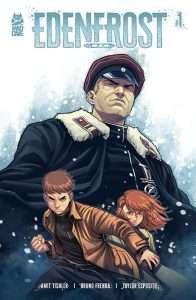
Even though Edenfrost, written by Amit Tishler and illustrated by Bruno Frenda, is a historical fantasy story set during the Russian Civil War, it borrows many plot points from the archetypal superhero narrative.
The story’s unlikely heroes are brother and sister, Alex and Yuli, who are on the run after their village is attacked by Russian soldiers. However, this is more than just a village being razed by superior firepower. A survivor of the onslaught says that a terrible monster sprang up out of the earth and attacked them. Alex knows about this monster and soon Yuli will, too. It is a monster that is immensely powerful, but it also craves someone who will use that power, whether for good or evil purposes.
It’s easy to get lost in the geopolitical nuances of this war that hangs over the book, but Tishler does a good job of keeping this story on a very basic path of conflict: hero(es)’s home destroyed, hero(es) must try to escape the charismatic yet evil villain (in Edenfrost, it’s the ice-cold Colonel Krasnov) pursuing them. Tishler does sprinkle some commentary about the effects of war, such as when Alex and Yuri must hide out with a woman who would kick them out (or worse) if she knew about their Jewish heritage and a soldier who tries to tempt Alex into using the golem’s power in the war effort. This tale could be applied to any story where the heroes must make some very difficult choices with the power they’ve been given.
That power is depicted through Frenda’s dynamic artwork. Fans of “Avatar: The Last Airbender” and how it depicts earthbending will love to see columns explode out of the ground. When the golem, a creature made out of earth and stone, not only appears but mow down enemy soldiers, the creature acts with a speed and brutality one typically sees in martial arts battles displayed in the graphic format. However, Frenda’s artwork isn’t just “Dragonball” or “Ranma ½” set in Ukraine. The faces of these characters all feel real and distinct. Alex and Julia are young and their emotions are all over their faces. Krasnov emotes very little, merely sneering at those who challenge his superiority until he tells the troops under his command to shoot those challengers.
Edenfrost is a superhero story, but it doesn’t necessarily end with its heroes soaring over a city skyline. Alex and Yuli are still surrounded by war, death, and social upheaval. Their powers don’t guarantee that they’ll even survive, much less survive this war with their values intact. Its mature themes might land with an adult audience who have grown up reading superhero comics but have lived long enough to know that one’s problems, or society’s ills, are solved by a radioactive spider bite.
Edenfrost By Amit Tishler Art by Bruno Frenda Mad Cave Studios, 2024 ISBN: 9781960578686
NFNT Age Recommendation: Adult (18+), Older Teen (16-18) Creator Representation: Israeli-American, Character Representation: Ukrainian,
Brian Reyes is a totally normal kid—until he isn’t.
One day, something strange and pointy appears on top of Brian’s head and grows into a full horn. In an attempt to learn more and help Brian, his parents take him to many doctors. Unfortunately, no one knows anything about horns growing on kids’ heads. At school, the other kids, except his best fried Avery, make fun of Brian, teasing and calling him Unicorn Boy. Avery and Brian have been friends since Avery saw Brian being bullied and interfered to protect him. Despite Avery’s kindness and acceptance, Brian feels weighed down by the other students’ harsh words.
At lunch one day, Brian is approached by a talking muffin named Wylit. After convincing Brian not to eat him, Wylit teaches Brian that his horn comes with magical powers. Going home from school, Wylit and Brian come across an almost-terrible scene of a cat about to get hit by a van. Using his powers, instinct, and Wylit’s guidance, Brian saves the cat. Saving the cat triggers a transformation that truly turns Brian into Unicorn Boy, a superhero. Unicorn Boy’s superpowers now include the ability to see dark shadow spirits. The shadow spirits chase Unicorn Boy all the way home, where they kidnap Avery! Unicorn Boy and Wylit must then embark on an adventure to save Avery from the Skull King and free the enslaved kitties they discover along the way.
Unicorn Boy is beautifully written. It has a great pace, with more time in the parts of the story that have character growth and information for the reader to learn. The action scenes move quickly, adding a feeling of intensity and urgency. This silly book is full of surprises and new magic. It displays and encourages creativity, imagination, and confidence. This story exemplifies the power of believing in oneself. It includes funny original characters and fun references to characters from popular children’s nursery rhymes.
Visually, the art has a cutesy style. Black, rounded outlines are used, adding to the cute cartoony vibe. The colors are vibrant and especially saturated during more magical scenes. During Unicorn Boy’s transformation sequence, it’s fun to see his outfit change and his hair grow and change color. At one point, Unicorn Boy begins to lose confidence and question himself. During this scene, the reader sees Unicorn Boy literally fall into a black void as his spirit falls. To me, this was the perfect visualization of that feeling. Then, slowly, Unicorn Boy begins to see sparks around him, shining light on him, put there by the people who love him. That light brings him out of his mental void and back to reality, where he has the mental strength to fight the bad guy.
The story ends with Avery also turning into a superhero, and an implication for future books of their adventures. This book will likely appeal to children aged 8-12, who love comedy, magic, and cats.
Unicorn Boy Vol. 1 By Dave Roman Macmillan First Second, 2024 ISBN: 9781250830265
Publisher Age Rating: 8-12 NFNT Age Recommendation: Easy Readers (5-9), Middle Grade (7-11)
Thanks to the many superhero movies and shows that have flooded theaters and streaming services, people are by now well familiar with the superhero origin story. Once the hero is bitten by a radioactive animal, caught in a nuclear bomb explosion, or discovered they get powers while under a yellow sun, they choose a costume, a superhero moniker, and begin fighting crime. That’s the basic story of Night Club, Volume One; written by Mark Millar and illustrated by Juanan Ramirez, except this story includes an intoxicating, bloody blend of vampire tropes.
The hero in question is Danny Garcia, a high school student and future viral sensation who is gravely injured in a stunt gone wrong. Lying in the hospital with a series of broken bones, young Daniel is visited by a vampire who recruits the young man in a war with other, more murderous vampires. But Danny doesn’t want to be just a soldier in an immortal war. He can take being shot, climb walls, and transform himself into mist or a swarm of bats. All he and his friends Sam and Amy need are luchadore masks, and some extra clothing to keep out the sun, to become superheroes who save the day while recording their exploits to put up on social media.
Some might be familiar with Millar’s more out there works like Wanted and American Jesus, but Night Club, reflects a more traditional approach to its superheroes. Millar’s story relies on the tried and true formula of typical superhero origin stories. Once Danny discovers his powers, he and his friends (whom he recently turned into vampires) enjoy their superhuman abilities until they encounter a larger and deadlier threat, which is a family of older vampires who murder rather indiscriminately. Millar doesn’t reinvent the wheel here. He simply smashes vampires and superhero tropes together, but Millar, who has also written several superhero comics for Marvel, tells a fun superhero story.
That superhero energy is maintained thanks to the dynamic artwork of Ramirez, who depicts these teen heroes as leaping from car to car, exploding into a swarm of bats, and baring their teeth at criminals. That style, along with the designs of their superhero costumes, enforces the idea that this book is a superhero story that just happens to feature vampires. Being that these heroes are vampires, Ramirez also depicts the necessary amount of blood and violence to show that these heroic vampires are still vampires who drink blood and who tend to combust when exposed to sunlight.
This book will soon have a show on Netflix, but Millar and Ramirez’s book works well beyond being a media tie-in. Though this book happens to feature creatures of the night, this superhero story has more in common with Spider-Man than the Crow, less about revenge and more about teenage power fantasies. This book’s teeth might put it in the adult section, but it seems tailor-made for adult superhero fans who loved watching Spider-Man swing above the New York streets and who’ve watched vampire movies like The Lost Boys multiple times.
Night Club Volume One By Mark Millar Art by Juanan Ramirez Image, 2023 ISBN: 9781534399914
Publisher Age Rating: 16 years and up Related media: Comic to TV
NFNT Age Recommendation: Adult (18+), Older Teen (16-18)
When I read Silver Surfer: Black by Donny Cates several years ago I was immediately grabbed by the art. It was the first time I had seen Tradd Moore’s work and I was captivated by it. Reviewers agreed; we were all caught up with how different and vibrant the illustrations were and how well it worked for the character and story. One of the few characters that might be even better suited to Moore’s psychedelic style is Doctor Stephen Strange, and Doctor Strange: Fall Sunrise is an amazing conceptual piece of art that proves this point. It’s an oversized book, for those of you with shelf size considerations, and it feels monumental when you hold it.
Doctor Strange wakes up alone in a strange place, which isn’t unusual for the character, but from the first page, otherworldly presences make themselves known. At first, he cannot remember who or where he is, but as he slowly remembers himself he begins to fight his way free of this hostile place and its ghosts. He tries to find a way home only to discover more mysteries and new people who would do him harm. He’s captured and bound by those who would take him to their home on Pleoma. As the story reaches an intentionally confusing point, we are given an interlude set previously where a woman who appears to be a goddess arrives late at night to the Sanctum Sanctorum to meet with Stephen. She has come to ask him to deliver her child in this world and in another that very night. She tells him the task will likely destroy him, but it will avert a genocide if they succeed.
From there, we head back to Dr. Strange, bound in a cart in another dimension with a woman named Yalda and her companion who are waiting to speak with him in the astral plane. They are healers in their lands and they would like to request his help here to perform a type of “surgery” to remove a deity of malice and hate from the Body Machine. Don’t worry about what the body machine is, you’ll hardly understand it and you won’t really be bothered. The main thing to know is that the visuals for all of the storytelling will keep you riveted.
The layout of the book is not traditional, even though there are some pages with more familiar panels. The influences you can see range from medieval illuminated manuscript art to psychedelic rock posters of the 1960’s and 70’s with touches of Jack Kirby sprinkled in. Some of the most densely packed details spill out of two page spreads and engulf you in the story. Heather Moore’s coloring throughout deserves a lot of praise as well. It brings so much depth and dimension to the mysterious Pleoma and helps guide the reader when the story shifts back to and forth from Earth. This style of art isn’t for everyone, it really is a lot to take in on each page and distorted people, gods and monsters may not always appeal. However, it’s such a standout, self contained work that it is still an easy recommendation.
Marvel rates this book as Teen+ and that feels appropriate based on violence and subject matter. There is no questionable language or nudity to speak of here, so it’s not something I would discourage teens from picking up if they are interested, but it is by no means a light read or a good introduction for people new to Doctor Strange. This Treasury Edition is great for libraries that can display an oversized graphic novel and showcase it, as it is bound to draw people to the section. I look forward to re-reading it and catching even more nuance and detail the next time through.
Doctor Strange: Fall Sunrise Treasury Edition By Tradd Moore Art by Tradd Moore, Heather Moore Marvel, 2023 ISBN: 9781302950767
Publisher Age Rating: T+ NFNT Age Recommendation: Adult (18+), Older Teen (16-18)

 ones just don’t show us any appreciation whatsoever! So, we gotta take the appreciation where we can find it, even if we have to make it ourselves.
 I knew of the Books of Doom mini-series by reputation, though I had never read it. Coincidentally, I started seeking out the original comics or the TP collection at my local comic shop’s end-of-the-year sale, before spying the new reprint one merry Wednesday several weeks later. I am happy to report that the story lives up to its status as the best retelling of Victor Von Doom’s origins ever.
 civilized worlds, evil flourishes. Pirates. Slavers. Mad scientists. Doomsday Cultists. All manner of evil-doer who seek to prey on those innocent settlers of remote worlds who cannot defend themselves.
 plan to hold auditions for a sidekick, no one is more excited than his own pets, Roscoe the dog and Fluffy the hamster. Their beloved human is always out saving the city, and they miss him at home. Becoming his new sidekick would mean spending lots of time with him, and Roscoe and Fluffy are both determined to audition. Even Captain Amazing’s brand-new pet, a chameleon named Shifty, is interested in trying out.
 brine. In the latest installment of Scott Morse’s middle grade graphic series, Magic Pickle and the Roots of Doom, our bread and butter superhero faces his biggest challenge yet.
 What’s it about?
 fly through their window, a large part of that hero’s narrative is their origin story. Of course, it’s not just the event that gave the hero their powers, but it also provides their motivations, whether they use their powers to preserve order or destroy evil, which transforms the debate into whether or not the hero is using their powers responsibly.
 Brian Reyes is a totally normal kid—until he isn’t.
 When I read
