In a world very like our own, despite fox-headed doctors and three eyed people being utterly ordinary, people know what happens after death. Crow gods meet the souls approaching purgatory, advising them how to cross harsh plains to reach the Gate of Rebirth. As a parting gift, they create a delicious dough that will last the 49 days the journey takes. Once the living learned of this practice they began to make funeral desserts for their loved ones. This manhwa follows two clients seeking special cakes for the recently dead from Margot’s bakery. Her interviews pull out essential characteristics of the deceased, then she and her assistant Miro—who appears as skeletal arms emerging from a sheet with eyeholes as she kneads dough—procure specialty ingredients, infuse words and emotions into the cake, and create a perfect, lovely dessert that lets their clients find a bit of peace as they continue on their own difficult grief journeys.
The first client is an author who helped a chronically ill blind woman love life again by reading her work in progress to her, whereas the second is a young woman who is unsure how well she knew her mother because the schedules of a truck driving vampire and high school student were nearly opposite.
This is an excellent title to entice fans of Japanese and Korean healing fiction novels such as Marigold Mind Laundry by Jungeun Yeun or The Curious Kitten at the Chibineko Kitchen by Yuta Takahashi. Even if they aren’t graphic novel fans already, they’ll be familiar with episodic tales tucked within frame stories beautifully exploring the bittersweetness of love and loss, the exploration of perspective power to temper regret, and the importance of finding people who understand.
It’s illustrated gorgeously, primarily in black and white but often incorporating shades of red to stunning effect, whether it’s a lovely pink sunset highlighting melancholy or a deep red fruit filling dripping from a cupcake. Many panels are intricately detailed, whether in the sense of emotion drenched portraits or full of tiny elements that expand the world building subtly. The dialogue is occasionally a little clunky or repetitive, presumably to match the original speech bubbles, but the prose on expository pages is uniformly lovely, creating a craving to know even more of this world. The perfectly plotted story is tender and sweet, despite the sadness that coats both women’s journey and readers will be eager to arrive at the reveals about why Margot engages in this work.
I’d certainly recommend this for any library collection, but especially for libraries engaging in book clubs or programming such as death cafes of grief support groups. As previously mentioned, this should be a good crossover title between prose and graphic literature. The story is likely best suited for adults, though loss is certainly something people can experience at any age. While people don’t need the grief experience to appreciate these stories, I believe that the experience adds an extra layer to the narrative. It’s an exploration of why and how everything matters, without pushing definitive answers or advice on readers.
With volume two releasing June 23rd, now is the perfect time to start the series.
Purgatory Funeral Cakes By Sanho Dark Horse, 2025 ISBN: 9781506751351
NFNT Age Recommendation: Adult (18+) Creator Representation: South Korean,
Amélie is a 16th century Dutch noblewoman fascinated by science and nature, but forced into an unhappy marriage by her impoverished parents. Her new husband, Hans, is dashingly handsome, loves animals, and is pleasant and outgoing in public. But in private, he belittles her and subjects her to sexual violence and humiliation. Her only respite occurs when Hans takes a business trip to Portugal, leaving her to freely study what fascinates her more than anything: flight.
Thinking of flight as both a glimmer of hope for escape and as a way to be closer to God, she studies the bones of birds, pours through books in her husband’s library, and crafts model flying contraptions. She ponders the way maple seeds spin in the air and is relieved to not hear a word from her husband for many months.
Things get complicated when Hans finally returns, accompanied by a beautiful young slave woman from an unknown place. He claims he saved her from a terrible fate and moves her into the house as his mistress. Amélie is both humiliated and fascinated by this woman, given the name Sahara by Hans after he acquired her. Hans is loving and tender with Sahara in stark contrast to his behavior with Amélie. She is quiet and cheerful, despite a deeply traumatic past, but tension develops between the two women. As they both adapt to life stashed away together in Hans’ house, they start to experience compassion and support for one another. They explore Amélie’s love of flight and begin work on a contraption that will change everything.
I am a complete sucker for historical dramas. I love a sumptuous setting, detailed costumes, and an exploration of life in a time that seems both unknown and absolutely familiar. Raging Clouds by South Korean author and illustrator Yudori ticks all those boxes for me. When I think of the art style, the first word that comes to mind is “exquisite”. I was absolutely captivated by every panel. There is so much attention to detail, particularly in the clothing. Yudori has a mastery over drawing the folds of fabric that really brings life to the art. There is detail everywhere, from the clothes, to furniture, to individual strands of hair. There are some historical inaccuracies here and there, but I can see due diligence was done to be true to the time period.
There is a lot of nudity in this work, but I really appreciate Yudori’s nuanced depictions. At times nudity is used to explore the beauty and desirability of the female form, while other times it’s employed to express dehumanization and subjugation, essentially the two extremes of being a woman under patriarchy. This is a deeply feminist work, and Yudori is not shy about showing the pain and trauma of being a woman under oppression.
The cover art and some errotic tension in the story might lure you into thinking this becomes a sultry queer romance, but as the author explains in an Instagram post, this is a story of failed attempts. As much as I love a queer romance, I also love a story of two women surviving through different aspects of patriarchy, seeing each other, and finding ways to lift each other up as the system tries to knock them down. It feels authentic and I want to see more stories featuring this kind of non-romantic love and compassion.
There are a lot of potential content warnings that librarians and readers might want to know about, some of which have already been mentioned, such as nudity and sexual violence, which includes rape and dubious consent. Several sexual acts are illustrated pretty clearly. There is also physical violence ranging from hitting to murder, although nothing very bloody is shown directly on the page. Amélie also experiences a lot of body image issues, which comes in the form of negative comments from others and negative self-talk.
As you might expect with a period piece, particularly one featuring people of color in Europe, there is casual and overt racism littered throughout the story and there are some historical terms for groups of people that are outdated by today’s standards. Sahara is a non-native speaker and her way of expressing herself could be interpreted as stereotyped. However, according to the author in another Instagram post, the inspiration for how Sahara speaks comes from her own experience as a non-native English speaker when she moved to the United States from Korea as a teenager.
There is also some animal harm at various points. A cat is the subject of a violent game among men and several dead animals are shown. There are no animal deaths, but as someone very sensitive to animal harm, the realism of the animals was slightly unsettling for me. It was balanced somewhat by an adorable pet cat doing very annoying (but still adorable) cat things, so the realism goes both ways.
While there are many challenging issues depicted in Raging Clouds, nothing feels out of place or unwarranted. This is definitely one for the adult collection, although some older teens might connect with it as well. I think it’s a beautiful and honest work exploring the lives of women in the past that is incredibly relatable to women of the present.
Raging Clouds By Yudori Fantagraphics, 2025 ISBN: 9798875001062
NFNT Age Recommendation: Adult (18+), Older Teen (16-18) Creator Representation: South Korean, Character Representation: Dutch,
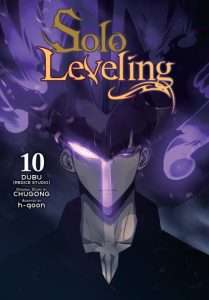
Every city fears becoming Jeju Island—a paradise now overrun with monsters when heroes failed to close their gate in time. In this alternate Earth, portals to deadly dungeons began spawning without reason across the world.
Simultaneously, some people manifested special powers. It is incredibly rare for their power level to change, leading to a classification system of hunters used to triage dungeons most effectively. This brings us to Jin-woo, known to be the weakest of them all. Still, as long as he survives, dungeon work is lucrative so he can pay his comatose mother’s medical expenses and support his sister. When he somehow survives an unexpectedly deadly dungeon, he gains the ability to level up and soon surpasses everyone else.
In these kinds of stories, it’s easy for the protagonist to feel overpowered and boring, but ten volumes in and Solo Leveling is going strong. The tension stays high because his increasing abilities are leading him to greater threats that no other hunter is even aware of. While he does sometimes come into conflict with other hunters, this usually ties more to the secondary tension – is Jin-woo’s humanity the cost for power? The kindness that was his defining feature seems colder as the volumes continue.
The reveals come just this side of excruciatingly slowly, creating the perfect sort of agonizing anticipation that must be shared with friends through theories about what is actually going on. These come with a charming cast of characters we hope Jin-woo will continue treating well as his journey changes him. Battles are, of course, frequent and can be both brutal and, occasionally, funny.
As with most manhwa releases, the volumes are entirely full color art peppered with breathtakingly gorgeous panels. The illustrator, Dubu, has such skill at detailed work, when the story beats call for it. These are most frequently used for creating realistic, awe inspiring monsters, but his skills for setting and faces are just as great. Of course, most of the art doesn’t require quite that level of detail, but is still gorgeous nonetheless. The fight scenes are drawn with care so are rarely confusing and employ techniques to elevate them beyond standard fare.
The series is obviously great for gamers, who will be unbothered by level-up screens, but they’re tucked into the story well enough that lack of video game knowledge is no barrier. It’s all perfectly acceptable for a teen audience, despite Jin-Woo’s adult age. There is violence but no sex or nudity, only occasional swearing, and isn’t covering controversial topics. That said, Jin-woo’s concerns are adult enough to keep general adult audiences engaged. This (and the occasional severed limb) is probably why Ize Press rates the series as older teen. Right now is an excellent time to drop into the series because the latest volume, ten, had major revelations about the purpose of the gates and Jin-woo’s special ability. Additionally, the anime was popular enough to have the first two episodes of season two run in theaters in anticipation of the January release. This is definitely a must-have series for people looking to get into manhwa – personally, it was one of the two that started my addiction!
Solo Leveling By Chugong , h-goon Art by DUBU Yen Press, 2024 ISBN: 9798400902536
Volume
ISBN
9
9798400901935
8
9798400901072
7
9798400900488
6
9798400900266
5
9781975344382
4
9781975337247
3
9781975336516
2
9781975319458
1
9781975319434
Company Age Rating: OT
NFNT Age Recommendation: Older Teen (16-18) Creator Representation: South Korean, Character Representation: South Korean,
Youngwoo Shin is a total loser. He is in debt to his parents, working freelance construction jobs to pay the bills, and has no hobbies or interests beyond video games. His favorite is the VR MMORPG Satisfy, which is the biggest fantasy game of its kind. It is there that Yongwoo becomes Grid the Warrior… and is just as much a loser as in the real world.
Three years of grinding and Grid has only managed to attain the modest rank of Level 73. Most other players who have been playing that long have levels over 200 and have found rare artifacts and unlocked special legendary classes. And Youngwoo loses even that after he stumbles across a magical tome containing the knowledge of a legendary blacksmith.
The bad news is that Grid has been knocked down to negative class levels and Youngwoo must start from square one. The good news is that his new Legendary Craftsman class has some special abilities that make up for his lack of combat power. These include the ability to wield any weapon and armor in the game and the ability to craft epic level items.
True, he takes a penalty for wielding unsuitable gear, but what does that matter when he still has an effective level 100 points higher than his single-digit attack score? Or when he can start selling the gear he crafts to make real-world money? Thus begins the legend of a new Legendary Blacksmith, who will forever change the world of Satisfy.
Overgeared started out as a Korean light novel series. It was later adapted into a graphic novel and has now been translated into English. In terms of story, it is like other Isekai science fiction where the hero enters a virtual fantasy world. What reportedly distinguishes it from similar series, however, is how Youngwoo grows as a person as the series continues and the complexity of its mythology.
There are signs of this in the first volume of Overgeared. Much of this book is devoted to explaining the world of Satisfy and the mechanics of how the game works. This is far from expository, however, and the information is naturally conveyed as Youngwoo learns about his new class and compares it to his old one.
We also learn through the eyes of other adventurers, who are stunned to see epic level arrows capable of slaying high-level enemies with a single shot showing up in the marketplace. There is also an early scene showing the game designers discussing the Legendary Blacksmith tome and what may happen when such power falls into the hands of a relative nobody.
The artwork of Team Argo is suitably animated and perfectly suit the story. The shading and inking effects are particularly noteworthy, giving an unusual sense of depth to the finished artwork. There are also subtle shifts in the color palettes, with cooler colors being used to denote the dull reality of Youngwoo’s life compared to the vibrant hues that dominate the world of Satisfy.
This volume is rated T for readers 13 and up. I consider that to be a fair rating. There is no nudity or sexual content, largely because Youngwoo seems uninterested in sex. Indeed, apart from one other warrior in a low-cut corset, there’s hardly any of the usual sexualized fantasy armor one expects to see in an Isekai comic. The violence level is also appropriate to the age range, with no excessive bloodshed.
Overgeared, Vol. 1 By Monohumbug Art by Team Argo Ize Press, 2023 ISBN: 9798400900518
Company Age Rating: 13+ Related media: Book to Comic
NFNT Age Recommendation: Adult (18+), Older Teen (16-18), Teen (13-16) Creator Representation: South Korean, Character Representation: South Korean,
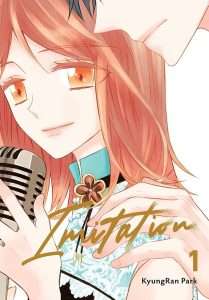
Maha Lee is an aspiring Idol. Her group, Tea Party, hasn’t hit the big-time yet, but she’s made a lot of friends on the circuit. Unfortunately, most of her fame to date is due to her amazing resemblance to solo singer La Lima. It wasn’t a huge issue, however, until Tea Party’s manager got them booked on Pop Idol Sports Games, alongside La Lima and Shax, the hottest boy band in South Korea.
An accident during the games leads to Maha Lee becoming the most hated woman on the Internet. This is partly due to the anti-fans dismissing her as a pathetic imitation of La Lima. Yet what concerns her most is the apparent hatred of Kwon Ryok, the bad boy of Shax, who is equally outspoken about his disapproval of wannabe Idols ripping off established artists. Unfortunately, fate and Maha Lee’s newfound popularity lead to her being offered more work. This includes her first acting role, opposite Kwon Ryok. This pushes Maha to prove to herself (and the world) that she has what it takes to make it big on her own merits and that she is more than just an imitation.
Originally published as a webtoon, Imitation was a smash hit on its original release. Indeed, it was adapted into a live-action series which ran on South Korean television from 2021 to 2023. This English translation does a masterful job of conveying both the story and K pop-culture to Western audiences. Notes in the back of the volume help explain the more subtle cultural references that are lost in translation. This includes a long list of foods Maha Lee must recite featuring various dishes that are considered old-fashioned by Korean hipsters. It is a small thing, but an important one. Thankfully, the general story is more universal, if born of the usual RomCom clichés and stock characters.
Maha Lee is the classic good girl, struggling to succeed in a competitive business. La Lima is the classic Mean Girl. Kwon Ryok is the typical harsh love interest who hides his sensitive side behind a rough facade. Thankfully, the supporting cast vary things up a bit. A good example of this is Yujin, Maha’s friend and lead singer of the boy band Sparkling, who seems to have a crush on Maha he dare not express. The usual love triangle elements are avoided, though Yujin does step in to defend Maha. This, in turn, inspires her bandmates to push her to stop talking to Kwon Ryok so they can guide her to the far kinder Yujin.
The artwork of KyungRan Park is like their writing – smooth and satisfying. There’s nothing visually outstanding about the artwork, but nor is there anything glaringly off. The strangest thing is that for all the talk of La Lima and Maha Lee resembling each other, the two have distinctly different designs apart from similarly shaped faces. Even when Maha instructed to straighten her hair to look more like La Lima, it does little to make her look that much like the elder Idol.
Imitation Vol. 1 is rated T for Teen. I consider that a fair rating. There’s no violence or bloodshed, apart from a staged strangling which leaves Maha Lee bruised and Kwon Ryok bleeding from where her nails dug into him. There’s also no sexual content, apart from one kiss, but that’s a given considering how strict Idol culture is about the Idols dating, much less going further. The end of this first volume, however, suggests more kisses will be inevitable as the series continues.
Imitation, Vol. 1 By KyungRan Park Yen Press, 2023 ISBN: 9781975367008
Company Age Rating: T Related media: Comic to TV
NFNT Age Recommendation: Older Teen (16-18), Teen (13-16) Creator Representation: South Korean, Character Representation: South Korean,
The Banned Book Club by Kim Hyun Sook, is based on the personal experiences of the author, who grew up during a time where South Korea was under a totalitarian government. It begins with Hyun and her mother arguing over her choice to go to school. Her mother wants her to give up school and continue to work in the family restaurant. Hyun ducks out to end the argument and attend her first day of school. Once off the bus, she is surrounded by protestors and police. Tear gas is exploding all around her, people pushing their way through the cloudy air to escape arrest. Hyun makes it to class and the teacher informs her that they need to stay away from Communist activities and not participate in protests.
Hyun wants to remain above the fray and avoid politics. She decides to join the folk dance team. They perform a dance for the school, which ends up turning political. She meets a young man on the team named Hoon who begins introducing her to new ideas. He runs the school newspaper and hides political messages in the articles. Hoon develops a crush on Hyun and the feeling turns mutual. He begins drawing her further into danger. She must decide how far she is willing to go.
The simplicity of the black and white artwork draws you into the horror of the situation. When Hyun first gets on campus, she experiences a moment of contentment. She is on a bus, headed to school, with a smile on her face. The minute she steps out, she is greeted with chants for the President to step down. The scene pulls back to reveal riot police with shields moving towards the protestors. Scenes shift to different angles, adding to the tension and chaos of the scene. There are two scenes of torture in the book. One is brief with the person having scrapes and bruises on their face. The other, while only a few pages seem as if it goes on forever. Part of it is left to the imagination as we see the objects he has been beaten with. The other act is quite cruel with the person’s face being smashed into the ground.
In the beginning, I found the title hard to get into as I had no familiarity or understanding of Korean history. The title Banned Book Club made me believe the story would be about how books changed the lives of students living in a brutal dictatorship. It was this aspect that I kept hoping would appear. After 94 pages the story began to take shape and I could see clearly where the author was going with the narrative. The theme became about how a young girl learns how to stand up and find her voice living with a government who wants to shut down any opposition or free thought. I highly recommend this book and suggest that readers learn about the Gwangju uprising to deepen their understanding. This graphic novel is most appropriate for older teens, but probably will be more appreciated by adults who are interested in historical events.
Banned Book Club By Hyun Sook Kim Art by Hyung-Ju Ko ISBN: 9781945820427 Iron Circus Comics, 2020 Publisher Age Rating: OT
Browse for more like this title NFNT Age Recommendation: Older Teen (16-18), Adult (18+) Character Traits: South Korean Creator Highlights: Own Voices, BIPOC Creator

 ordinary, people know what happens after death. Crow gods meet the souls approaching purgatory, advising them how to cross harsh plains to reach the Gate of Rebirth. As a parting gift, they create a delicious dough that will last the 49 days the journey takes. Once the living learned of this practice they began to make funeral desserts for their loved ones.
 impoverished parents. Her new husband, Hans, is dashingly handsome, loves animals, and is pleasant and outgoing in public. But in private, he belittles her and subjects her to sexual violence and humiliation. Her only respite occurs when Hans takes a business trip to Portugal, leaving her to freely study what fascinates her more than anything: flight.
 alternate Earth, portals to deadly dungeons began spawning without reason across the world.
 interests beyond video games. His favorite is the VR MMORPG Satisfy, which is the biggest fantasy game of its kind. It is there that Yongwoo becomes Grid the Warrior… and is just as much a loser as in the real world.
 Maha Lee is an aspiring Idol. Her group, Tea Party, hasn’t hit the big-time yet, but she’s made a lot of friends on the circuit. Unfortunately, most of her fame to date is due to her amazing resemblance to solo singer La Lima. It wasn’t a huge issue, however, until Tea Party’s manager got them booked on Pop Idol Sports Games, alongside La Lima and Shax, the hottest boy band in South Korea.
