What would you do if you had only six months to live?
This is the question facing everyone who contracts the G+ Virus. There is no cure. It is definitively lethal.
However, for some victims, it is also the best thing that ever happened to them. Because even as the G+ Virus overclocks the host body, it also allows people to briefly become more of what they are.
Creative people seem to become more creative, perhaps driven to make something that will outlive them. Even the baseline cases somehow become more physically capable.
A rare few, however, become something superhuman.
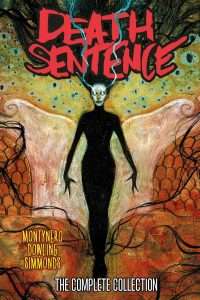
Death Sentence was an oddly prescient work. Originally published in 2014, it predates the many works of superhero fiction inspired by the COVID-19 pandemic. Of course, the idea of a disease bestowing superpowers is not entirely original. (George R. R. Martin’s Wild Cards is built around the same general premise.) What marks Death Sentence as unique is its distinctly British flavor and its tight characterization.
The first volume centers around a trio of newly infected G+ patients. Verity is an artist who accidentally kills the government agents sent to bring her in. Weasel is a rock star hoping for a comeback who becomes a fugitive after his powers accidentally kill a groupie. They become the unlikely heroes recruited to stop the third focus character, David “Monty” Montgomery – a comedian whose mind control powers allow him to turn all of London into a captive audience.
The second and third volumes explore the aftermath of the first, as the American and British governments attempt to exploit the most visible expression of superpowers in history. This leads to the introduction of new characters like Roots – a drug farmer who uses her powers to enhance her product and defend her neighborhood.
Writer Monty Nero does a fantastic job of building up the world and the characters. With subversive takes on politics and pop culture, Death Sentence invites comparison to the work of Alan Moore. This seems to be intentional, as Nero references Moore twice in the text. Once with the analogy “like Alan Moore on an acid trip,” and once more with the character of Creighton Baines, a comic writer whose creation is co-opted by masked protesters. (A clear reference to Anonymous and V for Vendetta.) However, while the influence is apparent, Nero still makes the story his own and goes beyond simply mimicking Moore.
The artwork is fantastic across the board, with each section of the story has a distinctive look. Mike Dowling draws the first volume with a gritty, dark aesthetic that evokes memories of classic Judge Dredd comics and the early years of Hellblazer. Martin Simmonds skews a bit more surreal in the second and third volume, as Verity begins to fully master her powers. And Nero takes over the art for the final three chapters of Volume 3, with more traditional comic art as the story skews into more traditional superhero fare.
Death Sentence: The Collected Edition is rated M for readers 18 and up and rightly so. This should be obvious given the back cover blurb screams “Sex, Superpowers, And Six Months To Live.” For those who need more detail, there is indeed explicit sexual content, outright nudity, and multiple acts of sexual violence. There is also physical violence in plenty, with considerable gore. There is also cursing, with liberal use of the F-dash-dash-dash-word. Needless to say, none of this is suitable for children. Adult audiences, however, looking for something in the same vein as The Boys but more dramatic, will be well served
Death Sentence: The Complete Collection By Monty Nero Art by Mike Dowling, Martin Simmonds, and Monty Nero Titan, 2025 ISBN: 9781787741461
Company Age Rating: M (18+)
NFNT Age Recommendation: Adult (18+) Creator Representation: Scottish, Character Representation: British, Bisexual,
Life on the Isle of Man is peaceful and quiet, and it is driving Kay Farragher mad! An aspiring songwriter and singer, Kay dreams of a world beyond her rural village and caring for her ailing grandmother. She dreams of a life on stage and audiences outside of the pub where she works.
The problem with dreams, however, is that sometimes they become nightmares.
A chance encounter with a young girl named Mona on Halloween Night gives Kay more than she bargained for. Mona claims to have come from a world of eternal twilight, straight from the faerie stories Kay’s grandmother believes in. Soon Kay finds herself neck-deep in that world, where a horseshoe is a weapon, a hero of legend seeks the bride he was promised, and the scoundrels of two worlds seek to scheme their way out of their own dark bargains.
I had high expectations heading into Cold Iron. Apart from a fondness for Celtic mythology and horror tales involving faeries, I am a big fan of Andy Diggle’s writing and have been since his highly underrated run on Hellblazer. I was not disappointed.
Two things distinguish Cold Iron from similar stories. One is the setting, which draws upon the unique mythology of the Isle of Man, rather than the more familiar Irish Leprechauns or the Selkies of Scotland’s Orkney Islands. The other is the lead character Kay, who is developed far beyond being the typical strong female protagonist that takes center stage in many modern horror stories.
Kay is a conflicted character, being both a dreamer and a realist. She delights in entertaining children with spooky tales and songs at Halloween, but she doesn’t believe in the myths her grandmother accepts as gospel. She longs to see the world, but wants to maintain the family farm, even as she rebels against the idea of a comfortable life working in a fish and chips shop and marrying her on-again/off-again boyfriend. These details make Kay seem more sympathetic and more real, grounding the fantastic elements of the story.
The artwork by Nick Brokenshire, with colors by Triona Farrell and letters by Simon Bowland, manages a similar balancing act. Brokenshire proves equally adept at capturing the static beauty of the Isle of Man and in depicting the weird horror of the faerie realm. Farrell uses different contrasting palettes for both worlds, with the vibrancy of the twilight realm offering a firm divide against the stark reality of Kay’s life. Bowland also uses distinctive fonts for the Fair Folk, to subtly hint at their alien nature.
Dark Horse Comics rated this volume as appropriate for ages 12 and up. I think that might be a fair assessment of the story, which has nothing more objectionable than a bit of violence and a few curse words. The artist notes in the back of the book, however, feature some sketches of naked fairies that are a bit extreme for a T-rating. I would shelve this volume in the older teen or adult section just to be safe and since I think the story is more likely to appeal to older audiences, who can appreciate the full horror Mona finds in the future.
Cold Iron By Andy Diggle Art by Nick Brokenshire, Triona Farrell, Simon Bowland, Tom Muller Dark Horse, 2023 ISBN: 9781506730875
Publisher Age Rating: 12+
NFNT Age Recommendation: Adult (18+), Older Teen (16-18) Creator Representation: British, Irish, Scottish, Character Representation: British,
The origin story of this timely graphic novel preceded our current pandemic situation as it was written as a radio drama for the BBC in 2017. In Resistance, the disease, Erysipelas (nicknamed “The Sips”), is a bacterium rather than a virus like COVID-19, but there are noticeable similarities between the two situations. Eerily, both diseases have a parallel incubation period, Australia is relatively safe because of its strict government and geographic location, and there are strong likenesses in the reactions and inaction of both the fictional and the authentic pharmaceutical companies and government leaders. Indeed, the most frightening aspect of Val McDermid’s story is the interference of politics and commerce with scientific exploration and development in trying to contain the spread of this fast paced and deadly infection.
Told through the lens of an investigative reporter, Zoe Beck, who had been sidelined to cover inconsequential events rather than hard news stories, the tale begins benignly at a food truck at a Solstice music festival in Scotland. At first, it is thought to be cases of food poisoning arising from the food truck’s meat products, but soon the infected people start to develop skin lesions and the illness becomes highly contagious and lethal. The pace of the story accelerates as the contagion begins to spread and the reporter—and reader—are faced with a frustrating lack of action. Scientists ponder while a plethora of worldwide deaths mounts and overwhelms the structures and procedures in place. Besides the talking media heads and scientific assessments, the reader is introduced to members of the reporter’s family, her colleagues, and contacts such as infectious disease expert Dr. Aasmah Siddiqui, as well as her friends, including the proprietors of the food truck initially blamed for the onset of the contagion. In fact, much of the horrifying plot revolves around blame, and the lack of admitting accountability. Award-winning mystery writer McDermid is in her element in creating a fictitious narrative that is all too plausible, in which strong characters are faced with horrific choices.
The murky black and white illustrations by Katherine Briggs are exceedingly compatible with this bleak story. The layout of many of the pages strongly advance the action while, at the same time, they alleviate the tedium of reading large amounts of text, some of which is fairly technical. She effectively utilizes frames, oddly shaped panels, overlays, and literary, symbolic, and iconic references that range from the medieval to New Age tarot cards. These embellishments add to the feeling of timelessness and, at the same time, the historical continuum and backdrop of such disasters. Her characters are quirky and, in some instances, represented as caricatures rather than full blown individuals, aiding this reader in keeping track of the main players while appreciating the contribution of other personalities who have a minor but essential role in the story.
There is much to contemplate and discuss in this graphic novel. It has a thread of hope for a society that tends to ignore any signposts that may lead to destruction while having a noir-like quality to both the writing and the artwork. Although set in Scotland, it has universal appeal and relevance. Recommended for public library collections and for high school students and educators.
Resistance By Val McDermid Art by Kathryn Briggs Grove Atlantic, 2021 ISBN: 9780802158727 Publisher Age Rating: Adult
NFNT Age Recommendation: Adult (18+), Older Teen (16-18) Creator Representation: Scottish Character Representation: Scottish
The legendary nineteenth century Agnes McVee: madam, serial killer, and inn owner of 108 Mile House, may not have really existed; but author and illustrator Sarah Levitt has brought her to astoundingly vivid life in Agnes, Murderess. Levitt introduces the folkloric Agnes to the reader through the backstory of Agnes’s childhood in Scotland through to her immigration to the Cariboo Region of British Columbia, accompanied by the grim ghost of her witchy grandmother Gormul. She also introduces the reader to early British Columbia gold rush geographical naming. The Cariboo Wagon road was started in 1862 from Mile 0 at Lillooet, a major town in the 1860s, where miners prepared to head north to the gold fields near Barkerville. As each mile was completed, a post was planted to accommodate the road crews. Several developed into well known “Mile Houses” when these places developed as stopping places to exchange horses or for travelers to obtain food and lodging. 108 Mile House was not much more than vacant land in 1860 with the 108 Mile Hotel of Agnus McVee fame operating from 1875 to 1885.
The new world was to be an agent of freedom and new starts, but unfortunately for Agnes, the struggle to remove herself from her upbringing and relatives proved to be deadly… deadly for those who met her. Levitt used a brochure about the legendary woman who killed some fifty people at her hotel with the aid of her husband and son-in-law as inspiration for her character and story. Although no official records of the woman or the murders existed, Levitt knew she had to tell the story depicted in the brochure. As noted in the introduction: “the first written record of Agnes did not appear until the 1970s, when an amateur historian self-published a guide to buried treasure in British Columbia.” “Lost Treasure in BC #3” is an expressly gruesome and violent story by Larry Lazeo of Fort Langley who was repeating a story he heard from an unnamed old timer. In 2006, Red Barn Productions filmed the story for CTV’s Travel and Discovery series and is also on a BC Government web page of historical information.
Levitt’s Agnes, taught by her greedy grandmother to adore shiny items, is drawn to the gold of the miners who stop at her hotel. She does not resist the call of that gold, and her bloodthirsty manner of acquiring it demonstrates her strength, both physical and mental, as well as her lack of ethics and morality. This is a woman who is her own person and follows her own desires, but also a woman who is also haunted by her upbringing and her lack of empathy and compassion. She is quick to anger and is reactive without a thought to consequences. She is not a conventional heroine but someone to be regarded at a far distance for your own safety! She leaves Scotland after a squabble between Gormul, and Seamus, a village boy, erupts in the unplanned stabbing death of Gormul with a pair of scissors. Seamus travels with Agnes to the new world and is an unwilling participant in much of the subsequent mass murders, thievery, and mayhem.
Levitt’s years of research into the gold rush, the Cariboo Region, the men that came to find the gold, and the women who came to service the men, is evident in the authentic and gritty setting of the graphic novel. The remote rural Scottish community and its members are also vividly portrayed but this reader is enchanted by the familiarity of the equally remote area of western Canada and an era that is so paramount to the development of that region.
According to Leavitt, the images of Agnes and her horrendous deeds came to her first and then the narrative expanded to represent journal entries found after Agnes died. Leavitt’s moody illustrations are in black and white, with occasional touches of grey. They are stark, unsentimental, harsh, but, especially in the case of the landscapes, breathtakingly appealing. Leavitt effectively uses deep blacks to amplify the loneliness and mental confusion of the terrifying but oddly ingratiating protagonist who remains with this reader long after the covers closed.
I highly recommend this title for adults and high school students who wish to explore Canadian history and legend, strong female protagonists, mass murders, evil, and the possible long-term effects of a non-nurturing upbringing. It is a story without any definite answers, and I would not want it any other way. Just in case you find this critic and review rather morbid and seek a second opinion, the title was a 2020 Doug Wright finalist for the best Canadian graphic novel. It has also been nominated in two categories for the 2020 Alberta Book Awards: speculative fiction and book illustration. Sarah Leavitt is also the author of Tangles: A Story of Alzheimer’s, My Mother, and Me. She teaches comics classes at the University of British Columbia in Vancouver.
Agnes, Murderess By Sarah Leavitt ISBN: 9781988298474 Freehand Books, 2019 Publisher Age Rating: Adult
Browse for more like this title NFNT Age Recommendation: Older Teen (16-18), Adult (18+)

 Life on the Isle of Man is peaceful and quiet, and it is driving Kay Farragher mad! An aspiring songwriter and singer, Kay dreams of a world beyond her rural village and caring for her ailing grandmother. She dreams of a life on stage and audiences outside of the pub where she works.
 The origin story of this timely graphic novel preceded our current pandemic situation as it was written as a radio drama for the BBC in 2017. In Resistance, the disease, Erysipelas (nicknamed “The Sips”), is a bacterium rather than a virus like COVID-19, but there are noticeable similarities between the two situations. Eerily, both diseases have a parallel incubation period, Australia is relatively safe because of its strict government and geographic location, and there are strong likenesses in the reactions and inaction of both the fictional and the authentic pharmaceutical companies and government leaders. Indeed, the most frightening aspect of Val McDermid’s story is the interference of politics and commerce with scientific exploration and development in trying to contain the spread of this fast paced and deadly infection.
