Call Me Iggy begins with a cinematic moment – a young man, presumably Iggy’s father, leaving Columbia in 1982 for Columbus, Ohio. The hairstyles and clothing in the images, as well as the color palette of yellows and browns, give the impression of a bygone era. Then we are propelled forward to 2016 Columbus, Ohio, where young Ignacio “Iggy” Garcia is riding along with his older brother, Billy to his first day of high school—where things quickly go awry.
Besides being the younger brother to a do-no-wrong older sibling (who is embarrassed enough by Iggy to pretend not to know him), he winds up in a Spanish class instead of the French class he wanted and he accidentally bumps into a girl at school (Marisol) and her coffee, spilling it all over her papers and books. But Spanish class turns out to be a chance to get to know Iggy’s crush, Kristi a little better so he decides to stick it out.
All of this seems rather mundane until the day when Iggy discovers his dead abuelito’s ashes in the basement and an accidental spill leads to an encounter with his grandfather’s ghost. Soon Iggy is striking a deal with his abuelito’s spirit to spread his ashes somewhere nice – in exchange for his Columbian grandfather’s help with Spanish class and impressing his crush.
There is so much about Call Me Iggy that feels timely, heartfelt, and thought-provoking all while maintaining its humor. As we find ourselves in another election year, it feels especially poignant to revisit the 2016 presidential election and what that looked like for Latin Americans. The way that the story tackles this and racism in America is well done, both realistic and hopeful.
Call Me Iggy’s author, Jorge Aguirre is, like Iggy, a Colombian-American born and raised in Columbus, Ohio and the story feels very honest and informed by life experience, despite the infusion of magical realism. The artwork by Rafael Rosado is vibrant and stunning, allowing readers to become fully immersed in the story. Panels including Iggy’s grandfather clearly depict that he is a transparent figure in clothing like those he wore in the first scene, when Iggy’s father was leaving Columbia in the ‘80s. The interactions between Iggy and his grandfather are one of the many entertaining things about the book – their banter is amusing and Iggy’s growth with his abuelito’s guidance is evident.
I loved seeing Iggy’s transformation as he began to learn more about his heritage – learning Spanish, salsa dancing, and how to cook arepas, among other things – and his burgeoning political leanings as he started to see what the future Trump presidency would mean for someone like Marisol or her family. The book is part family story, part commentary on the impact of assimilation. Getting to see Marisol’s family and their connection to their culture alongside Iggy’s own family and their journey is especially impactful.
The book is best suited for teens and will likely be enjoyed by those who gravitate towards stories of family, culture, and identity such as Laura Gao’s Messy Roots or Trung Le Nguyen’s The Magic Fish.
Call Me Iggy Vol. By Jorge Aguirre Art by Rafael Rosado Macmillan Children’s Publishing Group, 2024 ISBN: 9781250204158
NFNT Age Recommendation: Older Teen (16-18), Teen (13-16) Creator Representation: Latinx, Character Representation: Latinx,
Lucia Castillo wants more than anything to be a knight like her abuelo. Before he disappeared, he would tell her stories about fighting “monstruos y fantasmas y demonios” to save and protect those in need. Lucia is one of the only ones who believed him—the rest of the town called him “Abuelo Loco.”
Lucia’s determination to live her life by the knight’s code often gets her in trouble. She has a tendency to jump headlong into situations based on snap judgements, rather than taking the time to see what’s really going on. And that was before she found her grandfather’s magic helmet, which allows those of her bloodline to see ghosts, duende, and other supernatural creatures from Latin American folklore. She and her friend Sandro are certain the Mayor is up to no good, but how is Lucia supposed to convince the town to trust her? And perhaps more importantly, how can Lucia be sure she’s trusting the right people (or creatures) and not jumping to the wrong conclusions again?
Doña Quixote: Rise of the Knight describes itself as a, “contemporary graphic novel retelling of Don Quixote.” It is not. At best, it is a contemporary graphic novel that makes a couple references to Don Quixote. Teachers looking for an example of a good retelling or adaptation should probably pass this one by, but the distinction likely won’t matter much to its intended audience, who are less likely to be familiar with Don Quixote in the first place. In Doña Quixote, readers can learn about a variety of mythological creatures alongside Lucia and Sandro, like Duende, gnome-like creatures that clip children’s toenails while they sleep (to be helpful) and Sisimito, a Mexican Bigfoot who can’t resist a dance-off, even if his backwards feet mean he isn’t very good at it.
As far as the writing goes, the story is fairly simplistic and the characters are pretty much stereotypes—Lucia wants to be a knight, but is terrible at helping people and Sandro wants to do ballet, but his dad and brothers think it’s too girly. Learning about different supernatural creatures is definitely the best thing Doña Quixote has going for it. Were that all, I would say Doña Quixote: Rise of the Knight is a fairly mediocre middle grade graphic novel.
Unfortunately, the art of Doña Quixote: Rise of the Knight isn’t doing it any favors. The art style itself is flat and round, making all the figures look somewhat squished. (“Potato people” is what one fourth grade patron called them, while looking over my shoulder, and I can see where he’s coming from.) The color palette is incredibly loud, saturated, and unpleasant to the eyes. On many pages, the panels are so overloaded with colors and patterns that the eye doesn’t really have anywhere to land. The shading on figures’ faces is also incredible dark. Magaña is very heavy handed when it comes to shading every wrinkle on older characters’ faces to the point where it becomes hard to make out Abuela’s expression in several panels that should be emotionally significant. Because of how much the art decision affects Doña Quixote: Rise of the Knight’s readability, I would not recommend it to first time graphic novel readers or those with sensory processing issues. In fact, I simply wouldn’t recommend it.
Doña Quixote: Rise of the Knight By Rey Terciero Art by Monica Magaña Henry Holt and Co., 2023 ISBN: 9781250795472
Publisher Age Rating: 8-12
NFNT Age Recommendation: Middle Grade (7-11), Tween (10-13) Creator Representation: Latine Character Representation: Latine
Cade is a shy, horror-movie-obsessed teen living in rural Texas. Surrounded by homophobia, he figures he’ll never be able to come out as gay, let alone find a boyfriend. Anyway, he has other things to worry about. His family is low on money, so his parents insist that Cade get a summer job at a ranch, which pays better than the more comfortable indoor jobs he would prefer. It’s hard labor, but on the plus side he gets to work with Henry, the teenaged son of the ranch owner. Henry is attractive, mysterious, and possibly interested in Cade. But there are rumors swirling around the ranch. People have died. In fact, the whole situation reminds Cade of a horror movie. Will he be the next victim?
This is a retelling of Jane Austen’s novel Northanger Abbey, in which a young woman allows her love of Gothic novels to color her perception of the real world. Like the heroine of that novel, Cade sees and hears a few strange things and lets his imagination fill in the gaps with terrifying theories. Changing the Gothic novels to horror movies and the setting to a lonely ranch in modern-day Texas makes for a creative update. Cade’s unease and sense of being in danger are supported by encounters with racist and homophobic locals—a situation based on the author’s own experience growing up queer, closeted, and Latine in rural Texas.
Cade comes from a class background that is underrepresented in teen fiction: his blended, multiracial family is struggling financially, living in a rural area where military service and religion play a large part in many people’s lives. This adds to Cade’s isolation, as there is a lot of homophobia in the local culture. Even his generally well-meaning stepdad casually uses homophobic language. Henry, too, has struggled to reconcile his identity with his church’s condemnation of queer people.
A content note at the beginning advises that the book contains “moments of homophobia, misogyny, racism, domestic violence, animal cruelty, and confronting death.” There is a character whose past includes becoming suicidal and spending time in a mental health facility, and another character uses stigmatizing language about it. And although he is seeing a therapist and working on his anger issues, Henry can be violent, which is an alarming quality in a love interest. There are also a handful of swear words, up to and including the f-bomb. Despite all that, though, this story is not grim throughout. It is, after all, a romance, with plenty of sweet moments and—eventually—a hopeful ending.
The art is cute and expressive, with a simplified realistic style reminiscent of Faith Erin Hicks. The book is two-color, with shades of red and pink punctuated by bold black and lots of deep shadows, especially in the creepy parts. Horror movie fans may notice a few classic film posters in some of the panels.
This is a creative retelling that stands alone. Sometimes sweet and sometimes gripping, it addresses tough topics but also brings humor and smooches. Hand it to fans of Kevin Panetta’s Bloom and Alice Oseman’s Heartstopper.
Northranger By Rey Terciero Art by Bre Indigo Harper Collins Harper Alley, 2023 ISBN: 9780063007383
Publisher Age Rating: 13+ NFNT Age Recommendation: Older Teen (16-18), Teen (13-16)
Love comes in all shapes and sizes, whether it’s between adventurous pirates, burgeoning demon hunters, smooth spies, or even your average couple trying to make it all work. Young Men in Love, edited by Joe Glass and Matt Miner, showcases all these relationships and more, containing twenty stories from queer creators devoted to exploring the romantic hurdles and queer joy of male/masculine couples. This graphic novel boasts a variety of genres: fantasy, sci-fi, paranormal romance, contemporary slice of life, etc., ensuring that each reader will be able to find at least a story or two to enjoy.
Typical of most anthologies, not every story is going to be as hard hitting as the next one. With an average length of four to eight pages, there are some that struggle to break beyond their concept, leaving the reader more with an idea rather than a fleshed out narrative. The majority of contributors, however, manage to pace their stories so that, though we may not spend much time with these characters, they still leave a great amount of impact. Despite the varying appeal of each story, there is an admirable amount of honesty, vulnerability, and love interwoven within them all. An immense sense of pride lives in these pages that comes from an unwavering self-acceptance and the ability to love openly without shame or fear. Moments of loneliness, depression, and doubt play roles in multiple stories, but they always come around to love in the end, whether it comes from a partner or within themselves.
Given the graphic novel’s notable range in terms of content and themes, there are several stories that display aspects of queerness that are rarely discussed in the community. Ned Barnett and Ian Bisbal’s “Another Name” deals with a trans man realizing his identity and coming out to his partner in what was once a heterosexual relationship, highlighting the fears and anxiety that may come with such a discovery. “Act of Grace,” written by Anthony Oliveira and illustrated by Nick Robles, follows a teen expressing religious guilt to his priest, afraid of how his feelings for a boy may conflict with his Catholic upbringing. Editor Joe Glass, along with Auguste Kanakis, throw in a moving inclusion in “Love Yourself,” which has a character experience the fetishization of plus sized men in the community and how validation and love for someone comes from appreciating and celebrating the whole of them rather than a singular aspect. These are all facets to the queer experience that I have seen firsthand, but seldom are they reflected in media tailored to those they are meant to represent. Seeing these conflicts approached and resolved with such depth and respect allows the reader a touch of hope and comfort, even if they may not entirely relate to it.
Intent on including as many voices and experiences as possible, Young Men in Love also gives a tremendous amount of diverse representation in terms of ethnicity and body type. It shies away from solely depicting the stereotypical skinny, white, gay man, as there are several stories with black, brown, and plus-sized protagonists. What’s so refreshing about these depictions is that, aside from “Another Name” and “Love Yourself,” none of the stories make the characters’ backgrounds the focal point of their conflict. They exist as people foremost, without their identities being a source of added trauma.
As there is a separate artist accompanying each installment, there is a vast variety in art styles, ranging from charmingly cartoonish to engagingly realistic. I will forever throw praise onto Nick Robles, who puts so much life into his textures and instills a healthy dose of emotion and drama into “Act of Grace” through his use of lighting and character expressions. There is something Leyendecker-esque about his style where he captures the male form exceptionally well, making it the perfect fit for this collection. I also really appreciated the yellow tinge given to the palette and borders of Paul Allor and Lane Lloyd’s “The Way Home,” producing a nostalgic effect reminiscent of those old comics that had probably been left in the basement for too long. Overall, there is a vibrant rainbow of color throughout the graphic novel, as the reader is treated to vibrant pastels to moody, atmospheric shadows. Each story, as a result, becomes visually distinct and memorable, even if its content may not have lived up to the one that preceded it. None of the art in this graphic novel disappoints, which brings a certain coherence to all the differing perspectives within.
For fans of uplifting romantic stories with happy endings or layered depictions of queer experiences, Young Men in Love will hit that emotional, sappy spot in spades. As a romance comic, the content is fairly clean, with nothing going further than the occasional cuddle or kiss. The featured protagonists range from being young teens to full adults, so it may appeal most to readers fourteen and up. Librarians and educators looking to obtain graphic novels with positive and varied queer representation from queer creators should consider purchasing this title.
Young Men in Love Vol. By Joe Glass, Matt Miner A Wave Blue World, 2022 ISBN: 9781949518207
Publisher Age Rating: 13+ NFNT Age Recommendation: Adult (18+), Older Teen (16-18), Teen (13-16) Creator Representation: Black, Brazilian, British, Canadian, Greek, Latinx, Malaysian, Mexican-American, Bisexual, Gay, Queer, Nonbinary, Trans Character Representation: Black, British, East Asian, Latinx, Gay, Queer, Nonbinary, Trans, Catholic
In Season of the Bruja, Aaron Durán depicts the conflict of surviving cultural practices vs. rampant colonialism, while also delivering a touching story of grief and self-discovery.
Being the last bruja, Althalia carries a tremendous weight on her shoulders. Immense powers dwell inside her, and she needs to ensure that the history and ways of her ancestors live on. Her beloved abuela teaches Althalia all she can about her growing magical skills and the traditions of their people, but, after a chance encounter with a fanatic priest, the young bruja’s world is thrown into chaos. Facing a centuries-old and deadly prejudice, Althalia must fully realize her role as a bruja before everything she has worked hard to protect becomes lost to time forever.
Durán, over the course of the comic, presents readers with an intriguing, yet somewhat cryptic world. At many points, it feels as if one would need a basic understanding of Mexican folklore going in, as certain creatures, concepts, and figures go unnamed and unexplained, which may confuse some readers as to their significance in the story and to the characters. It is not enough to bring down the story as a whole, but may lead one to backtrack their reading several times to make sure they did not miss anything. I especially felt the shakiness of this world going into the third act, with characters moving from place to place so quickly, mythologies intertwining, and new, mysterious adversaries cropping up in the last thirty pages with little to no explanation. I didn’t even realize where much of the climax was taking place until I had finished and was reflecting on what I had read.
Overall, the world Durán has created is not an unrealized one, but one that could have used some more definition. At several points, it feels more like the second volume of a series rather than the first as the story expects the reader to take several plot threads at face value. From the very first page, readers are thrust immediately into action as we see Althalia taking on a possessed child with her friends Dana and Chuey, a werecoyote and chupacabra, respectively. The dynamics of their relationships have already been fully developed, which makes the scene almost feel like an intrusion rather than an introduction. The reader may struggle to engage with the conflict as these characters are still strangers to them, and the reason as to why these specific characters are here is a mystery. While the rash Althalia, passionate Dana and kind, paternal Chuey become endearing characters as the story goes on, the beginning paints a disorienting view of them.
All issues aside, Season of the Bruja is essential reading when it comes to its message of the importance of preserving traditional customs and the destructive impact of colonialism. Durán does not shy away from depicting the historical and enduring prejudices of the Christian church against Indigenous practices, making Althalia and her abuela’s commitment to the survival of their heritage all the more empowering and inspiring. Though Althalia struggles to find her place in her identity, her pride and dedication to those who came before her ultimately shine through. This is a comic that celebrates its culture and the love for it is shown on every page.
Sara Soler’s illustrations only add to the magic of Durán’s story, with eye-catching, lively colors and atmospheric lighting. The designs of the supernatural characters are a real treat, especially the otherworldly palettes of Althalia and abuela’s alebrijes, as well as the sinister, imposing forms of multiple demons. Full page spreads accompany significant moments in the story, each one beautiful and impactful as Althalia’s emotions start to run high and her magic takes center stage. Unfortunately, there are several moments in which it is difficult to track the action of the main characters, whether due to the lack of a panel showing transitions between movements or a hasty layout. Characters will suddenly appear in different places than shown before without explanation or have an interaction off panel that could have contextualized the scene better. In its calmer moments, the flow is more natural and easier to grasp, though there is still the odd messy transition here and there. Still, it is a style that matches the heart and soul of Althalia’s journey, giving it a standout look that is familiar and resonating.
The world may need some settling into, but Season of the Bruja remains a graphic novel with a captivating, strong identity, and heartfelt representation of Mexican culture. Those looking for a supernatural, emotional story with a heavy mythical and familial aspects will find an engaging read here. Due to its heavier themes underlaid with a lighter tone, this title may resonate the most with teens and adults. Librarians and educators in search of materials that give meaningful representation as well as cover rarely explored topics in graphic novels, such as systemic cultural erasure and preservation of Indigenous history, should consider purchasing this title.
Season of the Bruja, Vol. 1 By Aaron Durán Art by Sara Soler Oni Press, 2023 ISBN: 9781549308161
Publisher Age Rating: grade 7-9
NFNT Age Recommendation: Adult (18+), Older Teen (16-18), Teen (13-16) Creator Representation: Latinx, Spanish, Bisexual Character Representation: Latinx, First Nations or Indigenous,

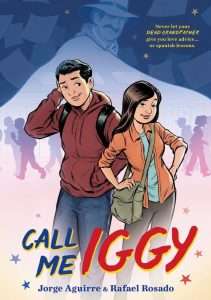 Call Me Iggy begins with a cinematic moment – a young man, presumably Iggy’s father, leaving Columbia in 1982 for Columbus, Ohio. The hairstyles and clothing in the images, as well as the color palette of yellows and browns, give the impression of a bygone era. Then we are propelled forward to 2016 Columbus, Ohio, where young Ignacio “Iggy” Garcia is riding along with his older brother, Billy to his first day of high school—where things quickly go awry.
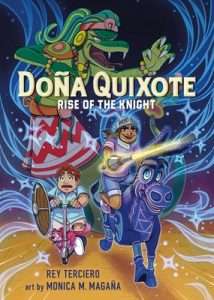 Lucia Castillo wants more than anything to be a knight like her abuelo. Before he disappeared, he would tell her stories about fighting “monstruos y fantasmas y demonios” to save and protect those in need. Lucia is one of the only ones who believed him—the rest of the town called him “Abuelo Loco.”
 Cade is a shy, horror-movie-obsessed teen living in rural Texas. Surrounded by homophobia, he figures he’ll never be able to come out as gay, let alone find a boyfriend. Anyway, he has other things to worry about. His family is low on money, so his parents insist that Cade get a summer job at a ranch, which pays better than the more comfortable indoor jobs he would prefer. It’s hard labor, but on the plus side he gets to work with Henry, the teenaged son of the ranch owner. Henry is attractive, mysterious, and possibly interested in Cade. But there are rumors swirling around the ranch. People have died. In fact, the whole situation reminds Cade of a horror movie. Will he be the next victim?
 Love comes in all shapes and sizes, whether it’s between adventurous pirates, burgeoning demon hunters, smooth spies, or even your average couple trying to make it all work. Young Men in Love, edited by Joe Glass and Matt Miner, showcases all these relationships and more, containing twenty stories from queer creators devoted to exploring the romantic hurdles and queer joy of male/masculine couples. This graphic novel boasts a variety of genres: fantasy, sci-fi, paranormal romance, contemporary slice of life, etc., ensuring that each reader will be able to find at least a story or two to enjoy.
 In Season of the Bruja, Aaron Durán depicts the conflict of surviving cultural practices vs. rampant colonialism, while also delivering a touching story of grief and self-discovery.
