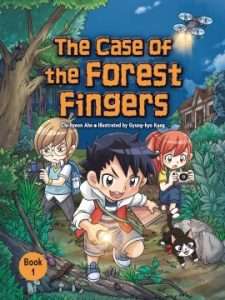
Lerner Graphic Universe often produces interesting graphic novels in translation and this informational series starter, translated from Korean, is a fun addition to their catalog. Illustrated in manga style, in full color and translated for Western readers to read left to right, it offers a fun mystery with a spooky element as well as some scientific facts.
Kihan Shin, a 5th grader, is the leader of the Mystery Science Detectives and always eager to investigate. Hannah Kang is their photographer and, more importantly, their muscle. Terry, a 4th grader, is just there to relax, but he’s willing to help out with his technological expertise as well as fly his drone to check out their investigations. They’ve even got a mascot, a cute black and white cat named Kkami. Their first mystery begins when Yunjin Ryu, a baseball player, comes to tell them that he lost his signed ball in the spooky woods on the hill behind the school. While searching for it, he had several terrifying encounters, including what appeared to be zombie fingers!
Kihan enthusiastically insists the team set out to investigate immediately, even though its nearly dark. As they explore the forest, there are frequent dramatic pauses in the narrative for entries in their case notebook, highlighting facts about forest ecosystems and the creatures they encounter there including Yunjin’s “zombies.” Clues and quizzes are included along the way, so readers can review what they’ve learned and try to figure out the mystery on their own. The story ends with a report on what they learned, a teaser for their next case, and a short comic from the artist.
The characters have the big eyes, spiky hair, and exaggerated expressions readers have come to associate with manga. However, this is clearly aimed at a middle grade audience since the characters differ mostly in hair color and style – they have realistic child-shaped bodies and the jokes that make them blush are mostly bathroom humor. Even the jump scares are child-appropriate. They’re drawn with dramatic dark colors, creepy shadows, and the characters drip nervous perspiration. However, scary things are quickly explained in a couple pages as natural phenomena, usually followed by case notes or activities. Kihan spends a lot of time grinning smugly, his mouth wide open to display prominent front teeth while fourth grader Terry tries to project a laid-back attitude with his blase face, despite his often obvious nerves. Hannah is fairly equal with Kihan, having a reasonable amount of time on the page and showing off her strength as well as her photography skills throughout the story, but although her high red ponytail never has a hair out of place she’s shown with a variety of emotions throughout the story.
This is a good introduction to manga conventions for younger kids as well as a great addition to STEM-themed graphic novels and a good choice for kids who want to read a comic that’s not TOO scary.
The case of the Forest Fingers By Chi-hyeon Ahn Art by Gyung-hyo Kang Lerner Graphic Universe, 2024 ISBN: 9798765627525
NFNT Age Recommendation: Middle Grade (7-11) Creator Representation: Korean, Character Representation: Korean,
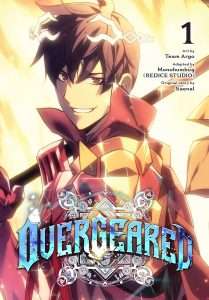
When an unremarkable player in an expansive virtual fantasy world discovers legendary blacksmithing abilities, it’s not exactly the answer to all his problems—but the ability to craft godlike equipment certainly goes a long way toward changing his circumstances.
Overgeared from IZE Press adapts this story of Youngwoo Shin from the Korean light novel of the same title. Youngwoo ks a bit of a loser in real life, and in the massive online VR Game Satisfy, he’s also a low ranging errand boy. However, when a job goes badly, he uses a powerful in-game item to turn his character into a smith and the successor to the greatest blacksmith in the game’s lore. Reset to base level but with an abundance of new abilities, Youngwoo decides to seize the opportunity in front of him in an effort to make something of himself in the game and out of it (there’s a pile of debt waiting for him back in the real world after all). However, alone and with the odds stacked against him, his only chance will be to craft an arsenal of advanced gear capable of offsetting his weaknesses (and there are many of those). It’s a difficult enough challenge on his own, but Youngwoo’s change has not gone unnoticed, and there are others who are quite interested in seeing what the newly forged smith will make of himself.
Volume 1 opens with intercuts of past and present, introducing Youngwoo’s in-game character named Grid in his overgeared state along with flashbacks to how this adventure began. It’s a bit of a jarring opening to follow, but once the stage is set, the story settles on following Grid in the immediate aftermath of his rebirth as an adventuring smith. There’s lots of game lore and rule mechanics mixed in with the gameplay, but with excitement and humor, the story strikes a fairly quick pace of daring and misadventures. Outside of the game, Youngwoo proves to be a bit of an unlikeable character. Struggling with money, jobs, and relationships, his video game addiction and general lack of motivation hang over his decisions. It’s early in the story yet, so there’s presumably room for growth, but it’s Grid’s sometimes bumbling attempts at gaining levels and fighting enemies that drives most of the story. Volume 1 already establishes a cast of in-game characters and conflicts that promise to kick off more shenanigans. And back in the real world, the game’s developers have also taken notice of Youngwoo’s new fortune, though it remains unclear exactly what they expect of him.
Illustrated in full color, this volume is a vibrant romp through the digital world of Satisfy. Video game menus and notifications are integrated into the story, visible to the characters as much as they are to the reader. And when the action kicks off, magic and combat explode across the page with stylization worthy of adventure comics and video games alike. The characters are distinct and the narrative is generally easy to follow, hitting the range of emotional beats effectively. It’s a comic that seems to relish its own concept and execution, and the art team brings the story to life with a visual language that’s engaging and fun to read.
On the whole, Overgeared is an enjoyable start to a new series. For those not thoroughly familiar with the genre already, the digressions into game mechanics and stats screens might be a bit distracting. And though I expect there’s much more to come, Youngwoo’s shortcomings as a protagonist make him occasionally tricky to root for with full sincerity. All that aside though, there’s a great deal to enjoy here in a comic that, while not necessarily treading any new ground, seems to have a great deal of fun setting out on an adventure. It’s a story aimed comfortably at teens, with plenty of fantasy violence but nothing too troubling in the content otherwise. Especially if readers have previously enjoyed titles like Solo Leveling and Ready Player One, Overgeared should find happy readers ready to settle into familiar territory and see where Grid’s often poor decision making leads next.
Overgeared Vol. One By Team Argo IZE Press, 2023 ISBN: 9798400900518
Related media: Book to Comic
NFNT Age Recommendation: Older Teen (16-18), Teen (13-16) Creator Representation: Korean, Character Representation: Korean,
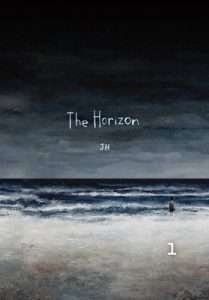
JH’s The Horizon is not a tale for the squeamish or faint of heart. The story opens with images of intense fear. A mother hides her child. Images are lost behind chalk-like scrawl of screams and booms. The sky darkens. All is quiet as the boy emerges from his hiding place. He picks his way across a carpet of corpses until eventually, he finds his mother- and desperately tries to push the pieces of her brain back into her broken skull.
It is at this place where the narration finally begins. The death of the boy’s mother “meant the death of the boy he had been and the end of the world he had lived in.”
The Horizon is a post-apocalyptic vision, shown through the eyes of a young boy, and the girl he meets whilst sheltering in an old school bus. The reader sees this tragedy through the eyes of the child. The reason why the violence began is obscured to the reader, as it is to the boy. (though this may come to light in later volumes, as this is the first of three.) The questions this graphic novel explores are not “how and why did this happen?” but rather “How and why do we keep on going?”
The answer resides in the boy and girls’ connection, traveling together with no destination in mind, but determined to keep each other safe: We do it together. And we do it for each other. It’s a surprisingly heartwarming and hopeful message in a world where every adult is a possible threat.
The Horizon is told primarily through a series of black and white images, with limited use of color for key dramatic images, like a field of corpses beneath a red sky, or the hopeful golden glow of fireflies. Characters are referred to in archetypal terms rather than formal names: The girl, the boy, the boy’s mother, and the strange man, giving them a sense of symbolic universality.
JH uses both narration and dialogue sparingly but meaningfully, and is able to communicate a wide range of events, ideas, and emotions though his artistic choices alone- like the way the eyes of the same man change from scene to scene, appearing more humanistic at times when the boy and girl can empathize with him and beady and black when his actions seem alien or frightening.
But despite its moments of beauty among pain, and its surprisingly hopeful themes, make no mistake, The Horizon is a horror graphic. It has its share of disturbing imagery, though always in service to the story and emotions being conveyed. There is a scene of an attempted rape of a child. While it is not incredibly detailed, it shows enough to make the intention clear (the man pushing the girl to the ground and fumbling to pull down his pants before the boy intervenes to rescue her) which can be too much for some readers and is why I wouldn’t purchase it for an elementary or middle school library. It’s something to consider if you are purchasing for high schools as well. I would recommend public libraries include this title in either their teen or adult collections, and not younger.
The Horizon is moving and impactful, and a bitterly beautiful example of the power of visual storytelling. I would definitely recommend this book, but only to very specific readers, who are comfortable with heavier topics and disturbing images. Overall, The Horizon has the potential to become a series that sticks in readers minds long after the final page is turned, and I look forward to seeing if books two and three will make good on this promise.
This work was originally published as a web comic on the app Webtoon and is now available in paperback print.
The Horizon Vol. 1 By JH Ize Press, 2023 ISBN: 9798400900297
Publisher Age Rating: 16+
NFNT Age Recommendation: Adult (18+), Older Teen (16-18) Creator Representation: Korean,
The Naked Tree is an autobiographical novel by Park Wan-suh that was published in 1985. It was adapted to a graphic novel by Keum Suk Gendry-Kim, translated by Janet Hong, in 2023. Booklist has spotlighted the graphic novel in its best of 2023 line-up and it has popped up in other places as a noteworthy title from the past year.
In The Naked Tree, protagonist Lee Kyeonga recounts her memories from the time of the Korean War, when she lost her two brothers, worked in a postal exchange, and became infatuated with a married artist named Ok Huido. Ok Huido is based on the real artist Park Su-geun, who Gendry-Kim writes about in the afterword. The heavy subject matter does not make for a pleasant reading experience, because The Naked Tree transports the reader to a time and place of danger, fear, and uncertainty. Kyeonga’s mercurial attitude and mean-spiritedness, especially towards her elderly, grieving mother, made me completely dislike her until the end of the book. Kyeonga’s memory of her mother’s cutting words towards her after her brothers’ deaths somewhat justified her bitterness. Upon reflection, I understood that during wartime and periods of personal loss, people are simply not at their best and Kyeonga exemplifies that.
The artistic style is unique but sometimes awkward. The faces of the characters are frequently rough caricatures, but occasionally they are drawn with more care, such as Kyeonga’s mother on p. 133. I wished that the whole work was as lovely as that larger, full-body illustration. Other times, the perspective is peculiar, such as when Kyeonga is seen from above gazing up at the falling snow. Gendry-Kim’s talent really shines in depictions of the scenery. Beautiful images of a busy street, a cathedral, the postal exchange (PX) where Kyeonga works, and the trees and houses of Kyeonga’s neighborhood bring the setting to life. Her color reproductions of Park Se-geun’s paintings are marvelous.
While The Naked Tree sparked my curiosity about the painter Park Se-geun, the odd artistic style, unlikeable main character, and melancholy tone did not appeal to me. Nonetheless, the book has its merits. Readers who are interested in civilian memoirs during wartime, and the Korean War specifically, should pick up The Naked Tree.
The Naked Tree By Keum Suk Gendry-Kim Drawn & Quarterly, 2023 ISBN: 9781770466678
Related media: Book to Comic
NFNT Age Recommendation: Adult (18+), Older Teen (16-18) Creator Representation: Korean Character Representation: Korean
After saving the world, what does it take to build a new one?
Boom! Studios presents the sequel to 2022’s Eve from Victor LaValle and Jo Mi-Gyeong. Children of the Moon finds Eve, her sister/clone, and Wexler trying to reestablish society in a world reborn, but without the guidance of Eve’s parents and with societies of rescued children scattered across the country coming to terms with the fact that the world is theirs to shape. When one known outpost fails to respond to attempts at communication, Eve and the others decide to pay a visit for themselves.
What they discover is a group known as the Children of the Moon, led by Selene. Cut off from the world, Selene and the children in her care have faced violence and it has changed them. They demand Wexler’s head as justice for past crimes, and Eve finds herself in a struggle she never expected to face—against the very people she believed she had saved. And when a new AI awakes with protocols of its own, everyone involved will face the possibilities of a world they don’t recognize.
LaValle returns to writing this sequel with many of the same themes that defined the first one while expanding on the world in new and unexpected ways. What is the world adults leave to their children? Going deeper into some of the questions established in the first volume, LaValle centers a coming-of-age story of children who have faced violence and trauma and now must each find their own way to grow beyond their pasts. Into this, he weaves questions of identity between Eve and her sister—each trying to define themselves apart from the other—and hard ideas of justice and forgiveness for past wrongs and current allies. This brings together layers of complex storytelling all wrapped up in a dynamic sci-fi survival thriller written for teens and adults alike to enjoy.
With vibrant color and action, Jo Mi-Gyeong and the rest of the visual team brings Eve and the others to life once more as they venture into the harsh and snow-covered landscapes of a brand-new territory. From the horrors of the diseased adult monstrosities to the mysteries and terrors of AI to the deep emotion of children forced to come of age far too soon, Mi-Gyeong balances a bright and somewhat cartoon style with enough grounded realism and tangible detail to keep the story tethered in reality and landing the emotional beats when they come.
While it is a sequel and functions best with an understanding of the events in the first volume, Eve: Children of the Moon offers enough of a standalone story with embedded recap that a new reader could begin here without a great deal of difficulty. Yet again, there are some intense themes and mild horror elements, but the story and visuals overall are perfectly acceptable for readers aged teen and older.
Overall, while there are a few beats and pacing elements that don’t land quite right as delivered, Eve: Children of the Moon is largely an ambitious and successful successor to the first volume. Balancing a variety of complex themes alongside an exciting and intriguing narrative, the creative team clearly cares about the lives of the characters they have created and have something to say about our world, even as they introduce us to another.
Eve: Children of the Moon By Victor LaValle Art by Jo Mi-Gyeong BOOM! Studios, 2023 ISBN: 9781646688760
Publisher Age Rating: 14+ NFNT Age Recommendation: Older Teen (16-18), Teen (13-16) Creator Representation: Black, Korean Character Representation: Black
Naerim Shin has been the victim of bullying since middle school. Between her introverted nature, her ‘gloomy’ appearance, and her mother’s work as a shaman, she’s been an easy target, and none of the adults in her life seem to notice or care. She dreads each day going to school, only to return to an empty home, as her mother’s work often is her sole focus.
An upcoming class means 48 hours with no escape from her classmates’ torment, and Naerim can’t help but wish for a knight in shining armor to come to her rescue. But when a group of girls force Naerim to break open a sealed wardrobe in an abandoned church, she ends up accidentally forming a contract with an ancient vampire instead.
The vampire, Fetechou Vlad, is bound to be Naerim’s servant in exchange for her “witch’s blood” in the hopes it will eventually make him human again.
Bloody Sweet is a manhwa (translated from Korean) originally serialized as a webcomic, with the first few installments available for free, and the rest locked behind a paywall. Yen Press’s edition is the first physical release of the english translation, with volume one currently available, and volume two set to release in 2024.
I set out really hoping to enjoy this title, and it definitely had a few things going for it. The art, published in full color, is lovely, and Naerim is a protagonist that is easy to relate to and root for- her struggles with depression, isolation and bullying are unfortunately all too common. Unfortunately, the story’s tone was incredibly inconsistent. Fetechou, the vampire, and really all of the paranormal elements, feel like they’ve been tacked on in a way that doesn’t mesh well with the rest of the story. The narrative swings wildly between intense scenes of bullying and suicidal ideation, and awkward, manic jokes about the vampire eating scabs, quoting snack commercials and acting like a puppy.
The story is strongest when it deals with real world elements, focusing on Naerim and the people in her life. She reconnects with a childhood church friend called Hyoyeol, who had been crushing on Naerim for years, and truly admires her as a person for her kindness. Hyoyeol is bubbly and bright. Because he is a year younger than Naerim, they don’t attend the same school, but he has huge potential to be a positive force in Naerim’s life, reaching out to include her and introducing her to others willing to accept her.
At the same time, one of the adults Naerim met at the church has also been hired at her school as a counselor, meant to help address bullying in the school. But whenever the story seems to really be hitting its stride, Fetechou returns with more false, overly cutesy energy and jarring sexual innuendo.
There are intense discussions of bullying, depression, and implications of an attempted suicide. (A bloody boxcutter is shown, as well as self-harm scars on the protagonist’s wrist). However, it is the prevalence of BDSM imagery and awkward sexual remarks (including those related to Naerim’s menstrual blood) that lead me to disagree with the publisher’s age recommendation of 13+. I would bump that up to a 16+ or even perhaps shelve this title with the adult collection. Libraries with a tight graphics budget could probably stand to skip this title entirely.
Bloody Sweet,Vol. 1 By NaRae Lee Yen Press, 2023 ISBN: 9781975366728
Publisher Age Rating: 13+ Series ISBNs and Orde
NFNT Age Recommendation: Adult (18+), Older Teen (16-18) Creator Representation: Korean, Character Representation: Korean, Depression
The Banned Book Club by Kim Hyun Sook, is based on the personal experiences of the author, who grew up during a time where South Korea was under a totalitarian government. It begins with Hyun and her mother arguing over her choice to go to school. Her mother wants her to give up school and continue to work in the family restaurant. Hyun ducks out to end the argument and attend her first day of school. Once off the bus, she is surrounded by protestors and police. Tear gas is exploding all around her, people pushing their way through the cloudy air to escape arrest. Hyun makes it to class and the teacher informs her that they need to stay away from Communist activities and not participate in protests.
Hyun wants to remain above the fray and avoid politics. She decides to join the folk dance team. They perform a dance for the school, which ends up turning political. She meets a young man on the team named Hoon who begins introducing her to new ideas. He runs the school newspaper and hides political messages in the articles. Hoon develops a crush on Hyun and the feeling turns mutual. He begins drawing her further into danger. She must decide how far she is willing to go.
The simplicity of the black and white artwork draws you into the horror of the situation. When Hyun first gets on campus, she experiences a moment of contentment. She is on a bus, headed to school, with a smile on her face. The minute she steps out, she is greeted with chants for the President to step down. The scene pulls back to reveal riot police with shields moving towards the protestors. Scenes shift to different angles, adding to the tension and chaos of the scene. There are two scenes of torture in the book. One is brief with the person having scrapes and bruises on their face. The other, while only a few pages seem as if it goes on forever. Part of it is left to the imagination as we see the objects he has been beaten with. The other act is quite cruel with the person’s face being smashed into the ground.
In the beginning, I found the title hard to get into as I had no familiarity or understanding of Korean history. The title Banned Book Club made me believe the story would be about how books changed the lives of students living in a brutal dictatorship. It was this aspect that I kept hoping would appear. After 94 pages the story began to take shape and I could see clearly where the author was going with the narrative. The theme became about how a young girl learns how to stand up and find her voice living with a government who wants to shut down any opposition or free thought. I highly recommend this book and suggest that readers learn about the Gwangju uprising to deepen their understanding. This graphic novel is most appropriate for older teens, but probably will be more appreciated by adults who are interested in historical events.
Banned Book Club By Hyun Sook Kim Art by Hyung-Ju Ko ISBN: 9781945820427 Iron Circus Comics, 2020 Publisher Age Rating: OT
Browse for more like this title NFNT Age Recommendation: Older Teen (16-18), Adult (18+) Character Traits: South Korean Creator Highlights: Own Voices, BIPOC Creator
A palimpsest is a document in which writing has been removed or replaced by new writing. This definition is at the forefront of Lisa Wool-Rim Sjöblom’s debut graphic memoir Palimpsest, and not only in title. Sjöblom explores her own adoption from Korea to Sweden, uncovering documents filled with half-truths and lies coming from individuals and agencies that seek to obfuscate her journey to discover her biological origins. At times maddening and endearing, Sjöblom’s story is a Sisyphean undertaking that navigates bureaucracy and exposes the shady roots of international adoption.
Adopted in 1979 to Swedish parents, Sjöblom recounts growing up in a society where she doesn’t quite fit in and where the narrative of international adoption confronts her at every turn, a narrative which espouses the virtues of Westerners “saving” vulnerable children. Without an origin beyond her adoption date, she takes pride in anything that has to do with Korea, like a shirt made in the country and the 1988 Summer Olympics in Seoul. That pride is squashed by the xenophobia, racial slurs, and just plain meanness she encounters in adolescence, but it prompts her to seek out her origin. Unfortunately, after inquiring with the Korean adoption agency that sent her to Sweden, she is only met with minimal information and dead ends, at many points being told to drop her inquiries and “let the past be past.”
Obviously this is incredibly unfair, and thus began a years long investigation involving Internet message boards, multiple adoption agencies, orphanages, city archives, the police, and visiting Korea. Sjöblom recounts how the officials involved with her adoption are of no use in providing actual information and much of the legwork to seek out details falls to her and her husband. Through verbatim email exchanges and demanding lines of questioning Sjöblom excels creating an incredible sense of empathy. Her search for her biological parents and how her adoption came to be is frustrating, but the trail is rife with hints and just enough breadcrumbs to make this story an intriguing mystery to be unraveled. Sjöblom ultimately receives some closure, but it is filled with doubt and perhaps some misgivings. Upon finding her birth mother, Sjöblom writes “I just feel a big emptiness,” and throughout the book readers will encounter and connect with these same feelings of dissatisfaction: not in the book itself, but in the drama that is life, and through reading, Sjöblom’s life by proxy.
Visually, the book is nothing short of stunning, but in a plain and understated way. Using spare earthtones and a simple drawing style, Sjöblom’s art is muted in comparison to what’s at stake in the text. Tense emotional moments are not portrayed with anguished faces or images of dread. Instead, Sjöblom invokes feeling in quiet ways, like the reddish blush of a cheek with a single cartoonish teardrop. Her work is precise and delivers.
Palimpsest is an important book and given its perceived narrow interest, is one that libraries must consider adding to their collections, particularly for adults. This is a book primed to punch well above its weight. It is not a comic just for adoptees with similar stories. The book takes a broad stroke exposing the underbelly of semi-illegal international adoptions and the poor-by-design recordkeeping that leaves adoptees second guessing their true origins. Even more paramount is how it dismantles adoption myths of Western parents “saving” children from impoverished countries. While in some instances that story can be true, Sjöblom writes how with any adoption a family bond is broken, regardless of the new family connection that comes to be. When viewed through the lens of the current situation on the US-Mexico border, it puts the practice of child separation into an even more harrowing light. Timely and in fitting mode for telling this type of personal story, Palimpsest should be read by any person who considers themselves to be a kind and caring human.
Palimpsest: Documents from a Korean Adoption By Lisa Wool-Rim Sjöblom ISBN: 9781770463301 Drawn and Quarterly, 2019 Publisher Age Rating: Adult
Tasha Godspell arrives in a new town only to find himself immediately thrown into jail. There he meets a young girl named East, who tells him the townsfolk are suspicious because of an ongoing war between humans and witches. East then proceeds to break out of jail, fight off the Witch Hunters with her golem—in this case, a gigantic mecha robot—and escape. Tasha responds by berating the Hunters for handling the girl’s capture so poorly—he should know because he’s one of the best Hunters around!
Tasha goes on the hunt with his partner, Halloween, who happens to be a sword-wielding Jack-o’-Lantern with an attitude. Halloween’s cooperation with Tasha is unique, as only witches tend to have Supporters. The pair locate East with the intention of arresting her, but she provides Tasha with information that might prove worthy of her release: she knows the location of the Red Witch, who Tasha has been hunting, and she’s willing to work with anyone to stop the Red Witch’s evil plans. With the help of two other Hunters—Xing Bairong, an infamous girl chaser who steals all of Tasha’s money, and Taras Doberg, an egotistical jerk—Tasha and Halloween set out to find the lair of the Red Witch, located in a war zone. It turns out that the Red Witch is Aria, Tasha’s little sister; years ago, he failed to protect her and she turned into a witch, killing their father in the process. Now she’ll do anything in her power to sway Tasha to the side of the witches, with the end goal of turning him into her Supporter so they can be together forever.
In the second volume, Tasha’s bag—with Halloween in it—is stolen by a young thief who attempts to lose Tasha many times, only to be tracked down again and again. When she gives up, Tasha informs the girl that Halloween is more than a puppet and reveals himself to be a Witch Hunter. Excited, she tells him that her name is Monica and she’s experiencing a strange problem: one month ago, young people in her village began to die of old age! Monica has the ability to see black “threads” connected to other people, and when someone’s threads begin to turn red, she knows they are going to die. Meanwhile, Xing and Taras hear rumors about this city and suspect that a witch is involved. When they arrive, they detect the presence of a witch… right next to Tasha. Could Monica be a witch? And if she is, could she actually be a good witch?
While this is a fast-paced read, the beginning is a bit confusing. Characters revealed early in the story are not fully explained; it is clear who Tasha and Halloween are, but East doesn’t even have a name until the end of the first volume. The dual identity of the Red Witch as Aria is not especially clear and, at several points, I thought they were different people—perhaps Aria is a servant of the Red Witch? I initially confused Aria’s guardian and teacher, Varete, with the Red Witch when she was introduced at the end of volume one. Librarians may need to encourage teens to push through the confusion and stick with it until they figure out who is whom.
Witch Buster’s original name in Korean is Witch Hunter. I am not certain why Seven Seas changed the title of the manhwa, but continued to call Tasha and his colleagues Hunters instead of changing their job title to Busters. This book will probably appeal to fans of series like Soul Eater and D-Gray Man, and it’s a good choice for western readers new to Asian comics, since it is published left-to-right instead of the right-to-left format of most manga. The only content that might cause some controversy is the typical fan service shots—Xing is a woman chaser and many of the girls’ clothes are short and revealing. While Witch Buster is not an essential purchase, the fact that the series is released in two-in-one omnibus editions does save some money and space in small collections. I recommend purchasing this title if you can’t keep manga on the shelves and you need a new series for your teens.
Witch Buster Vol. 1-2 by Jung-Man Cho ISBN: 9781626920224 Seven Seas, 2013 Publisher Age Rating: 14+
“Be careful what you wish for.” This familiar adage—and errant humanity’s tendency to ignore it—serves as the central theme of this Victorian-flavored horror manhwa set in a seven-story apartment building owned by the titular Mr. Void.
In a departure from similar cautionary tales, such as Pet Shop of Horrors, Nightmare Inspector, and XxxHolic, the wishers in this story are not actively shopping for fulfillment. Ignorant of the power of their own words, they are simply neighbors who are held to passing, hyperbolic comments they have made to the wrong person. Interestingly, that person is not the ominously-named Mr. Void, who resides on the top floor. Rather, it is the young, friendly third-floor tenant, Lavelle, who clearly finds this responsibility more burden than boon. Even as he draws unwitting residents into revealing their desires, Lavelle attempts to steer them in a safer direction. But with topics as foreboding as illicit taxidermy, romantic poetry, and even the weather, the odds are not in favor of a cheerful outcome.
The initial volume includes the first four chapters of the series, spanning the expression of three wishes and the repercussions of two of them. The reader has little doubt as to the ultimate resolution of the third wish, which is one of the drawbacks of such heavy-handed storytelling. However, the atmosphere of obvious, imminent doom allies the reader more closely with the enigmatic Lavelle than his confidants as he helplessly watches them dig their own graves. His role and the reason he’s bound to it are the real mysteries here, but the reader will have to wait for future installments to find any answers.
The full-color, digitally-painted artwork gives this series a Western comics feel, as do its period English setting, names, and figures—although younger, attractive characters like Lavelle have a recognizable manga/manhwa look and a few chibi panels interject some awkward humor. While the softly glowing color palette easily lends itself to peaceful moments and bright, sunny riverside scenes, it can contrast with the images when the tone of the content takes a darker turn. Whether that contrast adds to or detracts from the unsettling effect of the story remains for the reader to decide.
Despite creator HeeEun Kim’s history as a shojo artist (e.g. A Kiss for My Prince), her adaptation of JiEun Ha’s original novel falls into the supernatural horror genre. In particular, a scene that depicts a taxidermist’s tactile appreciation of his own skill could make some readers uncomfortable. The series’ mild language, after-the-fact violence, and non-sexual nudity—aside from a prostitute’s barely-covered bosom and skin-revealing taunts—make the series most appropriate for older teens. Adults who don’t mind knowing where many of the vignette plots are going may enjoy keeping a close eye on the through line.
For eager readers who don’t want to wait for the next collected volume to piece things together, the English publisher is releasing monthly digital chapters simultaneously with the Korean editions through their app and online vendors.
Void’s Enigmatic Mansion, Vol. 1 by HeeEun Kim, JiEun Ha ISBN: 9780316410991 Yen Press, 2014 Publisher Age Rating: OT (16+)

 Korean, is a fun addition to their catalog. Illustrated in manga style, in full color and translated for Western readers to read left to right, it offers a fun mystery with a spooky element as well as some scientific facts.
 answer to all his problems—but the ability to craft godlike equipment certainly goes a long way toward changing his circumstances.
 JH’s The Horizon is not a tale for the squeamish or faint of heart. The story opens with images of intense fear. A mother hides her child. Images are lost behind chalk-like scrawl of screams and booms. The sky darkens. All is quiet as the boy emerges from his hiding place. He picks his way across a carpet of corpses until eventually, he finds his mother- and desperately tries to push the pieces of her brain back into her broken skull.
 The Naked Tree is an autobiographical novel by Park Wan-suh that was published in 1985. It was adapted to a graphic novel by Keum Suk Gendry-Kim, translated by Janet Hong, in 2023. Booklist has spotlighted the graphic novel in its best of 2023 line-up and it has popped up in other places as a noteworthy title from the past year.
 After saving the world, what does it take to build a new one?
 her mother’s work as a shaman, she’s been an easy target, and none of the adults in her life seem to notice or care. She dreads each day going to school, only to return to an empty home, as her mother’s work often is her sole focus.
  A palimpsest is a document in which writing has been removed or replaced by new writing. This definition is at the forefront of Lisa Wool-Rim Sjöblom’s debut graphic memoir
  Tasha Godspell arrives in a new town only to find himself immediately thrown into jail. There he meets a young girl named East, who tells him the townsfolk are suspicious because of an ongoing war between humans and witches. East then proceeds to break out of jail, fight off the Witch Hunters with her golem—in this case, a gigantic mecha robot—and escape. Tasha responds by berating the Hunters for handling the girl’s capture so poorly—he should know because he’s one of the best Hunters around!
 “Be careful what you wish for.” This familiar adage—and errant humanity’s tendency to ignore it—serves as the central theme of this Victorian-flavored horror manhwa set in a seven-story apartment building owned by the titular Mr. Void.
