What happens when the leader of a major political superpower is compromised? What if a supernatural evil possesses someone who has control of our nation’s military or its nuclear weapons? In a world that’s already fraught with political tension, such a story might be considered either utterly taboo or absolutely necessary to discuss, but The Exorcism at 1600 Penn doesn’t wade too deeply into our current political morass; rather, writer Hanna Rose May and illustrator Vanesa Del Rey chose not to reinvent the demonic wheel in this straight-up story of possession that happens to take place at one of the most famous and powerful addresses in our country.
The story opens with Kelly Doyle finding her feet as the first female elected as President of the United States, which means her husband and children, teenage siblings Mara and Kevin, must also adjust Soon, Mara begins displaying some odd behaviors that can initially be chalked up to adjusting to a new school but soon become not only a source of concern for the family but a political concern for Kelly. Soon, Kevin and the rest of the family discover the truth; a demon has gotten into Mara and it sees destroying Kelly’s family as its mission until it realizes that Kelly’s office means it can spread human misery (and even violent destruction) on a much larger scale.
Fans of possession tales will be very familiar with the plot structure here: a person who seems well-adjusted starts behaving strangely, then that behavior escalates until the harried family, seemingly at their wits end, must accept that something supernaturally evil has entered that person. May’s story, however, adds an interesting wrinkle by adding the pressure of occupying the White House. For daughter Mara, it means dealing with the pressure of being a member of the First Family, and the bullying it engenders, which creates the right mindset for something demonic to enter. For mother Kelly, it means watching her daughter’s condition worsen while trying to handle an international crisis and her falling approval ratings. Having this situation happen to the first family also raises the stakes when said demon begins plotting to possess Kelly who, once again, controls the nation’s nuclear weapons.
Possession films like The Exorcist and Paranormal Activity aren’t known for their bright colors and Del Rey’s illustrations set the proper tone for this slow burn horror story. Apart from the characters looking like they stepped from a 14th century woodcutting page before dressing in modern clothes, the colors are very muted, save for angrier colors like red. The result is, while not necessarily looking realistic, a palette and overall appearance that doesn’t disturb the brooding atmosphere of the overall story. This art style also allows the demon, when it finally reveals itself, to be both unreal and real enough to appear threatening. Even the Capitol Building, which usually appears in illustrations and photographs a pristine white, is an ashy gray, which in itself might be a political statement.
Overall, the book is less politically charged and more demonically charged. It shows some element of political intrigue, but at its heart, it’s a story about well-meaning good people battling demonic forces. Adult readers who want a richly done demonic possession tale should check this book out, but they shouldn’t expect anything close to political satire.
The Exorcism at 1600 Penn By Hannah Rose May Art by Vanesa Del Rey IDW, 2025 ISBN: 9798887243177
NFNT Age Recommendation: Adult (18+), Older Teen (16-18) Creator Representation: Irish,
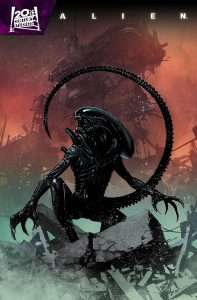
If there’s one thing the Alien franchise understands, it’s that greed gets punished—in this case through exploding chest cavities and widespread terror.
From Marvel Comics and 20th Century Fox comes Alien: Thaw by Declan Shalvey and Andrea Broccardo. If you’re at all familiar with any iteration of the Alien franchise, then you already know the basics. In this particular outing, a small team of scientists on a remote ice moon are searching for usable sources of water while also conducting some covert scientific research. There’s Batya Zhan, her daughter Zasha, and Batya’s partner Dayton. Zasha’s father died in a workplace accident and since then, Dayton has stepped up to fill the role of both teammate and surrogate father after months of isolation. Things really start getting interesting when Zasha finds a strange organism frozen in the ice and the small team brings it back to the research facility for further study. Always a good idea, right?
A pregnant Zatya tries to use the find to secure overdue transport off the moon and back to civilization, but instead attracts the attention of the Weyland-Yutani Corporation—a familiar presence across the Alien franchise. After hearing of the lifeform the Zhans have discovered, Weyland-Yulani buys the entire research company and arrives on the moon with a squadron of armed goons with itchy trigger fingers and limited common sense. Only problem is—that one organism was not the only thing buried in the ice. And with so much human activity, things are starting to melt. You can guess what happens next.
Having worked with IP such as Moon Knight and Deadpool as well as independent titles like Bog Bodies, Shalvey is no stranger to writing gritty and complicated characters trapped in progressively worsening circumstances. From the very beginning of the story, he establishes the isolation and the danger of the situation with a relatively likeable set of characters who are unable to escape their circumstances despite the progressively dire state of their situation. As things go from bad to worse, Shalvey fully confronts the capitalistic greed that underlies the bad decisions in any Alien story. As people put profit and legacy over common sense, safety protocols and rational thinking go out the window.
However, from the soldier who puts his own survival over the corporate mandate to Zasha’s desire to protect her mother—Shalvey finds moments of reason and empathy to ground the story in worthwhile ways. Some of the dialogue throughout feels a bit off, there are some plot holes and questions which hang over the narrative, the timeframe of the whole disaster is a bit too condensed, and the creators aren’t breaking any particularly new ground with this comic—but Shalvey has a talent for throwing characters into the mix and pacing out a story of conflict and survival—all of which he brings to bear on this narrative.
Meanwhile, Broccardo’s art goes for a certain amount of comic stylization without shying away from the gruesome violence of the Alien presence. As the creatures carve their way through the hapless grunts dragged along on another ill-fated mission, there is enough blood, burst chests, and viscera to convey the severity of this mistake without reveling in the gore. The characters are distinct, the action and emotions come through clearly, and there are some truly cinematic moments delivered as the researchers and corporate stooges uncover a whole lot more than they bargained for beneath the ice. Even in comic form, there’s a certain awe to watching a swarm of apex predators descend on their unwary and often unsavory prey.
Marvel lists a parental advisory for this title, and it’s definitely aimed at an older audience. However, the language is surprisingly censored throughout, so the main issue is the violence and gore which is graphic but not excessive. To be perfectly frank in assessment, Alien: Thaw is familiar, a bit underdeveloped, rushed, and kind of lacking in its final delivery of its ideas. It’s not the best writing Shalvey has delivered, nor is it the best Alien story on the market. It’s often illogical and occasionally a bit silly despite all the death and such. That being said, if you or your readers are particular fans of the franchise or are desperate for some more sci-fi horror comics, there’s still a bit here to enjoy. I can see the flaws clearly, but that didn’t stop me from enjoying myself or appreciating the few moments throughout that really do manage to shine as yet another profit-chasing bureaucrat leads a group of underlings to mass destruction. Alien: Thaw doesn’t have enough space to do everything it wants to—and it doesn’t always entirely make sense—but it’s a dramatic, cool, and gooey anti-greed story all the same.
Alien: Thaw By Declan Shalvey Art by Andrea Broccardo Marvel, 2023 ISBN: 9781302947668
NFNT Age Recommendation: Adult (18+), Older Teen (16-18) Creator Representation: Irish,
Life on the Isle of Man is peaceful and quiet, and it is driving Kay Farragher mad! An aspiring songwriter and singer, Kay dreams of a world beyond her rural village and caring for her ailing grandmother. She dreams of a life on stage and audiences outside of the pub where she works.
The problem with dreams, however, is that sometimes they become nightmares.
A chance encounter with a young girl named Mona on Halloween Night gives Kay more than she bargained for. Mona claims to have come from a world of eternal twilight, straight from the faerie stories Kay’s grandmother believes in. Soon Kay finds herself neck-deep in that world, where a horseshoe is a weapon, a hero of legend seeks the bride he was promised, and the scoundrels of two worlds seek to scheme their way out of their own dark bargains.
I had high expectations heading into Cold Iron. Apart from a fondness for Celtic mythology and horror tales involving faeries, I am a big fan of Andy Diggle’s writing and have been since his highly underrated run on Hellblazer. I was not disappointed.
Two things distinguish Cold Iron from similar stories. One is the setting, which draws upon the unique mythology of the Isle of Man, rather than the more familiar Irish Leprechauns or the Selkies of Scotland’s Orkney Islands. The other is the lead character Kay, who is developed far beyond being the typical strong female protagonist that takes center stage in many modern horror stories.
Kay is a conflicted character, being both a dreamer and a realist. She delights in entertaining children with spooky tales and songs at Halloween, but she doesn’t believe in the myths her grandmother accepts as gospel. She longs to see the world, but wants to maintain the family farm, even as she rebels against the idea of a comfortable life working in a fish and chips shop and marrying her on-again/off-again boyfriend. These details make Kay seem more sympathetic and more real, grounding the fantastic elements of the story.
The artwork by Nick Brokenshire, with colors by Triona Farrell and letters by Simon Bowland, manages a similar balancing act. Brokenshire proves equally adept at capturing the static beauty of the Isle of Man and in depicting the weird horror of the faerie realm. Farrell uses different contrasting palettes for both worlds, with the vibrancy of the twilight realm offering a firm divide against the stark reality of Kay’s life. Bowland also uses distinctive fonts for the Fair Folk, to subtly hint at their alien nature.
Dark Horse Comics rated this volume as appropriate for ages 12 and up. I think that might be a fair assessment of the story, which has nothing more objectionable than a bit of violence and a few curse words. The artist notes in the back of the book, however, feature some sketches of naked fairies that are a bit extreme for a T-rating. I would shelve this volume in the older teen or adult section just to be safe and since I think the story is more likely to appeal to older audiences, who can appreciate the full horror Mona finds in the future.
Cold Iron By Andy Diggle Art by Nick Brokenshire, Triona Farrell, Simon Bowland, Tom Muller Dark Horse, 2023 ISBN: 9781506730875
Publisher Age Rating: 12+
NFNT Age Recommendation: Adult (18+), Older Teen (16-18) Creator Representation: British, Irish, Scottish, Character Representation: British,
Those that consider graphic novels as a medium strictly for the young cite the fact that it relies greatly on pictures as well as words to tell a story, but those people might not be aware of the multiple examples of graphic novels tackling adult themes. These examples use a combination of pictures and words to convey a multitude of stories from a variety of viewpoints, including those adults who are responsible for the care and feeding of one or multiple smaller humans. One story that explores the POV of parents in the Irish paranormal mystery Scarenthood written and drawn by Nick Roche.
The story features four parents in Ireland who meet because their kids go to the same preschool, but who end up bonding because of a supernatural mystery. The cast of this book features Cormac, the main protagonist who the reader watches slowly fall apart. There’s also Jen, whose husband spends months working away from home and who is on Jen’s nerves when he is home. Rounding out the foursome is acerbic Siobhan and conspiracy theorist Flynno, who has a significant connection to the supernatural disturbances at their kids’ school. What begins as a diversion for the three parents from their lives of carting children and packing lunches becomes a threat to their lives and the lives of their children.
As a parent myself, I found myself heavily involved in Roche’s story, particularly Cormac’s, the character that gets the most attention. The supernatural entity that he’d unwittingly released has latched onto this single dad, affecting not only his sanity but his ability to raise his daughter Scooper. Cormac’s descent into self-doubt is sure to garner a lot of sympathy from parents who might feel they are not being the best caregiver. Cormac’s slippage is, however, closely followed by his new friends and it is initially through their eyes that we see Cormac struggle. When they come together to help him, it is a moment that showcases and further solidifies their bond. Roche does an excellent job of fleshing out the secondary parental characters, particularly Jen and Flynno. When at home, Jen shows signs of stress at always having her well-intentioned husband underfoot when it comes to raising their daughter. Flynno could have come across as a boisterous, unlikable know-it-all but Roche avoids this by diving into his backstory and giving him moments that let his heart shine.
The artwork hits the perfect balance for this kind of story. The characters do not look hyper-realistic; in some instances, they look like they could be part of a daily or monthly comic strip. In a story that is equal parts supernatural horror and comedy focusing on the mundane and mind-numbing aspects of parenting, the art style is a perfect fit. Indeed, the art and story, much like other great graphic novels, both work in harmony to tell a story with sympathetic characters facing down a mystical threat from Irish folklore that is worse than forgetting to pick up your child’s favorite cereal.
Scarenthood would be a great choice for libraries looking to fill their collection of horror graphic novels with something different, but this would also be a great choice for a library that has parents who wear t-shirts emblazoned with pictures of Frankenstein or The Lost Boys as they drop their little one off for storytime. Much like how parents are asked to maintain a delicate balance of being there for their small children while trying to carve out a life for themselves, Scarenthood maintains a balance of fun supernatural mystery and comedic look at the real-life funny-yet-frightening aspects of parenting.
Scarenthood By Nick Roche IDW, 2021 ISBN: 9781684058310
NFNT Age Recommendation: Adult (18+), Older Teen (16-18) Creator Representation: Irish Character Representation: Irish
Up front I must admit that I have been a long-time fan of Lafcadio Hearn’s writing on Japanese folklore especially Kwaidan(1904), the final short story collection published during his life time. Through his writing, based on research, oral tales from neighbors, and tales read to him by his wife, he became the first non-Japanese author to retell the folklore for readers of the English language.
Three of the retellings in this compilation are from Hearn’s final collection of “ghostly sketches”: “Nuki-kubi,”” Riki-Baka,” and “A Dead Secret”. An earlier work, Shadowings (1900), is also represented by three tales: “Reconciliation,” “Corpse Rider,” and “Screen Maiden.” The seventh tale, “Before the Supreme Court”, is from A Japanese Miscellany (1901). Author Sean Michael Wilson states in his brief source note that he has attempted to retain Hearn’s original wording as much as possible while adapting them to the manga format and I am happy to report that he has done what he had set out to accomplish. The source notes are adequate offering basic background information about Hearn and the retellers as well as information for finding the original tales and discovering more on your own.
The illustrations are evocative and heart breaking, focusing on facial expressions and emotions of all the characters, spectral and human. The large format of the publication and the simplicity of the backgrounds and panel arrangement add to the accessibility of the tales. It also reads right to left in traditional manga format. All seven folktales are about the complex interactions between the living and dead and while they are indeed ghostly, they are not all inescapably terrifying. But rather, they are instructive in offering glimpses of the beliefs and practices of Japanese society at the time Hearn collected and retold the tales.
I am not sure which one of the retellings is my favorite. The first tale, “A Dead Secret” is primarily about the return of a mother as a ghost but the underlying layers uncover hidden truths, love stories, and preserved secrets. “The Screen Maiden” tells the passionate and alarming tale of a young man who is almost fatally obsessed with a woman in a painting. As for the painting, “The space that she had occupied upon it remained a blank.” It is followed by a much darker tale of a masterless samurai and his adventures with deadly headless goblins. The images and antics in “Nuke-kubi” of the exasperated severed heads remained vivid long after I finished reading the story. “The Corpse Rider” is equally as visual, horrific, and memorable as it tells the story of a wife’s revenge on her ex-husband. The following entry, “Riki-Babka,” while horrifying did not leave this reader with a heavy heart, a ghost story with a more satisfying outcome, so to speak, reminiscent of one of my favorite clay figures, the golem of Jewish folklore. Hearn indicated that this tale was a personal experience narrative written exactly as it happened with only the names changed. And, if you can assert a ghost story as cheerful and redeeming, the penultimate tale “Before the Supreme Court” is exactly that. The initial horror is massaged by the very sensible conclusion. The compilation is completed by the eerie story of “Reconciliation” which leaves the reader contemplating the juxtaposition of justice and remorse.
This compilation was a refreshing read and highly recommended for those who appreciate exploring folklore and the genres of horror and ghost stories.
Manga Yokai Stories: Ghostly Tales from Japan By Lafcadio Hearn Sean Michael Wilson Art by Inko Ai Takita ISBN: 9784805315668 Tuttle, 2020 Publisher Age Rating: 14+ Series ISBNS and Order
Title Details and Representation NFNT Age Recommendation: Teen (13-16) Character Traits: Japanese Buddhist Creator Highlights: Irish, Japanese Related to…: Book to Comic

 the leader of a major political superpower is compromised? What if a supernatural evil possesses someone who has control of our nation’s military or its nuclear weapons? In a world that’s already fraught with political tension, such a story might be considered either utterly taboo or absolutely necessary to discuss, but The Exorcism at 1600 Penn doesn’t wade too deeply into our current political morass; rather, writer Hanna Rose May and illustrator Vanesa Del Rey chose not to reinvent the demonic wheel in this straight-up story of possession that happens to take place at one of the most famous and powerful addresses in our country.
 cavities and widespread terror.
 Life on the Isle of Man is peaceful and quiet, and it is driving Kay Farragher mad! An aspiring songwriter and singer, Kay dreams of a world beyond her rural village and caring for her ailing grandmother. She dreams of a life on stage and audiences outside of the pub where she works.
 Those that consider graphic novels as a medium strictly for the young cite the fact that it relies greatly on pictures as well as words to tell a story, but those people might not be aware of the multiple examples of graphic novels tackling adult themes. These examples use a combination of pictures and words to convey a multitude of stories from a variety of viewpoints, including those adults who are responsible for the care and feeding of one or multiple smaller humans. One story that explores the POV of parents in the Irish paranormal mystery Scarenthood written and drawn by Nick Roche.
 Up front I must admit that I have been a long-time fan of Lafcadio Hearn’s writing on Japanese folklore especially Kwaidan(1904), the final short story collection published during his life time. Through his writing, based on research, oral tales from neighbors, and tales read to him by his wife, he became the first non-Japanese author to retell the folklore for readers of the English language.
