It begins with a game among a group of middle school friends—a deadly game that sets off a series of events that haunts them from beyond the natural world. What have they unleashed, and how will they stop this evil from spreading? Supernatural thrills and chills multiply in Remy Lai’s (Ghost Book) Read at Your Own Risk, an eerie tale fraught with uncanny occurrences that spell trouble and impending doom.
Seventh grader Hannah spends her time journaling in her diary, recording all her private affairs including the fateful day when things turned weird after playing a game called Spirit of the Coin: what started out as an Ouija-like game to communicate with the dead quickly turns into a spook-filled mystery in R.L. Stine fashion. While walking home one day, an unseen force pushes Hannah from behind, yanks her by the wrists, and shoves her to the ground. During science class, a freak accident occurs in the middle of a lesson on dissecting an earthworm, resulting in a scalpel flying across the room, nicking her forehead that required two stitches. Later in the restroom, she spots a centipede wiggling around inside her face and squirming into her gums—or was that her paranoid, overactive imagination running wild? But then a spirit begins to speak with her directly, scrawling increasingly threatening messages in the pages of her diary. The stakes rise when the spirit starts to target her brother by controlling him like a puppet. Hannah must find a way to break this curse gone berserk, but how can she fight something she can’t even see?
Haunting tension create a sinister Goosebumps vibe in this graphic novel through zany black and white doodles and gothic stylized characters reminiscent of Tim Burton’s The Nightmare before Christmas and Neil Gaiman’s Coraline. As the plot unravels, the motives behind the malicious spirit don’t quite hit the mark, leaving room for questions and perhaps even a sequel for further exploration. Various characters—from Hannah’s classmates and teachers—pop in and out of the story, but ultimately Hannah takes the lead in moving the plot forward.
Fueled by its angst-ridden narrative voice, Lai’s story cranks up the suspense in steady bursts that explode onto double-page spreads as Hannah struggles to make sense of what’s happening while attempting to shake off the predatory entity. The storytelling style, orchestrated in sporadic journal entries paired with doodling sketches in the vein of Diary of a Wimpy Kid, makes this a fast read for reluctant readers of supernatural fiction wrapped in mystery, yet ends rather abruptly with a lingering, curious twist.
Read at Your Own Risk By Remy Lai Henry Holt, 2024 ISBN: 9781250323354
Publisher Age Rating: 8-12 NFNT Age Recommendation: Middle Grade (7-11)
Clar Angkasa skilfully breathes new life into three traditional folktales from her native Indonesia, offering a fresh look from the perspective of her female characters. In these retellings, her female protagonists are the ones with power and agency as they defend and defeat attacks against them physically and psychologically.
The first story, “Keong Mas,” revolves around two competing princesses as they combat selfishness by employing magic and, over time, selflessness. When the proud one is turned into a snail and regretfully thrown away by her younger sister, she is rescued by a fisher woman who teaches the princess the meaning of compassion, friendship, and, ultimately, affection. This is done through flashbacks of the backstory and there is an element of mystery concerning the identity of the person transformed into the snail. The flashbacks are established with muted colours while the palate of most of this tale is primarily shades of purple and gold.
The second story follows two sisters as well, but in this case, they are younger, the best of friends, and stepsisters. Bawang Merah and Bawang Putih develop a deep attachment to each other as well as their individual stepparents, but when the mother dies, the beloved father becomes despondent and angry, so much so that he is dangerous to both of the girls. When they meet a helpful stranger in the forest, they are offered a pumpkin containing a fortune. This fortune does not ease their situation, but it does release them from the inertia and hopelessness of their father’s heartbreak. Along with the purples used in the first tale, this story is augmented with shades of green and brilliant reds.
“Timun Mas,” the final story, is about a young woman who is a healer and horticulturalist living by herself and selling her seeds and natural medicines in the market. One day, to her horror, she is confronted by a giant who commands her to plant a magic seed that will produce a “fruit” he will claim when he returns in 17 years. Reluctantly, she plants the seed in her garden and grows . . . a young baby from a cucumber plant. She names the child The Golden Cucumber, or Timun Mas. The years pass by much too quickly. But before her daughter’s seventeenth birthday, mother and daughter concoct a plan to defeat the giant and his plans. This story’s palate shines with shades of greens and browns.
All three tales celebrate the rural lush landscapes of Indonesia, local customs and traditions, and magical forces and strong female characters through the colourful, cartoon-like illustrations. The panels are bursting with flowing patterns, fonts, and dialogue, adding an additional dimension to the visual telling of the three tales. There is a feeling of joy interspersed with the danger of the situations the protagonists find themselves caught up in through, for the most part, no fault of their own. The swirling panels, the colours, and the expressive features of the characters all add to an enjoyable adventure for the reader.
In the author’s note following the three stories, Angkasa explains her rationale for reworking these particular tales, focusing on feminine matters and issues ahead of the masculine focus of the traditional tales. She briefly explains why these three stories were chosen for the book before providing the texts for the original folktales. As a storyteller I would have also appreciated definite source notes for these tales, but understand that she is providing the texts that she is familiar with herself.
Highly recommended for the intended readership of 8- to 12-year-olds as well as adult readers who enjoy a well adapted tale that, while including some familiar tropes and motifs, will possibly be new to them too. Perfect for school and public library folklore collections.
Stories of the Islands By Clar Angkasa Holiday House, 2023 ISBN: 9780823449781
Publisher Age Rating: 8-12 NFNT Age Recommendation: Adult (18+), Middle Grade (7-11), Picture Books (3-8) Creator Representation: Indonesian Character Representation: Indonesian, Asexual
Everyone knows that ghosts can be terrifying. Many can rattle off stories about wandering spirits and vengeful entities that chilled the blood, but some might forget that ghosts aren’t always scary. One could point out that being a ghost is like having red hair or being double-jointed; it’s an aspect of that person’s (or spirit’s) character but it’s not the totality of it. The overall ghost story might tone down the terror for the audience or because the author wants to tell a different kind of story involving ghosts and the afterlife. Such is the case of Ghost Book, written and drawn by Remy Lai, a book about ghosts that speak to kids while also tackling some complex topics like grief and friendship.
The story begins with two children who were born on the same day, and are tied together due to some cosmic shenanigans. July Chen is considered eccentric by many of her classmates, when they notice her at all. She has what’s called Yin Yang eyes, which allow her to see ghosts, including the hungry ones that come out during Hungry Ghost Month. Despite her father’s insistence that ghosts aren’t real, she still sees them and William, who is not a ghost but a wandering spirit caught between the realms of the living and the dead. July tries to help her new friend get back to his body, but the price to save him may be too high.
Young readers will find a plucky protagonist in July Chen, who is considered by many of her peers to be “weird” but is still a brave, resourceful heroine when it counts. She is also dealing with the loss of her mother, who died when she was born, and a father who practically refuses to talk about July’s mother. As July tries to protect William, readers will also see a friendship that begins because both children are terribly isolated (William, because of his condition, and July, because of her reputation), but that bond grows more as they go on a quest into the realm of the dead where many terrors await them.
The art does depict some unsettling images of hungry ghosts. Looking like rejected sketches while Edvard Munch was painting “The Scream,” their empty eyes and repetition of the word “hungry”—all drawn in a sickly gray speech balloon—make them seem even more inhuman and terrifying. They become especially frightening when they are drawn toward William as a potential snack. However, the book balances the frights with lighter fantasy elements, like the bumbling Ox-head and Horse-face, who look exactly like their names imply. They are collectors of wayward spirits and are also pursuing July and William, but they are also more interested in eating dumplings than meeting their quotas.
The book exists in a world of Chinese mythology while also dealing with some universal truths. Ghost Book is a Orpheus-like descent into a fantastical underworld while also serving a moral about the hold grief can have over the living. Its simplistic artwork does imply that this story is for children, those who might see a little of themselves in William or July, but it also doesn’t pander to its audience and should be a part of any children’s graphic novel collection.
Ghost Book By Remy Lai Macmillan, 2023 ISBN: 9781250810434
Publisher Age Rating: 8-12 years
NFNT Age Recommendation: Middle Grade (7-11), Older Teen (16-18) Creator Representation: Indonesian,
School is out, and Jo is facing a boring summer at home with her siblings. With no friends, an absent father, a harried mother, and nothing to do at home, Jo reluctantly goes out for a walk. In the town’s shopping district, she discovers a dog that carries a basket shopping for groceries. When she follows the dog into a bookstore, a children’s art class meeting there assumes the dog belongs to Jo. Over the next several weeks, the art students befriend Jo, and she enjoys their companionship so much that she continues to pretend she owns the dog. The art students begin to use the dog, now called Pawcasso, as a model for their work and Jo helps them plan for an upcoming art show. Meanwhile, the town becomes divided over whether Pawcasso should be allowed to roam off-leash, and Jo’s secret becomes more difficult to keep. Jo risks losing her new friends and alienating her family as tensions rise in her small town.
Pawcasso is a heartwarming blend of lighthearted fun and deeper themes. Readers will laugh at watching Pawcasso navigate his path through the neighborhood, stopping to send and receive “pee-mail” at every tree, and occasionally rolling in poop. Yet more serious life lessons are also prevalent. Some of these are very practical, such as the need to consider the rights of everyone involved in a civic issue, like the question of whether dogs should be able to visit businesses off-leash. Other lessons involve thinking about the experiences that others may have had in the past, such as the loneliness that Jo learns is faced by the character at the center of the protest against Pawcasso. Jo learns many things about her own family, and about others in her community, and her relationships grow in unexpected ways throughout the book. These themes make Pawcasso a well-rounded story that’s highly enjoyable and has a lot of value.
Remy Lai’s full-color illustrations are winsome and expressive. Her cartoon style depicts both characters and setting in a way that is accessible and attractive to young readers, but also provides plenty of detail. The settings throughout the town are drawn in interesting ways, with a variety of unique shops, streets, homes, landscapes, and a main park. The characters frequent the same locations, helping the reader get to know the town well and making it a believable small-town setting for this doggie drama to unfold.
Middle grade readers will love Pawcasso, and what’s not to love? Between the adorable and precocious dog at its center, kids rallying their town for a worthy cause, a lonely girl making friends, and lessons learned about compassion and forgiveness, there’s a lot going for this book. Remy Lai lets her characters deal with genuine struggles in a way that shows how real kids face real emotions, but her books never get so heavy that kids won’t love to read them. Pawcasso joins her other well-loved books Pie in the Sky and Fly on the Wall as must-haves for any youth library.
Pawcasso By Remy Lai Holt Books for Young Readers, 2021 ISBN: 9781250774491 Publisher Age Rating: 8-12
NFNT Age Recommendation: Middle Grade (7-11) Creator Representation: Indonesian

 It begins with a game among a group of middle school friends—a deadly game that sets off a series of events that haunts them from beyond the natural world. What have they unleashed, and how will they stop this evil from spreading? Supernatural thrills and chills multiply in Remy Lai’s (Ghost Book) Read at Your Own Risk, an eerie tale fraught with uncanny occurrences that spell trouble and impending doom.
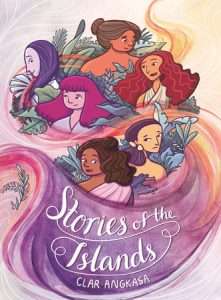 Clar Angkasa skilfully breathes new life into three traditional folktales from her native Indonesia, offering a fresh look from the perspective of her female characters. In these retellings, her female protagonists are the ones with power and agency as they defend and defeat attacks against them physically and psychologically.
 Everyone knows that ghosts can be terrifying. Many can rattle off stories about wandering spirits and vengeful entities that chilled the blood, but some might forget that ghosts aren’t always scary. One could point out that being a ghost is like having red hair or being double-jointed; it’s an aspect of that person’s (or spirit’s) character but it’s not the totality of it. The overall ghost story might tone down the terror for the audience or because the author wants to tell a different kind of story involving ghosts and the afterlife. Such is the case of Ghost Book, written and drawn by Remy Lai, a book about ghosts that speak to kids while also tackling some complex topics like grief and friendship.

