Heartcore is a roller coaster of the ups and downs of falling in and out of love. Author Št?pánka Jislová examines her relationship with relationships. How do we form preferences? What do our preferences say about our personal character? How are we informed about our identities? How do our identities dictate our roles in society? And, more importantly, how do we rebel against those dictations?
I am very thoroughly impressed how Jislová manages to blend all these things together in a way that is coherent and relatable—this book is a memoir, it’s a comic, it’s a romcom, it’s a tragedy, and it’s also a bit of a character study/psychological evaluation. Follow Jislová through her “classic Eastern bloc postcommunist 1990s childhood” and learn about the things that made her her. English language magazines, the coming of the widely-available internet, the contradictions in societal expectations for girls and women, the emotional repression of boys and men, first and early relationships, and navigating the isolation she felt as a young person.
“With infatuation came mania, and with mania, obsession. And with obsession, frustration.”
Heartcore was one of New York Public Library’s Best New Comics for Adults of 2025, and I do want to emphasize this is a book for adults. A lot of adult subject matter is discussed – casual hookups, alcohol, drugs, assault, and the like. The book is not explicit nor graphic, but there is nudity and sexual themes throughout.
The artwork is a simplistic and smooth style – no rendering with a very limited palette. The reds stand out among the grays and gives importance and hierarchy to the items or people the comic wants to highlight. The text and narrative are very easy to read, despite how densely packed this comic is.
A thoughtful and compelling read about the lines of sex and love and where those lines interconnect (or don’t). Be mindful of its placement in your collection if you add it – the clean, uncomplicated drawings might give off the idea that the story within is simple, but it absolutely is not and it is absolutely not for children.
Heartcore By Št?pánka Jislová Graphic Mundi, 2025 ISBN: 9781637790908
Company Age Rating: 16+
NFNT Age Recommendation: Adult (18+), Older Teen (16-18) Creator Representation: Czech, Bisexual,
The thought of robots may conjure images of memorable characters featured in The Terminator, Star Wars, or even Futurama, but Katerina Cupová’s adaptation of Karel Capek’s unappreciated play offers an intriguing view of automatons (and our place among them) from the perspective of an early 20th century Czech playwright.
R.U.R. primarily follows the exploits of Helena Glory, head of the League of Humanity and daughter of a powerful president, who infiltrates the island factory of Rossum’s Universal Robots, where robots are manufactured in order to improve the lives of humans. Helena believes that robots have the same rights as humans and should be liberated from their servitude, a view not shared by the humans running the factory—including Harry Domin, the dismissive and naive general manager of Rossum’s Universal Robots, who reveals that the origins of robot manufacturing are rooted in greed (shocker). Harry eventually forces Helena into marriage, and over the next decade, robots become more pervasive throughout the world. We soon discover (as is common in stories of robot oppression) that they are in fact more human-like than expected. Needless to say, things quickly go south for Helena, Harry, and the other humans of R.U.R., as the robots seek freedom.
Between Cupová’s prescient plot and Cupová’s energetic, playful art, it’s genuinely surprising that the original play was written in 1920. Capek touches on themes that have become so central to science fiction in the century following R.U.R. that they’re practically cliche: the dehumanization of workers due to advances in technology, the freewill of machines, the dangers of playing God, and the steep sacrifices of so-called “progress.” Recent questions surrounding the use of Artificial Intelligence suggest that the ideas addressed by Capek are even more timely today than a century ago.
Flipping to any page of R.U.R. will reveal Cupová’s loose, expressive style that perhaps belies the themes of conformity, automation, and the loss of the human spirit. The artist relies on bold, primary colors, an ink wash/watercolor-like aesthetic, and simplified figures that evoke both newspaper comic strips and picture books. By sticking to a limited palette, Cupová’s is able to draw your eye to important characters, especially during scenes in which bright, yellow-tinged humans are surrounded by a sea of nearly identical blue robots. She seems averse to preciseness (and rulers), making it very clear that a human being produced this comic—an interesting decision that seems very deliberate in light of the story’s concerns about the devaluation of humanity. Indeed, she is noticeably un-robotic and un-clinical. Particularly unusual is Cupová’s use of word balloons, which, in addition to being jagged and seemingly haphazard, tend to snake around the page, stretch across whole panels, and intertwine with each other. Despite pushing 300 pages, R.U.R. moves quickly, relying on only the most necessary of dialogue and letting the beautiful imagery do most of the storytelling.
At times, R.U.R. verges on the melodramatic, as the bleeding heart Helena looks further into the tragic ways profits and productivity are favored over freedom and individuality, but it’s executed so well and so undeniably accurate in its assessment of contemporary capitalist society that it’s easy to forgive. Of course, if any of R.U.R.’s themes seem banal, it’s only because of how overwhelmingly they have invaded so many popular science fiction narratives of the 20th and 21st centuries.
Although R.U.R. deals with some heavy ideas, there’s very little within its pages that would be inappropriate for younger readers. Anyone seeking a robot rebellion that resembles a bloodbath will simply not find it here, as much of the violence is either implied, happens between scenes, or is presented in such a cartoonish way that it feels completely removed from real world suffering. If younger YA readers of sci-fi are looking for something a little more thought-provoking, R.U.R. would certainly be a great entry point, especially if they’ve already been introduced to some of the complicated ethical questions surrounding A.I.
R.U.R. is a highly under-discussed classic of science fiction, so I suspect fans of the genre will enjoy seeing where so many of the tropes and themes of robot fiction originated. Unfortunately, despite R.U.R.’s almost incalculable influence on pop culture, there are so few ways to experience Capek’s play, but Cupová does an excellent presenting the source material in a way that’s surprisingly breezy and accessible without shying away from big, philosophical, and often uncomfortable ideas within the original text. If you’re into Blade Runner, the 2004 Battlestar Galactica reboot, Fritz Lang’s Metropolis, or Asimov’s I, Robot then the questions raised by this comic will feel extremely familiar and have you rethinking not only the consequences of unhindered technological advancement, but what it means to be a human being.
R.U.R. Rossum’s Universal Robots By Katerina Cupova Art by Kateina Cupová Rosarium Publishing, 2024 ISBN: 9798986614687
NFNT Age Recommendation: Adult (18+), Older Teen (16-18), Teen (13-16) Creator Representation: Czech,

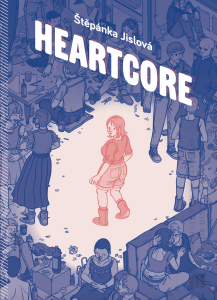 relationships. How do we form preferences? What do our preferences say about our personal character? How are we informed about our identities? How do our identities dictate our roles in society? And, more importantly, how do we rebel against those dictations?
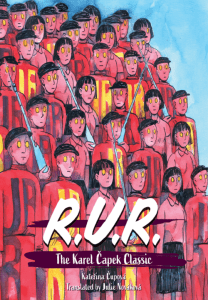 Katerina Cupová’s adaptation of Karel Capek’s unappreciated play offers an intriguing view of automatons (and our place among them) from the perspective of an early 20th century Czech playwright.
