Anima. Lisa Storm. Vera Vicious. Morgaine La Fey. Gaia.
Five different women, both friends and rivals. Five women among the hottest and wildest girls to be found cruising the Sunset Strip. They make the scene. They go backstage. They enjoy the drugs and the bands just passing through. Every night is a new party. Every party is a new adventure.
That changed with the arrival of The Moon Show—a band on the verge of becoming the next big thing. The girls are there when a major label signs them. They go on the road with the band as they go on-tour. And for a while they are living the dream in style.
However, the girls start noticing something is wrong. Other women the band picks up go missing. And some of the girls start seeing strange things while they’re high. Visions of some darkness behind The Moon Show. Something that calls for blood!
Groupies is a hard comic to quantify. It is horror, but it is a slow-boiling horror story where the terrors are more existential than gory and largely left to the imagination. There is a mystery, but the big secret of the story is telegraphed early and somewhat predictable given stories about musicians selling their souls are common enough. (The label that signs The Moon Show is called Asmodeus Records, for crying out loud!)
Thankfully, that’s not really what Groupies is about. The mystery and horror are just background dressing to the true focus of the comic. Namely, the stories of five different women trying to find meaning in their lives amid the sex, drugs, and rock and roll culture. And their vastly different reactions to everything around them.
Lisa Storm, for instance, enjoys the scene, but still dreams of finding true love with The Moon Show’s front-man, Si, despite knowing deep down he’s a dog. Gaia and Morgaine work together to bring rock stars into bed, yet both would rather spend time with alone with one another. The irony is they are both fearful of saying anything for fear of ending what they have. And then there’s Vera Vicious, who for all her blunt talk and complaints about other women trying to steal her man of choice, is the first to realize there’s something strange about the people from “the label” and something sinister going on. All in all, Helen Mullane does a fantastic job of developing these characters and putting the reader inside their heads.
Similarly, Tula Lotay turns every chapter into a different sort of visual journey. It does the artwork a disservice to describe it as merely psychedelic. Oh, there are shifts in the artwork as the characters get high, but there are different alterations to the style and colors depending on the drug. The dark visions Gaia has after taking datura, for instance, are different than the shared hallucination the women enjoy as they drop acid before going for a walk in the woods and start imagining themselves as dryads.
Groupies is rightly recommended for Mature readers. There is cursing. There is nudity. There is everything one would expect in a story devoted to exploring the dark side of sex, drugs, and rock-and-roll. And that’s before you bring in all the murder, assault and demons. In short, this is one to put in the adult collection of the public library and one to keep away from the kids and teens.
Groupies By Helen Mullane Art by Tula Lotay Mad Cave Studios, 2026 ISBN: 9781545821268
Company Age Rating: 18+
NFNT Age Recommendation: Adult (18+) Creator Representation: British, Character Representation: Bisexual,
Many science-fiction stories follow Mary Poppin’s advice of providing a spoonful of sugar to go with one’s medicine. While readers are usually enjoying the fantastic technologies and interdimensional shenanigans, they are also assimilating the story’s moral about universal problems that affects most everyone on earth, at least ideally. Sometimes, that’s a delicate balance. Too much sci-fi sweetness and the author’s message becomes lost, but too little and the audience becomes resistant to the author’s didactic delivery. Luckily, Acid Box, with its story provided by Sara Kenney and art provided by James Devlin, Emma Vieceli, and Ria Grix, manages that delicate balance.
This time travel adventure begins in 2026 with Jade Nyo, a Glasgow woman more interested in dancing and getting high (and taking care of her brother) instead of saving the world. During a trip to a seemingly normal restroom, however, she becomes acquainted with three women who call themselves Liminals, guardians of doorways through space and time. Jade becomes responsible for the Acid Box, a device that can potentially cause geological catastrophes. Jade and her companions, including her brother, go on a quest, traveling through space, time, and the 90’s rave culture scene to repair the Acid Box while hopefully not destroying the world.
As much as Kenney’s story is about environmental issues and humanity’s role in them, this story also serves as a love letter to rave culture and what music itself provides. Jade and the people she encounters on her journey serves as musical and historical tour guides through the ‘90s as the book explores the rave music genre along with historical events. Such a statement might sound like a synopsis from a PBS show about the power of music, but that’s not necessarily a bad thing. The main benefit of this musical genre, argued by Kenney’s story, is its power to connect people and unite them under a common cause. This trip through musical history also allows Jade to experience her own hero’s journey of self-discovery once she stops relying on recreational drugs to handle the mindbending time-travel narrative.
Complementing this mindbending journey is the visuals provided by the multiple artists that lend their talents to this book. There are many opportunities for these artists to be creative, from depicting natural disasters that seem to be sentient to trips through different time periods that take their toll on the body. Many of these panels take up whole pages, so the artists have a lot of canvas to show off their talents. Combined with Kenney’s story, the art is as vibrant and stirring as the music serving as the narrative’s heartbeat.
This book is ideal for librarians wanting graphic novels that take advantage of both the linguistic and visual aspects of the medium. Acid Box provides a visual feast for the eyes, a compelling protagonist, and a story that doesn’t dilute this message, the proper ratio of sugar and medicine.
Acid Box By Sara Kenney Art by James Devlin Not in listAvery Hill Publishing, 2025 ISBN: 9781917355056
NFNT Age Recommendation: Adult (18+), Older Teen (16-18) Creator Representation: British,
In this graphic novel adaptation, Raymond Chandler’s Trouble Is My Business, the book’s foreword asks the following question: “Why adapt this particular story into a graphic novel?” Ben H. Winters eventually answers the question, but by simply broaching it, he might remind readers how our cultural landscape has seen media companies and film studios wring every last drop of blood from the intellectual properties they own. That said, this graphic adaptation of Chandler’s 1939 short story still offers readers a unique entry into the world of Chandler’s hard-drinking, deep-thinking private detective Phillip Marlowe.
Marlowe is hired by an industrialist to protect his wayward adopted son Gerald from femme fatale archetype Harriet Huntress, who may have her own sinister intentions. After Gerald is is found dead, Marlowe must find the killer among a plethora of suspects, including Harriet, a mysterious chauffeur who displays a certain set of skills, and the typical thugs and criminals who populate 1930’s Los Angeles. It also goes without saying that finding the killer means Phillip Marlowe will live to drink, fight, and quip another day.
Telling a story in a visual medium (in movies or graphic storytelling) means that the original story is often condensed, sometimes brutally so. Secondary plots and characters that added flavor to the story are cut away from the story till all that remains is what can be told through a visual medium. This simple fact makes writer Arvind Ethan David’s choice of adapting a short story (rather than, say, a 400 page epic tale) a wise one. In retelling Trouble Is My Business, David shows he can balance the large amount of snappy dialogue while keeping the story’s pacing humming along. However, David seems to challenge himself by adding details about the inner lives of characters like Harriet without bogging down any of the action.
Telling the story, however, is only half of this book’s task; the other half is providing visuals that complement Chandler’s words and David’s direction and Ilias Kyriazis’s artwork is up to the task. The people populating this story are what one would expect from a 1930’s detective story. Jaws are suitably square, lips are drawn with just the right amount of sneer, and the women who perhaps shouldn’t be trusted look both beautiful and dangerous. The book offers up delicious eye candy apart from Harriet Huntress. This eye candy includes gunshots that seem to zip across the page and languidly curling cigarette smoke stretching toward the top of the page.
There may be those adult patrons, perhaps even those who’ve read all about Marlow’s exploits, who would turn up their nose at this book because they have been fed (perhaps even overfed) a diet of rehashes and reimaginings. However, retellings in the graphic novel format like this one shouldn’t be dismissed out of hand. There are plenty of graphic novel retellings of classic stories that serve not only as introductions to these books’ original source material but may draw readers to other classics, both graphically and non-graphically retold, that they might not have otherwise discovered.
Raymond Chandler’s Trouble Is My Business By Raymond Chandler, Arvind Ethan David Art by Ilias Kyriazis Pantheon, 2025 ISBN: 9780553387599
NFNT Age Recommendation: Adult (18+) Creator Representation: British,
“Everything ends,” says W. Maxwell Prince’s newest compilation of linked stories. But as is true of any Prince release, there’s more here than meets the eye.
Prince and Image comics give us Swan Songs, a series of six loosely connected narratives, each in their own way about endings. We open simply enough—with the end of the world. This grand cataclysm is grounded intimately in a hospital-bound mother and the son who fights to care for her amidst the end of everything. From there we travel through the end of a marriage and the eternal mortal combat. Husband and wife agree to face across fantastic realities as they reckon with young love and fractured connection. We cross the aftermath of a prison sentence and a biblically-infused post-apocalyptic story of a new Eden. We go deep into the psyche of a man who cannot feel joy and we end at a sidewalk that extends out into nothing. But, as the comic asks each time in its own way, is this truly where these stories end after all?
Prince has shown himself to be truly at home in the weird, stitching together narratives of people living through the uncertain and often uncomfortable realities of existence. Though there is significantly less horror in this volume than some of his other works, Swan Songs is a compelling blend of truly strange storytelling and deeply poignant themes. From calamities to eternal combat to the depths of the human subconscious, the writing and imagery across this series is sometimes tangible and other times utterly surreal. Nevertheless, the characters facing these strange circumstances are immediate and recognizable—people awash in humanity and doubt, doing the best they can to find connection. I don’t know how Prince manages to do it, but each new comic he releases somehow feels more powerful than the last. The final issue here presents a twisted inversion of Shel Silverstein’s famous work. While this issue initially felt like the weakest in the collection, it manages to rouse itself to a quiet but powerful conclusion, drawing together questions that have built through each preceding story and leaving the book with a powerful send-off. It’s an ending that leaves things open without feeling at all like it has abandoned the reader before the time is right. And this works because even when the story ends—life still goes on.
Pairing with Prince’s writing, six artists bring their talents to capturing each entry in this tapestry of endings. Showcasing some notable names in contemporary comics, the shifting styles move between color palates and visual aesthetics as the real gives way to the unreal across these pages. Each artist brings a distinct style to their chapter, but this is an anthology where every artist stands strong on their own. At the same time, the six recognizable styles feed into each other and manage to create a cohesive whole despite the only vague threads tying them together. Prince’s writing is gripping, but these artists provide a visual journey that carries the reader along into some fascinating places.
Image gives Swan Songs a Mature rating and with a spread of sex, violence, strong language, and mature themes, this is clearly a volume aimed at adults. However, it’s difficult to convey just how much lies between the covers of this this book. Anyone interested in comics that manage to be surreal, dark, hopeful, and contemplative all at once will find something to enjoy. There are subtle references to Ice Cream Man to be found, so anyone who is an established fan of Prince’s other work is sure to be intrigued. But for those who want an entry point that is less horrific than the Ice Cream Man series, there’s darkness here, but it combines with a meditative melancholy that offers more possibility than the sometimes nihilistic undertones which run through Prince’s other offerings.
In summary, as with Prince’s other work, Swan Songs is weird, surreal, dark, and more complex than one might expect—but in spite of all its strangeness, he remains an immensely compelling storyteller who is playing with the possibilities of the format while delving deeper and deeper into the strange uncertainties that make us human. I never know where he’s headed next, and I will keep reading across every unexpected chapter spanning our world and imagined others.
Swan Songs Vol. 1 By W. Maxwell Prince Art by Martin Simmonds, Caspar Wijngaard, Filipe Andrade, Caitlin Yarsky Image, 2024 ISBN: 9781534398283
Publisher Age Rating: M NFNT Age Recommendation: Adult (18+)
Creator Representation: British, Portuguese Character Representation: Neurodivergent
Gotta’ catch them all—“them” being a host of ultra-powerful demons set loose on earth and now largely under the control of an assortment of criminals, altruists, and opportunists. What’s the worst that could happen?
Boom! Studios brings us the opening volley in a new series from Simon Spurrier and Charlie Adlard. In voice over and flashback, the story opens with an introduction to Ellie and her uncle Alfie. Young and naïve, Ellie convinces her uncle to show her a summoning—an act he reluctantly agrees to. The moment… doesn’t go great, but no one dies and it begins Ellie’s introduction to an occult world of magic, angels, demons, and hierarchies far beyond human understanding jotted down in conflicting grimoires and notes scribbled by long-dead madmen.
Twelve years later, Ellie is not the naïve youngster she once was. Other things have changed, too. Alfie is dead, and the circumstances may not be so simple as they first appeared. More immediately, demons, once only summoned by complex rituals, are suddenly appearing at the beck and call of low-level gangsters with only the most basic understanding of magic. Something has changed. And so Ellie sets off with those few people she somewhat trusts, her trusty claw hammer, and all the magical knowledge at her disposal to figure out what happened to Alfie, stop the demonic rampages across the city, and send every one of these beings back to the abyss—even if she has to exorcise each one of them herself.
If only it were that simple.
In Spurrier’s hands, Damn Them All quickly embraces a richly textured mix of noir, dark urban fantasy, and horror. The characters are sharp, the landscape is gritty, and the action draws the reader deeper into this world where there is always some secret or paranormal mystery waiting to be revealed. Not every comic that takes on this scope of storytelling and worldbuilding manages to pull it off, but Spurrier clearly has a handle on the script and the medium to balance all the elements at play here. It’s sometimes a little tricky to keep track of all the players and developments, but the writing quickly brings it all to life and stays strong from start to finish, with snappy dialogue, careful management of time and character jumps, and a bold story that’s only getting started. As great as the demon-hunting adventure is, Spurrier takes the time to go deeper, giving us insight into the complexities of this world and characters, even as incomprehensible beings throw down in the street outside.
Hand-in-hand with Spurrier’s writing, Adlard’s illustrations do a fantastic job creating this world and these characters on the page. With realism that leaves room for stylization, the visuals feel rough and grounded except when reality is interrupted by supernatural forces. As the story continues, these two planes of existence become readily intertwined, as colorful magic courses along gritty back alleys and blood-stained crime scenes. The characters are distinct and diverse, with each page and panel engaging to look at, as investigation moves to action and back again—interspersed with ongoing narration from Ellie and other key characters.
Boom! does not list a specific age rating for this title, but Damn Them All is clearly written for adult audiences. There’s consistent strong language that those familiar with more British styles of cursing may not be surprised by—as well as graphic violence and disfigurement, drug use, and adult situations. The comic has a horror edge to it, but there’s a dark humor running through much of the story that lightens the impact somewhat. The marketing draws an unsurprising comparison to the character of John Constantine, and readers familiar with that brand of gritty but snappy dark fantasy should have an idea of what to expect here. In final summary, Damn them All is not for every collection—but if your readers like mature paranormal noir, Spurrier, Adlard, and the rest of this creative team have created an excellent first volume of a story that should not disappoint readers looking for a complex antihero who’s willing to throw a demon prince through a window just because she’s having a bad day.
Damn Them All By Simon Spurrier Art by Charlie Adlard BOOM! Studios, 2023 ISBN: 9781684159116
NFNT Age Recommendation: Adult (18+) Creator Representation: British Character Representation: British
Life on the Isle of Man is peaceful and quiet, and it is driving Kay Farragher mad! An aspiring songwriter and singer, Kay dreams of a world beyond her rural village and caring for her ailing grandmother. She dreams of a life on stage and audiences outside of the pub where she works.
The problem with dreams, however, is that sometimes they become nightmares.
A chance encounter with a young girl named Mona on Halloween Night gives Kay more than she bargained for. Mona claims to have come from a world of eternal twilight, straight from the faerie stories Kay’s grandmother believes in. Soon Kay finds herself neck-deep in that world, where a horseshoe is a weapon, a hero of legend seeks the bride he was promised, and the scoundrels of two worlds seek to scheme their way out of their own dark bargains.
I had high expectations heading into Cold Iron. Apart from a fondness for Celtic mythology and horror tales involving faeries, I am a big fan of Andy Diggle’s writing and have been since his highly underrated run on Hellblazer. I was not disappointed.
Two things distinguish Cold Iron from similar stories. One is the setting, which draws upon the unique mythology of the Isle of Man, rather than the more familiar Irish Leprechauns or the Selkies of Scotland’s Orkney Islands. The other is the lead character Kay, who is developed far beyond being the typical strong female protagonist that takes center stage in many modern horror stories.
Kay is a conflicted character, being both a dreamer and a realist. She delights in entertaining children with spooky tales and songs at Halloween, but she doesn’t believe in the myths her grandmother accepts as gospel. She longs to see the world, but wants to maintain the family farm, even as she rebels against the idea of a comfortable life working in a fish and chips shop and marrying her on-again/off-again boyfriend. These details make Kay seem more sympathetic and more real, grounding the fantastic elements of the story.
The artwork by Nick Brokenshire, with colors by Triona Farrell and letters by Simon Bowland, manages a similar balancing act. Brokenshire proves equally adept at capturing the static beauty of the Isle of Man and in depicting the weird horror of the faerie realm. Farrell uses different contrasting palettes for both worlds, with the vibrancy of the twilight realm offering a firm divide against the stark reality of Kay’s life. Bowland also uses distinctive fonts for the Fair Folk, to subtly hint at their alien nature.
Dark Horse Comics rated this volume as appropriate for ages 12 and up. I think that might be a fair assessment of the story, which has nothing more objectionable than a bit of violence and a few curse words. The artist notes in the back of the book, however, feature some sketches of naked fairies that are a bit extreme for a T-rating. I would shelve this volume in the older teen or adult section just to be safe and since I think the story is more likely to appeal to older audiences, who can appreciate the full horror Mona finds in the future.
Cold Iron By Andy Diggle Art by Nick Brokenshire, Triona Farrell, Simon Bowland, Tom Muller Dark Horse, 2023 ISBN: 9781506730875
Publisher Age Rating: 12+
NFNT Age Recommendation: Adult (18+), Older Teen (16-18) Creator Representation: British, Irish, Scottish, Character Representation: British,
There was a time when superhero stories were thought to be just for kids, but titles like Suicide Squad helped tear that stereotype apart. People who’ve seen Margot Robbie portray Harley Quinn on the big screen might be familiar with the Suicide Squad, a group of lesser-known villains coerced to work for the government in exchange for lighter sentences. Many of these missions have high fatality rates, hence the group’s name, but mainstays like Quinn and Captain Boomerang have stayed alive, largely due to their popularity. However, that makes Suicide Squad: Blaze, written by Simon Spurrier and illustrated by Aaron Campbell, and its focus on people other than its regular roster an adult-rated anomaly.
Yes, the shark man King Shark, the boomerang-tossing Australian Captain Boomerang, and the John Cena vehicle Peacemaker are not the true stars of this book; that dubious honor goes to a group of convicts. They become part of a government experiment that grants normal people superpowers that will eventually kill them, but this group feels they have nothing left to live for, anyway. These newly-powered individuals are the last line of defense against a super-powered individual murdering and devouring people. Even stalwarts like Superman and the Justice League are unable to defeat him, so odds are that planet Earth will burn.
Some might be familiar with Spurrier and Campbell’s collaborations on Hellblazer, and the same violent yet bleak tone is present here. One of Suicide Squad’s appeals is the fact that the roster, apart from a few core characters, is constantly in flux as B-list villains often meet gruesome, and sometimes comedic, ends. Blaze ups the ante by having a twist with these newly superpowered people: when one of them dies, their power gets divided up among the remaining convicts, so it’s guaranteed that their number will diminish and those who survive will steadily become more powerful. One of those who might be the last superperson standing is Michael Van Zandt, who wants to get back together with the love of his life before his powers kill him. But this might be too hopeful (and a deep misunderstanding of this book’s themes) to think there’s any chance of a happy ending.
Campbell’s art is well-suited to showcase this dark universe where even Superman can be gravely injured and the Justice League are cannon fodder. Deaths and dismemberments are shown in graphic detail, and the powers that exist in this world are far from phenomena resembling Renaissance artwork of angels. The powers summoned by these people burn their bodies and distort their dimensions. In case Spurrier’s morally bankrupt characters haven’t clued readers into the book’s worldview, Campbell’s depiction of powers and what they do to a person’s anatomy will show these people to be fundamentally cursed.
The characters from the classic Suicide Squad roster, like King Shark and Quinn, have some shining character moments, but mostly this is a title to see who is left standing while the world burns. It’s a superhero book that has a inky black view of superheroes, which might be up the alley of readers who enjoyed Suicide Squad movies but think they could have gone darker.
Suicide Squad: Blaze By Simon Spurrier Art by Aaron Campbell DC Black Label, 2023 ISBN: 9781779514264
NFNT Age Recommendation: Adult (18+) Creator Representation: British
Love comes in all shapes and sizes, whether it’s between adventurous pirates, burgeoning demon hunters, smooth spies, or even your average couple trying to make it all work. Young Men in Love, edited by Joe Glass and Matt Miner, showcases all these relationships and more, containing twenty stories from queer creators devoted to exploring the romantic hurdles and queer joy of male/masculine couples. This graphic novel boasts a variety of genres: fantasy, sci-fi, paranormal romance, contemporary slice of life, etc., ensuring that each reader will be able to find at least a story or two to enjoy.
Typical of most anthologies, not every story is going to be as hard hitting as the next one. With an average length of four to eight pages, there are some that struggle to break beyond their concept, leaving the reader more with an idea rather than a fleshed out narrative. The majority of contributors, however, manage to pace their stories so that, though we may not spend much time with these characters, they still leave a great amount of impact. Despite the varying appeal of each story, there is an admirable amount of honesty, vulnerability, and love interwoven within them all. An immense sense of pride lives in these pages that comes from an unwavering self-acceptance and the ability to love openly without shame or fear. Moments of loneliness, depression, and doubt play roles in multiple stories, but they always come around to love in the end, whether it comes from a partner or within themselves.
Given the graphic novel’s notable range in terms of content and themes, there are several stories that display aspects of queerness that are rarely discussed in the community. Ned Barnett and Ian Bisbal’s “Another Name” deals with a trans man realizing his identity and coming out to his partner in what was once a heterosexual relationship, highlighting the fears and anxiety that may come with such a discovery. “Act of Grace,” written by Anthony Oliveira and illustrated by Nick Robles, follows a teen expressing religious guilt to his priest, afraid of how his feelings for a boy may conflict with his Catholic upbringing. Editor Joe Glass, along with Auguste Kanakis, throw in a moving inclusion in “Love Yourself,” which has a character experience the fetishization of plus sized men in the community and how validation and love for someone comes from appreciating and celebrating the whole of them rather than a singular aspect. These are all facets to the queer experience that I have seen firsthand, but seldom are they reflected in media tailored to those they are meant to represent. Seeing these conflicts approached and resolved with such depth and respect allows the reader a touch of hope and comfort, even if they may not entirely relate to it.
Intent on including as many voices and experiences as possible, Young Men in Love also gives a tremendous amount of diverse representation in terms of ethnicity and body type. It shies away from solely depicting the stereotypical skinny, white, gay man, as there are several stories with black, brown, and plus-sized protagonists. What’s so refreshing about these depictions is that, aside from “Another Name” and “Love Yourself,” none of the stories make the characters’ backgrounds the focal point of their conflict. They exist as people foremost, without their identities being a source of added trauma.
As there is a separate artist accompanying each installment, there is a vast variety in art styles, ranging from charmingly cartoonish to engagingly realistic. I will forever throw praise onto Nick Robles, who puts so much life into his textures and instills a healthy dose of emotion and drama into “Act of Grace” through his use of lighting and character expressions. There is something Leyendecker-esque about his style where he captures the male form exceptionally well, making it the perfect fit for this collection. I also really appreciated the yellow tinge given to the palette and borders of Paul Allor and Lane Lloyd’s “The Way Home,” producing a nostalgic effect reminiscent of those old comics that had probably been left in the basement for too long. Overall, there is a vibrant rainbow of color throughout the graphic novel, as the reader is treated to vibrant pastels to moody, atmospheric shadows. Each story, as a result, becomes visually distinct and memorable, even if its content may not have lived up to the one that preceded it. None of the art in this graphic novel disappoints, which brings a certain coherence to all the differing perspectives within.
For fans of uplifting romantic stories with happy endings or layered depictions of queer experiences, Young Men in Love will hit that emotional, sappy spot in spades. As a romance comic, the content is fairly clean, with nothing going further than the occasional cuddle or kiss. The featured protagonists range from being young teens to full adults, so it may appeal most to readers fourteen and up. Librarians and educators looking to obtain graphic novels with positive and varied queer representation from queer creators should consider purchasing this title.
Young Men in Love Vol. By Joe Glass, Matt Miner A Wave Blue World, 2022 ISBN: 9781949518207
Publisher Age Rating: 13+ NFNT Age Recommendation: Adult (18+), Older Teen (16-18), Teen (13-16) Creator Representation: Black, Brazilian, British, Canadian, Greek, Latinx, Malaysian, Mexican-American, Bisexual, Gay, Queer, Nonbinary, Trans Character Representation: Black, British, East Asian, Latinx, Gay, Queer, Nonbinary, Trans, Catholic
Vampires as a horror trope are so popular because they can be metaphors for all sorts of different aspects of our society, particularly the horrific ones. They work well with themes like unhealthy relationships and negative emotions, but they work particularly well as puppet masters, or mysterious shadowy figures that are secretly in control of everything. If you were a basically immortal species that fed on humans, you would not only create a network of businesses to help protect yourself, but you’d also try to find the necessary levers of power so that you could shepherd your flock of unwitting, blood-filled humans until they were ready to be harvested. Sure, In the world of Blood Stained Teeth, Vol 1: Bite Me, written and illustrated by Christian Ward and also illustrated by Patric Reynolds, there are vampires who run the world, but protagonist Atticus Slaone is definitely not one of those vampires.
Despite being a member of the aristocratic First Born, those vampires who are born vampires, Atticus Sloane is not necessarily living the high life (or high unlife, as it were). He does have a way of making some extra money: for the right price, Atticus can turn anyone into a vampire. These Sips that Atticus created have all the immortality, strength, speed, etc. that other vampires get, but they are also potential loose cannons that could reveal the existence of vampires. The First Born are clearly not happy with Atticus’s side hustle, so he is commanded to kill all the Sips he’s created, lest there be a wooden stake and a sunrise waiting for him.
Atticus is written by Ward as a clear antihero who is far from perfect. He has his moments where he looks good in his shades and he verbally stakes both his own customer base and the First Born who think they are above it all, but he also has some clear moments where he realizes that he’s in over his head. When he’s not looking like an apex predator of the night, he’s trying to avoid being killed by the First Born and those Sips Atticus has clearly underestimated.
While Atticus is trying his best to find his misplaced progeny and stay undead (rather than completely dead), he’s roving in a world that is somehow both easy and harsh on the eyes. It’s easy because Ward and Reynolds’s artwork does a great job with dynamic angles and faces that are gorgeously expressive, even as they have blood dripping down their teeth. The colors in this universe, however, shine like the neon signs one would expect to find near divebars or barely illuminating shadowy alleyways. It’s not a natural or even pleasing brightness in these pages; it’s the kind of light that would seem natural to vampires who find their food in an artificially-brightened night.
There is the beginning of a good story here, and Atticus himself is a likable enough character, but it also feels like Ward’s pen and Atticus’s fangs have barely scratched the surface of this universe. There are plenty of Atticus’s Sips for readers to meet and watch as they meet their ends, meaning that librarians who invest in this book should consider getting the rest of the series as it comes out because Atticus might have many more neon-filled nights left to survive.
Blood Stained Teeth, Vol. 1: Bite Me By Christian Ward Art by Patric Reynolds Image, 2022 ISBN: 9781534323858
Publisher Age Rating: 16 and up
NFNT Age Recommendation: Adult (18+), Older Teen (16-18) Creator Representation: British,
A young girl and her giant metal guardian trek across a fantastic world full of beauty, conflict, and danger in this bittersweet tale of coming-of-age and survival.
From Image Comics, Step by Bloody Step is a wordless graphic novel which conveys a great amount of depth through its striking sequence of visuals. We meet the girl and her guardian amidst a frozen landscape beneath a tree perched atop a cliffside. However, it does not take long for them to leave this place. The girl is full of wonder, searching for flowers and taking in the vastness of the world. Her guardian, meanwhile, is love and violence, looking after the girl’s need while also fending off the multitude dangers of the wilds.
Time passes as the pair traverse the world, leaving the mountains behind as they pass by small settlements who speak a language neither girl or guardian understands. The girl grows older, chafing against the constant direction of her protector. And still more world stretches out before them—a world of imperialism and warfare which will carry the two travelers to the edges of their endurance and force them both to make decisions which will impact everything to come.
Though the only dialogue in Step by Bloody Step is presented in glyphs without translation, brief poetic passages begin each section of the story and help set the book’s tone. Even without additional words, Spurrier has scripted a simple story that carries a heart of great emotion. The guardian raises a child in a hostile world. Grief, love, and power war in the lives of every character. The violence of a dangerous existence threatens to overwhelm at every turn. This comic is a fantasy adventure, a survival story—but most of all it is a tale of growing up, of cycles of life, and of the legacy each of us leaves behind.
By nature of its form, the greatest strengths of the story come in the art. On every page, Bergara crafts landscapes that are both terrible and beautiful. Every emotional high and low is conveyed in the visuals, from flashes of fleeting beauty to the love and devastation stretching from the characters’ eyes to the depths of their souls. Bergara builds worlds and characters across these pages, creating spreads and panels worth lingering over even as the story grips your heart without uttering a word.
Altogether, Step by Bloody Step is an achievement of visual storytelling. For fans of coming-of-age narratives, for those who are parents or caregivers, and those who want to lose themselves in fantasy worlds, this creative team has a lot to deliver. Image rates the title Teen+, and with violence that is often graphic but rarely too realistic, it’s perfectly suitable for older teen as well as adult readers. It’s a comic well-worth putting into the hands of a wide audience, but anyone who connects with the emotional core of the story will find something truly special here. As a feat of both comics and storytelling, Step by Bloody Step deserves a place in any collection aimed at teens and above.
Step by Bloody Step By Simon Spurrier Art by Matías Bergara Image, 2022 ISBN: 9781534322387
Publisher Age Rating: T+
NFNT Age Recommendation: Adult (18+), Older Teen (16-18) Creator Representation: British, Uruguayan

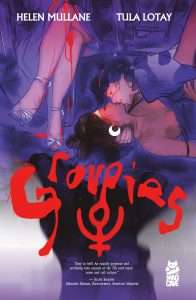 They make the scene. They go backstage. They enjoy the drugs and the bands just passing through. Every night is a new party. Every party is a new adventure.
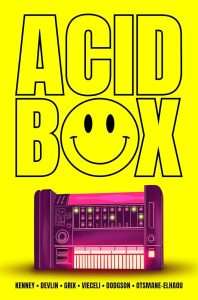 Many science-fiction stories follow Mary Poppin’s advice of providing a spoonful of sugar to go with one’s medicine. While readers are usually enjoying the fantastic technologies and interdimensional shenanigans, they are also assimilating the story’s moral about universal problems that affects most everyone on earth, at least ideally. Sometimes, that’s a delicate balance. Too much sci-fi sweetness and the author’s message becomes lost, but too little and the audience becomes resistant to the author’s didactic delivery. Luckily, Acid Box, with its story provided by Sara Kenney and art provided by James Devlin, Emma Vieceli, and Ria Grix, manages that delicate balance.
 In this graphic novel adaptation, Raymond Chandler’s Trouble Is My Business, the book’s foreword asks the following question: “Why adapt this particular story into a graphic novel?” Ben H. Winters eventually answers the question, but by simply broaching it, he might remind readers how our cultural landscape has seen media companies and film studios wring every last drop of blood from the intellectual properties they own. That said, this graphic adaptation of Chandler’s 1939 short story still offers readers a unique entry into the world of Chandler’s hard-drinking, deep-thinking private detective Phillip Marlowe.
 “Everything ends,” says W. Maxwell Prince’s newest compilation of linked stories. But as is true of any Prince release, there’s more here than meets the eye.
 Gotta’ catch them all—“them” being a host of ultra-powerful demons set loose on earth and now largely under the control of an assortment of criminals, altruists, and opportunists. What’s the worst that could happen?
 Life on the Isle of Man is peaceful and quiet, and it is driving Kay Farragher mad! An aspiring songwriter and singer, Kay dreams of a world beyond her rural village and caring for her ailing grandmother. She dreams of a life on stage and audiences outside of the pub where she works.
 There was a time when superhero stories were thought to be just for kids, but titles like Suicide Squad helped tear that stereotype apart. People who’ve seen Margot Robbie portray Harley Quinn on the big screen might be familiar with the Suicide Squad, a group of lesser-known villains coerced to work for the government in exchange for lighter sentences. Many of these missions have high fatality rates, hence the group’s name, but mainstays like Quinn and Captain Boomerang have stayed alive, largely due to their popularity. However, that makes Suicide Squad: Blaze, written by Simon Spurrier and illustrated by Aaron Campbell, and its focus on people other than its regular roster an adult-rated anomaly.
 Love comes in all shapes and sizes, whether it’s between adventurous pirates, burgeoning demon hunters, smooth spies, or even your average couple trying to make it all work. Young Men in Love, edited by Joe Glass and Matt Miner, showcases all these relationships and more, containing twenty stories from queer creators devoted to exploring the romantic hurdles and queer joy of male/masculine couples. This graphic novel boasts a variety of genres: fantasy, sci-fi, paranormal romance, contemporary slice of life, etc., ensuring that each reader will be able to find at least a story or two to enjoy.
 particularly the horrific ones. They work well with themes like unhealthy relationships and negative emotions, but they work particularly well as puppet masters, or mysterious shadowy figures that are secretly in control of everything. If you were a basically immortal species that fed on humans, you would not only create a network of businesses to help protect yourself, but you’d also try to find the necessary levers of power so that you could shepherd your flock of unwitting, blood-filled humans until they were ready to be harvested. Sure, In the world of Blood Stained Teeth, Vol 1: Bite Me, written and illustrated by Christian Ward and also illustrated by Patric Reynolds, there are vampires who run the world, but protagonist Atticus Slaone is definitely not one of those vampires.
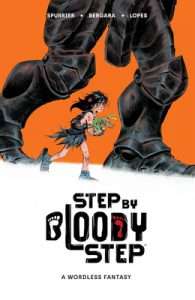 A young girl and her giant metal guardian trek across a fantastic world full of beauty, conflict, and danger in this bittersweet tale of coming-of-age and survival.
