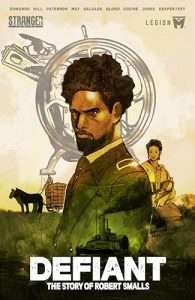
Shining a light on a lesser know story from the Civil War era, Legion M Entertainment and Stranger Comics bring together a talented creative team including creatives from Disney, Marvel, and DC, for Defiant, this first volume chronicling the life of Robert Smalls.
Born to an enslaved mother in the American South, Smalls dreamed of freedom. Beginning with his childhood, Defiant follows Smalls as he grows through education, love, and eventually into working as a sailor when war breaks out against the North. It is in this war that Smalls sees an opportunity at freedom, to steal the Confederate transport ship he worked on and escape to Union-controlled territory with some of his fellow crew and their families.
It was this escape that made Smalls famous, but his life’s work did not stop there. He continued as an influential figure throughout the war and beyond, including time serving in Congress. There are many today who do not know the details of Smalls and his life, and in the supplementary material that accompanies this graphic novel, the creators, as well as Smalls’s great great grandson, reflect on the power of legacy and the necessity of telling stories like this in order to remember the past and inform the future.
Defiant opens with a framing narrative depicting Smalls later in life as he takes his grandson fishing. It is here, as they wait for the fish to bite, that he begins to recount his story. Each section of the book captures key moments of Smalls’s youth and adulthood. It’s a significant length of time to cover, but the creators pace the story well, showcasing the experiences that formed Smalls’s character and the sense of defiance that would later drive him to risk everything in pursuit of freedom. The story is told with fondness and dramatic flair, but it doesn’t lose sight of the Smalls’s humanity or the horrors of US slavery at the time.
Balancing cinematic sensibilities with a desire to share a true segment of history, the writing effectively moves between interludes with the older Smalls and the larger narrative chunks leading up to his dramatic escape. The dialogue is straightforward and occasionally on the nose, but the book does an excellent job identifying important details to convey and moving the story along, while also bringing the reader into Small’s life along with the lives of those around him. It’s a story told with concern for historical truth, but also with acknowledgement that some liberties were taken and some factual gaps filled in to bring the story to life.
With these same cinematic sensibilities, the artistic team uses bold coloring and some dynamic layouts that quickly grab the reader’s attention. There’s a general sense of realism to the visual sequences, but the art takes some compelling creative liberties at times which help to elevate the themes and content of the story. There is one pivotal moment early in the book where Smalls, as a child, witnesses the violence and cruelty committed against the Black people around him. With use of light and shadow as well as distortions of faces that once seemed less threatening, the artists bring us into the experience of the moment and the realization of the evil inherent to the institution of slavery. Here and elsewhere, the art reckons with the realities of the time without the need to linger over pain and suffering. As the book progresses into the dramatic escape that Smalls is most known for, the visuals continue to bring the reader into the action, with effective choices in framing and dramatic moments that heighten both the tension and the heroism of what Smalls and the other achieved.
Stranger Comics lists Defiant as suitable for all ages. There are a range of areas in the content to be mindful of—violence and death in war and toward enslaved people, occasional slurs, briefly implied nudity, and some sequences of tension and threat which at times include children. However, none of these are presented for shock value or in graphic detail; even the creators state that their intention is not to linger over the violence and other horrors of the time. What detail we do see in the pages is relatively brief, maintaining focus on Smalls as a central figure and celebrating what he achieved without glossing over the reality that helped shape him.
As such, it’s a suitable read for older kids and upward, not only for the book’s sense of adventure, but also for the rich and important history it seeks to convey. In the afterword, writer Rob Edwards reflects on the importance of telling stories and why he sees such value in remembering the life of Robert Smalls. There is value, not only in the history recorded here, but in the discussions offered by Edwards and the others in this book who reflect on what it can mean for us today, to remember the bravery and steadfastness of those who have come before. In this way, Defiance is a perfect read for the current moment, and a great addition to shelves in schools, libraries, and home collections, especially with a movie also in production.
Defiant The Story of Robert Smalls By Rob Edwards Art by Sean Damien Hill Legion M and Stranger Comics, 2025 ISBN: 9781939834379
NFNT Age Recommendation: Teen (13-16) Creator Representation: Black, Character Representation: Black,
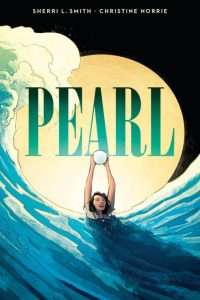
To be stateless, drifting between two cultures, belonging to neither one nor the other completely, creates a confounding challenge for finding a place called home. Such is the plight of young Japanese American teenager Amy during the tumultuous times of World War II. In Pearl, Sherri L. Smith (Flygirl) and Christine Norrie (Cheat) chronicle her dilemma amidst the shadow of war in the United States and Japan.
The opening pages introduce Amy’s great grandmother, who as an ama, dives for pearls along the shores of Honshu in Japan. The narrative then shifts and traces her lineage to thirteen-year-old Amy on the island of O’ahu, Hawai’i in 1941. One day, news of her grandmother’s deteriorating health prompts Amy to travel to Japan while her parents stay home to take care of her newborn brother. She stays at her uncle’s farm on the outskirts of Hiroshima and is drafted into translating news from American radio broadcasts for the Japanese military.
When the Japanese bomb Pearl Harbor and Amy learns of the incarceration of Japanese Americans back home, she must navigate between her dual identity as Japanese and American: “To the Americans, I was a traitor. To the Japanese, I was an American. I had no country to call my own.” In this conflicted tale of grasping one’s identity amidst the looming specter of war spanning across the Atlantic, Pearl explores themes of emigrating to one’s ancestral land, becoming estranged as an outsider between two cultures, and grappling with despair, hope, and the will to survive in the aftermath of atomic destruction.
The story falls short in developing the family dynamics between Amy and her relation to her grandmother, leaving more to be desired. While she interacts with relatives in Japan, their relationship to her fail to fully crystalize. The graphic novel’s strength lies in its picturesque visuals of the sea in deep space compositional panels ensconced in pastel hues of blue and flashbacks tinted in light gray, establishing a muted tone of melancholy and wonder. Wordless panels and speech bubbles depicting nuanced emotions and symbolic imagery imbue selected scenes with dramatic impact, conveying the affective interactions between characters and their environment.
Fantastical elements blend into the narrative and expressive artwork, which include the haunting personification and specter of death as characters struggle past the ravages of war and emotional trauma. Although lacking in secondary character background development, this graphic historical novel presents a conflicted perspective of a Japanese American caught in the socio-political throes of World War II and will complement diverse middle grade graphic novel collections to highlight this crucial period of U.S. American history.
Pearl By Sherri L. Smith Art by Christine Norrie Scholastic GRAPHIX, 2024 ISBN: 9781338029437
Publisher Age Rating: 10-14
NFNT Age Recommendation: Tween (10-13) Creator Representation: Black, Character Representation: Japanese-American,
Author and artist James Spooner shares his story of discovering the punk scene as a Black teenager during the late 1980s in The High Desert: Black. Punk. Nowhere.
Spooner moved to a majority White area in California with his White mom (his dad was a Black bodybuilder who lived in Brooklyn) during his high school years. While trying to find where he fit in, skateboarding videos introduced him to punk music, “…the first time I found music that matched my emotions,” (24). The music led him to new friends, a new style and expression, and lent him a veneer of toughness to hide his deeper emotions behind. As the story progresses, James is exposed to the drug scene, white supremacy and Nazi skinheads. He also learns about the Black influence on punk music, intersectionality, and radical political activism.
During a crucial visit to his dad in Brooklyn during winter break, Spooner meets socially involved punks and discovers new bands through them. More importantly, he begins to understand that punk isn’t just about nonconformity and disdain towards authority. Punk is about questioning and disrupting potentially harmful norms, using one’s voice, and collaborating with others to seek social justice and foster inclusivity. “If punk rock was teaching me anything, it’s that us kids have power,” (344). This lesson was vital for the politically and socially focused adult Spooner would become.
The book first caught my eye because of the bold, expressive art. The grayscale illustrations with rich splashes of opaque black are dynamic and character-driven. Lyrics from songs by Black Flag, Minor Threat, Wasted Youth, and other bands populate the pages, with footnotes that include the song and band names. Flipping through and seeing the punk outfits, haircuts, and depictions of teenage life during that time period intrigued me enough to take on the 300+ page memoir. This is a graphic novel with art that tells the story as much as the text does.
This book is great for adult readers, but you don’t have to have any special interest in memoir, punk music, or activism to enjoy it. The universal themes of The High Desert and the wonderful art should appeal to any adult graphic novel enthusiast.
The High Desert: Black. Punk. Nowhere. By James Spooner Harper Collins, 2022 ISBN: 9780358659112
NFNT Age Recommendation: Adult (18+)
Creator Representation: Black Character Representation: Black
The story of a kid trying to figure out a new life and school after their family moves far away is a classic story in children’s literature and Jonathan Todd’s Timid shows why young readers still need these kinds of stories.
Cecil’s family is moving from Florida to a Massachusetts town near Boston. There’s no palm trees in New England and his sister Leah will be away at college, but at least their new house has space for him to have his own art studio and his family already has a church to go to (with a cute girl who Cecil sees at services every week).
School is its own separate challenge. Cecil struggles with his shyness and finds it hard to come out of his shell. His fellow students start to notice his drawing skills and he slowly finds his place… or so he thinks. He loves sharing his artwork with his classmates but it sure seems like he’s being taken advantage of. When someone takes his work and uses part of it in a not very nice portrayal of the principal, Cecil finds his voice and learns there’s no perfect way to be anything, you just have to be yourself.
Cecil’s identity as a demure, artistic Black boy is the strongest aspect of Timid and one that guides the graphic novel’s story. He doesn’t feel like he fits in with the Black kids at his school. He doesn’t want to be seen as trying to be white by hanging out with just the white kids either. The book doesn’t shy away from the reality of being Black in a majority white school and the microaggressions Cecil deals with. When he starts at the new school, someone asks him if he’s there as part of the program that buses kids in from Boston proper and later in the book, a white student touches his hair while teasing him about it. There’s points where Cecil overanalyzes his every move in an attempt to not fall into unwanted stereotypes and how this being on guard affects him.
Cecil’s story in Timid is based on Todd’s own life and his storytelling is very earnest. While it’s not an actual memoir, you can feel that it’s been very influenced by personal experiences Todd himself faced. Younger readers will appreciate that the story is told in a very straightforward, relatable way. Almost all of the problems Cecil comes up against are solved fairly quickly and easily but without shorting the emotions surrounding them. They happen, there’s a resolution, and life keeps going, even if the problems are still lingering in the background at times.
Todd’s art style is very comic-inspired, with even a tinge of newspaper comics style to it. The bold lines throughout really make the panels jump off the page. It’s refreshing to see a middle grade graphic novel with a different art style than the ones that dominate the shelves. Readers interested in creating their own comics will likely appreciate Todd sharing his own childhood artwork that mirrors the comic that Cecil draws to enter the neighborhood comic shop’s content.
Timid will appeal to a variety of readers: those who enjoy the fish out of water story, those who can’t get enough of graphic novel memoirs, and those looking for stories to inspire their own confidence, as well as the teachers and librarians who recommend them. It would be best enjoyed by younger middle grade readers, especially those looking for stories about inspiring artists, the desire to fit in while still remaining yourself, and conquering their own shyness.
Timid By Jonathan Todd Scholastic GRAPHIX, 2024 ISBN: 9781338305708
Publisher Age Rating: 8-12
NFNT Age Recommendation: Middle Grade (7-11), Tween (10-13) Creator Representation: Black, Character Representation: Black, Protestant ,
After saving the world, what does it take to build a new one?
Boom! Studios presents the sequel to 2022’s Eve from Victor LaValle and Jo Mi-Gyeong. Children of the Moon finds Eve, her sister/clone, and Wexler trying to reestablish society in a world reborn, but without the guidance of Eve’s parents and with societies of rescued children scattered across the country coming to terms with the fact that the world is theirs to shape. When one known outpost fails to respond to attempts at communication, Eve and the others decide to pay a visit for themselves.
What they discover is a group known as the Children of the Moon, led by Selene. Cut off from the world, Selene and the children in her care have faced violence and it has changed them. They demand Wexler’s head as justice for past crimes, and Eve finds herself in a struggle she never expected to face—against the very people she believed she had saved. And when a new AI awakes with protocols of its own, everyone involved will face the possibilities of a world they don’t recognize.
LaValle returns to writing this sequel with many of the same themes that defined the first one while expanding on the world in new and unexpected ways. What is the world adults leave to their children? Going deeper into some of the questions established in the first volume, LaValle centers a coming-of-age story of children who have faced violence and trauma and now must each find their own way to grow beyond their pasts. Into this, he weaves questions of identity between Eve and her sister—each trying to define themselves apart from the other—and hard ideas of justice and forgiveness for past wrongs and current allies. This brings together layers of complex storytelling all wrapped up in a dynamic sci-fi survival thriller written for teens and adults alike to enjoy.
With vibrant color and action, Jo Mi-Gyeong and the rest of the visual team brings Eve and the others to life once more as they venture into the harsh and snow-covered landscapes of a brand-new territory. From the horrors of the diseased adult monstrosities to the mysteries and terrors of AI to the deep emotion of children forced to come of age far too soon, Mi-Gyeong balances a bright and somewhat cartoon style with enough grounded realism and tangible detail to keep the story tethered in reality and landing the emotional beats when they come.
While it is a sequel and functions best with an understanding of the events in the first volume, Eve: Children of the Moon offers enough of a standalone story with embedded recap that a new reader could begin here without a great deal of difficulty. Yet again, there are some intense themes and mild horror elements, but the story and visuals overall are perfectly acceptable for readers aged teen and older.
Overall, while there are a few beats and pacing elements that don’t land quite right as delivered, Eve: Children of the Moon is largely an ambitious and successful successor to the first volume. Balancing a variety of complex themes alongside an exciting and intriguing narrative, the creative team clearly cares about the lives of the characters they have created and have something to say about our world, even as they introduce us to another.
Eve: Children of the Moon By Victor LaValle Art by Jo Mi-Gyeong BOOM! Studios, 2023 ISBN: 9781646688760
Publisher Age Rating: 14+ NFNT Age Recommendation: Older Teen (16-18), Teen (13-16) Creator Representation: Black, Korean Character Representation: Black
It’s always difficult when your vision doesn’t translate to reality the way you hope it will. This is what Lika deals with in artist and author Lawrence Lindell’s delightful Blackward. Lika and her pals Lala, Tony, and Amor (they/them) have a club called The Section, “a group for Black folx who a little bit ‘other’”. They want to attract newcomers and establish a community for Black people who feel like they don’t fit in anywhere else. Lika’s vision is a safe space that celebrates differences, but it’s hard to get the word out and it’s discouraging to face down the trolls. As the leader of The Section, Lika relies upon the mentorship of bookstore owner Mr. Marcus and the support of Lala, Tony, and Amor to realize her vision. It’s wonderful to see how The Section succeeds despite obstacles.
Blackward is full of heart. Lindell offers serious themes alongside a playful sense of humor. The bold color palette and dynamic cartoon style make every page pop. The book brings up concepts such as acceptance versus judgment; inclusion versus othering; individual struggles, teamwork, and community-building; being Black and queer; and even just being Black and different. The terrific sense of humor sparkles in interactions between the elder Mr. Marcus and the four young friends, Amor’s revulsion towards children, and the over-the-top White ally who gets it all wrong.
The art is pure fun. From the first pages that depict each character’s house and bedroom in a bright rainbow of hues, I looked forward to a joyful reading experience. Black, toothy speech bubbles chomp into Lala’s dialogue when a toxic instigator interrupts her. On date night, Lindell illustrates the characters getting ready as a silhouetted superhero transformation. The lettering also changes to suit the tone of the panel, using color, style, and positioning to accentuate various moods. Each chapter opens with a word in four different languages. For example, Community, Comunidad, Jumiya, and Communauté are in English, Spanish, Swahili, and French respectively, and the colors of the words correspond to Lika, Amor, Tony, and Lala.
I highly recommend Blackward for all public libraries. Anyone who has felt like a misfit will appreciate it, though I think it will resonate most deeply with Black nerds. Put this book in the hands of older teens and adults who love cartoony art and relish being their quirky and authentic selves.
Blackward By Lawrence Lindell Drawn & Quarterly, 2023 ISBN: 9781770466784
Publisher Age Range: 14+ NFNT Age Recommendation: Adult (18+), Older Teen (16-18) Creator Representation: Black Character Representation: Black, Bisexual, Queer, Nonbinary, ADHD, Anxiety, Depression
Garvey’s Choice joins a long line of books adapted as a graphic novel. The original Garvey’s Choice is a novel in verse by Nikki Grimes. Garvey struggles to connect with his dad, who expects him to be someone who he is not. It is told in a series of poems in the Japanese Tanka style. The book which came out in 2016 has been popular with middle grade readers, for good reason. It’s a heartwarming story about finding your voice, and the poetry of Nikki Grimes is poignant and deep while using few words.. I am a huge fan of her writing, and was excited to read this book.
Garvey is a young black boy in a larger body. He loves science fiction, space, and reading, however, his father wants him to play sports. The relationship between father and son is strained. They have a difficult time relating to each other, and in general Garvey struggles with feelings of isolation and loneliness. Over the course of the book, Garvey finds his voice through music, with his friends, and eventually with his family.
The Tanka style is discussed in an author note at the end of both the original book and the graphic novel. It is a format that originated in Japan. Each poem is five lines long, with specific syllable patterns, however, Grimes does not follow the syllable counts exactly. The poetry style which focuses on mood and emotion, fits Garvey’s character arc on his journey to find himself.
Theodore Taylor III illustrates the graphic novel in a bright cartoonish style, similar to that of Jerry Craft’s New Kid. The graphic novel illustrates the characters, plot, and poetic metaphors from the original book, but doesn’t necessarily add much depth to the mood or themes. The best parts of the graphic novel are from the poetry text. And while, I do not think the illustrated format adds much to the story, I do think it is a great purchase for elementary collections, because of the illustrations. Poetry can be an intimidating format for some readers. In condensing text to verse, some context must be implied rather than stated, which can be confusing for some. By illustrating the entire text through the graphic novel format, that context is no longer implied but clearly shown, which can provide a strong scaffold for some readers.
The graphic novel text is fairly similar to Grime’s original verse. There are times that the wording of the poems is adjusted, and they switch up the order of some poems, but for the most part, the text of the graphic novel is very consistent with the book. Lines from the poems are turned into speech bubbles or as narration on the page. Some of the poems are told over the course of a two-page spread, sometimes multiple poems share the spread, but most are confined to one page. The illustrated metaphors add weight to Garvey’s emotional journey.
Notably, a large part of the novel explores Garvey’s relationship with his weight, which is also a source of contention with his dad. But Garvey isn’t illustrated with a body size that is noticeably larger than other characters. He is round, but so is everyone else. I think this is a missed opportunity for body representation.
While not perfect, I think the graphic novel Garvey’s Choice is a strong purchase for elementary collections, especially if novels in verse or books by Grimes are used in the curriculum. In such cases, this graphic novel adaptation could be a good supplement. Either way, Garvey’s Choice is an excellent book and story, whether you read it in the original format or as a graphic novel.
Garvey’s Choice Vol. By Nikki Grimes Art by Theodore Taylor III Wordsong, Astra Publishing House, 2023 ISBN: 9781662660085
Publisher Age Rating: 9-12
NFNT Age Recommendation: Middle Grade (7-11) Creator Representation: Black, Character Representation: Black,
It is spring of eighth grade, time for a Riverdale Academy Day School tradition: a school trip to somewhere exciting and educational. For Jordan and his friends, that just happens to mean a trip to Paris. School Trip is the third installment of Jerry Craft’s graphic novels about Jordan, who readers first met in the Newbery and Coretta Scott King Award winning New Kid, and an excellent addition to the collection.
At the cusp of a new stage in his life, Jordan finally feels a part of the RAD community and can’t wait to travel overseas with his classmates and teachers. He never gets to see kids like him, other young Black kids from New York City, traveling the world and experiencing different cultures. This is his chance to be the main character and blaze a path. But there’s more than just the trip on his mind. Eighth grade will be over before he knows it and he’ll have to decide between RAD, where he’s no longer the new kid, or art school, the place that could help make his dreams come true. He knows what his parents want him to do and where his friends will be but hasn’t quite come to realize the best path for himself.
A prank causes some unexpected changes to the RAD trip to Paris, but the group makes the best of the situation. Along the way, the classmates learn more about each other, sometimes resulting in conflicts amongst the characters. Craft’s masterful storytelling gives these arguments and discussions depth, without seeming unrealistic for a bunch of eighth graders.
The trip exposes each student’s prejudices, fears, and unrealized ideas about themselves and their peers. Readers will see characters like themselves reflected back at them and School Trip gives them the space to discuss similar things happening in their lives. Witnessing Jordan and Ramon, amongst others, sticking up for themselves against unaware bully Andy may even give readers confidence to do something similar.
The introduction of the Thumbs-Downers in the story gives a realistic explanation to why negative, hateful people always speak the loudest and get the most attention. A two page spread between Drew, the focus of Craft’s Class Act, and Andy is particularly visually striking as a follow up to this idea. Andy is a Thumbs-Downer but he’s much more than that and must recognize his own privilege. This scene could, and should, cause reflection in young readers as they consider their own racial, socioeconomic, and religious backgrounds.
As with Craft’s previous books, it is recommended readers keep an eye out for easter eggs throughout School Trip, especially anyone who reads lots of graphic novels. There’s even some aimed at older readers! Craft does a great job of setting his characters in very specific places without the cities and backgrounds becoming the main focus. Your eye is always drawn to the characters and their stories.
School Trip belongs on every library’s and classroom’s shelves, alongside its predecessors. Craft’s fondness and appreciation for these characters is evident throughout the book, something that readers of all ages will find themselves feeling as they follow along with Jordan, his family, and his classmates.
School Trip By Jerry Craft Quill Tree, 2023 ISBN: 9780062885531
NFNT Age Recommendation: Middle Grade (7-11), Teen (13-16), Tween (10-13) Creator Representation: African-American, Black Character Representation: African-American, Black
Love comes in all shapes and sizes, whether it’s between adventurous pirates, burgeoning demon hunters, smooth spies, or even your average couple trying to make it all work. Young Men in Love, edited by Joe Glass and Matt Miner, showcases all these relationships and more, containing twenty stories from queer creators devoted to exploring the romantic hurdles and queer joy of male/masculine couples. This graphic novel boasts a variety of genres: fantasy, sci-fi, paranormal romance, contemporary slice of life, etc., ensuring that each reader will be able to find at least a story or two to enjoy.
Typical of most anthologies, not every story is going to be as hard hitting as the next one. With an average length of four to eight pages, there are some that struggle to break beyond their concept, leaving the reader more with an idea rather than a fleshed out narrative. The majority of contributors, however, manage to pace their stories so that, though we may not spend much time with these characters, they still leave a great amount of impact. Despite the varying appeal of each story, there is an admirable amount of honesty, vulnerability, and love interwoven within them all. An immense sense of pride lives in these pages that comes from an unwavering self-acceptance and the ability to love openly without shame or fear. Moments of loneliness, depression, and doubt play roles in multiple stories, but they always come around to love in the end, whether it comes from a partner or within themselves.
Given the graphic novel’s notable range in terms of content and themes, there are several stories that display aspects of queerness that are rarely discussed in the community. Ned Barnett and Ian Bisbal’s “Another Name” deals with a trans man realizing his identity and coming out to his partner in what was once a heterosexual relationship, highlighting the fears and anxiety that may come with such a discovery. “Act of Grace,” written by Anthony Oliveira and illustrated by Nick Robles, follows a teen expressing religious guilt to his priest, afraid of how his feelings for a boy may conflict with his Catholic upbringing. Editor Joe Glass, along with Auguste Kanakis, throw in a moving inclusion in “Love Yourself,” which has a character experience the fetishization of plus sized men in the community and how validation and love for someone comes from appreciating and celebrating the whole of them rather than a singular aspect. These are all facets to the queer experience that I have seen firsthand, but seldom are they reflected in media tailored to those they are meant to represent. Seeing these conflicts approached and resolved with such depth and respect allows the reader a touch of hope and comfort, even if they may not entirely relate to it.
Intent on including as many voices and experiences as possible, Young Men in Love also gives a tremendous amount of diverse representation in terms of ethnicity and body type. It shies away from solely depicting the stereotypical skinny, white, gay man, as there are several stories with black, brown, and plus-sized protagonists. What’s so refreshing about these depictions is that, aside from “Another Name” and “Love Yourself,” none of the stories make the characters’ backgrounds the focal point of their conflict. They exist as people foremost, without their identities being a source of added trauma.
As there is a separate artist accompanying each installment, there is a vast variety in art styles, ranging from charmingly cartoonish to engagingly realistic. I will forever throw praise onto Nick Robles, who puts so much life into his textures and instills a healthy dose of emotion and drama into “Act of Grace” through his use of lighting and character expressions. There is something Leyendecker-esque about his style where he captures the male form exceptionally well, making it the perfect fit for this collection. I also really appreciated the yellow tinge given to the palette and borders of Paul Allor and Lane Lloyd’s “The Way Home,” producing a nostalgic effect reminiscent of those old comics that had probably been left in the basement for too long. Overall, there is a vibrant rainbow of color throughout the graphic novel, as the reader is treated to vibrant pastels to moody, atmospheric shadows. Each story, as a result, becomes visually distinct and memorable, even if its content may not have lived up to the one that preceded it. None of the art in this graphic novel disappoints, which brings a certain coherence to all the differing perspectives within.
For fans of uplifting romantic stories with happy endings or layered depictions of queer experiences, Young Men in Love will hit that emotional, sappy spot in spades. As a romance comic, the content is fairly clean, with nothing going further than the occasional cuddle or kiss. The featured protagonists range from being young teens to full adults, so it may appeal most to readers fourteen and up. Librarians and educators looking to obtain graphic novels with positive and varied queer representation from queer creators should consider purchasing this title.
Young Men in Love Vol. By Joe Glass, Matt Miner A Wave Blue World, 2022 ISBN: 9781949518207
Publisher Age Rating: 13+ NFNT Age Recommendation: Adult (18+), Older Teen (16-18), Teen (13-16) Creator Representation: Black, Brazilian, British, Canadian, Greek, Latinx, Malaysian, Mexican-American, Bisexual, Gay, Queer, Nonbinary, Trans Character Representation: Black, British, East Asian, Latinx, Gay, Queer, Nonbinary, Trans, Catholic
In virtually all stories—novels, epic myths, fairy tales, movies, and even biographies—characters must undergo a trial of sorts. Mythologist Joseph Campbell coined this paradigm as the archetypal hero’s journey, wherein an individual must fulfill a series of tasks to achieve a goal and return from this quest with a boon to benefit society. A critical stage of this journey entails venturing into a katabasis, a sojourn into the underworld or land of the dead. In a dynamically fascinating exploration of this descent into darkness, Brian McDonald (Old Souls) and Toby Cypress (The Gravediggers Union) delineate how this universal voyage into the underworld permeates time and space in Land of the Dead: Lessons from the Underworld on Storytelling and Living. What unfolds is a most intriguing graphic essay spanning across countless cultures and stories that encompasses the multitudinous nuances of storytelling.
In folkloric fashion mirroring some indigenous cultures, a crow serves as the narrative guide who breaks the cinematic fourth wall, steering readers into the magical realms of imaginative storytelling. As an agent of the land of the dead, the crow recounts the earliest written story from antiquity—The Epic of Gilgamesh. This mythic tale embodies humanity’s eternal quest for immortality since the dawn of time, plunging readers into the depths of the underworld, for therein lies wisdom to be attained. Like a multifaceted puzzle box in the episodic tradition of the Arabian Nights, McDonald traverses the landscapes of literature, film, and oral storytelling, highlighting common threads across cultures similar to how Joseph Campbell illuminated familiar motifs, themes, and tropes in The Power of Myth.
This extensive graphic essay traces a literary history of stories from antiquity to the present for the young and old alike. From angelic characters in Cinderella and Steven Spielberg’s E.T. to Scrooge’s grim, sordid outlook on life in Charles Dickens’ A Christmas Carol and Uncle Charlie’s sinister intentions in Alfred Hitchcock’s Shadow of a Doubt, McDonald brilliantly connects varied themes of survival, necography, isolation, and memory. Cypress’s striking artwork shines through thoughtfully composed panels tinged with shaded hues. Meticulously rendered sketches of characters accentuated by sparing use of ambient coloring amplifies certain scenes and moods, adding a tonal richness to each story.
A treasure trove and visual feast for the literati, writers, cinephiles, and storytellers of classic and contemporary works, Land of the Dead exemplifies a monumental achievement that bears repeated readings for renewed insight. Although not necessarily a handbook on the craft of storytelling, one will discover the intricate underlying frameworks, motifs, and themes that infuse the mechanics and wizardry behind compelling stories throughout time. A fine addition to public and academic library collections, this literary masterpiece cuts across multi-interdisciplinary subjects and aims to attract a wide readership, demonstrating the alluring power of stories and the lessons they bestow upon humanity.
Land of the Dead: Lessons from the Underworld on Storytelling and Living By Brian McDonald Art by Toby Cypress Macmillan First Second, 2023 ISBN: 9781626727311
NFNT Age Recommendation: Adult (18+), Older Teen (16-18) Creator Representation: Black

 creative team including creatives from Disney, Marvel, and DC, for Defiant, this first volume chronicling the life of Robert Smalls.
 challenge for finding a place called home. Such is the plight of young Japanese American teenager Amy during the tumultuous times of World War II. In Pearl, Sherri L. Smith (Flygirl) and Christine Norrie (Cheat) chronicle her dilemma amidst the shadow of war in the United States and Japan.
 Author and artist James Spooner shares his story of discovering the punk scene as a Black teenager during the late 1980s in The High Desert: Black. Punk. Nowhere.
 literature and Jonathan Todd’s Timid shows why young readers still need these kinds of stories.
 After saving the world, what does it take to build a new one?
 It’s always difficult when your vision doesn’t translate to reality the way you hope it will. This is what Lika deals with in artist and author Lawrence Lindell’s delightful
  Grimes. Garvey struggles to connect with his dad, who expects him to be someone who he is not. It is told in a series of poems in the Japanese Tanka style. The book which came out in 2016 has been popular with middle grade readers, for good reason. It’s a heartwarming story about finding your voice, and the poetry of Nikki Grimes is poignant and deep while using few words.. I am a huge fan of her writing, and was excited to read this book.
 It is spring of eighth grade, time for a Riverdale Academy Day School tradition: a school trip to somewhere exciting and educational. For Jordan and his friends, that just happens to mean a trip to Paris.
  Love comes in all shapes and sizes, whether it’s between adventurous pirates, burgeoning demon hunters, smooth spies, or even your average couple trying to make it all work. Young Men in Love, edited by Joe Glass and Matt Miner, showcases all these relationships and more, containing twenty stories from queer creators devoted to exploring the romantic hurdles and queer joy of male/masculine couples. This graphic novel boasts a variety of genres: fantasy, sci-fi, paranormal romance, contemporary slice of life, etc., ensuring that each reader will be able to find at least a story or two to enjoy.

