In fact, it took me a very long time to gather my thoughts to write this review for the book, and I’m still not convinced that I have come up with a cohesive whole here, but here we go.
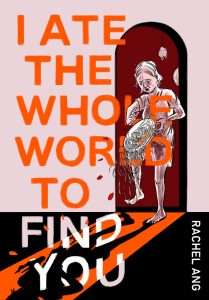
Our protagonist is Jenny, but even giving her the title of “protagonist” is a bit generous. I tend to think of protagonists as very active in their respective narratives, but the way this story was constructed makes me feel like she’s more of a canvas on which this surreal narrative is projected. Which, according to the product description, is intentional and it definitely contributes to the overall negative tone of the book.
The surreal aspects are definitely something I appreciate about the narrative, but the story overall is rough. The plot is a string of loosely connected stories that, for me, boil down to a laundry list of traumas and disasters. And, for me, it’s very hard to get through. I’ll let the publisher explain it:
A coworker-turned-prospective-lover confesses a hard-to-swallow fetish. A train ride fantastically goes off the rails as old habits get dragged across the tracks. Cousins revisit summer holiday bliss—or was it really horror? Exes fumble an attempt to reconnect over a dip in the pool on a squelching summer day. And an expectant mother slips into an unusual place as she embarks on a communion with her baby more pure than language can accommodate.
There are several adult themes featured in the narrative including sexual fetishes, (child) death (but also: childbirth), religious trauma, child sexual abuse, and vehicle collision/accident.
The narrative’s final page offers the reader one small sliver of hope—a newborn baby, a chance to protect a new life from what plagued Jenny.
For me personally, I was not able to catch the optimism that I think was supposed to be projected here. There simply isn’t enough in the overall story to suggest that change is possible.
The artwork is interesting when it breaks from reality and introduces seemingly unrelated imagery that freely flows through the narrative. It’s otherwise difficult to criticize because it’s not particularly notable in either direction. The scratchy pencils are perfectly competent and they are technical in showing plane changes, but the overall look is not distinct and I actually had a little trouble identifying different characters. I always appreciate a muted and largely monotone color pallet, however.
This might be the first book I don’t feel comfortable recommending, not even in very specific circumstances. I think there is value in these sorts of memoirs, and they are unfortunately relatable to many readers, but I think there is better on offer. Please see Tsunami by Ned Wenlock, Epileptic by David B., Precious Rubbish by Kayla E., or even the tried-and-true classic, Maus by Art Spiegelman.
I Ate the Whole World to Find You By Rachel Ang Drawn and Quarterly, 2025 ISBN: 9781770467583
Publisher Age Recommendation: N/A, but I will note that Drawn and Quarterly has a Kids section on their website and this title is not listed there
NFNT Age Recommendation: Adult (18+), Older Teen (16-18) Creator Representation: Australian, Character Representation: Australian,
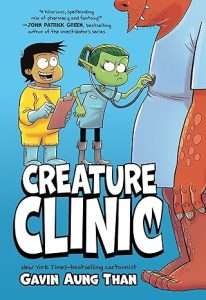
Kara Orc is a doctor-in-training alongside Tucker Wolf at the Creature Clinic. Besides working with her competitive rival, Kara also has to contend with her mother, head doctor of the clinic. When a giant collapses outside their doors, no one can figure out what’s wrong with him; however, an unconscious human is discovered under his boot. Humans live in Fableland, which is outside of Myth Valley where the clinic is located, so they are rarely seen.
Kara wants to do the right thing and treat the human as a patient, but her mother wants him gone and orders Oblong, the janitor, to take him away. Oblong decides to help Kara with her plan to secretly treat the human, except once the human, Mitch, wakes up, he and Oblong become friends and secretly travel around the clinic together. Mitch has a plan to help the other patients, but with humans banned from the premises, they’ll have to get creative to help him prove himself and treat the giant before it’s too late.
This was an interesting take on the hospital setting that showcases how caring and asking questions can help patients just as much as the medicine that gets prescribed. The cast of characters was well rounded with a variety of personalities and creatures throughout the story. Most of the creatures will be known to the reader, but there’s a small handful, like Oblong, that are new and different. The coloring matched the tone, and the setting had a clean art style in the clinic and rougher details when it would enhance the characteristics of the scene outside of the clinic.
The charm of this story is in the relationship between daughter and mother, which addresses generational trauma in a realistic way. The author effectively portrays a variety of relationships between the myriad characters: family, friend, and rival. This would make a great addition to any middle school library or public library.
Creature Clinic By Gavin Aung Than Macmillan First Second, 2025 ISBN: 9781250847584
Company Age Rating: 8-12
NFNT Age Recommendation: Middle Grade (7-11), Teen (13-16), Tween (10-13) Creator Representation: Australian,
The character of John Law is an interesting footnote in the long career of comics legend Will Eisner. He was created in 1948 and was to headline a new comic book as part of Eisner’s independent imprint. Unfortunately, the early sales on his first two comics were not promising, and Eisner elected to stick to his more reliable (and profitable) work on The Spirit. To that end, he took the three John Law stories he had written and reworked them into stories for The Spirit.
At first glance, John Law would appear to be a knock-off of The Spirit. Both figures are brawny, wearing suits and fedoras. However, the characters are wildly different beyond John Law sporting an eyepatch instead of a mask and smoking a pipe while on the job. Whereas The Spirit was a superhero who worked outside the law, John Law was one of the few honest cops in the Crossroads City Police Department. Both men fought colorful criminals, but John Law also had to navigate the corruption of his fellow police officers.
Even so, it was only a twist of fate and a devout archivist that led to John Law seeing the light of day. Eclipse Comics editor Cat Yronwode stumbled across the original John Law proofs while organizing Will Eisner’s archives in 1983. With his permission, she published the three John Law stories as a one-shot comic.
That was all that existed until 2001, when Australian comic creator Gary Chaloner asked Eisner for permission to put his own spin on John Law. This led to a new John Law series, which was originally published as a web comic on the website Modern Tales. It was later published in print by IDW.
Chaloner went beyond writing new John Law tales. He began building a shared universe made up of other obscure Will Eisner creations. For instance, he tweaked John Law’s background a bit, giving him a lost love in the form of socialite Brenda Banks. This was the secret identity of one of Eisner’s detective heroines, Lady Luck. This was not entirely unprecedented, however, as Eisner had given John Law a kid sidekick in the form of another one of his less-popular comedy creations, Nubbin the Shoeshine Boy.
The Collected Will Eisner’s John Law contains all these stories, plus a new John Law story by Chaloner that gives him a new squad of young detectives to mentor. All of them are established Eisner creations and one of them establishes a connection between the worlds of John Law and The Spirit. That alone is enough to make this volume of interest to comics history buffs, and anyone who enjoys shared universes or Noir thrillers. Both Eisner and Chaloner are in fine form and Chaloner truly honors the legacy of his inspiration.
Titan Comics rates this volume 15+ for older teens and adults. I think that is a fair rating. While there’s little in the way of overt violence or bloodshed, one story does feature the shocking death of a child. There’s some suggested sex and teased nudity, including a bit of butt crack when John Law accidentally walks in on Brenda Banks as she’s toweling off after a shower. There’s also a bit of weird horror in some stories that may be a bit much for the easily spooked.
The Collected Will Eisner’s John Law By Will Eisner, Gary Chaloner Titan, 2025 ISBN: 9781787745353
Company Age Rating: 15+
NFNT Age Recommendation: Adult (18+), Older Teen (16-18) Creator Representation: Australian,
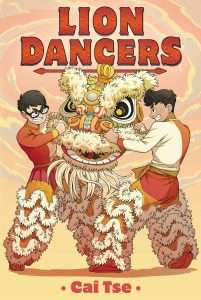
Wei has always wanted to be a lion dancer. His father was part of a championship-winning lion dance team, and Wei dreamed of doing athletic stunts like him. He joined a team, where he and his friend Hung danced together in the two-person lion costume: Wei as the head, and Hung as the tail. But when Wei’s father died and Hung started making fun of lion dancing, Wei quit.
Two years later, in middle school, Wei is unhappy as a benchwarmer on the basketball team. When he learns about a local junior lion dance team, he decides to join. Lion dancing again feels great, and Wei is making new friends. The only problem? Hung is on the team, and he wants Wei out.
This fun story offers a fascinating look at some techniques and traditions of lion dancing. The team consists of not just the dancers inside the lion costumes but also drummers and cymbalists who accompany the dance. All members of Wei’s junior team are trained on drums and cymbals as well as dancing, and they sometimes switch out during long performances, since the dancing can be exhausting. The team does a variety of performance types, from dancing onstage to roaming through crowds on the street at Lunar New Year to being hired to bless shops and restaurants.
Like many sports stories, this book includes a competition aspect: the senior team captains are observing the junior team to decide which members will participate in an upcoming competition. Wei and Hung both desperately want to be chosen. Both currently dance as lion “heads,” and both are skilled, though Hung is better because Wei has not been dancing for the last two years. However, Wei is improving quickly, and Hung faces a frustrating problem: he wants to keep performing as a head, but he has the stronger, heavier build of a tail. When a lion jumps or rears up during a performance, the person dancing as a tail must lift their partner, and it is becoming hard for Hung’s tail to lift him. Wei is smaller, ideally built for a head. When he joins the team, Hung is furious, fearing that he will once again be made a tail to Wei’s head. This leads to much of the book’s conflict and drama. While the story mostly follows Wei, we get a few scenes from Hung’s point of view as well.
The art is clear, dynamic, and expressive. The characters have a cartoon style, but still fit with the highly detailed lion costumes and backgrounds. The movements are natural and easy to follow, even when the characters are in their lion costumes. The costumes themselves are beautifully illustrated and become highly expressive with the dancers’ movements. The characters’ facial features are sometimes similar, but distinctive hairstyles make it easy to tell them apart. At the beginning of each of the book’s eight chapters, a lion dance move or tradition is illustrated and explained. This adds interesting context to the story. Readers may be inspired to look up some lion dance performance videos!
The conflicts in this story are Wei versus Hung and Wei versus his own self-doubt. There is some middle-school meanness, but no physical violence. Wei has a lot of self-doubt, and he misses his dad, but he has a loving grandmother and one good friend even before he joins the team, so there is support in his life.
This is a lively story featuring a highly athletic sport/performance art that may be unfamiliar to many readers. It will appeal to fans of middle school stories featuring unusual sports, like Roller Girl by Victoria Jamieson, and to anyone interested in learning about a cool dance tradition.
Lion Dancers By Cai Tse Simon & Schuster Books for Young Readers, 2024 ISBN: 9781665927239
It begins with a game among a group of middle school friends—a deadly game that sets off a series of events that haunts them from beyond the natural world. What have they unleashed, and how will they stop this evil from spreading? Supernatural thrills and chills multiply in Remy Lai’s (Ghost Book) Read at Your Own Risk, an eerie tale fraught with uncanny occurrences that spell trouble and impending doom.
Seventh grader Hannah spends her time journaling in her diary, recording all her private affairs including the fateful day when things turned weird after playing a game called Spirit of the Coin: what started out as an Ouija-like game to communicate with the dead quickly turns into a spook-filled mystery in R.L. Stine fashion. While walking home one day, an unseen force pushes Hannah from behind, yanks her by the wrists, and shoves her to the ground. During science class, a freak accident occurs in the middle of a lesson on dissecting an earthworm, resulting in a scalpel flying across the room, nicking her forehead that required two stitches. Later in the restroom, she spots a centipede wiggling around inside her face and squirming into her gums—or was that her paranoid, overactive imagination running wild? But then a spirit begins to speak with her directly, scrawling increasingly threatening messages in the pages of her diary. The stakes rise when the spirit starts to target her brother by controlling him like a puppet. Hannah must find a way to break this curse gone berserk, but how can she fight something she can’t even see?
Haunting tension create a sinister Goosebumps vibe in this graphic novel through zany black and white doodles and gothic stylized characters reminiscent of Tim Burton’s The Nightmare before Christmas and Neil Gaiman’s Coraline. As the plot unravels, the motives behind the malicious spirit don’t quite hit the mark, leaving room for questions and perhaps even a sequel for further exploration. Various characters—from Hannah’s classmates and teachers—pop in and out of the story, but ultimately Hannah takes the lead in moving the plot forward.
Fueled by its angst-ridden narrative voice, Lai’s story cranks up the suspense in steady bursts that explode onto double-page spreads as Hannah struggles to make sense of what’s happening while attempting to shake off the predatory entity. The storytelling style, orchestrated in sporadic journal entries paired with doodling sketches in the vein of Diary of a Wimpy Kid, makes this a fast read for reluctant readers of supernatural fiction wrapped in mystery, yet ends rather abruptly with a lingering, curious twist.
Read at Your Own Risk By Remy Lai Henry Holt, 2024 ISBN: 9781250323354
Publisher Age Rating: 8-12 NFNT Age Recommendation: Middle Grade (7-11)
In volume one, Nyneve is just trying to get through school without exploding any buildings or attracting the military’s attention during the conscription trials. Unfortunately, both happen within the span of a few days. While the building is easily repaired with magic, the Witch Guard will not be dissuaded from conscripting Nyneve into service even though she had a poor showing in the trials. In a panic, Nyneve rushes home and cuts off all her ankle length hair, which she has been hiding under a shortening glamour. But cutting your hair is a punishable offense since it diminishes your magic power, so Nyneve finds herself on the run. Her mother stays behind to slow Nyneve’s pursuers and is captured and placed under house arrest. Nyneve travels into the wilds and finds herself rescued by a raven. Ravens are usually spies for the Witch Guard, but Banana can speak without the aid of magic and wants Nyneve to join the resistance.
In volume two, Banana and Nyneve meet new friends and allies as Nyneve continues to question her future and place. Briefly finding a place with a small section of the resistance, Nyneve feels out of place and decides to leave in the night, telling no one. After almost being caught in a city and being reunited with her school friends who were conscripted, Nyneve is willing to follow Banana’s suggestion that she visit a remote broom maker to craft her own transportation.
Full of Asian and Oceanic cultural references, Witchy is sure to bring more diversity to your graphic novel collection. The unique magic system power measured by hair length, is sure to delight readers looking for something different than the prominent magic school or wand wielding tropes. Since the themes of witch burning, on-page misgendering, and violence are included, this series is intended for teenagers and older teenagers.
The illustrations have a blended watercolor quality to them and the curvy lines do an excellent job at creating motion and capturing emotion. The care and attention to detail is clear on each page and the creator makes good use of close ups and landscapes to aid the storytelling. The second volume seems to have less action, especially in the second half of the book, but the pacing allows Nyneve to reflect and grow without being rushed in her decisions.
Witchy is a webcomic and can be found at witchycomic.com. According to the website more volumes past the first two are forthcoming but are currently on hiatus until a different project is finished.
Many people are familiar with the story of Robin Hood, the hero who, according to nearly every Robin Hood story, “robs from the rich and gives to the poor.” They no doubt also remember his daring fights with the dastardly Sheriff of Nottingham. People are also familiar with the term “reimagining,” a word that might elicit groans from some as being a sign that an entity is creatively bereft. However, there are reimaginings that get some mileage by turning the readers’ expectations on their heads. Such is the case of Nottingham, vol. 1: Death and Taxes, which retells the well-known story of Robin Hood as a medieval noir.
Written by David Hazan and illustrated by Shane Connery Volk, the story recasts the Sheriff as a principled investigator looking into a series of tax collector murders. He believes that these murders are the work of the Merry Men, terrorists who even wear masks with exaggerated grins. They are led by a man known only as the Hood. What the Sheriff eventually finds is a conspiracy that soon grows, or perhaps metastasizes, into the legend everyone knows.
Hazan’s story reads at times like a police procedural, complete with the crime scene investigations and interrogations of suspects. The Sheriff in this tale is also fleshed out beyond a one-dimensional villain; he’s a grizzled veteran of the Crusades who has grown cynical of human nature. He’s also smart enough to see the shades of gray implied in the Merry Men’s activities. Indeed, Hazan’s tale totally flip-flops the dynamic of the Sheriff and Robin Hood. In this story, the Sheriff attempts to maintain his moral center if not being downright heroic, while Robin Hood and his men, especially his companion Maid Marian, are villains who commit some very nefarious deeds.
Volk’s artwork reflects the gritty and violent tone of the story. A lot of people die by various medieval weapons and in very graphic ways. The amount of blood and bloody violence in this book is comparable to what one would find in a horror graphic novel. While the masks of the Merry Men are exaggerated grins, the expressions of many of the book’s characters, while never descending into bad caricature, are either stoic or sneering. That does, however, benefit the noir tone of the story, since the shades-of-gray morality of this world gives the characters very little to smile about.
Nottingham, vol 1 has some good moments, but it also feels unfinished, especially by the end of the volume. There is a clear progression to the story arc, and there is a definitive if not wholly satisfying ending, but it also feels like this story skims over a lot of its own established nuances, like the Sheriff’s own military history and how it’s affected him. Overall, while not being flat archetypes, the characters are painted with some broad, and violent, strokes. However, their distinct personalities and stories might be explored more in future volumes. Some stories simply take a while before really finding their footing after introducing the world in which the story takes place. It should be up to librarians with patrons who might be interested in graphic novel reimaginings and crime drama whether or not they want to take a chance and see if volume 2, should it come out, goes deeper into its characters.
Nottingham, vol. 1: Death and Taxes By David Hazan Art by Shane Connery Volk Mad Cave, 2021 ISBN: 9781952303142 Publisher Age Rating: 16 years and up
NFNT Age Recommendation: Adult (18+), Older Teen (16-18) Creator Representation: Australian
Stone Fruit, the debut graphic novel by comics artist Lee Lai, is a heartfelt story about two young women navigating the end of a relationship and the tension points between biological and chosen family. Lai does a marvelous job adapting the structure of young adult coming-of-age stories to the tumultuous years of our twenties, when many of us are still working out what kind of adults we hope to become.
This book centers on Ray, a young woman who’s part-time caretaker to her rambunctious young niece Nessie, and Bron, Ray’s fiercely imaginative, mentally ill girlfriend. Ray and Bron have decided to forge a life together, but their fresh start is complicated by existing family ties. For Ray, family means a strained relationship with her sister, Nessie’s mom, who is wary of Bron’s mental illness and perhaps her trans identity. Bron has her own complicated family of origin: religious conservative parents who have never fully accepted her as a trans woman, but also a younger sister who feels like Bron left her behind. When Bron decides to leave Ray and return home to her parents, both women find themselves reevaluating their familial relationships, unearthing trauma but also testing for the possibility of connection.
Stone Fruit feels like a novel that has the potential to be someone’s favorite book, appearing at the right moment for a reader facing any of the challenges that animate Ray and Bron’s lives: mental illness, a strained relationship with a sibling, an unexpected breakup, a first taste of aunthood. Though Stone Fruit is a breakup story, its melancholy is tempered by moments of joy and insight. Lai has a particular talent for capturing the mundane: life-altering conversations in nondescript restaurants; awkward breakups that end with running out into the street in your underwear; bad babysitting sessions powered by episodes of Peppa Pig. The understated storytelling meant that it took me a while to feel immersed in the story, but once I found my footing, I was deeply moved by this sharply observed snapshot of the human experience.
Lai’s art is terrific and will please fans of traditional media, with fluid brushwork and dreamy blue gouache. Simple four-panel pages put the emphasis on characters and text; the artwork is accomplished but never gets in the way of the narrative. Lai’s one bold artistic choice is her depiction of Ray, Bron, and Nessie during their babysitting romps—the three become monsters with reptilian skin and wicked teeth, a witchy image of female power that serves as a symbol for the kind of female-centered family that Ray and Bron want to create.
Stone Fruit is a strong choice for adult comics collections. I’d particularly recommend it to new adult readers looking for a narrative that speaks to their experiences; however, older adult readers will find just as much to enjoy here. Those purchasing for a young adult audience should be aware of the inclusion of nudity and a brief sex scene.
This title also delivers welcome representation of queer, trans, and Chinese diaspora experiences, adding breadth and inclusivity to graphic novel collections that have historically tended to exclude marginalized voices. Lai is a new voice to look out for, and her debut is well worth picking up.
Stone Fruit By Lee Lai Fantagraphics, 2021 ISBN: 9781683964261
NFNT Age Recommendation: Adult (18+) Creator Representation: Australian, Canadian, East Asian, Trans Character Representation: Chinese, Queer, Trans, Ambiguous Mental Illness
When Boom! Box first solicited Fence in the fall of 2017, they billed it as a fusion of Yuri! On Ice (an anime about figure skating) and Check, Please (an amazing web comic about college hockey and baking). This was a great marketing move, because I immediately added it to my pull list, and I am more than thrilled to review the first volume.
Fence, Vol. 1 collects issues one through four, and follows Nicholas Cox, a scrappy guy from the wrong side of the tracks who dreams of becoming a world-class fencer. Lacking the funds to pay for formal training, he cleans up a fencing studio in exchange for lessons, and enters a regional fencing tournament. He’s confident bordering on cocky, and the bottom seed, so of course he’s eliminated in the first round by the enigmatic Seiji Katayama, a fencing prodigy. Seiji disdains Nicholas, and he has a lot to learn about sportsmanship, but still beats Nicholas 15-0. Nicholas vows to beat Seiji one day, no matter how hard he has to work.
Despite his disastrous loss, Nicholas is recruited by the head fencing coach of Kings Row, an all-boys boarding school with a middling fencing program. Nicholas accepts the offer of a shot at a fencing scholarship, thinking he’ll get another chance to beat Seiji, who’s being recruited by Exton, the top fencing school in the country. However, once Nicholas arrives at Kings Row, he discovers that Seiji, for some reason, decided to come to Kings Row instead of Exton, that Seiji is also his new roommate, and that they’re both competing for one of the coveted three spots on the varsity fencing team. Now, not only is Nicholas’ honor on the line, but also his scholarship—if he doesn’t win a spot on the team, he’ll lose it, and won’t be able to afford the tuition at Kings Row.
Overall, Fence is a joy to read and experience. The dialogue and story, by C.S. Pacat, is sharp and funny, and she easily integrates explanations and background information about fencing techniques and rules into the story. This makes the story and technicalities easy to follow, with the added bonus of looping the reader in without making you feel like an idiot. Fencing novices will have no trouble following the story, and near novices like me (thank you, one semester of fencing class) will definitely learn something new.
What makes this comic really stand out, though, is the art. Pencils are done by Johanna the Mad, a popular web artist who makes her comic debut with Fence. She excels at dramatic framing, and I paused many times while reading this book to admire just how well she captures movement and emotions, whether it’s the swagger of Seiji Katayama leaving defeated opponents in his wake, how cavernous and intimidating the salle (a room used for fencing) feels on the first day of tryouts, and Nicholas’ anguish in defeat.
With the uber-dramatic framing, sometimes Fence feels less like a graphic novel and more like Japanese anime. The flow of the panels and the story feel an awful lot like anime cuts, and the plot is a classic sports anime storyline. Although not a huge fan of anime myself (Yuri! On Ice is one of two shows I’ve seen in their entirety), I’ve been to enough Otakons and listened to my otaku friends talk about sports anime enough to recognize it when I see it. The tropes are all there, including the scrappy underdog, the characters who go from being rivals to friends to maybe more (hopefully—Seiji and Nicholas are still firmly in the “rivals” stage of that evolution), and even the odd-couple friendships. There’s even one panel where one character is so in awe of Seiji that a wreath of red roses appears around the aloof prodigy’s head.
You would think that this would make Fence tropey and predictable, but somehow it really, really works. All the elements—the dialogue, the pencils, the inks—come together to create a loving homage to sports anime in comic form, with enough twists to make the story original and exciting. You can really tell that Pacat and Johanna the Mad are in sync for the vision of this comic, and the result is an entertaining, fun book that would be a great addition to any library.
On top of all of its merits, Fence also features an incredibly diverse cast. You would think that the upper echelons of prep-school fencing would be overwhelmingly hormonal white boys, but the fencing team at Kings Row is made up of hormonal boys of all races, cultures, sexual orientations, and gender identities. It’s fantastic to see that kind of representation in this comic, and I hope other creators in the industry follow suit.
Fence, vol. 1 by C.S. Pacat Art by Johanna The Mad ISBN: 9781684151929 Boom!Box, 2018 Publisher Age Rating: (13+)

 Kara Orc is a doctor-in-training alongside Tucker Wolf at the Creature Clinic. Besides working with her competitive rival, Kara also has to contend with her mother, head doctor of the clinic. When a giant collapses outside their doors, no one can figure out what’s wrong with him; however, an unconscious human is discovered under his boot. Humans live in Fableland, which is outside of Myth Valley where the clinic is located, so they are rarely seen.
 headline a new comic book as part of Eisner’s independent imprint. Unfortunately, the early sales on his first two comics were not promising, and Eisner elected to stick to his more reliable (and profitable) work on The Spirit. To that end, he took the three John Law stories he had written and reworked them into stories for The Spirit.
 dreamed of doing athletic stunts like him. He joined a team, where he and his friend Hung danced together in the two-person lion costume: Wei as the head, and Hung as the tail. But when Wei’s father died and Hung started making fun of lion dancing, Wei quit.
 It begins with a game among a group of middle school friends—a deadly game that sets off a series of events that haunts them from beyond the natural world. What have they unleashed, and how will they stop this evil from spreading? Supernatural thrills and chills multiply in Remy Lai’s (Ghost Book) Read at Your Own Risk, an eerie tale fraught with uncanny occurrences that spell trouble and impending doom.
 In volume one, Nyneve is just trying to get through school without exploding any buildings or attracting the military’s attention during the conscription trials. Unfortunately, both happen within the span of a few days. While the building is easily repaired with magic, the Witch Guard will not be dissuaded from conscripting Nyneve into service even though she had a poor showing in the trials. In a panic, Nyneve rushes home and cuts off all her ankle length hair, which she has been hiding under a shortening glamour. But cutting your hair is a punishable offense since it diminishes your magic power, so Nyneve finds herself on the run. Her mother stays behind to slow Nyneve’s pursuers and is captured and placed under house arrest. Nyneve travels into the wilds and finds herself rescued by a raven. Ravens are usually spies for the Witch Guard, but Banana can speak without the aid of magic and wants Nyneve to join the resistance.
 Many people are familiar with the story of Robin Hood, the hero who, according to nearly every Robin Hood story, “robs from the rich and gives to the poor.” They no doubt also remember his daring fights with the dastardly Sheriff of Nottingham. People are also familiar with the term “reimagining,” a word that might elicit groans from some as being a sign that an entity is creatively bereft. However, there are reimaginings that get some mileage by turning the readers’ expectations on their heads. Such is the case of Nottingham, vol. 1: Death and Taxes, which retells the well-known story of Robin Hood as a medieval noir.
 Stone Fruit, the debut graphic novel by comics artist Lee Lai, is a heartfelt story about two young women navigating the end of a relationship and the tension points between biological and chosen family. Lai does a marvelous job adapting the structure of young adult coming-of-age stories to the tumultuous years of our twenties, when many of us are still working out what kind of adults we hope to become.
 When Boom! Box first solicited Fence in the fall of 2017, they billed it as a fusion of Yuri! On Ice (an anime about figure skating) and Check, Please (
