
The Spark Experiment
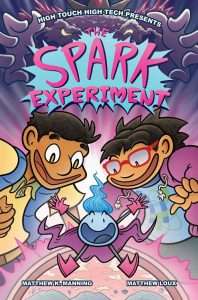 The story opens with David, a brown-skinned, lanky middle-schooler, imagining the “spark” of creativity and ideas as a cute little cartoon creature. He arrives home and meets up with his neighbor Marta, a lively homeschooled 2nd grader with red-rimmed glasses and the two investigate an explosion in David’s basement. It turns out his mom has successfully created a tool to shrink herself down so she can travel between dimensions into a “micro universe.” Unfortunately, she’s left the tool behind.
David and Marta go on a brief adventure to rescue David’s mom and, while in the microscopic dimension, encounter the blue spark of David’s imagination. It’s pictured as a blue ball with a purple cape, gloves, and boots on it’s stick-like arms and legs and a splash of blue “hair.” Together, with the help of David’s experiments, they rescue his mom from a crowd of purple creatures like Spark that seem to be sucking her creativity.
Inspired by Spark and their adventure, David tries again to start a Science Club and gets more interest this time. With the enthusiastic participation of Marta, he demonstrates how to make “space mud” at the club’s first meeting in his backyard and even gets the interest of a girl, Lisa. She’s shown wearing tights, a long skirt, and a loose jacket with curly black hair and a blue knit cap. David’s audience includes a kid with long blonde hair in a wheelchair.
However, the story is far from over – Spark isn’t the only creature that came through the portal from the microscopic universe and David’s mom is working on a new project in their basement that could mean disaster! David will have to bring out his trusty experiments and depend on Marta’s inexhaustible energy to save the day with science and keep the spark of inspiration alive.
There’s not a lot of variation in body types pictured, but that’s due more to Loux’s art style than a studied lack of diversity. Loux’s characters all have long, thin, flexible limbs and show exaggerated emotions with their wide mouths, heavily-drawn eyebrows, and the rapid changes in their eyes. The science experiments have a few illustrations, but these are mostly part of the story – the instructions are primarily in the text.
The other dimension is colored in orange-hued pinks, pale purples, and yellows with lots of ripples, creatures with multiple legs, and speech bubbles that look like tropically patterned easter eggs. This contrasts with the everyday suburb where David lives with blue skies and green trees and lawns.
The story includes 18 simple science experiments, from slime to a straw rocket and there is a QR code that has videos to accompany each experiment. The book is sponsored by a science organization called High Touch High Tech which creates fun science experiences.
There is some disconnect in the story – David is supposed to be a middle schooler, but the science experiments are more something an elementary student, like Marta, would enjoy doing. They do somewhat interrupt the flow of the story. As Marta points out, they’re running from monsters so why didn’t David just bring a compass instead of magnetizing a needle in the middle of a chase? However, the story is mostly a vehicle to carry the science experiments and a younger audience will enjoy the light story and be interested in trying the different projects. Manning is an experienced author who is used to creating nonfiction/fiction graphic novel scripts and the plot moves smoothly despite the sometimes jarring science elements. Older readers who like Matthew Loux’s art and are interested in the science-fiction genre are more likely to enjoy his own graphic novel series, The Time Museum.
The Spark Experiment
By Matthew Manning
Art by Matthew Loux
Andrews McMeel, 2026
ISBN: 9798881601928
NFNT Age Recommendation: Easy Readers (5-9)

