One click and this new dimension opens. A panel is the threshold to a dimension of gutters and splash pages. A dimension made of ink and Kirby Krackles. A world where a madman writes of comics and graphic novels. You are about to enter No Flying No Tights.
News From The Fallout is a macabre delight. Any fans of the Twilight Zone or old school creature features looking for a fast paced adventure might find their fix with this mini-series. From the creators Chris Condon (Ultimate Wolverine) and Jeffrey Alan Love (The Thousand Demon Tree), News From The Fallout is a nonstop sprint of a story. This miniseries is set in 1960s Nevada and follows a private in the U.S. Army named Otis Fallows, after a nuclear bomb test goes horribly wrong.
Now, with no disrespect to Chris Condon and the script, this series is carried by Jeffrey Alan Love’s art work. It really is something to behold. It exists as some sort of combination of CRT TV static and shadowpuppetry mixed with pages of background lore. Love conveys just enough detail for your brain to fill in the rest of the horrific details. He’ll show the row of fangs in shadow and the reader can imagine what else it’s hiding. There’s a narrative focus on ash and he takes that opportunity to make every scene feel shrouded in ash as well as emulate the 50s and 60s television technology with a grayscale color palette. It really sets the mood for a Cold War era monster thriller, a haunted nuclear nightmare.
While Love’s artwork is probably the best selling point, Chris Condon’s script is no slouch. Given the limitations of a narrative in six issues, Condon makes every word count. He gives each of Love’s silhouetted characters a distinct voice, making up for the lack of clarity in Love’s chosen style. Along with tight and efficient characterization, Condon created a story propelled by its own moment. Each scene crashes into the next, usually with a great amount of violence. At the beginning and ending of every issue there is background information in the form of within-universe media like menus or redacted military orders. Condon uses these glimpses into the goings on in Atomic Alley to ground the story in some form of reality.
For any librarians looking to expand their adult graphic fiction or science fiction selection, this isn’t a terrible pick. This would be right at home in a read-alikes display with Ray Bradbury or Harlan Ellison. Image comics gives no listed age rating, but I would recommend this to mainly adults based on the horror and violent elements of the entire series.
News From the Fallout By Chris Condon Art by Jeffrey Alan Love Image Comics, 2026 ISBN: 9781534335745
Before Superman and superheroes came to dominate American comics, there was an age undreamed of. Pulp fiction was gaining in popularity, and it occurred to advertising agent Joseph H. Neebe that there might be a market for comic strips based on action and adventure rather than comedy. He approached Edgar Rice Burroughs (who had just set up shop in what would become Tarzana, California) about licensing his Tarzan character as a comic strip. Burroughs, who was already aiming to make movies based on the Lord of the Jungle agreed, but this still left the question of who would draw the comic.
Enter Harold “Hal” Foster—a Canadian illustrator who had little interest in drawing comics. However, with times being tough (and about to become tougher when The Great Depression hit), Smith got the comic off the ground by drawing the daily strip in 1929. He would later return, reluctantly, to draw a full-color Sunday strip in 1931. And yet, over the next few years, Smith began to believe he could take the comics he crafted and turn them into the high art he’d wanted to create.
However, Foster grew increasingly dissatisfied with the quality of the scripts he was given. He was also unhappy with the increasingly inadequate flat fee he was paid when the writers were given a percentage of the profits. He eventually left Tarzan for a more lucrative deal with King Features, where he was given more money, creative control, and the ability to write and draw his own adventure comic, the equally revolutionary Prince Valiant.
This history is detailed in the introduction to Hal Foster’s Tarzan. The Complete Sunday Comics 1931-1937. However, it understates just how important these comics were to the medium. Legends like Frank Frazetta, Wally Wood, Bernie Wrightson and Jack Kirby all cited Hal Foster as a major influence on their own comics. And without the success of the first Tarzan newspaper comics fueled by Foster’s work, it is possible that the action/adventure comics and the later comic books might never have come about. For that reason alone, this volume is well worth studying on a scholarly level.
Another reason is Foster’s command of anatomy, which was impressive and unlike anything appearing in the funny pages at the time. Foster took his research seriously and lamented that some of the writers he worked with failed to consider things like what kind of trees were likely to line an African river. Alas, his dedication was not appreciated by his employers and one of the chief reasons Burroughs considered Foster the best artist to handle Tarzan was that he was very good at drawing attractive women. (This skill, it might be noted, was honed by Foster’s work as a commercial artist, drawing women in lingerie in catalogs in the days before photography became inexpensive.)
On that note, there is no publisher rating for this collection. The amount of sex and violence within it was shocking for its time, but there’s nothing that would be inappropriate for a teenage audience today. There are a few bare male backsides and one naked boy who comes to Tarzan’s aid in one story, but nothing more overtly sexual than various queens of lost cities informing Tarzan that he is now theirs.
It should also be noted there is some material in these comics that has not aged well. There are multiple instances of the white goddess trope, with superstitious African natives taking in a white woman as their leader. Thankfully, Smith does not present these characters as the offensive caricatures that were commonplace in other comics of the time, but the four-color recreations for this book do feature some Asian characters with dimly yellowed skin.
One final warning. At $200 this volume may be a bit expensive for a library collection. Serious collectors of Tarzan lore and comics history should consider this a must-have. However, unless one’s library has a special collection devoted to Platinum Age comics or something similar, this one may be a bit of a budget breaker.
Hal Foster’s Tarzan: The Complete Sunday Comics 1931-1937 By Dian Hanson Art by Hal Foster TASCHEN, 2026 ISBN: 9783754402641
Related media: Book to Comic
NFNT Age Recommendation: Adult (18+) Creator Representation: Canadian,
This is a relatively new series, focusing on creepy or mysterious stories. However, although written by the same author, the first two books in the series are very different.
In the first title, Area 51, Steve Foxe teams up with Fran Bueno to present a slightly creepy but generally informational explanation of the theories, legends, and facts around “Area 51.” The framing story is a young boy attending his unknown uncle’s funeral. TJ, uncomfortable in a black suit with slicked-back red hair, sneaks off on his own and discovers a secret room in his uncle’s house with CIA classified documents. Bueno illustrates this portion like a, as TJ says, “history textbook.” There are images of Eisenhower, a history of the CIA, an explanation of the popular understanding of the events after nuclear testing, and up through the formation of, and public knowledge, of what came to be known as Area 51.
Throughout this section, the colors vary between dull, sandy browns with a few bright reds showing imagined images of mutants and aliens. The story leads up to the development of aircraft meant for intelligence missions and these planes are shown in sleek blacks with secret night-time scenes in dark blue. As TJ continues reading the files, he is interrupted by men in black suits and his mother and he hastily finishes the tales up through the current day, from humorous denials from public figures like Bill Clinton to a thoughtful look at how conspiracies form and current speculations about Area 51. The story ends with an anticlimactic confrontation with the suited men and TJ returns home with his parents, a single bright disc shooting across the night sky.
The second title, Unwanted Guests, features a different illustrator, Naomi Franquiz, and blends several “true” ghost stories into the framing story. Franquiz’ art in the opening story is colorful and includes lots of folds and lines in clothing as well as the background. Foxe sets the framing story by introducing a biracial family moving to a new neighborhood. Minnie, the younger sister, has thick black eyebrows, an exuberant bush of brown curls, a missing tooth, and freckles. She’s dressed in blue overalls and a pink striped shirt. She’s followed by her older brother Jackson. His curls are shaved on the sides with a pompadour style on top and he wears khaki pants and a bright checked orange and yellow sweater. The two siblings bicker over mysterious stains and noises until their dad, with darker skin and a chinstrap beard, sends them off to the park to play. At the park they meet “Theo” a spookily pale kid who presents Asian. Franquiz continues the bright colors with a reddish playscape surface and bright autumn colors in the leaves.
Theo drops hints about their house and then tells them two scary stories. In the first story, a ghost tale from the 1920s, Franquiz switches to a more subdued palette with sepia tones that contrast with the brightly colored contemporary neighborhood. Minnie and Jackson interrupt for explanations of terms like spiritualism and poltergeists and Theo ends the story on an ambiguous, creepy note. After a very nervous night, the siblings approach Theo again and he tells them a second story about yet another Minnie – Minnie Clyde Winston and her bleeding house. This story, which is from the late 1980s, has brighter, more contemporary colors. Minnie is shown as a Black woman with light skin and curly hair and the pools of inexplicable blood are a viscous red. There are a few gruesome images of blood-drenched monsters but the story fades away as Minnie gradually denies the events to reporters to get some peace. As the story ends, readers return to the bright autumn park and Theo hints at a third story, about a young boy named Theodore who disappears in an attic… echoes of the earlier stories he told are revisited in the siblings’ experiences that night and the book ends with a final, ghostly shiver.
Both titles include sources for the unsolved mysteries, but the first book has a more straightforward, historical approach which is mirrored in the simpler, more basic tones of Bueno’s art. The second book, with the lengthier and creepier framing story, has a more gruesome tinge which pairs well with Franquiz’ colorful art and heavily emphasized lines. While both books will appeal to young readers, the first is more likely to interest those who already have an interest in aliens, unsolved mysteries, and history while the second will appeal more to fans of ghost stories and scary tales.
Archives of the Unexplained By Steve Foxe Art by Fran Bueno, and Naomi Franquiz Macmillan First Second, 2025
Volume
ISBN
1 Area 51
9781250850287
2 Unwanted guests
9781250850263
NFNT Age Recommendation: Middle Grade (7-11), Tween (10-13)
Three goofy characters deal with “superpowers” in this black and white New Zealand import. The Ministry of Superpowers has opened and is offering superpowers to every animal in the world! Marge, Barry, and Zeb are extremely excited—especially Zeb—and line up to receive their powers. Zeb, a somewhat neurotic zebra, stands on his hind feet and has wildly changing and dramatic expressions, heightened by his spiky, mohawk-style mane. Barry the lemur has a long, stripy tail and is used to Zeb’s dramatics. The two meet Marge (Margarine), a placid penguin with a plump, pillow-shaped body, when they line up and the three bond while waiting in line—behind the massive butt of a water buffalo.
But when they finally get to the Ministry, the be-wigged minister, a squirrel, is done for the day! He gives in and hands out superpowers for them, but they’re not at all what they expected. Marge is surprised—but pleased—at her mac ‘n’ cheese powers and promptly starts whisking everything in sight. She and Barry both agree that Barry’s new gift of handwriting is an excellent power. Zeb can’t believe how lame their powers are… and is horrified when his is even worse. As he sobs in despair, his power is basically just… being a zebra! Throughout the rest of the story, Zeb struggles to come to terms with his “superpower” while Marge and Barry try to deal with their friend’s dramatics.
Stapleton waltzes through Haddow’s goofy story with raucous caricatures—a chicken with super-strength karate-chops villains while wildly flapping her wings, Marge spins her flipper into a tornado as she panic-stirs everything in sight into lumps of mac ‘n’ cheese, and Barry dreamily fantasizes about calligraphy pens. Zeb, meanwhile, gallops from one crisis to another, his wilder moments explained helpfully to Marge by Barry in asides, and a cast of animals big and small make continual appearances in Zeb’s story. The prison he and the others “break into” is dark and spooky, but the “villainous” animals aren’t particularly stereotyped, other than a giant, toothy crocodile.
The story is laid out in panels, but most of the text is written in captions and there is minimal dialogue in speech balloons – mostly arguments between the three and complaints from Zeb, who is, despite his denials, quite the “whiny unicorn.”
While the plotline of this story, and the art style of Stapleton, is very different, this is obviously meant to appeal to fans of Aaron Blabey’s Bad Guys. The black and white cartoon art, humorous anthropomorphic animals, and unexpected actions and powers make this an automatic read-alike for that very popular series. Whether young readers will embrace the emotionally dramatic Zeb, cheerful Marge, and practical Barry will depend on their interest in future adventures, but this first book at least is likely to be a hit.
The (Not So) Superheroes: The Terrible Trio By Swapna Haddow Art by Minky Stapleton Scholastic, 2025 ISBN: 9781546182986
There are many tall tales about the highwayman Dick Turpin. The actual history, as is usually the case, is somewhat more muddled. Such is the way of legends.
Unlike the more internationally famous Robin Hood, we know for certain there was a Dick Turpin. He was born in 1706 and died by hanging in 1739. What he did in between and whom he associated with is somewhat more debatable. It is agreed, however, that he spent the last few years of his life as a horse thief and highwayman, after several years as a house-robber, poacher, and smuggler.
Dick Turpin and the Crimson Plague is more concerned with romantic fiction than solid fact. Nevertheless, this updated and expanded edition of the original 2011 graphic novel concludes with a decent overview of the real history. This is noteworthy, given how the stories contained within this volume are as unlikely as the account of Turpin riding 200 miles in a single night.
The main story, The Crimson Plague, finds Dick Turpin and his fellow thief, Tom King, enjoying their ill-gotten gains in London. After watching another unfortunate’s execution, the two decide to have some fun at the local brothel. However, it becomes apparent that there is a dark secret within the bawdy house’s basement. Soon, the two thieves become monster-slayers, fighting to save London from a vampire invasion!
The new edition of Dick Turpin and the Crimson Plague colorizes what was originally a black-and-white comic. The color art by Gavin Ross is decent enough. However, there are many pages I think might have hit harder in monochrome. Indeed, there are some pages where the colors seem to obscure the original inks of Graeme Howard’s artwork.
This new edition also contains an original short comic. Subtitled “The Crawling Terror,” this tale finds Dick Turpin and Ton King making camp in a cave. Unfortunately, the depths of the cave contain monsters that seem more appropriate to a Conan comic than a Dick Turpin story. Still, the artwork for this chapter by Roland Bird and Brett Burbridge is stronger than the main event.
All in all, I found Dick Turpin and the Crimson Plague to be an amusing read. I enjoy a good story of supernatural horror and stories about reluctant heroes. This is both. I also enjoyed the history provided at the end, which adds some context to what came before.
Time Bomb Comics does not offer a rating for Dick Turpin and the Crimson Plague. I would suggest that any librarian interested in this place it in the adult collection. First, because there is considerable bloodshed and Steven Tanner’s scripts do not skimp on adult language and sexual content. The only nudity in the book is a corset that slips to reveal one sex worker’s nipples at one point.
Another note for librarians: the only place I believe this new edition hardcover is available is the Time Bomb Comics website. The edition currently listed on Amazon and GoodReads under the provided ISBN is for the 2011 original.
Dick Turpin and the Crimson Plague By Steve Tanner Art by Roland Bird Time Bomb Comics, 2025 ISBN: 9780956182241
Shy Cat and the Stuff-the-Bus Challenge by Dian Day and Amanda White teaches young readers about food insecurity through the story of Mila and her best friend Kit. Mila, a budding cartoonist, splits her time between her moms’ houses. Kit lives with his mom in an apartment. After bonding over being new kids at school, they are inseparable. Mila even gets to school early to join Kit for the school breakfast program since he doesn’t like to go alone. Between school, petting neighborhood cats, and DIY movie making, things are great between the two! Until Kit has a meltdown at school, setting the main story in motion.
The Stuff-the-Bus Challenge asks the students to bring goods to be donated to a local food bank. The challenge is simple – stuff the bus with food! The winning class gets their own pizza party. Students are excited to meet the challenge, when Kit discovers a dented can amongst the donated items. Who would donate something imperfect? Why do his classmates think it’s okay to give their dented cans to people who need food? This tipping point spurs Mila to better understand food insecurity and how close to home it can be.
Throughout the story, Kit’s hunger and how it affects him personally day to day is hinted at: headaches, crankiness, being secretive. Mila recounts a time she thought Kit was being rude upon quickly eating three bananas at her house. Her mom explains that “sometimes rude was just hungry” and it shouldn’t take away from Mila’s time spent with Kit. The story makes it clear that, even though she cares about Kit dearly, Mila struggles with her own emotions and how to be a good friend, even when your friend is being off-putting, because you don’t always know what they’re going through. In learning more about Kit’s situation, she’s forced to deal with and control her own emotions.
Shy Cat and the Stuff-the-Bus Challenge covers a lot within its pages. As Mila speaks with the adults in her life, there’s several pages that are fairly text heavy. These honest conversations are worthwhile. The graphic novel introduces different ways to fight food insecurity, including a great introduction to community gardening. Mila realizes the importance of speaking your mind and standing up for what’s right, something readers may find especially inspiring. The book includes some backmatter on the Hungry Stories project, which both author and artist are members of, for anyone looking to learn more about the topic at hand.
White’s art in Shy Cat and the Stuff-the-Bus Challenge is colorful, realistic, and cozy when it needs to be. Individuals of different races, abilities, and bodies are shown around Kit and Mila’s community. Lots of cats too! Mila’s Shy Cat comics are interspersed throughout the story, they become a way for her to express her emotions, almost like a graphic diary, and these work quite well in doing that.
Shy Cat and the Stuff-the-Bus Challenge would be a great choice for a middle grade book club or classroom read along. The Good Question Bus in the story, where students can ask questions anonymously, can even be adopted for individual classrooms. This graphic novel deals with topics that must be spoken about openly and honestly in a way that its intended audience can relate to.
Shy Cat and the Stuff-the-Bus Challenge By Dian Day Art by Amanda White Not in listSecond Story Press, 2026 ISBN: 9781772604450
Company Age Rating: 9-12
NFNT Age Recommendation: Middle Grade (7-11), Tween (10-13)
In a world where supernatural being and humans tensely live in proximity to each other, a turf war between organized families of demi humans is the spark that will trigger a much larger conflict to come.
Gran Familia is the first serialized story from creator Louis Yamani and Titan Comics. The book introduces us to Leo, the somewhat haphazard but sincere manager of Goodfellas Bistro. Along with fellow employees Rose and Zach, Leo seems committed to keeping his head down and his spirits up as he runs a business amidst the growing threat of demi human attacks on humans across the city.
Through genetic mutation, these demi humans take a variety of forms—vampires, werewolves, mermaids, and more. It’s a bit like folklore meets superheroes. And whispers that a new family of demi humans is making a power play in the city have everyone tense. However, it’s not until this new family attacks a friend of Leo’s that readers learn the bigger picture; Leo is a part of the Gran Familia, the most powerful of the demi human families, and is a powerful vampire in his own right. But when Leo steps in to punish the upstarts who hurt someone he cared about, it sets off a series of consequences involving law enforcement and local criminals, all of whom have their own interests as well as a score to settle with a member of the Gran Familia.
Yamani balances episodic storytelling with a larger narrative in a way that serves the story well. Each section of the book finds Leo and friends caught up in the circumstances of the humans and demi humans that live around them. With each new adventure (or misadventure) readers learn more about the characters and the world as Leo can’t seem to stop himself from helping those in need around him even as he balances his demi human and human lives. At the same time, members of human law enforcement are on a quest to eradicate all demi humans, regardless of who they are.
As Leo’s interventions gain attention from unfortunate places, the narrative ups the stakes toward the inevitable confrontations. Overall, the idea of supernatural beings living alongside humans is not fresh, but this manga never makes the concept feel stale either. Leo’s clumsy affects do feel a bit like other manga characters we’ve seen before, but when the mask comes off and he leaps into action, he proves himself a hero worth following. Overall, the writing delivers an entertaining and packed first volume while putting plenty of pieces in place for these characters and the larger world.
Yamani’s art as well, is excellent. Sometimes sparse and sometimes full of fine detail, the visuals shift well from mundane sequences to highly stylized moments of supernatural action. There are a few rough moments where the visual sequence is a little hard to follow, but for the vast majority of the volume, the imagery is a treat to behold. Beyond the cityscapes themselves, some of the high points visually are when Leo and the other demi humans unleash their powers, changing form and dashing across the page—each character with their own distinct abilities and presentation. From start to finish, there’s a great deal to enjoy in the artistic storytelling, and Yamani shifts layouts and tones enough to keep that journey interesting.
Titan lists the age for the title as 15+. There’s some stylized but occasionally intense violence, scattered language, occasional mild fanservice, and some non-detailed nudity in nonsexual contexts. It’s nothing most older teens can’t handle, but definitely worth being aware of for those on the edge of that age range. As a first volume, Gran Familia isn’t necessarily doing anything groundbreaking, but it’s a whole lot of fun that manages to put its own touch on this blend of supernatural action and mafia-esque crime thriller. There’s humor to balance the more intense moments and a distinct cast of characters that propel each episode of the story along in a way that still manages to feel cohesive. There’s plenty here to delight readers of supernatural action manga, and the story is engaging but straightforward enough that this could be an excellent entry point for readers without much manga experience. Simply put, I had a fun time diving into this world and I hope to be there to see what trouble Leo gets himself into next.
Gran Familia By Louis Yamani Titan, 2025 ISBN: 9781787747135
Baki Hanma has just upset the annual karate championship and sent shockwaves through the world of martial arts. This wide-eyed, 17 year old white belt newbie shouldn’t have been able to face off against more seasoned fighters, yet somehow he toppled them all to win first place. What’s going on with this kid?
Originally serialized for the magazine Weekly Shonen Champion in 1991, Baki the Grappler is among the best selling manga in Japan, however the still-ongoing manga has never been officially translated for English readers until now. A Netflix anime adaptation was released in 2020, but that series covers a later arc in the overall story. This is truly the first time the earliest part of Baki’s tale has been readily available to English speaking fans.
Coming fresh to the series, I expected this to be a one dimensional story about fighting and relentlessly beating opponents, and at first at first glance, that seemed true. Baki initially appears to just be an oblivious wunderkind with a lucky streak and a heart of gold. When asked directly, he can’t quite articulate his training goals, other than to say he’d like to become the strongest man on the planet. But there are hints that there’s more beneath the surface. Readers see him meticulously mark off photos of defeated opponents. His typically kind demeanor cools significantly when dealing with bullies, and betrays a cold and calculating side. There are also mysterious scars all over his body that strangely allow him to withstand even the most intense punches. He may even have ties to dangerous underground fighting rings. Clearly there’s much more going on with this seemingly happy-go-lucky kid. You don’t get all the answers in this volume, but I immediately wanted to crack open the second volume to see what makes Baki tick.
Almost every page is filled with action and the art is crisp and easy to follow. The manga style in this volume is a bit dated with rounder and softer lines than more recent iterations of the character, but it contributes to the classic feel of this manga. In terms of theme I’m reminded of other popular manga and anime series of the 1980s and 90s, such as Naruto and Dragon Ball, with their stories of (mostly) young men pushing themselves to be the strongest fighters in their community. There are no magical powers or fantastical elements for Baki, even if everyone’s muscles bulge just as unrealistically as Goku and Vegeta’s. Machismo practically drips off each page.
Other than the fighting that occurs in almost every panel, there are only a few content warnings. Some of the fighting turns more violent, with visibly broken bones and blood. There is a panel with teenage nudity and somewhat crude mentions of male anatomy. There is one awkward scene between 17 year old Baki and his attractive older landlady, where she is a little too eager to put her hands on him and he is visibly uncomfortable. The landlady and her teenage daughter are the only women in the first volume, and both are in supporting roles to the men.
The publisher rates this volume for older teens and I agree that’s probably where it fits best in a library collection. Adult readers might also enjoy it, and I could see it ticking the nostalgia box for fans of 80s and 90s manga and anime. While definitely aimed at a male audience, any reader that enjoys stories of perseverance, athleticism, and martial arts should give Baki the Grappler a try.
Baki the Grappler By Keisuke Itagaki Kodama Tales, Inc., 2024 ISBN: 9781966523000
Company Age Rating: Older Teen
NFNT Age Recommendation: Adult (18+), Older Teen (16-18) Creator Representation: Japanese,
It is the last days of the Roman Republic. The armies expanding into Gaul face increasing resistance from the Helvetii and Germanic tribes. The future of Rome itself is in question.
All of this is meaningless to Coax. He is Gallic, yet knows nothing of his tribe, for his parents were enslaved by Romans before he was born and died in the revolt led by Spartacus. He was content to be a slave himself, until an act of sacrilege destroyed his family. He freed himself and became a pirate, bleeding Rome as much as he could. And yet, while his thirst for the blood of Roman soldiers is great, he still ransoms one young officer who convinces Coax he is worth more alive than dead. Surprisingly, he proves to be right, and soon has the ransom Coax set.
Years later, Coax is in bondage again, captured and sentenced to slavery for his crimes. He seems sure to die in the arena as a gladiator, but for the intervention of a Roman officer. To his surprise, it is the officer he ransomed years before—a man named Gaius Julius Caesar. He offers Coax a choice – serve as his spy in those places where a Gaul can pass that a Roman cannot. In exchange, Caesar offers Coax his aid in finding those responsible for killing his daughter and driving his wife to end her life.
It is a devil’s bargain, though the two fighting men get along well enough despite their different stations. However, Coax is not under any delusions that he is anything but a weapon to Caesar. And though he does not realize it, his actions in the service of his savior may yet bring about the downfall of Rome.
I went into Caesar’s Spy with enthusiasm. Not out of any love for Roman history, but because of the pedigree of the creative team. I was familiar with Max Von Fafner’s work on various Conan the Barbarian books and loved what I had seen. I was less familiar with French writer Jean-Pierre Pecau, though I did enjoy his steampunk Sherlock Holmes story Moriarty: Clockwork Empire. Both are in fine form in Caesar’s Spy.
While it is tempting to call Coax a Conan substitute based on Max Von Fafner’s designs, Coax is a radically different character. He lacks Conan’s crude chivalry, though he does have a code of honor. He gives respect to those who respect him, even if they are Roman. He also takes offense at Caesar going against Coax’s word that a group of Helvetii refugees would be given safe passage. Not enough to stand against Caesar, who he honors as his commander. But enough to free the Helvetii princess Sanian, who is presented to him as a slave.
This goes on to form one of the main conflicts of the novel, with Sanian organizing her own campaign against Rome and Caesar. The irony is that she and Coax might have been allies, had it not been for Coax’s promise to Caesar and, later, Sanian’s rebellion killing one of the few men Coax calls friend. This is but one example of the emotional complexity of Jean-Pierre Pecau’s scripting. The story is also well-researched regarding Roman history during The First Triumvirate.
In terms of art, Caesar’s Spy is equally fantastic. As I said earlier, I’m a big fan of Max Von Fafner. His artwork is beautifully detailed and visceral, yet subtly streamlined. The action scenes are intense and the period costuming generally well depicted. The sole exception to this is some of the women’s clothing seems more like specialty lingerie than the sort of thing an Egytpian noblewoman would wear in her private chambers. In fairness, Von Fafner does not shy away from showing fit young men in equally revealing outfits.
On that note, Titan Comics rated Caesar’s Spy as 15+. Generally, I would agree with that assessment, but I would still classify this one as a graphic novel for adults. There is ample sexual content, brief nudity, and copious violence, though nothing I would classify as pornographic. The sexual acts are not depicted on the page, though we do see the characters naked before and after the acts. And yet, I would classify this as a work for adults because most teenagers are unlikely to appreciate the complex relationships and emotional depth of the characters.
Caesar’s Spy By Jean-Pierre Pecau Art by Max Von Fafner Titan, 2025 ISBN: 9781787746978
Company Age Rating: 15+
NFNT Age Recommendation: Adult (18+), Older Teen (16-18) Creator Representation: French, Serbian,
Continuing to showcase fan favorites from the original show, Mariner, Boimler, Tendi, Rutherford, and T’Lyn, this first volume in the new ongoing series features the same humor and adventure from the cartoon in episodic comic form. Starting off with a series of short adventures that solve themselves, we see our lower decks’ lieutenants in the bar, where Mariner is complaining about the lack of substantive adventure. This is obviously followed by adventures that get a little too dangerous, including a battle royale with mentors from previous iterations of Star Trek, a new universe quickly consuming theirs, and a time traveling menace wreaking havoc on the timeline.
I appreciated that the artists used the same character styles as the original cartoon and that it was consistent across issues. The primary color scheme of bright and bold with only cel shading really showcases the Star Fleet uniforms and aliens they encounter periodically. And it was fun to see previous favorites like Picard and Scott drawn in this style.
Although you can read this volume without seeing any of the cartoon’s five seasons, it would probably lead new readers to some confusion when character growth or previous adventures are referenced. The footnotes at the bottom of almost every page were fun but mostly unnecessary to the story after the first issue. They also seemed to be attributed to various characters and the narrator without identifying who was speaking in most cases, which was confusing more often than not. This would work best in public libraries since the show was produced for adults and contains adult themes and bleeped language. The subject matter can also get a little dark and depressing, so it’s definitely not meant for children to read although upper teens would likely enjoy it. If you have fans of the show at your library, they should enjoy reading this tie-in continuation.
Star Trek Lower Decks: Second Contact By Ryan North Art by Derek Charm and Jack Lawrence IDW, 2025 ISBN: 9798887243030
Related media: TV to Comic
NFNT Age Recommendation: Adult (18+), Older Teen (16-18)

 One click and this new dimension opens. A panel is the threshold to a dimension of gutters and splash pages. A dimension made of ink and Kirby Krackles. A world where a madman writes of comics and graphic novels. You are about to enter No Flying No Tights.
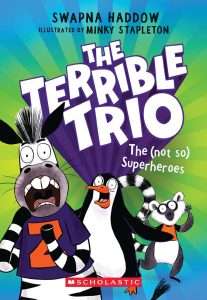 and is offering superpowers to every animal in the world! Marge, Barry, and Zeb are extremely excited—especially Zeb—and line up to receive their powers. Zeb, a somewhat neurotic zebra, stands on his hind feet and has wildly changing and dramatic expressions, heightened by his spiky, mohawk-style mane. Barry the lemur has a long, stripy tail and is used to Zeb’s dramatics. The two meet Marge (Margarine), a placid penguin with a plump, pillow-shaped body, when they line up and the three bond while waiting in line—behind the massive butt of a water buffalo.
 Such is the way of legends.
 story of Mila and her best friend Kit. Mila, a budding cartoonist, splits her time between her moms’ houses. Kit lives with his mom in an apartment. After bonding over being new kids at school, they are inseparable. Mila even gets to school early to join Kit for the school breakfast program since he doesn’t like to go alone. Between school, petting neighborhood cats, and DIY movie making, things are great between the two! Until Kit has a meltdown at school, setting the main story in motion.
 demi humans is the spark that will trigger a much larger conflict to come.
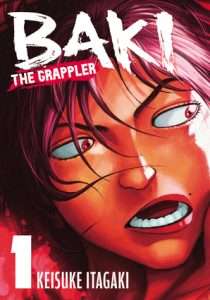 Baki Hanma has just upset the annual karate championship and sent shockwaves through the world of martial arts. This wide-eyed, 17 year old white belt newbie shouldn’t have been able to face off against more seasoned fighters, yet somehow he toppled them all to win first place. What’s going on with this kid?
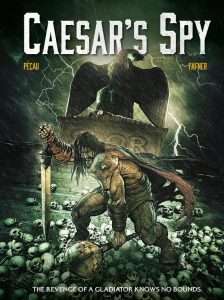 tribes. The future of Rome itself is in question.
 Continuing to showcase fan favorites from the original show, Mariner, Boimler, Tendi, Rutherford, and T’Lyn, this first volume in the new ongoing series features the same humor and adventure from the cartoon in episodic comic form. Starting off with a series of short adventures that solve themselves, we see our lower decks’ lieutenants in the bar, where Mariner is complaining about the lack of substantive adventure. This is obviously followed by adventures that get a little too dangerous, including a battle royale with mentors from previous iterations of Star Trek, a new universe quickly consuming theirs, and a time traveling menace wreaking havoc on the timeline.
