Heartcore is a roller coaster of the ups and downs of falling in and out of love. Author Št?pánka Jislová examines her relationship with relationships. How do we form preferences? What do our preferences say about our personal character? How are we informed about our identities? How do our identities dictate our roles in society? And, more importantly, how do we rebel against those dictations?
I am very thoroughly impressed how Jislová manages to blend all these things together in a way that is coherent and relatable—this book is a memoir, it’s a comic, it’s a romcom, it’s a tragedy, and it’s also a bit of a character study/psychological evaluation. Follow Jislová through her “classic Eastern bloc postcommunist 1990s childhood” and learn about the things that made her her. English language magazines, the coming of the widely-available internet, the contradictions in societal expectations for girls and women, the emotional repression of boys and men, first and early relationships, and navigating the isolation she felt as a young person.
“With infatuation came mania, and with mania, obsession. And with obsession, frustration.”
Heartcore was one of New York Public Library’s Best New Comics for Adults of 2025, and I do want to emphasize this is a book for adults. A lot of adult subject matter is discussed – casual hookups, alcohol, drugs, assault, and the like. The book is not explicit nor graphic, but there is nudity and sexual themes throughout.
The artwork is a simplistic and smooth style – no rendering with a very limited palette. The reds stand out among the grays and gives importance and hierarchy to the items or people the comic wants to highlight. The text and narrative are very easy to read, despite how densely packed this comic is.
A thoughtful and compelling read about the lines of sex and love and where those lines interconnect (or don’t). Be mindful of its placement in your collection if you add it – the clean, uncomplicated drawings might give off the idea that the story within is simple, but it absolutely is not and it is absolutely not for children.
Heartcore By Št?pánka Jislová Graphic Mundi, 2025 ISBN: 9781637790908
Company Age Rating: 16+
NFNT Age Recommendation: Adult (18+), Older Teen (16-18) Creator Representation: Czech, Bisexual,
Albert is a 32-year-old professor, newly hired to teach theoretical physics at Charles University. Albert has many things on his mind as he enters the city by train. Chief among them are the happiness of his wife and two sons, who did not want to move from Zurich for the sake of his job. There are also money troubles, and the vicious rival determined to destroy his latest theory.
Franz is a 28-year-old insurance salesman, who still lives with his parents in their house in Prague. He dreams of being a writer but has yet to get anything published. Indeed, ignoring a few professional press releases, he has not really written anything.
Within 16 months, both Albert and Franz would change the way we viewed the world. For Albert was Albert Einstein, destined to become the most influential scientist of the 20th century. And Franz was Franz Kafka, whose writings would forever change literature. Two dreamers obsessed with finding the truth, albeit in different disciplines. Two men who, despite living in the same city for 16 months in similar social circles, have not been recorded to have ever spoken. Indeed, apart from one journal entry confirming Kafka attended one of Einstein’s lectures and a suggestion they might have met at the salon of Berta Fanta, there is no record of the two luminaries ever meeting, much less talking shop. But what if they had?
Einstein in Kafkaland is built around this conceit. It is well researched, with more footnotes and asides than a Terry Pratchett novel. However, despite the title, the focus is upon Einstein and his work. Very little of the book details Kafka’s activities at the same time. Indeed, most of Kafka’s appearances in the story are in the form of the Lewis Carroll characters that Ken Krimstein envisions tormenting Einstein as he tries to reconcile the Theory of Relativity with the critiques of his friends and enemies alike.
This is an absurd conceit, but an amusing one to those with the right intellectual mindset. Prague is made up as a Wonderland of sort, full of infectious madness that Einstein just barely escapes. This tone is set early on, as Einstein looks out the window of his new office and marvels at the happy people dancing in a nearby park. He feels quite hopeful about this display in his new home, until it is politely pointed out that the “park” is a sanitarium.
Krimstein’s art is as eclectic as the story. A mixture of sketches and watercolors brings the story to life. There is little constancy between the sketching styles, however, adding to the aura of madness, as Einstein goes down the rabbit hole trying to reimagine reality.
Einstein in Kafkaland is not rated for age by the publisher. The concepts it details mark this book as firmly written for adults, as few outside the arena of academia are likely to find it of interest. Even then, I question how many may find it comprehensible. There is, at least, nothing objectionable in terms of sex or violence. Indeed, there is no mention of sex or violence at all, beyond Einstein and his wife confirming their pacifist beliefs and a brief discussion of the daughter they had out of wedlock and put up for adoption.
Einstein in Kafkaland: How Albert Fell Down the Rabbit Hole and Came Up with the Universe By Ken Krimstein Bloomsbury, 2024 ISBN: 9781635579543
A reworking of the 400-year-old Jewish legend of the Golem of Prague is the foundation for this contemporary exploration of life, crime, and death in Venice Beach, California.
Adam, the Golem, now resides in California and has a direct link with the human protagonist Jake, a secular Jew hipster. Jake’s bloodline has been historically protected by the Golem, demonstrated in the graphic novel in two historical vignettes taking place during World War II. This background is further explained through discussions with Jake’s Uncle Steph. Jake’s life, and Adam’s existence, become imperilled when Jake falls for a neighbour with connections to a Santa Muerte cult and drug-dealing gangsters.
The legend of the Golem is born of violence towards Jewish people. In Venice Beach, the violence is not motivated by antisemitism but the death cult of the antagonists as they secure their drug fiefdom. Nevertheless, there are numerous connections in the storyline to Jewish culture, traditions, and history through the agency of Jake’s uncle and the vignettes. Adam may not be regarded as a legendary creature by the citizens of California, but readers have no doubt who he is and has always been although he does not physically resemble his ancient origins of a man made of clay. He is, however, a very large being that locals call “The Giant of Venice” or “El Gigante”.
Contemporary Venice Beach itself is a primary character in this tale, exemplified by Vanessa Cardinali, who provides potent contrasts between the sunny and exuberant day time scenes and the dramatic noir scenes at night. The original script for the storyline, written by Chanan Beizer, won the inaugural ScreenCraft Cinematic Book contest in 2018 before being offered as a Kickstarter project. Vanessa Cardinali is the lead artist with a variety of others illustrating the balance of the story. Bill Sienkiewicz created the striking cover as well as the uncompromising prologue depicting the origin of the Golem. Jae Lee was responsible for the World War II flashbacks, Paul Pope for the Golem’s interface with two teens, Michel Allred for the map of Venice Beach, Nick Pitarra for his double-page spread of the neighbourhood, and Stephen R. Bissette’s horror dream sequence. All the artists, colourists, and letterers are identified and celebrated within the graphic novel. The different styles and use of colour add to the enchantment of the book and the understanding of the time sequences of the story. The major disappointment was that the story-arc is divided into two volumes. This first one ends in a cliff-hanger that requires patience for readers in the resolving of the tale. I had not realized this when I first dove into the novel although the number 1 is visible on the spine but not the cover.
I therefore am recommending it with reservations. I am unable to pronounce the ending as satisfactory until the second volume is published. The story is extremely violent and includes images of sexual congress and horror but is fascinating at the same time. I am looking forward to finding out where the storyline will take me and the Golem. I will admit that I have a fascination with the Golem and have visited Prague and the supposed place of the creation of the clay creature and so may be successfully drawn into this world because of that. I may have been drawn into it because it is well told and effectively and thoughtfully illustrated and packaged. Or, as I highly suspect, for both reasons.
The Golem of Venice Beach, Vol. 1 By Chanan Beizer Art by Vanessa Cardinali, Bill Sienkiewicz, Jae Lee, Clover Press, 2022 ISBN: 9781951038601
NFNT Age Recommendation: Adult (18+) Creator Representation: Jewish Character Representation: Jewish

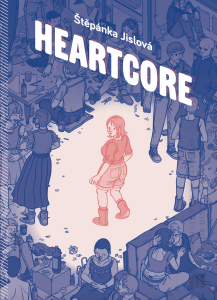 relationships. How do we form preferences? What do our preferences say about our personal character? How are we informed about our identities? How do our identities dictate our roles in society? And, more importantly, how do we rebel against those dictations?
 Prague. April 1, 1911.
 A reworking of the 400-year-old Jewish legend of the Golem of Prague is the foundation for this contemporary exploration of life, crime, and death in Venice Beach, California.
