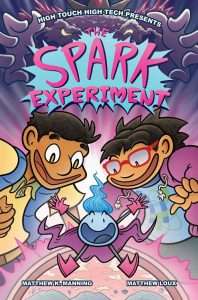
The story opens with David, a brown-skinned, lanky middle-schooler, imagining the “spark” of creativity and ideas as a cute little cartoon creature. He arrives home and meets up with his neighbor Marta, a lively homeschooled 2nd grader with red-rimmed glasses and the two investigate an explosion in David’s basement. It turns out his mom has successfully created a tool to shrink herself down so she can travel between dimensions into a “micro universe.” Unfortunately, she’s left the tool behind.
David and Marta go on a brief adventure to rescue David’s mom and, while in the microscopic dimension, encounter the blue spark of David’s imagination. It’s pictured as a blue ball with a purple cape, gloves, and boots on it’s stick-like arms and legs and a splash of blue “hair.” Together, with the help of David’s experiments, they rescue his mom from a crowd of purple creatures like Spark that seem to be sucking her creativity.
Inspired by Spark and their adventure, David tries again to start a Science Club and gets more interest this time. With the enthusiastic participation of Marta, he demonstrates how to make “space mud” at the club’s first meeting in his backyard and even gets the interest of a girl, Lisa. She’s shown wearing tights, a long skirt, and a loose jacket with curly black hair and a blue knit cap. David’s audience includes a kid with long blonde hair in a wheelchair.
However, the story is far from over – Spark isn’t the only creature that came through the portal from the microscopic universe and David’s mom is working on a new project in their basement that could mean disaster! David will have to bring out his trusty experiments and depend on Marta’s inexhaustible energy to save the day with science and keep the spark of inspiration alive.
There’s not a lot of variation in body types pictured, but that’s due more to Loux’s art style than a studied lack of diversity. Loux’s characters all have long, thin, flexible limbs and show exaggerated emotions with their wide mouths, heavily-drawn eyebrows, and the rapid changes in their eyes. The science experiments have a few illustrations, but these are mostly part of the story – the instructions are primarily in the text.
The other dimension is colored in orange-hued pinks, pale purples, and yellows with lots of ripples, creatures with multiple legs, and speech bubbles that look like tropically patterned easter eggs. This contrasts with the everyday suburb where David lives with blue skies and green trees and lawns.
The story includes 18 simple science experiments, from slime to a straw rocket and there is a QR code that has videos to accompany each experiment. The book is sponsored by a science organization called High Touch High Tech which creates fun science experiences.
There is some disconnect in the story – David is supposed to be a middle schooler, but the science experiments are more something an elementary student, like Marta, would enjoy doing. They do somewhat interrupt the flow of the story. As Marta points out, they’re running from monsters so why didn’t David just bring a compass instead of magnetizing a needle in the middle of a chase? However, the story is mostly a vehicle to carry the science experiments and a younger audience will enjoy the light story and be interested in trying the different projects. Manning is an experienced author who is used to creating nonfiction/fiction graphic novel scripts and the plot moves smoothly despite the sometimes jarring science elements. Older readers who like Matthew Loux’s art and are interested in the science-fiction genre are more likely to enjoy his own graphic novel series, The Time Museum.
The Spark Experiment By Matthew Manning Art by Matthew Loux Andrews McMeel, 2026 ISBN: 9798881601928
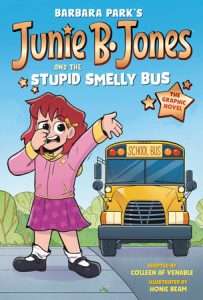
There is a long and storied tradition of bratty kids in children’s literature: Ramona B. Quimby, Max, basically every kid except Charlie in Charlie and the Chocolate Factory. And, of course, Junie B. Jones. Barbara Parks’ kindergarten heroine first entered the scene in 1992 and has graced 31 books, multiple stage plays, and a video game, even finding her way into Banned status in the early 2000s for not displaying good social values, poor grammar, and “mouthiness”. That by itself, in addition to being a straight up mood, could attract new readers to this legacy series. Now our kindergarten sass mouth is starring in her own graphic novel series from Penguin Random House, adapted by Colleen AF Venable and illustrated by Honie Beam. The first three books, Junie B. Jones and the Stupid Smelly Bus, Junie B. Jones and a Little Monkey Business, and Junie B. Jones and Her Big Fat Mouth, are already available and the fourth is expected September 2026.
All three graphics follow the original books closely with mild nods towards modernization (a fidget seat in Junie B.’s classroom and the appearance of a cell phone) but no real structural changes. Junie B. Jones and the Stupid Smelly Bus sees Junie B. on her first day of kindergarten and her dread over the too loud, too crowded, too much bus pushes her to hide in her school overnight with disastrous results. Junie B. Jones and a Little Monkey Business has Junie B. get confused over the arrival of her new baby sibling and telling an oopsie lie about him being a monkey. Finally, Junie B. Jones and Her Big Fat Mouth follows our main character dealing with an upcoming job day at school and realizing that she occasionally talks before she thinks things through.
Visually, the graphic is cute with a bright, animated art style and easy to follow panel flow. Beam adds fun, wavy cell borders when Junie B. is imagining wild scenarios and the book plays with different text styles for moments of emphasis. Venable sticks incredibly closely to the source material, in fact a little too closely.
I’m not sure this graphic does enough that’s different from the books. I mentioned nods towards modernization and they really are only nods. Venable didn’t leave room for changes in how contemporary children move through what is essentially a new world from what Junie B. inhabited. I’m not saying kids today can’t be “mouthy” or opinionated, there’s just something about this that feels out of step for me. Not only Junie B.’s behavior, but the reactions from the adults in her life seem really far removed from how kids today may behave. The books are filled with moments of Junie B. struggling or lashing out in a way that’s played for laughs, but reads as almost upset and none of the adults in the book seem to acknowledge or provide thoughtful help. I really wanted to like this -I love a mouthy, rude kid- but I finished feeling a little indifferent.
Junie B. is a hard character to like and that has always been part of her draw. She represents that main character part of us that remembers each questionable childhood moment or sees others having those same moments and can take a minute to laugh at them. Having these stories in a new format may introduce a new generation to their parent’s favorite sassy, mouthy rude kid. But, I suspect they’re going to meet her and not know what to do with her.
Junie B. Jones By Colleen AF Venable Art by Honie Beam Penguin Random House Viking Books for Young Readers, 202
Volume
ISBN
Junie. B. Jones and the Stinky Smelly Bus
9780593706701
Junie B. Jones and a Little Monkey Business
9780593706718
Junie B. Jones and Her Big Fat Mouth
9780593706725
Company Age Rating: 6-9
NFNT Age Recommendation: Easy Readers (5-9), Picture Books (3-8)
Judith Henderson is a Canadian author who previously teamed up with illustrator T. L. McBeth for a series of highly-illustrated easy readers, Big Words, Small Stories. She’s launched a new series with a new illustrator Sara Sarhangpour, which has the same lively sense of humor and fun cartoon illustrations.
In their first adventure, “Willa and Wade and the way-up-there”, Willa, an ostrich, and Wade, a penguin, are thinking about flying. They both imagine what it would be like to soar through the skies, but, as Willa says, they have “no lift.” Willa, drawn as a lanky peach-colored bird with a round red body, creamy white wings, tail, and ruff, and snazzy running shoes and Wade, a squashy blue blob with a cream belly and giant wire spectacles, go through a series of adventures to try to experience flight. The pages alternate between the two drawn against a white background with speech bubbles, simple panels outlined in black, and a few full-page panels with green or blue backgrounds and simple objects like a pool, cliff, or ocean. The open-ended final spread of the story shows the two temporarily suspended against a golden sky, dotted with fluffy white clouds and blue birds, as they finally manage to “fly”.
In their second adventure, “The Museum of Willa and Wade” we see a little more of their personalities when they find a sparkly button and start a museum. The art in this book, although still depicting the same characters in the first, includes more close-ups and Willa and Wade are drawn more simply and in broader outlines. There are still lots of individual panels and images of the two collecting items for their museum, discussing their arrangement, and having a few minor squabbles between each other and the other animals who come to view their museum. This story ends on a humorous note as the two examine a possible exhibit to be loaned to their mini museum – and the final page shows the item looming over their handful of items in a box.
These simple comics are intended to be easy readers, although parents and teachers expecting the carefully leveled words of an “easy reader” from US publishers will be disappointed. There are a few simple captions, shown in a thick, dark font against a peach background, and short, simple sentences in speech balloons. However, while the text is brief, it does include more complex words like “ancient” and “fabulous”. Henderson and Sarhangpour do a good job though of pairing simple art and relatively simple text; a big challenge in early comics is not putting too many things on the page for the learning reader to decode. This is a strong choice of an intermediate easy reader for kids who have mastered the basics and enjoy gentle humor and for parents and teachers looking for portrayals of curiosity and positive, healthy friendships.
Willa and Wade By Judith Henderson Art by Sara Sarhangpour Kids Can Press, 2025
Tasha is absolutely thrilled to relive her Gramp Abominable’s stories of Camp Yeti, even if things will look a little different. Due to the low numbers of yetis, she’s convinced her parents to turn it into Camp Monster and welcome everyone, but things don’t go as expected.
The new campers—and Tasha’s cousin—don’t seem to appreciate the traditions or the changes at Camp Monster and there are lots of clashes from mischievous goblins using their magic to a nervous werewolf who doesn’t want to learn to swim. Even worse, there are rumors and signs of humans in the area! Will Tasha get to experience the joys of summer camp as she’s imagined or will the camp have to close down as soon as it’s reopened?
Falynn Koch has previously collaborated with Kate Messner, but this is her first fully fictional graphic novel; her previous titles included entries in the Science Comics and History Comics series. Her art is well-suited for middle grade fiction, leaning towards simple lines and colorful images. Koch introduces the diverse monsters at the beginning of the book, combining with Messner’s dialogue to create individual portraits of each creature. Tasha and her cousin Kami have fluffy white fur, curved yellow horns and yellow tongues, varying shades of blue skin on their face masks, hands, and feet. Kami wears a blue fedora, making it easy to tell the yetis apart. The campers include a pair of green goblin twins, with slightly different fur patterns, a nervous red werewolf, soccer-loving vampire in shades of purple, ballet-loving ogress with blonde hair and green skin, and a bright orange griffin who is eager to get swimming. The monsters are divided up into two cabins roughly along gender lines at the beginning of the story, but Koch does not portray them as conforming to human (or monster) gender norms throughout the book. They wear (or don’t wear) a variety of clothing, from a pink tutu to loose tunic-like shirts.
In this first book, the creators focus on getting to know the characters and Koch moves the story through various scenarios and running storylines at the camp that give readers a feel for each camper’s individual personality. Lupo, the werewolf, struggles to swim and while Coach Q, a mermaid, is understanding, the bulky sea serpent, Coach J, doesn’t really get it. Their confused faces and Lupo’s misery are shown in their features, regardless of fur and scales, as the campers interact with the lake in different ways. The most striking contrast is shown between Isabelle, the ballet-loving ogress and Vera, the soccer-loving vampire. Isabelle is clear on her love of all things pink and fancy, always shown in pink, her blonde hair in a bun, while Vera prefers more active clothing (all purple to match her hair and skin) and would rather be out playing soccer than doing her nails. On the other hand, Vera is a confirmed vegetarian and recoils from Isabelle’s collection of live spiders she keeps for snacks. Koch keeps the reader from stereotyping either of the two as she constantly introduces new facets of their personalities and interests while keeping their basic portrayal consistent.
The creators move the story through all the ups and downs of very different monsters trying to enjoy camp together until they end up faced with an enemy that makes them all scared – humans! To keep the camp from being shutdown due to the dangers of humans, the monsters will have to put aside their differences and work together, but do they even want to stay at camp? Messner includes letters home from each of the campers that fill out the story and keep the plot moving while Koch focuses on the humor and drama of the monsters’ daily interactions.
This story is full of pranks, jokes, and fantastical creatures while carrying an underlying message of diversity, acceptance, and cooperation. There are several layers of humor, making this appeal to a wide range of readers, and middle grade readers are unlikely to outgrow their interest in the characters before the next book in the series is released.
Recommend to young readers ready to move on from Kevin Sherry’s Yeti Files and those who enjoy light-hearted graphic novels with bright, appealing illustrations like The Investigators.
Camp Monster By Kate Messner Art by Falynn Koch Bloomsbury, 2026 ISBN: 9781547609413
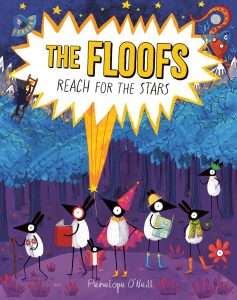
This quirky debut comic comes from the UK. Creator Penelope O’Neill has dreamed up a gentle, odd world with small creatures who go on surprising adventures.
The book begins with a map, showing a green island against a blue sea. Landmarks, and each Floof’s special home or place, are marked on the map. Next, O’Neill introduces the cast—each Floof has a long, pointed, mouse-like head, two rabbity ears, cotton fluff body, and stick legs and arms. But each is given a unique twist, both in their description, “Loves fashion” or “Organized” and in their accessories and size. There’s also a guest appearance by Mika, a puffy blue creature who lives in the mountains. There are three chapters or adventures – each is introduced by a simple, four panel comic.
In the first story, Wizard decides to work a special spell and calls his best friend, Bean, to help. But things go wrong in so many ways! Fortunately, the Floofs are ready to help and after much bickering, some complaining, and calling up the ghost of Wizard’s great, great, great, great, great grandma, the adventure ends happily. The second chapter features Dill. She loves a good adventure and finding an alien in need of help is just the adventure she’s been dreaming of – not to mention the fun of making a new friend. In the third and final chapter, readers revisit Wizard’s friend Bean. Adventures are all very well, but what she really wants is to sit quietly and read her new book. Unfortunately, whether she wants it or not, an adventure comes to her and after many strange experiences, she finally finds the perfect quiet spot to read.
O’Neill’s comics are a charming mix of text and art. A few sentences or a short paragraph every few pages provides the main narrative flow of the story while the comic panels primarily include commentary, rather than dialogue, from the Floofs. Each segment has a different primary color—Wizard’s adventure takes place mostly in deep purples and blues, as it’s a night-time adventure. Dill’s adventure starts and ends with the bright green of the park and forest, but quickly changes to the blues of the lake, as she and the alien go searching underwater on their quest. Bean’s adventure is also primarily shown in greens, but as she wanders deeper and deeper she ventures into white and gray fog, purple mountains, and the deep, dark blue of caves and the night sky.
Although at first glance this might seem like a title intended for young children, it has quite sophisticated vocabulary and humor, from the alien telling Dill it’s a hurtful stereotype to Wizard’s interactions with his peppery ancestral ghost. This reminded me vividly of Tove Jansson’s Moomins, with the slightly surreal sense of humor, longing for a quiet life, and vivid, quirky personalities of the various characters. O’Neill’s comic style is all her own though, and the odd little island world of the Floofs is a fun place to visit.
Elementary age readers who are fluent enough to follow both the art and text, and who enjoy this kind of gentle, fantastic silliness will probably enjoy this. However, I would suggest the main use for this book would be as a cozy read-aloud; its enjoyment depends more on personal taste than reading level and families who enjoy regular read-aloud sessions will find this a wonderful addition to their repertoire.
The Floofs Reach for the Stars By Penelope O’Neill Frances Lincoln Children’s Books, 2025 ISBN: 9780711298354
Sean Avery is an Australian author with a handful of humorous picture books in print in the US. This is his first graphic novel published in the states and it has the same quirky, manic humor that many Australian children’s books seem to feature.
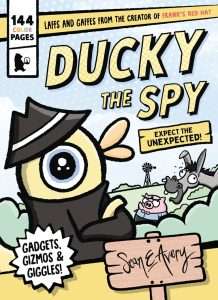
Readers start the story by meeting Ducky, always portrayed in profile with a large, staring eye, plump beak, black fedora, and trenchcoat. Ducky’s boss, and the boss of the whole farm, is Mr. Pig, a massive pink sphere with floating eyebrows and a small pink bowtie. Mr. Pig has a secret mission for Ducky, but it won’t be easy to get them started. Just when Mr. Pig thinks he’s getting somewhere, Donny the Donkey, Ducky’s “partner” shows up. Finally, Mr. Pig manages to explain the mission – someone is stealing from his personal slop trough. Ducky is on the case! Maybe. Sort of… Along the way there will be disguises, lasers, and tough-talking cats as well as a lot of confusion!
Avery’s art is hectic and explosive, with bulging eyes, dim-witted henchcats, and, of course, Donny who has buck teeth and a tendency to lose control at pivotal and stressful moments. Throughout the wild story, Ducky maintains their cheerfully bland expression, leading to wild exasperation on the part of the other animals as they bulge out of the panels in frustration. The backgrounds of the panels are shown in pastel patterns of polka dots, circles, and the occasional hearts until Donny lets loose and everything is clouded with poisonous green farts. The panels are large and, interspersed with a few full spreads, are laid out in 2, 3, or 4 panels per page. The text is bold and brief, with emotions conveyed through the animals’ wild eyes, exaggerated facial expressions, and the variation in speech bubbles. Ducky, of course, never changes expression throughout, placidly causing havoc as they go about their spying.
A recurring plot point is Mr. Pig’s assorted family, which is the only thing Ducky is confused by – Mr. Pig’s wife is a horse and his children are a chicken and a goat. His chicken daughter, Gretta, is an inventor and creates gadgets for Ducky while his son, Richard, is a goat who is kidnapped.
This is a silly story that will appeal to elementary-age readers who like lots of goofy humor in their comics and a simple, bold storyline and art. Hand to readers who are just figuring out how to tell jokes or who want a quick, funny story.
Ducky the Spy By Sean Avery Walker Books Australia, 2025 ISBN: 9781760659356
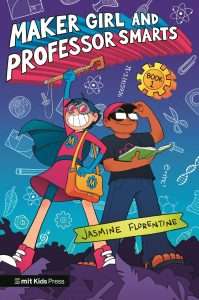
Jesus “Chuy” Reyes, age 12, starts the story by introducing himself and his best friend, Yael Levy or Yaya. Chuy is super smart and fascinated by all things intellectual—Yaya is a hands-on inventory and can make anything, even if she is a bit goofy at times. When a comet strikes earth and people gain mysterious powers, Chuy is super bummed – not only do these powers not conform to scientific laws, but he didn’t get any! When one of the second-rate supervillains of New Bork City ruins their ice cream, Yaya makes up her mind – they will become superheroes! With Chuy’s smarts and Yaya’s maker skills, the two take on Mr. Anti-Freeze, who is threatening to slimerize all the ice cream in New Bork City!
Florentine’s illustrations are bright and cheery, with lots of primary colors and drawn with clean, sharp lines. Chuy has brown skin, heavy eyebrows that move dynamically to indicate his exasperated moods, including up onto the outside of his pink baseball cap, and square glasses. He’s a tall, sturdy kid who gets a little excited about intellectual pursuits, but otherwise is mostly dragged along by the exuberant Yaya. Yaya, a skinny kid with short blue-black hair, is wildly enthusiastic about everything from superheroing to ice cream, despite the more cautious Chuy’s warnings and her younger brother’s embarrassment. Her family home is decorated to show her Jewish culture and Yoel, her younger brother, wears a kippah. Their villain has brown skin and pink hair.
The story is fairly simple, interspersed with lots of helpful (and random) facts from Chuy and step-by-step guides to making things from sorbet to grappling hooks from Yaya. The story ends with character studies and links to websites with guides for young makers.
Superhero take-offs like this tend to be cheesy, but this story is fully aware of its silliness and plays it for all it’s worth. Chuy’s repeated complaints that he’s NOT a superhero, the ridiculous villain, and Yaya’s wild enthusiasm will make readers giggle along with the author and maybe catch the making bug, even if they don’t want to put on a costume or have a super-powered bag to hold all their tools. While this is unlikely to satisfy readers who want “real” superheroes, it will certainly please younger readers who like funny stories and are interested in hands-on building. A must have for libraries and schools that include a maker space.
Maker Girl and Professor Smarts Vol. By Jasmine Florentine Candlewick, 2025 ISBN: 9781536239584
NFNT Age Recommendation: Easy Readers (5-9), Middle Grade (7-11)
In a sparkling blue pond surrounded by lush greenery there is a village of happy frogs. But one small frog is not content to stay there – he’s ready to set out on an adventure. On his journey Froggy meets new friends, has some frightening and exciting adventures, and finally finds the place he belongs.
Walshe’s charming illustrations are a huge draw. Froggy is a small green lump with sturdy arms and legs – although he can jump like a frog, he is usually depicted more anthropomorphically, walking on his back legs. During peaceful moments in the story, green and blue predominates, but in moments of fear and drama the color scheme changes to hot reds and oranges. Froggy’s friends include a crew of regular woodland critters, from a gold fish (Fishtopher) to a pair of fuzzy bees. There are also more fantastical critters that include several cryptids and a wizard. The occasional humans shown include a Black family camping in the woods, a few teens fishing and boating, and a scruffy white man with greedy eyes and an old-fashioned camera looking for evidence of cryptids to benefit himself.
This is a gentle but funny story – the narrator interjects comments from time to time, describing the action and lamenting that they don’t get to participate in the treats on offer – while Froggy’s determination and the goofy scenarios he gets into range from cozy to hilarious. The sequence where the two cryptids teach him how to bite and his miscommunication with the wizard are especially funny. Most of the main characters use male pronouns, although the cryptids do not have a designated gender.
Intermediate readers will enjoy the simple adventures, quirky humor, and fresh, bright colors and even older readers can find something to appreciate in the tongue-in-cheek humor of the narrator and the contrast between Froggy’s wild enthusiasm and his small size. There are other titles similar in theme and reading level to this debut comic – Paige Braddock’s Stinky Cecil, Rosemary Mosco’s Expedition Backyard, and Renee Kurilla’s The Flower Garden. However, Walshe’s title stands out with her charming and funny illustrations, the slightly snarky twist of her humor, and differs from the others in that there isn’t an informational aspect to her story. At times it might seem to be moving towards reality, but it’s really a cozy fantasy, from the anthropomorphic pond animals in clothes and homes to the peaceful cryptids, wizard’s potions, and finally the helpful tips for life in the pond on the last spread, warning readers that fish hold grudges and all snails are terrible gossips. Readers will be rooting for Froggy in his adventures and looking forward to more comics from this debut author.
Froggy: A Pond Full of Pals! By Paige Walshe Flying Eye Books, 2025 ISBN: 9781838749361
NFNT Age Recommendation: Easy Readers (5-9), Middle Grade (7-11)
Who isn’t fascinated by dinosaur facts? I’m old enough to have been part of a large portion of the general population that grew up with an understanding of dinosaurs that came from Jurassic Park or The Land Before Time. Both good movies in their own unique ways, but the point is: when I was growing up, it was generally accepted that dinosaurs were giant reptiles and they definitely didn’t have feathers.
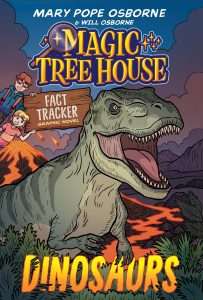
The Magic Tree House Fact Checkers is a series of nonfiction books that are written by Mary Pope Osborne together with either her husband Will Osborne and her sister Natalie Pope Boyce. These books break complex subjects down into simple concepts that young children can readily comprehend. They help develop a child’s skills at reaching conclusions through the logic of cause and effect. But the most fundamental gain of the nonfiction Fact Trackers is that they give children an appreciation for the wonders of the “real” world and inspire a curiosity for learning more about history and natural science.
Jack and Annie are your guides – they narrate and explain their time traveling adventures to the reader while dropping facts about where they happen to be visiting. Red vocabulary words are highlighted and defined in the corners of certain panels, mindful and considerate of its target reader. And although informative and well-rendered, do not expect this graphic novel to contain scientific illustrations. But do expect some basic scientific language – such as “megalosaurus,” how to pronounce it, and what it translates to – the history of dinosaur archeology specifically (including how we humans got it all wrong), the history of the planet, and a little bit about what we still don’t know.
Magic Tree House Fact Tracker Graphic Novel: Dinosaurs is a solid start to a basic and foundational understanding of paleontology. The information is laid out simply in an organized fashion and the pictures that accompany it are engaging and rendered in full color.
Magic Tree House Fact Tracker Graphic Novel vol. 02: Dinosaurs By Mary Pope Osborne, Will Osborne Art by Jomike Tejido Penguin Random House, 2025 ISBN: 9780593705841
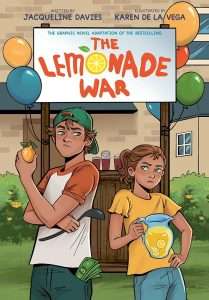
At the end of the summer, siblings Evan and Jessie will both start fourth grade. Evan is right on schedule, while his gifted little sister Jessie is skipping a grade. The problem is, their school only has one fourth-grade classroom. Evan and Jessie are close, but Evan fears that being in the same class will make it obvious that his little sister is, in some ways, smarter than he is. So while Jessie is looking forward to school starting, Evan is dreading it.
Jessie—brilliant with academics but not so much with social skills – can’t see why Evan would be upset, which just upsets him more. Now, Evan doesn’t want to hang out with Jessie for what’s left of the summer, so he ditches her to set up a lemonade stand with another neighborhood kid. Jessie is hurt, but thinks maybe if she starts her own lemonade stand, she can impress Evan and make him want to hang out with her again.
Instead, the lemonade stands become a fierce competition, which spirals until Evan and Jessie make a bet: whoever earns more money by the end of the summer gets both of their profits. It’s Jessie’s math and business smarts versus Evan’s doggedness and people skills. Who will win? And will Jessie and Evan ever work things out between them, or will their closeness be a casualty of the lemonade war?
This graphic novel adapts the 2007 book The Lemonade War, the first of a series, which garnered a list of awards and positive reviews. Like the original, this adaptation gets its tension and momentum from Evan and Jessie’s sibling rivalry, but also slips in some math and lots of basic economics concepts, all explained in an accessible way for young readers. Jessie calculates profit margins and tries out the value-added tactic of offering free pretzels at her stand; Evan runs afoul of local business regulations when he starts selling lemonade on public property downtown without a license. As they try to out-maneuver each other, Evan and Jessie use business strategies including underselling, advertising, and even franchising.
Jessie and Evan are very different, but both sympathetic and interesting. Thought bubbles provide lots of information on their interior lives, showing readers when there is a miscommunication, something Jessie doesn’t understand, or something Evan thinks but isn’t willing to say. Flashbacks help explain their motivations and illustrate how close the siblings normally are. While no diagnosis is ever mentioned, Jessie seems coded as perhaps being on the autism spectrum: she takes social interactions at face value and is often confused when people are not straightforward, and one page shows her looking at a chart of facial expressions labeled with different emotions.
The art is clear, with a slightly cartoonified realistic style. Panel sizes and layouts vary, adding visual interest. The backgrounds are fairly simple, keeping the focus on the characters and what they are doing – including, occasionally, working out lemonade-related math, which is laid out for readers to see. When a flashback begins, the panel outlines change from having black outlines and sharp corners to brown outlines and rounded corners, and all the colors take on a slightly muted look, like a subtle version of the sepia tone in old photos.
This book has sympathetic characters who feel like real kids. It packs in a lot of kid-friendly economics concepts, but its driving force remains the relationship between Evan and Jessie. Hand it to kids who like realism and good-hearted young characters trying to navigate family and friend conflicts – and to fans of stories about kid entrepreneurs, like the Baby-Sitters Club.
The Lemonade War By Jacqueline Davoes Art by Karen De la Vega Harper Collins Harper Alley, 2025 ISBN: 9780063310384

 The story opens with David, a brown-skinned, lanky middle-schooler, imagining the “spark” of creativity and ideas as a cute little cartoon creature. He arrives home and meets up with his neighbor Marta, a lively homeschooled 2nd grader with red-rimmed glasses and the two investigate an explosion in David’s basement. It turns out his mom has successfully created a tool to shrink herself down so she can travel between dimensions into a “micro universe.” Unfortunately, she’s left the tool behind.
 Charlie and the Chocolate Factory. And, of course, Junie B. Jones. Barbara Parks’ kindergarten heroine first entered the scene in 1992 and has graced 31 books, multiple stage plays, and a video game, even finding her way into Banned status in the early 2000s for not displaying good social values, poor grammar, and “mouthiness”. That by itself, in addition to being a straight up mood, could attract new readers to this legacy series. Now our kindergarten sass mouth is starring in her own graphic novel series from Penguin Random House, adapted by Colleen AF Venable and illustrated by Honie Beam. The first three books, Junie B. Jones and the Stupid Smelly Bus, Junie B. Jones and a Little Monkey Business, and Junie B. Jones and Her Big Fat Mouth, are already available and the fourth is expected September 2026.
 readers, Big Words, Small Stories. She’s launched a new series with a new illustrator Sara Sarhangpour, which has the same lively sense of humor and fun cartoon illustrations.
 low numbers of yetis, she’s convinced her parents to turn it into Camp Monster and welcome everyone, but things don’t go as expected.
 go on surprising adventures.
 Sean Avery is an Australian author with a handful of humorous picture books in print in the US. This is his first graphic novel published in the states and it has the same quirky, manic humor that many Australian children’s books seem to feature.
 fascinated by all things intellectual—Yaya is a hands-on inventory and can make anything, even if she is a bit goofy at times. When a comet strikes earth and people gain mysterious powers, Chuy is super bummed – not only do these powers not conform to scientific laws, but he didn’t get any! When one of the second-rate supervillains of New Bork City ruins their ice cream, Yaya makes up her mind – they will become superheroes! With Chuy’s smarts and Yaya’s maker skills, the two take on Mr. Anti-Freeze, who is threatening to slimerize all the ice cream in New Bork City!
 In a sparkling blue pond surrounded by lush greenery there is a village of happy frogs. But one small frog is not content to stay there – he’s ready to set out on an adventure. On his journey Froggy meets new friends, has some frightening and exciting adventures, and finally finds the place he belongs.
 Who isn’t fascinated by dinosaur facts? I’m old enough to have been part of a large portion of the general population that grew up with an understanding of dinosaurs that came from Jurassic Park or The Land Before Time. Both good movies in their own unique ways, but the point is: when I was growing up, it was generally accepted that dinosaurs were giant reptiles and they definitely didn’t have feathers.
 Jessie is skipping a grade. The problem is, their school only has one fourth-grade classroom. Evan and Jessie are close, but Evan fears that being in the same class will make it obvious that his little sister is, in some ways, smarter than he is. So while Jessie is looking forward to school starting, Evan is dreading it.
