After her mom dies, teen protagonist Joey is forced to move to Kodiak, Alaska to live with her dad; quite different from where she lived in Seattle!
Her dad hasn’t been present in her life until NOW, and even though everyone tells her he’s a nice stand-up guy, that previously didn’t include her, apparently. The only friend she’s made is a 3000-pound grizzly living in the woods near her house. While Kodiak people talk about a mythical “spirit bear”, no one has seen it except her. Did I mention that her dad is a state trooper? Did I mention that Joey can see auras? When Joey goes missing in a snowstorm while taking her dad’s boat out, (without his permission) the bear comes to her rescue. (The bear also rescues her twice!) State troopers and volunteers with rifles start a search, and well, you can imagine how this turns out. BUT WAIT! MORE drama is in store – Eons-old Mama Grizzly knows her cub has been killed, and BOY IS SHE PISSED!
I’m on the fence about this title. The pacing of this story is awkward. It seems like a LOT of sturm-und-drang in a very short time. Joey is already dealing with her mom’s death and a move and has to witness the brutal killing (TWICE!) of the only friend she’s made. Any ONE of these things would be profoundly disturbing to any teen, and the bloody killing scenes by the hunters AND THEN AGAIN by the troopers and searchers could be triggering to some teens. They were to me, and I’ve had Hunters Education classes! Car crashes, plane crashes, evacuations of people, explosions everywhere and the destruction of downtown Seattle follow. After Mama’s rampage, the story hustles on to a hurried-up and (what I felt was) unlikely, too-easy ending. Joey and her father finally work together to lead Mama and her dead cub back to the wilderness. I like a good kaiju story as much as anyone, but it’s too much plot for only 168 pages. Authority figures and adults (with some exceptions) are one-dimensionally portrayed as testosteroney enthusiastic killers. The plot lurches from one unlikely situation to another. Finally, there are plot threads that are never explained, like the huge bones found during a construction site excavation, and the hunters who kill a grizzly without facing consequences. (It’s illegal to do that in AK without a bear tag, which is won in a organized lottery, and only used legally during a certain period of time.)
The art is well developed, but I feel like the women are more realistically and positively drawn. The men are drawn with sharp angles and scatological grimaces. Joey’s dad is drawn in a two-dimensional way that blocks us from imagining the “guy everyone loves.” All the animals are drawn in a wonderfully realistic and mystical fashion.
We certainly need more comics and graphic novels that depict native Alaskan peoples, stories and culture, but I think this comic tries to do too much. Is it a Godzilla/Kaiju action story? Is it a story about a teen processing her grief? Is it about life challenges and changes? One barely has time to catch one’s breath and think about it.
The comic is marked for “Young Adult” age range, and I would shelve it there. Despite my quibbles, teens may like it purely for the action. I would call it an optional purchase.
Queen Kodiak By Christopher Greenslate Art by Riccardo Faccini Mad Cave Studios, 2026 ISBN: 9781545821015
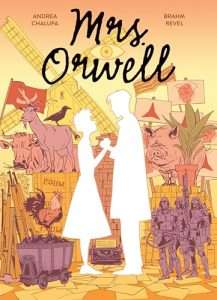
From studying under J.R.R. Tolkien in university to fighting the rise of fascism in the 20th century to serving as a powerful creative force behind the most famous works published by George Orwell—23rd Street Books dives into the life of Eileen O’Shaughnessy in Mrs. Orwell, written by journalist, author, and filmmaker Andrea Chalupa with art by Brahm Revel.
Mrs. Orwell opens with our introduction Eileen O’Shaughnessy (later Eileen Blair), studying at university under the esteemed Professor Tolkien, partying at night, and chafing against the strict social standards which hold women back in the name of propriety. At a party, she crosses paths with a writer named Eric Blair, who publishes under the name George Orwell.
With shared interests in art and politics, the two find a deeply passionate connection, somewhat to the dismay of Eileen’s brother with whom she lives. From marriage to traveling conflict zones in Europe in search of political movements and armed resistance to the rise of fascism and the brewing storm of what would become World War II, Eileen and her husband find themselves tested as they fight for both their ideals and their lives.
A talented writer on her own, Eileen throws herself fiercely behind supporting her husband’s work, serving as editor, typist, and muse for numerous of his publications, especially influencing his most famous titles, Animal Farm and 1984. With a world in violent chaos and a marriage fraught with turmoil and infidelity, this graphic novel shines a light on two incredibly influential writers—only one of whom remains widely known today.
As discussed in the note at the end of the book, Mrs. Orwell serves as a work of historical fiction that nevertheless draws heavily from recorded fact. It even includes a reading guide for anyone wanting to dive deeper into Eileen’s life. While never shying away from the complexities and failings of either Eileen or Eric, the main focus remains on recognizing and celebrating Eileen’s work and the vital role that art and resistance play in the face of violence. The characters are layered, revealing facets of themselves through engaging and entertaining dialogue, while Chalupa carries us through a great span of time including major historical events on the world stage. It’s a great deal of content to cover in a book of this sort, and if Mrs. Orwell has any flaw, it’s that there’s not quite enough time to unpack some of the history, particularly in the book’s later portion.
Nevertheless, in tackling themes of fascism, war, censorship, art, and media—there’s a wealth of material here that remains all too relevant today. But in addition to uncovering lesser known biography and vital discussions about the nature of creation and resistance, the book is also simply fun to read. Entertaining and often funny, it succeeds on a narrative level as much as a historical one. It’s a feat to balance all these elements, and Chalupa has written a striking story about two passionate, flawed, messy, creative, and highly influential people which brings them to vibrant life within these pages.
And speaking of vibrant pages, Revel’s shifting palate of art is a delight from start to finish. Colors and tones shift across the story, as do the layouts and structures of each page. With a careful eye for pacing and visual storytelling, Revel keeps the art grounded without being afraid to weave in flashes of stylization and dramatic representations of emotions alongside the more focused, powerful moments the book has to offer. Heightening both humor and heartache, Revel’s visuals are a vital aspect of the book’s appeal. The grit feels real, as does the threat of war and death. At the same time, we get soft romantic interludes, mixed realities where fiction intrudes on the present, and appropriate weight given to the heavier themes the book holds in store.
23rd Street Books lists this title for adult readers. There are smatterings of violence, sexuality, and language throughout, but the book never lingers on the more mature elements or presents them in graphic detail. At the same time, with a strong historical focus alongside a range of complex topics and themes, it’s likely the book will appeal most to older readers and those already familiar with Orwell’s work. It could also be a good companion read for older students studying Orwell’s life and writing. Overall, Mrs. Orwell is an excellent read in its own right, while also bringing to life a figure often lost in the obscurity of history. A woman who refused to accept the bounds society placed on her, a fighter who dreamed of a better world, a writer who left her mark for generations to come—more people should know the name Eileen O’Shaughnessy, and this graphic novel is an excellent step in ensuring that her life and accomplishments are not forgotten.
Mrs. Orwell By Andrea Chalupa Art by Brahm Revel 23rd Street Books, 2026 ISBN: 9781250877857
Company Age Rating: Adult
NFNT Age Recommendation: Adult (18+), Older Teen (16-18)
Amu Hinamora sometimes feels like an anxious mess, but seen from the outside, she’s popular and cool. It helps that she’s one of the Guardians: rare kids who have tiny magical companions called Guardian Characters, which grant special powers. In fact, where most Guardians have a single Guardian Character each, Amu has four. Perhaps it’s no surprise that she is chosen for a special mission: unraveling a mystery at a prestigious but strange middle school called Arcana Academy.
In the world of Shugo Chara!, every child has an egg in their heart that represents an ideal version of themselves that they want to be. Most children never discover their eggs, but some rare eggs hatch into tiny chibi people called Guardian Characters. Guardian Characters mostly hang around offering commentary, but they can also help their Guardians transform into powered-up versions of themselves.
Arcana Academy has a problem: students are losing confidence in themselves, which can turn their eggs into X Eggs. These hatch into not heroic and helpful Guardian Characters but mischievous and dangerous X Characters. As a Guardian, Amu specializes in restoring X Eggs. That’s her main mission at Arcana Academy, but she also has a secret assignment: to learn about the Academy’s powerful treasures, the Arcana Jewels.
This is a cute adventure with lots of humor. Amu is an entertaining protagonist: since readers can see her thought bubbles, we know when, beneath her Cool Girl exterior, she’s confused or panicking or paying less attention to her mission than to her crush’s cute school uniform. Her four Guardian Characters can also see her thoughts, and they have lots to say about them, which is often funny.
Guardian Characters are a fun element: each one represents an aspirational version of their Guardian, often in an over-the-top way. For instance, Amu’s crush has a princely, chivalrous personality; his Guardian Character is an actual king who gives him the ability to transform into a monarch in full regalia and use a defensive power called Holy Crown. Amu’s four Guardian Characters have personas ranging from artistic to athletic, and enable her to transform into four different superpowered versions of herself.
The supporting cast adds to the fun. There’s Amu’s crush, whose sweet personality contrasts humorously with his tyrannical Guardian Character. Another Arcana student, Niya, is a video streamer with a pair of cat ears (thanks to his Guardian Character being an anthropomorphic cat), lots of silly energy, and a crush on Amu. Amu’s new roommate is so shy and quiet that for awhile Amu doesn’t realize there is another person in her room at all.
The Guardians’ transformations and magical powers have major magical girl vibes, complete with elaborate outfits. The art throughout the manga is rich with detail, from the gothic architecture of Arcana Academy to the flowers, stars, bubbles, and sparkles sprinkled through the backgrounds. Playing card suits are a major theme: Arcana Academy’s four dorms are Heart Tower, Diamond Tower, Spade Tower, and Clover Tower, and are decorated with the corresponding symbols (“clover” being clubs). The four suits also appear on Amu’s four Guardian Characters and seem to be connected to the Arcana Jewels.
At the end of this volume is a collection of translation notes to clarify elements of the story that are otherwise hard to translate. For instance, the headmaster of Arcana Academy uses a Japanese counting word that implies that Guardian Characters are objects, while everyone else counts them using the word that is used for people. The notes offer a fascinating glimpse into the differences between Japanese and English and the ways translators try to bridge them.
There is a brief introduction to the main cast and the concept of Guardian Characters at the beginning of the book—a helpful reference, especially for readers new to Shugo Chara! With a new setting and largely new cast, this volume can stand alone or serve as an entry point to the series, though new readers may get a sense they are missing a little bit of context. Still, the story holds up well on its own as a light, fun magical-girl-style adventure.
Shugo Chara! Jewel Joker By Peach-Pit Kodansha, 2026 ISBN: 9798888777107
There are many tall tales about the highwayman Dick Turpin. The actual history, as is usually the case, is somewhat more muddled. Such is the way of legends.
Unlike the more internationally famous Robin Hood, we know for certain there was a Dick Turpin. He was born in 1706 and died by hanging in 1739. What he did in between and whom he associated with is somewhat more debatable. It is agreed, however, that he spent the last few years of his life as a horse thief and highwayman, after several years as a house-robber, poacher, and smuggler.
Dick Turpin and the Crimson Plague is more concerned with romantic fiction than solid fact. Nevertheless, this updated and expanded edition of the original 2011 graphic novel concludes with a decent overview of the real history. This is noteworthy, given how the stories contained within this volume are as unlikely as the account of Turpin riding 200 miles in a single night.
The main story, The Crimson Plague, finds Dick Turpin and his fellow thief, Tom King, enjoying their ill-gotten gains in London. After watching another unfortunate’s execution, the two decide to have some fun at the local brothel. However, it becomes apparent that there is a dark secret within the bawdy house’s basement. Soon, the two thieves become monster-slayers, fighting to save London from a vampire invasion!
The new edition of Dick Turpin and the Crimson Plague colorizes what was originally a black-and-white comic. The color art by Gavin Ross is decent enough. However, there are many pages I think might have hit harder in monochrome. Indeed, there are some pages where the colors seem to obscure the original inks of Graeme Howard’s artwork.
This new edition also contains an original short comic. Subtitled “The Crawling Terror,” this tale finds Dick Turpin and Ton King making camp in a cave. Unfortunately, the depths of the cave contain monsters that seem more appropriate to a Conan comic than a Dick Turpin story. Still, the artwork for this chapter by Roland Bird and Brett Burbridge is stronger than the main event.
All in all, I found Dick Turpin and the Crimson Plague to be an amusing read. I enjoy a good story of supernatural horror and stories about reluctant heroes. This is both. I also enjoyed the history provided at the end, which adds some context to what came before.
Time Bomb Comics does not offer a rating for Dick Turpin and the Crimson Plague. I would suggest that any librarian interested in this place it in the adult collection. First, because there is considerable bloodshed and Steven Tanner’s scripts do not skimp on adult language and sexual content. The only nudity in the book is a corset that slips to reveal one sex worker’s nipples at one point.
Another note for librarians: the only place I believe this new edition hardcover is available is the Time Bomb Comics website. The edition currently listed on Amazon and GoodReads under the provided ISBN is for the 2011 original.
Dick Turpin and the Crimson Plague By Steve Tanner Art by Roland Bird Time Bomb Comics, 2025 ISBN: 9780956182241
Anima. Lisa Storm. Vera Vicious. Morgaine La Fey. Gaia.
Five different women, both friends and rivals. Five women among the hottest and wildest girls to be found cruising the Sunset Strip. They make the scene. They go backstage. They enjoy the drugs and the bands just passing through. Every night is a new party. Every party is a new adventure.
That changed with the arrival of The Moon Show—a band on the verge of becoming the next big thing. The girls are there when a major label signs them. They go on the road with the band as they go on-tour. And for a while they are living the dream in style.
However, the girls start noticing something is wrong. Other women the band picks up go missing. And some of the girls start seeing strange things while they’re high. Visions of some darkness behind The Moon Show. Something that calls for blood!
Groupies is a hard comic to quantify. It is horror, but it is a slow-boiling horror story where the terrors are more existential than gory and largely left to the imagination. There is a mystery, but the big secret of the story is telegraphed early and somewhat predictable given stories about musicians selling their souls are common enough. (The label that signs The Moon Show is called Asmodeus Records, for crying out loud!)
Thankfully, that’s not really what Groupies is about. The mystery and horror are just background dressing to the true focus of the comic. Namely, the stories of five different women trying to find meaning in their lives amid the sex, drugs, and rock and roll culture. And their vastly different reactions to everything around them.
Lisa Storm, for instance, enjoys the scene, but still dreams of finding true love with The Moon Show’s front-man, Si, despite knowing deep down he’s a dog. Gaia and Morgaine work together to bring rock stars into bed, yet both would rather spend time with alone with one another. The irony is they are both fearful of saying anything for fear of ending what they have. And then there’s Vera Vicious, who for all her blunt talk and complaints about other women trying to steal her man of choice, is the first to realize there’s something strange about the people from “the label” and something sinister going on. All in all, Helen Mullane does a fantastic job of developing these characters and putting the reader inside their heads.
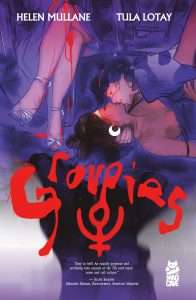
Similarly, Tula Lotay turns every chapter into a different sort of visual journey. It does the artwork a disservice to describe it as merely psychedelic. Oh, there are shifts in the artwork as the characters get high, but there are different alterations to the style and colors depending on the drug. The dark visions Gaia has after taking datura, for instance, are different than the shared hallucination the women enjoy as they drop acid before going for a walk in the woods and start imagining themselves as dryads.
Groupies is rightly recommended for Mature readers. There is cursing. There is nudity. There is everything one would expect in a story devoted to exploring the dark side of sex, drugs, and rock-and-roll. And that’s before you bring in all the murder, assault and demons. In short, this is one to put in the adult collection of the public library and one to keep away from the kids and teens.
Groupies By Helen Mullane Art by Tula Lotay Mad Cave Studios, 2026 ISBN: 9781545821268
Company Age Rating: 18+
NFNT Age Recommendation: Adult (18+) Creator Representation: British, Character Representation: Bisexual,
Superheroes might seem like they’re everywhere, from movies to underwear, but imagine living in a world where men and women with superpowers actually exist and save the world on a regular basis. Comics like Kurt Busiek’s Astro City have discussed what it’s like for mostly regular people to live in a world populated by people with powers, but Athanasia written by Daniel Kraus and illustrated by Dani, takes a much darker look at this concept. It not only explores what happens to superheroes who have lost their lives but what their remains mean for those with more earthbound problems.
Kraus’s tale takes us to Venture City, a town known for its superheroes, and follows young Forrest Molson. Forrest is a recovering addict who is looking for direction after graduating high school, so she goes into the family business. Like her father and grandfather, Forrest helps maintain the grounds at Athanasia, a cemetery housing the fallen members of Venture City’s greatest superhero team, the Dynamic Guild. Frustrated with her life and prospects, Forrest soon makes an astounding discovery: a chemical oozes from Athanasia’s soil that gives Forrest different superpowers. This new drug of choice (and the power that comes with it) soon takes over Forrest’s life. As friends and family try to pull Forrest back from the brink, her brush with superpowers soon becomes her villain arch.
Kraus is an author who’s better known for horror novels like Whalefall and Angel Down, but Athanasia is a horror story that touches upon many modern anxieties. The superheroes of this world mainly appear through their memorials, meaning they are not there when the Molson family, who have a deep respect for their positions as Athanasia’s caretakers, actually need them, illustrating how some heroes fly so high that they miss seeing the people who need their help. However, the truly harrowing moments in this book are when Forrest’s addiction spirals out of control, and she commits acts that both shock and appall readers.
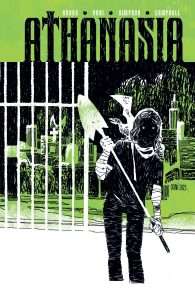
Enhancing this story’s dark tones is Dani’s artwork, which eschews the dynamic colors in most superhero epics in favor of black and white ink drawing. This contrast shows readers that this story takes place far below the eyes of heroes, but the black and white also lets the book’s main villain shine. When the ooze makes its appearance and begins corrupting Forrest in earnest, the ooze (and the energy Dani manipulates when on the ooze) is colored a radioactive green, signifying its toxic nature and the frightening power now at Forrest’s fingertips.
There are many superhero stories that have cemented their status in our pop culture, but there are a multitude of stories, like Alan Moore’s Watchmen, that show the shadowy underbelly of these stories. This book will draw fans of both “Watchmen” and “Astro City” because it walks a thin tightrope of hope, like the kind in superhero narratives, and despair, like when readers take too long a glimpse beneath the capes.
Athanasia By Daniel Kraus Art by Dani Vault, 2025 ISBN: 9781638492818
NFNT Age Recommendation: Adult (18+), Older Teen (16-18)
Tasha is absolutely thrilled to relive her Gramp Abominable’s stories of Camp Yeti, even if things will look a little different. Due to the low numbers of yetis, she’s convinced her parents to turn it into Camp Monster and welcome everyone, but things don’t go as expected.
The new campers—and Tasha’s cousin—don’t seem to appreciate the traditions or the changes at Camp Monster and there are lots of clashes from mischievous goblins using their magic to a nervous werewolf who doesn’t want to learn to swim. Even worse, there are rumors and signs of humans in the area! Will Tasha get to experience the joys of summer camp as she’s imagined or will the camp have to close down as soon as it’s reopened?
Falynn Koch has previously collaborated with Kate Messner, but this is her first fully fictional graphic novel; her previous titles included entries in the Science Comics and History Comics series. Her art is well-suited for middle grade fiction, leaning towards simple lines and colorful images. Koch introduces the diverse monsters at the beginning of the book, combining with Messner’s dialogue to create individual portraits of each creature. Tasha and her cousin Kami have fluffy white fur, curved yellow horns and yellow tongues, varying shades of blue skin on their face masks, hands, and feet. Kami wears a blue fedora, making it easy to tell the yetis apart. The campers include a pair of green goblin twins, with slightly different fur patterns, a nervous red werewolf, soccer-loving vampire in shades of purple, ballet-loving ogress with blonde hair and green skin, and a bright orange griffin who is eager to get swimming. The monsters are divided up into two cabins roughly along gender lines at the beginning of the story, but Koch does not portray them as conforming to human (or monster) gender norms throughout the book. They wear (or don’t wear) a variety of clothing, from a pink tutu to loose tunic-like shirts.
In this first book, the creators focus on getting to know the characters and Koch moves the story through various scenarios and running storylines at the camp that give readers a feel for each camper’s individual personality. Lupo, the werewolf, struggles to swim and while Coach Q, a mermaid, is understanding, the bulky sea serpent, Coach J, doesn’t really get it. Their confused faces and Lupo’s misery are shown in their features, regardless of fur and scales, as the campers interact with the lake in different ways. The most striking contrast is shown between Isabelle, the ballet-loving ogress and Vera, the soccer-loving vampire. Isabelle is clear on her love of all things pink and fancy, always shown in pink, her blonde hair in a bun, while Vera prefers more active clothing (all purple to match her hair and skin) and would rather be out playing soccer than doing her nails. On the other hand, Vera is a confirmed vegetarian and recoils from Isabelle’s collection of live spiders she keeps for snacks. Koch keeps the reader from stereotyping either of the two as she constantly introduces new facets of their personalities and interests while keeping their basic portrayal consistent.
The creators move the story through all the ups and downs of very different monsters trying to enjoy camp together until they end up faced with an enemy that makes them all scared – humans! To keep the camp from being shutdown due to the dangers of humans, the monsters will have to put aside their differences and work together, but do they even want to stay at camp? Messner includes letters home from each of the campers that fill out the story and keep the plot moving while Koch focuses on the humor and drama of the monsters’ daily interactions.
This story is full of pranks, jokes, and fantastical creatures while carrying an underlying message of diversity, acceptance, and cooperation. There are several layers of humor, making this appeal to a wide range of readers, and middle grade readers are unlikely to outgrow their interest in the characters before the next book in the series is released.
Recommend to young readers ready to move on from Kevin Sherry’s Yeti Files and those who enjoy light-hearted graphic novels with bright, appealing illustrations like The Investigators.
Camp Monster By Kate Messner Art by Falynn Koch Bloomsbury, 2026 ISBN: 9781547609413
Heartcore is a roller coaster of the ups and downs of falling in and out of love. Author Št?pánka Jislová examines her relationship with relationships. How do we form preferences? What do our preferences say about our personal character? How are we informed about our identities? How do our identities dictate our roles in society? And, more importantly, how do we rebel against those dictations?
I am very thoroughly impressed how Jislová manages to blend all these things together in a way that is coherent and relatable—this book is a memoir, it’s a comic, it’s a romcom, it’s a tragedy, and it’s also a bit of a character study/psychological evaluation. Follow Jislová through her “classic Eastern bloc postcommunist 1990s childhood” and learn about the things that made her her. English language magazines, the coming of the widely-available internet, the contradictions in societal expectations for girls and women, the emotional repression of boys and men, first and early relationships, and navigating the isolation she felt as a young person.
“With infatuation came mania, and with mania, obsession. And with obsession, frustration.”
Heartcore was one of New York Public Library’s Best New Comics for Adults of 2025, and I do want to emphasize this is a book for adults. A lot of adult subject matter is discussed – casual hookups, alcohol, drugs, assault, and the like. The book is not explicit nor graphic, but there is nudity and sexual themes throughout.
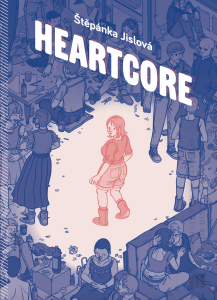
The artwork is a simplistic and smooth style – no rendering with a very limited palette. The reds stand out among the grays and gives importance and hierarchy to the items or people the comic wants to highlight. The text and narrative are very easy to read, despite how densely packed this comic is.
A thoughtful and compelling read about the lines of sex and love and where those lines interconnect (or don’t). Be mindful of its placement in your collection if you add it – the clean, uncomplicated drawings might give off the idea that the story within is simple, but it absolutely is not and it is absolutely not for children.
Heartcore By Št?pánka Jislová Graphic Mundi, 2025 ISBN: 9781637790908
Company Age Rating: 16+
NFNT Age Recommendation: Adult (18+), Older Teen (16-18) Creator Representation: Czech, Bisexual,
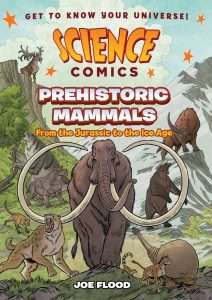
Science Comics is a long-running series, which invites a wide variety of skilled creators to explore different scientific subjects. All of the titles in the series have a certain amount of narrative story holding the information together, but some definitely lean more towards the expository, which is the case in this title
A prose introduction from Emily Lindsay, a paleontologist who works at La Brea Tar Pits, gives some context for the book, explaining the rise and extinction of megafauna and prehistoric mammals and the importance of large mammals today. Flood begins the narration with an iconic sequence of panels showing a line of mammoths tramping across a glacier in Siberia, where they are then attacked by a pack of cave lions and one young mammoth plunges into the icy water below.
He uses this sequence to kick off the basic concepts being introduced in the book, showing the modern relatives of mammoths and cave lions – elephants and African lions – and then jumping back to the origin of mammals and their gradual development over millions of years. These pages are filled with neatly drawn charts of evolution and cartoon creatures in bright colors who comment on each other’s adaptions with jokes.
Flood helps readers follow the evolutionary development of mammals with a yellow diapsid, “Dia” and a red synapsid, “Sid.” Eventually, Dia evolves into the dinosaurs, eyeing Sid hungrily, while Sid evolves into the early mammals, brownish-yellow, blue, and purple creatures. In the next big extinction, Dia’s survivors shrink down to a feathery yellow bird while Sid returns to his red, basic mammalian form. Flood’s color-coded animal adaptations make it easy for young readers to follow the complex concepts of evolution and adaptation over the huge periods of time represented.
The story next moves on to the Cenozoic, the age of mammals. Flood illustrates the early mammals in soft browns and grays with faint black patterns, setting them amidst lush green jungles and forests. This morphs into the more colorful variety of mammals we’re more familiar with today, as well as gradually diversifying plant life, with colorful flowers, birds, insects, and more. Dia and Sid continue to show up—Dia staying in her yellow bird form while Sid changes frequently, although generally keeping to a four-footed, small red mammal shape.
Flood continues the story, showing how the changes in climate and habitat prompted evolutionary changes in mammals and drawing more and more parallels between prehistoric and modern creatures as evolution progresses. The original red of Sid the synapsid shows up again here, in the arrows and charts, while extinct animals are generally shown in plain greys and browns, allowing the animals who have contemporary survivors to show up more clearly in the artwork.
Sid shows up again, illustrating the evolution of herbivores from small to large, to survive the large carnivores. Dia flies along above a fleeing Sid, making comments on the predator and prey racing about. The two follow along as the story nears the modern day, showing the niche animals that evolved on the now-distinct continents and the convergent evolution of different species. When the narration reaches the ice ages of the Pleistocene, Flood steps away from animals in a spread to illustrate the climate changes with blue and green diagrams and a fiery sun shooting rays of orange and red toward earth.
The narrative begins to return to the introduction, showing the migration of mammoths and describing the La Brea Tar Pits, as well as introducing the evolution of a new mammal – humans. Sid and Dia show up again, watching the arrival of humans. Flood illustrates the changing evolution of different human species, showing a variety of darker skin colors, postures, and hair textures. He has a distinctive style when drawing human faces and this begins to show up in this last section of the book, with larger eyes, square, blocky hands, and thick lips. The story ends with a discussion of the current extinction event we are living through and the effect it has on mammals, including humans.
Flood has written or illustrated several other Science Comics titles and his blocky, simply style with lightly humorous touches and clear, simple diagrams is well-suited to the series. He does an excellent job in this title of connecting the complicated and wide-ranging topic together, moving between epochs and eras and tying the exposition together with narrative touches from beginning to end. The text is very readable, although the number of Latin species names may daunt some young readers. However, those who are interested in prehistoric life will be generally familiar with the nomenclature and the text is very understandable even if readers stumble over some of the names. This is another excellent entry in a strong series that should be represented in all public and school libraries.
Prehistoric Mammals From the Jurassic to the Ice Age By Joe Flood Macmillan First Second, 2026 ISBN: 9781250868428
NFNT Age Recommendation: Middle Grade (7-11), Tween (10-13)
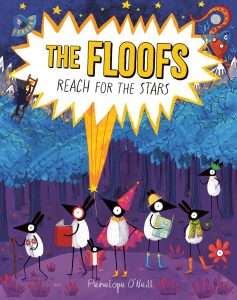
This quirky debut comic comes from the UK. Creator Penelope O’Neill has dreamed up a gentle, odd world with small creatures who go on surprising adventures.
The book begins with a map, showing a green island against a blue sea. Landmarks, and each Floof’s special home or place, are marked on the map. Next, O’Neill introduces the cast—each Floof has a long, pointed, mouse-like head, two rabbity ears, cotton fluff body, and stick legs and arms. But each is given a unique twist, both in their description, “Loves fashion” or “Organized” and in their accessories and size. There’s also a guest appearance by Mika, a puffy blue creature who lives in the mountains. There are three chapters or adventures – each is introduced by a simple, four panel comic.
In the first story, Wizard decides to work a special spell and calls his best friend, Bean, to help. But things go wrong in so many ways! Fortunately, the Floofs are ready to help and after much bickering, some complaining, and calling up the ghost of Wizard’s great, great, great, great, great grandma, the adventure ends happily. The second chapter features Dill. She loves a good adventure and finding an alien in need of help is just the adventure she’s been dreaming of – not to mention the fun of making a new friend. In the third and final chapter, readers revisit Wizard’s friend Bean. Adventures are all very well, but what she really wants is to sit quietly and read her new book. Unfortunately, whether she wants it or not, an adventure comes to her and after many strange experiences, she finally finds the perfect quiet spot to read.
O’Neill’s comics are a charming mix of text and art. A few sentences or a short paragraph every few pages provides the main narrative flow of the story while the comic panels primarily include commentary, rather than dialogue, from the Floofs. Each segment has a different primary color—Wizard’s adventure takes place mostly in deep purples and blues, as it’s a night-time adventure. Dill’s adventure starts and ends with the bright green of the park and forest, but quickly changes to the blues of the lake, as she and the alien go searching underwater on their quest. Bean’s adventure is also primarily shown in greens, but as she wanders deeper and deeper she ventures into white and gray fog, purple mountains, and the deep, dark blue of caves and the night sky.
Although at first glance this might seem like a title intended for young children, it has quite sophisticated vocabulary and humor, from the alien telling Dill it’s a hurtful stereotype to Wizard’s interactions with his peppery ancestral ghost. This reminded me vividly of Tove Jansson’s Moomins, with the slightly surreal sense of humor, longing for a quiet life, and vivid, quirky personalities of the various characters. O’Neill’s comic style is all her own though, and the odd little island world of the Floofs is a fun place to visit.
Elementary age readers who are fluent enough to follow both the art and text, and who enjoy this kind of gentle, fantastic silliness will probably enjoy this. However, I would suggest the main use for this book would be as a cozy read-aloud; its enjoyment depends more on personal taste than reading level and families who enjoy regular read-aloud sessions will find this a wonderful addition to their repertoire.
The Floofs Reach for the Stars By Penelope O’Neill Frances Lincoln Children’s Books, 2025 ISBN: 9780711298354

 After her mom dies, teen protagonist Joey is forced to move to Kodiak, Alaska to live with her dad; quite different from where she lived in Seattle!
 force behind the most famous works published by George Orwell—23rd Street Books dives into the life of Eileen O’Shaughnessy in Mrs. Orwell, written by journalist, author, and filmmaker Andrea Chalupa with art by Brahm Revel.
 Guardians: rare kids who have tiny magical companions called Guardian Characters, which grant special powers. In fact, where most Guardians have a single Guardian Character each, Amu has four. Perhaps it’s no surprise that she is chosen for a special mission: unraveling a mystery at a prestigious but strange middle school called Arcana Academy.
 Such is the way of legends.
 They make the scene. They go backstage. They enjoy the drugs and the bands just passing through. Every night is a new party. Every party is a new adventure.
 with superpowers actually exist and save the world on a regular basis. Comics like Kurt Busiek’s Astro City have discussed what it’s like for mostly regular people to live in a world populated by people with powers, but Athanasia written by Daniel Kraus and illustrated by Dani, takes a much darker look at this concept. It not only explores what happens to superheroes who have lost their lives but what their remains mean for those with more earthbound problems.
 low numbers of yetis, she’s convinced her parents to turn it into Camp Monster and welcome everyone, but things don’t go as expected.
 relationships. How do we form preferences? What do our preferences say about our personal character? How are we informed about our identities? How do our identities dictate our roles in society? And, more importantly, how do we rebel against those dictations?
 titles in the series have a certain amount of narrative story holding the information together, but some definitely lean more towards the expository, which is the case in this title
 go on surprising adventures.
