
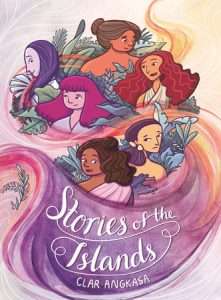
 Clar Angkasa skilfully breathes new life into three traditional folktales from her native Indonesia, offering a fresh look from the perspective of her female characters. In these retellings, her female protagonists are the ones with power and agency as they defend and defeat attacks against them physically and psychologically.
The first story, “Keong Mas,” revolves around two competing princesses as they combat selfishness by employing magic and, over time, selflessness. When the proud one is turned into a snail and regretfully thrown away by her younger sister, she is rescued by a fisher woman who teaches the princess the meaning of compassion, friendship, and, ultimately, affection. This is done through flashbacks of the backstory and there is an element of mystery concerning the identity of the person transformed into the snail. The flashbacks are established with muted colours while the palate of most of this tale is primarily shades of purple and gold.
The second story follows two sisters as well, but in this case, they are younger, the best of friends, and stepsisters. Bawang Merah and Bawang Putih develop a deep attachment to each other as well as their individual stepparents, but when the mother dies, the beloved father becomes despondent and angry, so much so that he is dangerous to both of the girls. When they meet a helpful stranger in the forest, they are offered a pumpkin containing a fortune. This fortune does not ease their situation, but it does release them from the inertia and hopelessness of their father’s heartbreak. Along with the purples used in the first tale, this story is augmented with shades of green and brilliant reds.
“Timun Mas,” the final story, is about a young woman who is a healer and horticulturalist living by herself and selling her seeds and natural medicines in the market. One day, to her horror, she is confronted by a giant who commands her to plant a magic seed that will produce a “fruit” he will claim when he returns in 17 years. Reluctantly, she plants the seed in her garden and grows . . . a young baby from a cucumber plant. She names the child The Golden Cucumber, or Timun Mas. The years pass by much too quickly. But before her daughter’s seventeenth birthday, mother and daughter concoct a plan to defeat the giant and his plans. This story’s palate shines with shades of greens and browns.
All three tales celebrate the rural lush landscapes of Indonesia, local customs and traditions, and magical forces and strong female characters through the colourful, cartoon-like illustrations. The panels are bursting with flowing patterns, fonts, and dialogue, adding an additional dimension to the visual telling of the three tales. There is a feeling of joy interspersed with the danger of the situations the protagonists find themselves caught up in through, for the most part, no fault of their own. The swirling panels, the colours, and the expressive features of the characters all add to an enjoyable adventure for the reader.
In the author’s note following the three stories, Angkasa explains her rationale for reworking these particular tales, focusing on feminine matters and issues ahead of the masculine focus of the traditional tales. She briefly explains why these three stories were chosen for the book before providing the texts for the original folktales. As a storyteller I would have also appreciated definite source notes for these tales, but understand that she is providing the texts that she is familiar with herself.
Highly recommended for the intended readership of 8- to 12-year-olds as well as adult readers who enjoy a well adapted tale that, while including some familiar tropes and motifs, will possibly be new to them too. Perfect for school and public library folklore collections.
Stories of the Islands
By Clar Angkasa
Holiday House, 2023
ISBN: 9780823449781
Publisher Age Rating: 8-12
NFNT Age Recommendation: Adult (18+), Middle Grade (7-11), Picture Books (3-8)
Creator Representation: Indonesian
Character Representation: Indonesian, Asexual

