
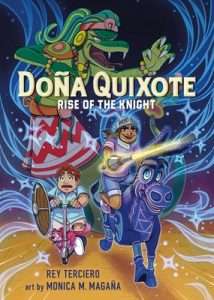
 Lucia Castillo wants more than anything to be a knight like her abuelo. Before he disappeared, he would tell her stories about fighting “monstruos y fantasmas y demonios” to save and protect those in need. Lucia is one of the only ones who believed him—the rest of the town called him “Abuelo Loco.”
Lucia’s determination to live her life by the knight’s code often gets her in trouble. She has a tendency to jump headlong into situations based on snap judgements, rather than taking the time to see what’s really going on. And that was before she found her grandfather’s magic helmet, which allows those of her bloodline to see ghosts, duende, and other supernatural creatures from Latin American folklore. She and her friend Sandro are certain the Mayor is up to no good, but how is Lucia supposed to convince the town to trust her? And perhaps more importantly, how can Lucia be sure she’s trusting the right people (or creatures) and not jumping to the wrong conclusions again?
Doña Quixote: Rise of the Knight describes itself as a, “contemporary graphic novel retelling of Don Quixote.” It is not. At best, it is a contemporary graphic novel that makes a couple references to Don Quixote. Teachers looking for an example of a good retelling or adaptation should probably pass this one by, but the distinction likely won’t matter much to its intended audience, who are less likely to be familiar with Don Quixote in the first place. In Doña Quixote, readers can learn about a variety of mythological creatures alongside Lucia and Sandro, like Duende, gnome-like creatures that clip children’s toenails while they sleep (to be helpful) and Sisimito, a Mexican Bigfoot who can’t resist a dance-off, even if his backwards feet mean he isn’t very good at it.
As far as the writing goes, the story is fairly simplistic and the characters are pretty much stereotypes—Lucia wants to be a knight, but is terrible at helping people and Sandro wants to do ballet, but his dad and brothers think it’s too girly. Learning about different supernatural creatures is definitely the best thing Doña Quixote has going for it. Were that all, I would say Doña Quixote: Rise of the Knight is a fairly mediocre middle grade graphic novel.
Unfortunately, the art of Doña Quixote: Rise of the Knight isn’t doing it any favors. The art style itself is flat and round, making all the figures look somewhat squished. (“Potato people” is what one fourth grade patron called them, while looking over my shoulder, and I can see where he’s coming from.) The color palette is incredibly loud, saturated, and unpleasant to the eyes. On many pages, the panels are so overloaded with colors and patterns that the eye doesn’t really have anywhere to land. The shading on figures’ faces is also incredible dark. Magaña is very heavy handed when it comes to shading every wrinkle on older characters’ faces to the point where it becomes hard to make out Abuela’s expression in several panels that should be emotionally significant. Because of how much the art decision affects Doña Quixote: Rise of the Knight’s readability, I would not recommend it to first time graphic novel readers or those with sensory processing issues. In fact, I simply wouldn’t recommend it.
Doña Quixote: Rise of the Knight
By Rey Terciero
Art by Monica Magaña
Henry Holt and Co., 2023
ISBN: 9781250795472
Publisher Age Rating: 8-12
NFNT Age Recommendation: Middle Grade (7-11), Tween (10-13)
Creator Representation: Latine
Character Representation: Latine

