Octopus Pie: There Are No Stars In Brooklyn is the first collection of Merideth Gran’s web-comic of the same name. The comic follows the life of Eve Ning, her pot-smoking roommate Hanna, and a constellation of supporting characters.
We first meet Eve as she and her boyfriend are breaking up:
Setting – Eve’s Mom’s House: Eve, James, and Eve’s Mom are sitting in the living room. James has just broken up with Eve over the phone, but still won’t leave.
James: And I mean, the fact is that billions of universes exist where Eve and I aren’t dating. We mainly exist to be broken up forever, y’know? And like you can totally apply that to life and death …
(His words continue in the background while Eve gets more and more upset and her mother looks more and more entertained. Finally, Eve gets up and takes James’ arm).
Eve: All right, Steven Schpielberg. Out we go.
James: But I’m not done Schpieling!
Eve (pushing James ahead of her): Don’t be silly. You’ve already shown me the light!
James: I have? Really?
Eve (slamming the door behind him): Hell yes. No more existential boyfriends!!
Mom: Not even in the multiverse?
Eve: Never!
Eve and her friends are twenty-somethings navigating post-college life with varying success. The book is divided up into chapters, each one following a distinct story.
I had a few issues with this series. The drawings are simple line drawings. I found them to be a little too simple, often having trouble finding ways to distinguish the characters from one another. I also found the story lines a little disjointed. The comic is divided up into chapters each telling a different tale from Eve’s life, but each individual storyline did not always flow well for me. The beginning can feel a little disconnected from the end of the story or the punch line gets a little lost, leaving the reader wondering if they had missed something. I chalked most of this up to the serial nature of its publication. That is, rather than being a novel that an author could revisit and re-edit, once a strip is published, the author cannot go back and re-work any choppy plot lines.
But by far my biggest issue with this comic is that it is about hipsters. I didn’t know about hipsters before I read the comic. Many of the ways the people in the comic talked and comments they made mystified me. So I started doing my research (including asking my sister, who is always up-to-date on pop culture). I went to the Octopus Pie web site to read more about the characters. I got my teenagers to read the comic (they were uninterested).
Matt Granfield, in his book HipsterMattic, defines hipsters in this way:
“While mainstream society of the 2000s had been busying itself with reality television, dance music, and locating the whereabouts of Britney Spears’s underpants, an uprising was quietly and conscientiously taking place behind the scenes. Long-forgotten styles of clothing, beer, cigarettes and music were becoming popular again. Retro was cool, the environment was precious and old was the new ‘new’. Kids wanted to wear Sylvia Plath’s cardigans and Buddy Holly’s glasses — they reveled in the irony of making something so nerdy so cool. They wanted to live sustainably and eat organic gluten-free grains. Above all, they wanted to be recognized for being different — to diverge from the mainstream and carve a cultural niche all for themselves. For this new generation, style wasn’t something you could buy in a department store, it became something you found in a thrift shop, or, ideally, made yourself. The way to be cool wasn’t too look like a television star: it was to look like as though you’d never seen television.”
So Eve works at an independent organic food store and her friends reject pop and consumer culture. Putting aside my personal feelings about hipsterism, this is an adequate comic. It did not blow me away with art or well-constructed plots, but it is a relatively new comic and I have confidence that Gran will improve as she gains experience. It’s just that the comic is really targeting a very specific market.
I’m sure the hipsters would be pleased with my lack of “getting it”. After all, I’m not supposed to.
Recommended for hip teens and young adults (occasional nudity, lots of pot, swearing)
Octopus Pie: There Are No Stars In Brooklyn by Merideth Gran ISBN: 978-034552043 Village Press, 2010 Publisher Age Rating: teen
Manga is an art and like any art form it requires practice and guidance. Although I am not someone who draws, I enjoy reading books about how to acquire the needed skills to become a comic artist. It’s always a topic that was in demand among the manga fans at my library, many of whom dreamed of becoming manga artists themselves.
Those who have worked their way through basic “how to draw” books and easier guides to creating comics are probably looking for a more in-depth instructional manual. Digital Manga’s How to Pen & Ink is certainly in-depth, though it narrows its focus almost exclusively onto the skills of inking a comic, so readers are expected to have a foundation of drawing skills, knowledge of basic art terms (perspective, etc.), and an understanding of how manga works. Readers that have that will find How to Pen & Ink a useful tool.
The book starts with a close up examination of how manga artists Oh!Great (Tenjo Tenge), Satoshi Shiki (Kami-Kaze), and Yasuhiro Nightow (Trigun) build a scene. In addition to photographic guides, the manual also interviews all three about the tools they use, their drawing process, how they get ideas, etc. Following that are three especially useful sections. The first talks about the process of moving from drawing doodles to creating characters to building scenes for those characters….
Was your artwork stolen just before the school art show? Did a thief try to take your new stereo? Are you being blamed for scratching a friend’s new CD? Never fear, help is on the way! Max Finder and Alison Santos, the stars of OWL Magazine’s popular graphic novel mystery series, are here to help. Using keen eyes, sharp minds, and logical thinking they’ll solve any crime that comes across their path.
O’Donnell’s mystery series is the perfect read for kids who love Encyclopedia Brown, but also enjoy comics. In this collection, Max and Alison solve ten cases revolving around the people in their town. The cases are all four pages long, making them perfect to pick up and sample at leisure. Both boys and girls should enjoy the stories as each of the two detectives has their moment to shine, so even though the series is named for Max, it’s obvious that they are equal partners. The other kids in the town are regular participants in the mysteries, allowing readers to get to know them. Though those characters are slightly stereotypical–there’s the girly girl, the athletic boy, the nerd, the bully–they don’t always fall into the roles expected of them when it comes to the mysteries. Allowing the meeker kids to be the criminals and the bullies to be innocent is a good technique for keeping the story fresh.
Stories can make you sigh for all sorts of reasons. Frustration, contentment, resolve. Angelica and the Bear Prince, published by Random House Graphix in October 2025, pulls a deep, comforting, swoon-like sigh from the reader, at least this reader. This is a cup of cocoa of a graphic novel. A warm, joint popping hug of a graphic novel. A fully broken-in hoodie of a graphic novel. It’s the best kind of sweet, romantic, comfort read.
Angelica and the Bear Prince, author/illustrator Trung Le Nguyen’s follow up to the award winning The Magic Fish, is a very loose reimagining of the Norwegian fairy tale East of the Sun and West of the Moon. It follows Angelica, Jelly to her friends, who is picking herself back up after hitting a pretty serious burnout wall. Jelly is an over-achiever and a people-pleaser who got so wrapped up in her desperation not to disappoint people that she ran herself right into the ground.
With perfect timing for her to realign herself, Jelly gets an internship at the theater company that was her happy place as a child. She gets to spend the whole winter stage managing her favorite play with her best friend Christine who is starring opposite the play’s lead and the theater’s mascot Peri the bear in Jelly’s favorite play. The mascot whose social media account Jelly has developed a pen pal style relationship with. The mascot who is embodied by a figure from Jelly’s past who is desperate to reconnect with her. The reveal here and the shift in their relationship takes a while to develop but is so, so satisfying.
Per Nguyen, this is a story about grief and it drips off every page. The grief that comes with growing up, grief of mourning a loved one, grief of dealing with mental health struggles. And with all that heaviness, this is an incredibly light, hopeful graphic, partially because of Nguyen’s stunning art. The illustrations are like a manga processed through a Disney lens, giving the graphic a bright, beautiful flow that is incredibly easy to read. The characters feel lived in and real and their hopes and struggles are incredibly relatable. The story is romantic and sweet and so beautifully told.
One of my favorite things about this graphic is that all the characters are given room to grow. So frequently in stories like this anyone who is not the central romantic couple just fade into the background, but Nguyen doesn’t fall into that. Jelly’s mom, still mourning the loss of her own mother, is anxious and uncertain and desperate to help her daughter grow while keeping Jelly her little girl. The stern manager of the theater is learning how to keep loving after their own loss and massive life changes. Christine, who easily could have been relegated to the barely-seen-best-friend role or the focus of Jelly’s jealous for landing the lead role of the Princess in the play, is a ride or die bestie throughout both being there for Jelly to lean on and going to her for support when she realizes her relationship isn’t what she deserves.
Angelica and the Bear Prince is such a lovely, cozy graphic. Teens and preteens alike can easily get wrapped into the romance and coming of age elements of the story and the focus on transformation and growth. It’s a legit pleasure to read.
Angelica and the Bear Prince By Trung Le Nguyen Penguin Random House Graphic, 2025 ISBN: 9781984892669
Company Age Rating: 12+
NFNT Age Recommendation: Older Teen (16-18), Teen (13-16), Tween (10-13) Creator Representation: Vietnamese, Nonbinary , Character Representation: South Asian, Trans, Anxiety, Depression
Jesus “Chuy” Reyes, age 12, starts the story by introducing himself and his best friend, Yael Levy or Yaya. Chuy is super smart and fascinated by all things intellectual—Yaya is a hands-on inventory and can make anything, even if she is a bit goofy at times. When a comet strikes earth and people gain mysterious powers, Chuy is super bummed – not only do these powers not conform to scientific laws, but he didn’t get any! When one of the second-rate supervillains of New Bork City ruins their ice cream, Yaya makes up her mind – they will become superheroes! With Chuy’s smarts and Yaya’s maker skills, the two take on Mr. Anti-Freeze, who is threatening to slimerize all the ice cream in New Bork City!
Florentine’s illustrations are bright and cheery, with lots of primary colors and drawn with clean, sharp lines. Chuy has brown skin, heavy eyebrows that move dynamically to indicate his exasperated moods, including up onto the outside of his pink baseball cap, and square glasses. He’s a tall, sturdy kid who gets a little excited about intellectual pursuits, but otherwise is mostly dragged along by the exuberant Yaya. Yaya, a skinny kid with short blue-black hair, is wildly enthusiastic about everything from superheroing to ice cream, despite the more cautious Chuy’s warnings and her younger brother’s embarrassment. Her family home is decorated to show her Jewish culture and Yoel, her younger brother, wears a kippah. Their villain has brown skin and pink hair.
The story is fairly simple, interspersed with lots of helpful (and random) facts from Chuy and step-by-step guides to making things from sorbet to grappling hooks from Yaya. The story ends with character studies and links to websites with guides for young makers.
Superhero take-offs like this tend to be cheesy, but this story is fully aware of its silliness and plays it for all it’s worth. Chuy’s repeated complaints that he’s NOT a superhero, the ridiculous villain, and Yaya’s wild enthusiasm will make readers giggle along with the author and maybe catch the making bug, even if they don’t want to put on a costume or have a super-powered bag to hold all their tools. While this is unlikely to satisfy readers who want “real” superheroes, it will certainly please younger readers who like funny stories and are interested in hands-on building. A must have for libraries and schools that include a maker space.
Maker Girl and Professor Smarts Vol. By Jasmine Florentine Candlewick, 2025 ISBN: 9781536239584
NFNT Age Recommendation: Easy Readers (5-9), Middle Grade (7-11)
Classic Fantastic is our series of features on the classics of the format—please check out our other picks for the most important titles, in terms of appeal, innovation, and storytelling, that every library should own. What’s it about? In the DC universe, Leonard...
These are the first two entries in a new series for transitional and beginning readers which has an interesting take on the classic odd couple trope of easy readers. In the first book, Duck Moves In! Moose’s search for piece and quiet is disturbed by the advent of Duck. Duck, who has been searching for a “forever home” has found it—on Moose’s head. Moose is horrified and over the course of several chapters makes increasingly desperate attempts to relocate Duck. However, the two finally work out a compromise and discover common ground, whereupon they declare each other friends.
In their second adventure, Moose Blasts Off, Moose is playing his favorite imaginary game of Astronaut when Duck interrupts and wants to play too. Moose is happy to teach Duck how to use his imagination—but less pleased when Duck’s imagination starts changing Moose’s beloved game. After a brief argument, Moose realizes it might be fun to try something new and the two start using their imaginations together.
Reedstorm’s art style is bold and simple enough for a transitional comic, but has enough subtle detail and hidden jokes to intrigue more fluent readers and to make this work as a read-aloud. Moose has dramatic big eyes and one-dimensional antlers which serve as a back drop for the green-headed Duck whose orange beak mirrors Moose’s bigger snout and mouth. As the action in each story increases in pace and intensity, the panels become crowded with Duck’s household belongings and imaginary characters until each story explodes in a final confrontation and reconciliation. The panels vary in size, but generally either fill a whole page or divide it into an upper and lower panel, allowing young readers to easily follow the action. The exaggerated expressions of the characters are also a helpful aid for kids learning to follow both visual and textual cues through the story. Reedstorm’s art is especially interesting in the second story, where he differentiates between the two friends’ imaginary creations by putting them in speech bubbles and giving them a slightly glassy look and a blue or yellow tinge. When the two join forces, their creation is green, joining the two imaginations together.
I’m wary of easy readers using the classic odd couple trope since many of them provide very poor models for friendship, pairing one animal who refuses to respect boundaries or is wildly extroverted (like Duck) with a more introverted character (like Moose) who mysteriously decides to be friends and let the other character use them. This is where Reedstrom carefully crafted mix of art and story shine; while keeping plenty of humor in the contrast between the two characters, and emphasizing their differences as well as their similarities, he also models healthy friendship models. When Moose reaches breaking point, Duck respects his boundaries—and points out that he just has to use his words for what he needs from Duck.
While it’s unlikely that any new series will hit Elephant and Piggie heights any time soon, this is a worthy successor and a strong purchase for any libraries that want to build their transitional and easy graphic novel collections.
Duck and Moose Duck Moves in! Vol. By Kirk Reedstrom Disney-Hyperion, 2024 ISBN: 9781368097277
Batcat, a roly-poly, plump, and pink creature with no tail, pointed ears, and magenta bat wings, lives in a tree house and they are just fine all by themselves, playing video games, eating fast food, and watching the stars. Alone. Just the way they like it.
Then, one day, a ghost shows up. Batcat is shocked, annoyed, and extremely displeased, so they travel to the friendly neighborhood witch for a solution. From there they set out on a quest for ingredients for a potion that will solve all their problems. It turns out to be a difficult and miserable journey, especially when Batcat encounters bats and cats, neither of whom are willing to accept them. Exhausted mentally and physically, Batcat makes it back to the witch with the ingredients, only to be faced with the challenge of deciding exactly what they want to do with the ghost in their house and their life.
Ramm’s goofy cartoon art sends grumpy Batcat fluttering through caves, with a host of purple-black bats who don’t find Batcat quite batty enough, through a cemetery of selfish cats who definitely do not think Batcat is catty enough, and through encounters with skeletons, griffins, and other magical creatures. Along the way there is confetti, explosions, and longings for fast food, jokes, hijinks, and lots of pink, purple, and turquoise puffy art.
Meggie Ramm, who uses they/them pronouns like their creation, which was built from short cartoons they drew for elementary kids during comic classes, makes a central point of Batcat’s duality. They are frustrated and hurt by the bats and cats who insist they be one thing or the other and not their own, unique amalgam of both bat and cat. In the end, Batcat develops empathy for the ghost (whom they have been thinking of as merely obnoxious) and realizes they too might have different sides to their character. It’s difficult to fit a lot of emotional nuance into a short comic book for kids, but I was frustrated that Batcat at no point tried to communicate with the ghost about their feelings, even when they returned, they just suddenly accepted them as a roommate. I think a lot of early elementary books, especially those that push heavily on the “odd couple” friends trope like Frog and Toad, are guilty of one-sided relationships like this and don’t really teach kids that it’s ok to be an introvert, want to be alone, or not be friends with someone who annoys and bothers you. This is definitely an adult perspective, and a somewhat personal one, but it definitely threw me out of the story and made me disappointed with the ending.
Despite my own objections, this is a cute story, specifically encouraging young readers who may feel they don’t fit any single mold, and encouraging everyone to see things from other perspectives. This will be popular with fans of Yi’s Cat & Cat and stories of cheerful grumps like Cranky Chicken, and makes a nice addition to early elementary graphic novel collections.
Batcat By Meggie Ramm Abrams Amulet, 2023 ISBN: 9781419756573
Publisher Age Rating: 6-9
NFNT Age Recommendation: Middle Grade (7-11) Creator Representation: Nonbinary Character Representation: Nonbinary
Promotions for this new comic series proclaim it to be the new Dog Man, which is certainly over-ambitious for what it offers. However, its silly humor will please many intermediate comic readers.
The Bumble brothers, Christopher and Walter, are biracial twins and, as the story begins, their goofiness is firmly established. They wake up on a Saturday morning and go into a panic because a cloud moves in front of the sun, making them think it has disappeared. This is especially traumatic because it’s the day of the release of a new issue of their favorite comic series, starring superhero Frabbit. After various nonsensical antics, they make their way to the dining room and their parents, who are too busy arguing about the boys’ baby pictures to fix them breakfast. After a short interval, the boys are sent to the store by their mother to buy milk. At first, she tries to request “ultra-pasteurized, homogenized, glorified, rarified, purified and liquified with vitamins A and D added” but quickly gives up and just gives them two dollars for milk. Naturally, the boys forget their task as soon as they get out of the house and start getting into various shenanigans, leading them to end up at the comic shop buying the latest issue of Frabbit. More shenanigans ensue, ending with them returning home sans milk and comic, but all is not lost, as Papa Bumble comes to their rescue.
Schatell is an experienced illustrator of picture books and easy readers, and moves easily to the graphic novel format with a classic cartoon style. Both brothers have light brown skin, Christopher has curly hair and a buck tooth and tends to be goofier than his brother; Walter has straight brown hair and glasses. A few other people, including their parents, are shown, and the others mostly are brown-skinned as well. All are the classic expanded stick man pose, with skinny legs and arms, simple shapes for feet, four-finger hands, and pinpoint eyes, although Walter’s are are dots in his oversized glasses. Frabbit, their favorite superhero, makes frequent appearances and is depicted with the top half of a white rabbit, including a buck tooth and long ears, and the bottom half of a frog, with two giant green feet. The adults the boys come into contact with are generally resigned to their silliness, unless, like Papa Bumble, they share in the goofiness themselves.
There is a typo on page 7, but the the book has a firm binding, especially for a paperback, and is reasonably priced. The reading level and nonsensical “plot” would make this, in my opinion, more suited for younger readers, those just graduating to chapter books. It’s most similar to the intermediate easy reader Noodleheads series based on “fool” type fairy tales in graphic novel format illustrated by Tedd Arnold. Older readers, even Dav Pilkey fans, are apt to require more actual plot from their reading. However, there is no potty humor or violence, other than some squabbles between the boys, so it may be an alternative for libraries needing graphic novels without Pilkey-style anarchic humor. Purchase where Noodleheads books are popular and more bland fare for intermediate readers is needed.
Bumble Brothers: Crazy for Comics By Steve Metzger Art by Brian Schatell Reycraft, 2022 ISBN: 9781478875840
Publisher Age Rating: 4-8 years old NFNT Age Recommendation: Easy Readers (5-9)
Really Bird promises to deliver surprise twists, high drama, and a lot of laughs, but it falls flat.
This story begins with an introduction of our three main characters. Really Bird, our protagonist who really wants to be first and his friends, Pup, and Cat. They banter back and forth through a couple of different scenarios like climbing up a tree. This situation is pretty unfair to Pup, the dog, who isn’t not only not good at climbing, but he’s terrified about being up on top of a tree. Really Bird has Cat help Pup down and then Cat celebrates herself for helping Pup. Pup is the only polite and considerate character in this book, as we see him say thank you to Cat for helping him down from the tree that he was peer pressured to climb up.
Next, we see the characters argue about who was first on the ground. This short story concludes with Really Bird declaring that he was first, and that he is going to be the leader to take them all home. Really Bird wraps up this tale by happily announcing that he wanted to be first today and he was.
This was a very poorly written book. It delivers a terrible message to young readers and fails to hold your attention despite it being such a quick read. I read this to my child and he was bored and confused with the ending. Additionally, I wish that the text used a consistent sentence case for young readers to see correctly written English, however many words or letters are capitalized when they are not part of a name or a title, for example “OKay” or “Today I really REALLY want to be First”. This may be providing a poor example for the children that this book is designed for to start learning correct sentence structure.
The artwork is very cute. The style is sure to please any child from the beginning inside cover showing our three main characters walking into the story, to the three of them leaving together on the back cover. The drawings are simple, cute and have a bright color theme throughout. This is a picture book, so there are no panels or typical graphic novel page organization. Lastly, the text is a cute, but a large and easy to read font.
Overall, this book shows selfish characters getting what they want, an example of peer pressuring a friend into a dangerous situation, and celebrating getting to be first. The lesson for children to take away from this story is unclear, perhaps it’s that being first is the best? On the back cover it states that, “Really Bird adventures deliver surprise twists, high drama, and a lot of laughs. Friendship and emotional learning are at the heart of every book.” I missed where there was a plot twist, as the plot was completely predictable, there were absolutely no jokes or obvious humor, and I hope that children don’t learn anything about how to treat others in friendship from the examples in this book. As an avid reader, mother, and librarian, I have read thousands of picture books and this one unfortunately, I couldn’t possibly recommend.
I Really Want to Be First!: A Really Bird Story Vol. 1 By Harriet Ziefert Art by Travis Foster OtherRed Comet Press, 2022 ISBN: 9781636550183

 Octopus Pie: There Are No Stars In Brooklyn is the first collection of Merideth Gran’s web-comic of the same name. The comic follows the life of Eve Ning, her pot-smoking roommate Hanna, and a constellation of supporting characters.


 Random House Graphix in October 2025, pulls a deep, comforting, swoon-like sigh from the reader, at least this reader. This is a cup of cocoa of a graphic novel. A warm, joint popping hug of a graphic novel. A fully broken-in hoodie of a graphic novel. It’s the best kind of sweet, romantic, comfort read.
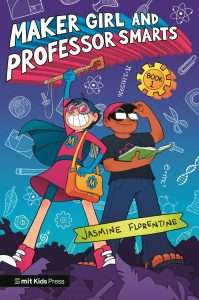 fascinated by all things intellectual—Yaya is a hands-on inventory and can make anything, even if she is a bit goofy at times. When a comet strikes earth and people gain mysterious powers, Chuy is super bummed – not only do these powers not conform to scientific laws, but he didn’t get any! When one of the second-rate supervillains of New Bork City ruins their ice cream, Yaya makes up her mind – they will become superheroes! With Chuy’s smarts and Yaya’s maker skills, the two take on Mr. Anti-Freeze, who is threatening to slimerize all the ice cream in New Bork City!
 classic odd couple trope of easy readers. In the first book, Duck Moves In! Moose’s search for piece and quiet is disturbed by the advent of Duck. Duck, who has been searching for a “forever home” has found it—on Moose’s head. Moose is horrified and over the course of several chapters makes increasingly desperate attempts to relocate Duck. However, the two finally work out a compromise and discover common ground, whereupon they declare each other friends.
 Batcat, a roly-poly, plump, and pink creature with no tail, pointed ears, and magenta bat wings, lives in a tree house and they are just fine all by themselves, playing video games, eating fast food, and watching the stars. Alone. Just the way they like it.


