Going viral can be a one way ticket to fame … or a gut punch about how the rest of the world sees you. In Maysoon Zayid and Shadia Amin’s Shiny Misfits, Bay Ann discovers that even when she’s showing off how talented she is, many people can’t see past her disability. Can she one up the sudden fame of her former crush turned archnemesis?
A few things about Bay Ann Musa: she won’t eat any food with a face, she has the best friends in the world, she walks her pet cat Lucy (who speaks to her privately in rhymes) in a stroller, and she loves to perform. For this year’s talent show, she’s created a zombified tap dance routine called “Broadway Zom-by” and, as expected, comes in first place. As she soaks in all the praise of the adoring audience, the swoon worthy Alyee Maq gives her a kiss, causing Bay Ann to start to fall, only for Alyee to catch her and save the day.
When the video of Alyee catching Bay Ann goes viral, Alyee is hailed as a hero for saving a “special girl” and making a “sick girl’s dream come true.” Yes, Bay Ann has cerebral palsy, but she’s certainly not dying! She won the talent show! But no one can focus on that and she starts to notice the world sees her only as her disability, not the tap dancing talent show winner that she is. She makes it her goal to prove she’s the best and deserves her own fame, without anyone saving her.
Shiny Misfits is an Own Voices story. Like Bay Ann, Maysoon Zayid is Arab-American, Muslim, and has cerebral palsy. Zayid’s voice is very strong in her writing, with her comedy skills shining through. When things go wrong for Bay Ann, they usually go comically wrong, so there is a lot of humor in this story. Young readers who want their own fifteen minutes of fame will be inspired by Bay Ann’s dedication. Her relationship with her parents, who are divorced and are two very different forces in her life, is a particular highlight of the storytelling.
Readers looking for a story heavily focused on cerebral palsy or disability in general may find themselves disappointed. Being disabled is just another thing about Bay Ann and not a large part of the narrative. Instead, her friendships, her interactions with the adults in her life, and her desire to be famous on her own terms show the type of girl Bay Ann is. She’s not a perfect protagonist but it’s clear that’s now the intention of Shiny Misfits. Readers looking for a fast paced graphic novel should also pass on it; the story takes time to build up. A positive of that is that the book leaves the reader feeling like Bay Ann, impatient as she waits to get her revenge and go viral.
Shadia Amin’s art is joyful and expressive. The emotions on Bay Ann and the other characters’ faces are obvious before you even read the text. Plus, Lucy the rhyming cat is super cute. The graphic novel’s coloring, by Elle Pierre, is vibrant and colorful, bringing this memorable story and cast of characters off the page.
Middle grade readers who like graphic novels with plucky protagonists, like the Sanity and Tallulah books, or ones where friendship helps drive the story, like the Paws series, will enjoy Shiny Misfits. Zayid’s voice is distinctive and fun—the graphic novel world needs more characters like Bay Ann and her friends.
Shiny Misfits By Maysoon Zayid Art by Shadia Amin Scholastic GRAPHIX, 2024 ISBN: 9781338752502
Publisher Age Rating: 8-12 NFNT Age Recommendation: Middle Grade (7-11), Tween (10-13)
Creator Representation: Palestinian-American, Muslim, Cerebral Palsy Character Representation: Cerebral Palsy, Muslim
Kacie can find everything (and everyone) she needs on Mercer Street, the center of her familiar town. But when things change over her summer vacation, she’s determined to get to the bottom of it. Booki Vivat’s Meet Me on Mercer Street is a story about how suddenly a space can change and how a community can come together to embrace both the old and the new.
A budding artist, Kacie notices everything around her, even the things that people don’t say out loud. It feels like she knows everyone in her neighborhood and they know her, thanks to her parents’ dry cleaning business on the busy corridor of Mercer Street. It’s also where she met her best friend Nisha whose parents own Khanna’s Grocery and Deli, right down the block. They usually spend every summer together, but this year, Kacie’s parents sent her to spend the summer with her cousins. She can’t wait to catch up, but when she gets home, there’s no trace of Nisha. She’s not answering her messages and Khanna’s is gone!
Undeterred by the lack of information, Kacie makes it her mission to find out where Nisha went and what’s going on in the neighborhood. There’s a new store, $Mart, taking over for the grocery, where the employees don’t seem to want to actually talk to anyone. There’s a new kid and his mom living in Nisha’s old apartment. Who are these people? Kacie relies on the familiarity of her neighbors to find comfort, but the change is slowly creeping up on her own parents’ business and Kacie doesn’t know what to do.
This graphic novel touches on a lot of concepts, including economic status, gentrification, community displacement, and civic engagement. Vivat excellently frames Kacie’s story as a mystery to be solved in a setting with a number of endearing characters and a neighborhood full of personality. The book would work very well as a class read or a choice for a middle grade book club; there are a lot of discussion points throughout the story and many chances for readers to think about how they’d deal with the changes Kacie faces.
The format of the book is closer to a heavily illustrated novel than a traditional graphic novel, making it a reasonable choice for readers looking to try either type of format. Vivat’s illustrations are colorful and vibrant. The characters each have a distinct look and personality that’s brought to life alongside the text. Readers with a close eye will enjoy the Easter egg homages to famous mysteries in the background of some of the pages.
Meet Me on Mercer Street is highly recommended for middle grade readers, both existing graphic novel fans and those looking to get into them. Readers who enjoy Terri Libenson’s hybrid text/illustration books like Positively Izzy will gravitate towards the similar style of storytelling found in Vivat’s latest book.
Meet Me on Mercer Street By Booki Vivat Scholastic, 2024 ISBN: 9781338788686
Publisher Age Rating: 8-12 NFNT Age Recommendation: Middle Grade (7-11), Tween (10-13)
A house can be just a place to live but a home can be so much more than that. It can be where you feel safe, where you feel loved, and where you feel comfortable. Mazie Lovie’s middle grade graphic memoir The Lucky Poor tells Mazie’s own experience growing up poor, with not always ideal living situations, until her mom becomes a homeowner through Habitat for Humanity Canada.
Mazie lives with her mom and her younger brother, Jake. They’ve lived in the Bug House, with her mom’s boyfriend, then an apartment that was way too small for the three of them. Her grandparents live on a farm nearby where she spends every weekend, the most stable and consistent home in her young life. Her grandparents have a (two room) vacation cottage home too, where Mazie gets to spend a week every summer. It’s great to live with so much family close by but when it comes to physical space, it’s not always that great.
As Mazie starts getting older, she admits to herself she needs more space, her own dedicated space without Jake barging in. Jake is autistic and it’s not always easy for Mazie to be patient with him. It’s not until she joins a group with other kids with autistic siblings that she feels safe admitting this. It’s a lot of emotions for a tween to handle, dealing with being poor and not having her own room, but Mazie knows her family is part of the lucky poor, the group of people who dance around the poverty line but always have a roof over their head.
When Mazie is 13, her mom is the recipient of a house from Habitat for Humanity Canada. The family is required to complete 500 volunteer hours and maintain the upkeep of the house. The House, as it’s referred to in the book, gives Mazie a taste of the classism that’s been lying within some of her family members. They think Mazie’s mom doesn’t deserve the house. There’s people worse off than they are, they already had a place to live, why should they get a free house? The Lucky Poor does a gentle job of dealing with these heavy topics, as Mazie looks within to try to understand why anyone would feel this way. Readers will also see how hard her mom works at being the perfect homeowner and her need to continue to prove they deserve it.
The book primarily focuses on Mazie’s family but delves more into her friendships as she gets older. The House becomes a space for community; her Girl Guides group uses it as a meeting spot and it serves as a help for other members of her troop. Readers can use the story as a kickoff to think about what their living situation means to them and how it may serve as a place beyond just where their family lives.
The story told in The Lucky Poor ties into the book itself, with Mazie deciding what she wants to do with her life as it ends. Lovie’s art style is colorful and cartoonish, reminiscent of a webcomic in the best way. It may potentially attract younger readers but the narrative of Mazie’s life is more on the older middle grade side. Readers who’ve personally experienced housing insecurity may find this graphic memoir particularly emotional at times and it could evoke big emotions in readers of any class background.
There’s a lot of heart and love in The Lucky Poor, along with potential for discussion about classism and dealing with discrimination, even from the people you love. It’s recommended for readers of other graphic memoirs for middle grade readers, such as The Tryout and Chunky.
The Lucky Poor A Habitat for Humanity Story By Mazie Lovie Iron Circus, 2024 ISBN: 9781638991250
Publisher Age Rating: 11-13
NFNT Age Recommendation: Middle Grade (7-11), Tween (10-13)
At PICA, the Peachtree Institute of Collegiate Arts, art is everything! Peachtree native Molly Bauer spent her whole life with the plan to attend the art school in her own backyard. Sure, the school isn’t perfect, but being a student there would be a dream come true for Molly. In Ngozi Ukazu and Madeline Rupert’s Bunt!: Striking Out on Financial Aid, things don’t work out anywhere near how Molly expects, so desperate times call for desperate measures…softball.
Molly wasn’t expecting to spend her first day as a PICA student at the financial aid office and she certainly wasn’t expecting to find out the scholarship she received no longer exists. How is she supposed to pay for art school now? She’s left taking on predatory student loans and pouring over ways to fund her education. Then she finds an extremely specific loophole involving collegiate sports and an often overlooked athletic scholarship! (PICA is an art school, after all.) Molly just needs to start a school softball team and win one game to get a very lucrative scholarship.
With the help of her best friend Ryan, a PICA dropout and local Peachtree legacy kid, Molly takes on the ultimate group project in the form of an art school softball team. Some of their fellow students even think it’s all just very elaborate performance art.
Bunt! is a modern graphic novel retelling of the classic ragtag sports team trying to beat the odds. The team consists of a mishmash of personalities, with, “Let’s not suck at sports!” as their initial rallying cry. Ukazu’s writing makes the team come alive; each character’s particular quirks and interests are ever present without overtaking the plot. Readers will find themselves rooting for the players and getting equally annoyed at their shortcomings. With the variety of stereotypical art school students as characters, it’s easy to find a favorite.
Rupert’s art is colorful and comical. There are panels with less obvious background action, so readers will want to keep a close eye as they read along. The character design is all very distinctive, so everyone stands out, unlike some other team books where the teammates start to blend together. Peachtree itself jumps off the pages, too.
Bunt! will find its audience in young adult readers, particularly older teens close to the characters’ ages. The bureaucracy of college financial aid is unfortunately relatable, even if Bunt! deals with it in a very silly way at times. The book also deals with the threat of colleges and universities overtaking the towns and communities they’re located in and how that affects the people who live there. There’s some light vigilante justice that might make readers question how they’d deal with a similar situation.
Readers who enjoyed Ukazu’s beloved Check, Please series will enjoy this new graphic novel of hers, with Rupert’s engaging art style. Bunt! is a recommended read for anyone who has played softball, considered themself an art student, or who loves the story of underdogs doing their best to save the day and certainly anyone who might be all three. It will be a great addition to art school library shelves.
Bunt! Striking Out on Financial Aid By Ngozi Ukazu Art by Mad Rupert Macmillan First Second, 2024 ISBN: 9781250193513
Publisher Age Rating: 14-18 NFNT Age Recommendation: Older Teen (16-18)
We’re in this together! V for victory! The onset of World War II brought a whole new way of life to the United States, one that affected everyone in many different ways. The latest addition to First Second’s History Comics series, World War II: Fight on the Home Front, written by Kate Hannigan with art by Josh Rosen, details the realities of living in America during that unprecedented time.
Readers meet a group of everyday American kids, learning to live without ice cream as part of the nation’s pursuit of freedom around the world. These kids act as the graphic novel’s narrators, taking us through the beginning of the United States joining the war as Allies after the attack on Pearl Harbor to the country’s final act of war in the atomic bomb, causing the destruction and death of thousands of Japanese citizens. The book dedicates some focus to the facts of the war overseas, but doesn’t act necessarily as a full picture of the entire global conflict. Instead, readers learn what daily life was like for the folks not fighting on the frontlines.
History Comics: World War II is full of nonstop facts. Young readers will learn the realities of rationing and how it affected Americans’ diets and cooking habits. Real recipes are even included for anyone wanting to taste the era! They’ll learn about changes in culture, like how the war popularized paperback books and superhero comics, when some of the Marvel and DC superheroes still popular today made their debuts. These facts and how they still affect our nation today could make for some spirited discussions amongst readers, especially when compared to the ongoing division of the last few years of the country’s history.
While there is a lot of fun trivia to be learned, Hannigan and Rosen don’t shy away from the uglier realities of the American homefront during the war. Readers get a brief history on Japanese-Americans being forced into internment camps, leaving everything but one bag behind. Racism against Black Americans and Latino Americans continued even as these citizens stepped up to fight for their country. Due to the intended audience and focus of the book, while these topics are included, the subjects aren’t covered in extreme depth. However, this is the case for everything included in the graphic novel, as it is an overview of the period. Hannigan provides additional resources for readers looking to learn more at the book’s end.
Rosen’s art reflects the tone of the particular topic at hand throughout the book. Familiar faces and scenes are recognizable without being too on the nose or comical. The characters are diverse in race, body, and ability, which will help young readers understand how this time affected everyone in the nation. Many primary sources are used alongside Hannigan’s writing; there are excerpts from personal letters and newspapers throughout the book. These are given as much consideration on the page as everything else, making the facts come alive and feel much more personal.
While there’s no shortage of WWII focused books for young readers, World War II: Fight on the Home Front is a welcome addition to the genre with its unique focus on the average American citizen. A variety of topics are covered, as well as how they affected life after wartime too, so readers looking for more detailed stories about the war itself and its atrocities may find the book too general. Still, Fight on the Home Front is an excellent addition to classrooms and libraries, with lots of potential for activities, discussions, and further reading.
History Comics: World War II: Fight on the Home Front By Kate Hannigan Art by Josh Rosen Macmillan First Second, 2023 ISBN: 9781250793348
Publisher Age Rating: 9-13 NFNT Age Recommendation: Middle Grade (7-11), Tween (10-13)
Have you ever driven past a pond and heard a symphony of frog croaks? Well, you were probably hearing those frogs’ regional accents. (Yes, their accents!). Maybe you’re familiar with tadpoles as part of the frog life cycle but did you know out of 2000 eggs, only five will make it to adulthood? (Don’t worry, not only have frogs adapted but they’ve flourished!) There is so much to learn about frogs and Liz Prince’s Frogs: Awesome Amphibians, the latest entry into FirstSecond’s Science Comics series, has no shortage of them.
Fran’s a city kid until one of their dads gets a new job and the whole family moves out to the country. It’s quiet, there’s no one around, and the only thing for them to do is sit by the pond through the trees of their backyard, missing their friends back home. That is, until they meet a talking tadpole in said pond and find themself in Professor Sal A. Mander’s class at Amphibian Academy. The professor is an upright talking salamander who wears glasses and a jacket, just as one would expect at such a school.
Before they know it, Fran’s learning all the ins and outs of amphibians, frogs’ particular classification of cold-blooded vertebrates. This graphic novel is packed to the gills with fascinating frog facts! Fran transports to the Andes Mountains to meet the Lake Titicaca frog, watches a play about the four life stages of an amphibian, and visits the African tropical savannah to discover the role water plays in some frogs’ home environments. They even learn how they can help keep frogs safe and thriving in their very own town!
Prince’s enthusiasm and adorations of frogs shines throughout Science Comics: Frogs. It is very heavy on the information and often goes into detail overload, which will make frog fan readers not want to put this graphic novel down. Not all of the facts are pretty and some more sensitive readers may find themselves slightly grossed out. Fran will be relatable to readers, as even they can’t always hide their disgust at some of the grosser info. Prince’s art style is bright and fun so even the slightly difficult portions are more palatable to younger readers.
Like others in the Science Comics series, the book begins with an introduction from a scientist and ends with additional information for anyone looking to learn more. Frogs: Awesome Amphibians ends with a glossary, as well as a mini comic featuring Prince. She encourages readers to take action and find local Big Night projects, where frog appreciators of all ages come together to help the creatures cross busy roads during their yearly migrations.
Frogs are a common classroom and library pet, so this book is recommended to those that have one, as it’s a handy and colorful guide for readers of all ages who want to learn more. It would also be a great supplement for students learning about the animal kingdom at large and looking for a more in-depth deep dive on a specific vertebrate.
There’s so much to learn about these amazing amphibians, as the title suggests, and Science Comics: Frogs fits nicely both into this ongoing series and onto your non-fiction graphic novel shelf for middle grade readers.
Science Comics: Frogs Awesome Amphibians Vol. By Liz Prince Macmillan First Second, 2023 ISBN: 9781250268860
Publisher Age Rating: 9-13
NFNT Age Recommendation: Middle Grade (7-11), Tween (10-13)
Your face is crooked. You’re going to make everyone you love sick and die. You’re ugly and no one likes you and you’re going to be alone forever. The bees flying around Isaac Itkin’s mind never seem to shut up. What if they’re right? Buzzing, written by Samuel Sattin and illustrated by Rye Hickman, is a look into the life of a twelve year old boy with obsessive compulsive disorder.
Isaac was recently diagnosed with OCD. Focusing is impossible with the same intrusive thoughts never giving him a break. He just wants to get through the school day and maybe draw a little before going home where he doesn’t have to worry about being such an embarrassment. His mom is busy and his sister can’t stand to be around him, so diving into his sketchbook is the perfect way for Isaac to escape all the noise. The particular unrelenting noise of his OCD is depicted in the form of a small squad of bees that encircle him at every chance, always colorful in an otherwise drab world. They’re always waiting to pop up and ruin his day, to convince him of things that are untrue that he can’t escape.
Then Isaac meets Micah at school. Micah notices his drawing of a dragon and asks if he’s interested in joining their Swamps and Sorcery game. Similar to Dungeons and Dragons, the tabletop role playing game is all about fantasy, letting players be whoever (and whatever) they want to be as they work together. It also doesn’t hurt that Micah themself catches Isaac’s eye as he develops his first crush. Within the world of the game and the supportive circle of friends he plays with, Isaac finds life becoming more colorful day by day.
Buzzing is one of the latest graphic novels aimed at younger readers that features a RPG within the story. While parts of the game do come to life on the pages, the story isn’t so much about the game as it is about Isaac’s relationship with his new friends and his family, especially as they begin to understand his mental illness. His sister is learning how to deal with her younger brother’s new diagnosis and how to support him, even if she doesn’t quite understand.
His mom wants to keep him away from anything that could potentially be triggering and to live in the present in the real world, taking advice from doctors they’ve seen. Any reader who’s had to defend their interests to misunderstanding families will relate to Isaac and his mom. She only wants the best for him and has to listen to him to understand what that best really is. Sattin doesn’t write Isaac’s mom as bad or negative, but instead as a parent learning to understand what her son is going through.
Hickman’s art style features very expressive faces and the wordless panels contain just as much emotion as the others. The color palette fluctuates throughout the book. It’s colder and sterile when Isaac is feeling his worst but bright, warm, and colorful when he’s feeling joyful and accepted. The fantasy scenes will catch the eyes of RPG loving readers especially!
Buzzing is recommended to middle grade readers and has some cross appeal to younger teen readers. It’s also recommended to anyone working through their own OCD diagnosis or even to parents reading to better understand their child.
Buzzing By Samuel Sattin Art by Rye Hickman Little, Brown, 2023 ISBN: 9780316628419
Publisher Age Rating: 8-12 NFNT Age Recommendation: Middle Grade (7-11), Teen (13-16), Tween (10-13)
Character Representation: Queer, OCD, Obsessive Compulsive Disorder (OCD)
The first time you visit New York City is a rite of passage. It’s a magical metropolis, full of famous museums and people and shops, with people from all over the world making the pilgrimage every single day. Jillian Tamaki and Mariko Tamaki’s incredible new adult graphic novel Roaming lets readers spend time with three friends as they spend five days in the city, finding themselves somewhere on the path to adulthood.
It’s spring break 2009. Dani has dreamt of New York City; she was that girl who was reenacting songs from Rent in high school. Now a freshman in college, she’s apart from her best friend Zoe for the first time. The two friends are reuniting in the city for their getaway, with Dani bringing along her new friend Fiona, a fellow art school student. Dani’s been planning for this trip for years and she is ready for the three of them to see the sights of the Big Apple. Fiona will help them navigate; she has American parents and her brother lives in Brooklyn, so she’s very familiar with the city (and she won’t let you forget it).
But, even though it’s only been a few months away at school, Zoe is different. She’s shaved her head and only wears black. She isn’t as excited by Dani’s meticulously planned binder full of maps and activities as Dani hoped she’d be. Zoe finds herself increasingly intrigued by Fiona. Sure, she can be a bit of a know-it-all at times but, unlike Dani, she’s not acting like a typical Canadian tourist. She’s magnetic and new. The trio quickly finds they all are seeking much different New York experiences on this trip.
Roaming is a beautiful look at early adulthood and the intricacies of relationships during that time. The characters spend time essentially playing what it’s like to be an adult around the city, even as Dani resists it and tries to stick to plan. There’s worth in fulfilling the dreams you’ve had for yourself, even if it’s as simple as visiting all the museums and tourist sites. The story is simultaneously very simple and very intense. Dani, Zoe, and Fiona all experience and navigate situations both familiar and brand new.
The book is aimed at an adult audience and includes scenes with nudity, sex, and substance use. It is recommended for older teen and adult readers. With its 2009 setting, it is both incredibly nostalgic for millennials (the thrill of visiting a Uniqlo for the first time!) and just retro-tinged enough for readers currently in college (what life was like before most people had smartphones).
Mariko Tamaki writes characters who speak like your own friends, ones you can relate to and understand. Readers will find themselves wanting to be friends with every character and also annoyed by every character. Jillian Tamaki’s art is expressive with a simple, warm color palette. There are multiple conversations about art throughout the book. Tamaki mirrors this art in the captivating double page spreads throughout the book, including as day/chapter breaks. The art and the words fit beside each other perfectly, it is a true collaboration between the cousins.
Another graphic novel by the duo, This One Summer, was a smash hit and a Caldecott Award winner. Many of the readers of that graphic novel are older now and will find themselves just as drawn to Roaming. You may not find yourself understanding or knowing everything about these characters, the story is truly a moment in time, but you will find yourself engrossed and enchanted by this story of three friends and their 2009 spring break trip to New York City.
Roaming Vol. By Mariko Tamaki Art by Jillian Tamaki Drawn & Quarterly, 2023 ISBN: 9781770464339
NFNT Age Recommendation: Adult (18+), Older Teen (16-18) Creator Representation: Japanese-Canadian, Gay, Character Representation: Canadian, Canadian-American, Gay, Queer,
Katie the Catsitter is back in another installment of her eponymous graphic novel series! This time, she’s preparing to officially become the Mousetress’s sidekick but things like friendship, jealousy, and, oh yeah, robots just keep getting in the way. Katie the Catsitter #3: Secrets and Sidekicks, written by Colleen AF Venable and art by Stephanie Yue, is a fast-paced, colorful adventure in Katie’s New York City.
Katie and her best friend Beth are ready to start their sidekick training. They even have the perfect sidekick names picked out: Aluminum Foiled and Cheesy Justice. Madeline, aka the Mousetress, is one of New York City’s top superheroes, even if the media likes to paint her as a supervillian (but Katie and Beth know the truth!). Along with her literal hundreds of extremely intelligent powerful cats, the Mousetress uses brains and technological know-how to protect the citizens of the city. Meanwhile, Katie’s mom is so busy working all hours of the day that she doesn’t even know what her daughter is up to.
Suddenly, a giant yellow robot is stomping its way through the city, about to destroy everything in sight, until it’s hit by a puddle splash. Turns out, this robotisn’t waterproof. Katie knows this robot is from the heinous Buttersoft Bionics but how can she prove it? No one wants to believe her.
On top of everything going in the world of superheroes and supervillains, Katie’s got regular middle school drama. Her skateboarding crew, the Wheel-las, is dealing with too many third and fourth wheels (pun intended). Katie’s friend Jess really feels the brunt of this, on top of Katie’s suspicions about Jess’s boyfriend’s family who owns Buttersoft Bionics, even though Jess swears they aren’t evil people. Plus, the threat of robots is threatening NYC PopCon, where Katie and her friends are cosplaying. With everything going on, can Katie do the right thing, defend her city, and prove who are the real villains after all?
While some readers might find Secrets and Sidekicks easy to dive into, it’s recommended that readers are familiar with the previous two books in the series, as they’ll give them the world building to help understand Katie’s world of superheroes and supercats. The names and skills of the many featured cats are both adorable and hilarious, readers will love meeting them. The book’s back matter includes Yue’s sketches, as well as words from the creators, some facts about them, and a friendship bracelet making guide, appropriate even for an arm with a paw.
There is a lot of action in the book but there are points where it feels more drawn out, making Secrets and Sidekicks appropriate for a more solidly middle grade audience. Katie’s friendship troubles will be relatable to readers her age. The superheroes aspect gives the book more appeal to readers who might not otherwise pick up a book about cats. As previously mentioned, the art is bright and cartoony at times, matching the action and the vibe of the book perfectly.
Katie the Catsitter #3: Secrets and Sidekicks is a charming addition to the series. Any cat loving reader will enjoy this book, as well as readers who enjoy the Paws or Making Friends graphic novel series, both of which have similar elements (cats! magic!) to Venable and Yue’s series.
Katie the Catsitter #3: Secrets and Sidekicks By Colleen AF Venable Art by Stephanie Yue Penguin Random House Graphic, 2023 ISBN: 9780593379691
Publisher Age Rating: 8-12
NFNT Age Recommendation: Middle Grade (7-11), Tween (10-13)
Asking for help isn’t always easy … and what do you do when that help causes you to develop superpowers overnight? Welcome to Hannah’s world, told in Side Effects, a graphic novel by Ted Anderson with art by Tara O’Connor.
Hannah’s in her first year of college and things just don’t feel right. She’s overwhelmed, her roommate walked in on her crying, and she feels like such a failure she’s not sure she’ll make it through the semester. She doesn’t want to disappoint her parents and the pressure is getting to be too much. Hannah meets with Dr. Jacobs, the on-campus doctor, who prescribes her medication for her mental health. Despite not being fully on board, as she believes those pills can change your personality, she decides to take them anyway, just to see if they offer any help in dealing with her anxiety and depression. Suddenly, she feels almost superhuman as she develops different superpowers with each new medication! Are the meds really causing her to read people’s minds? How will these powers affect her relationship with Iz, the cute girl she’s been seeing?
Before the story even begins, Side Effects has a content warning, a helpful tool for readers to be aware of some of the more intense parts of the story. It is never graphic or explicit and no real medications are named. Hannah’s side effects, however, can be read as exaggerated versions of those found in real life medications. Her ability to shoot electricity from her hands? Similar to brain zaps. She experiences other realistic side effects, like dissociation and drowsiness. Readers who’ve dealt with the process of finding the right medication will find themselves understanding what Hannah is going through. Framing Hannah’s side effects as superpowers makes the book accessible for readers who might be tentative regarding their own mental health care. The focus on therapy, as well as medication, is appreciated.
O’Connor’s art is expressive; the character’s faces are excellent. The coloring, also done by O’Connor, matches the changing situations dynamically. The scenes of Hannah and her superpowers are very superhero comic like, just like she feels her life is turning into when she develops them.
Side Effects is appropriate for an older teen audience and up. The book deals with some very heavy topics, including attempted and implied sexual misconduct from a professor, hence the appreciation for the content warning before the story begins. Anderson’s storytelling is easily readable, but late high school and early college readers will find more relatability to Hannah’s experiences. While it takes place in modern time, adult readers long out of college can enjoy the graphic novel, too.
Side Effects is a book about mental health acceptance and not being afraid to ask for help when you need it. It wants to break the stigma of mental health medications and does a good job of showing them in a realistic but not irresponsible way. There’s always a need for stories about mental illness that still have happy endings and Side Effects is a welcome addition to that world of graphic novels.
Side Effects By Ted Anderson Art by Tara O’Connor Seismic Press, 2022 ISBN: 9781956731088
Publisher Age Rating: 13-17 years old NFNT Age Recommendation: Adult (18+), Older Teen (16-18)
Creator Representation: Ambiguous Mental Illness Character Representation: Lesbian, Anxiety, Depression

 Going viral can be a one way ticket to fame … or a gut punch about how the rest of the world sees you. In Maysoon Zayid and Shadia Amin’s Shiny Misfits, Bay Ann discovers that even when she’s showing off how talented she is, many people can’t see past her disability. Can she one up the sudden fame of her former crush turned archnemesis?
 Kacie can find everything (and everyone) she needs on Mercer Street, the center of her familiar town. But when things change over her summer vacation, she’s determined to get to the bottom of it. Booki Vivat’s Meet Me on Mercer Street is a story about how suddenly a space can change and how a community can come together to embrace both the old and the new.
 loved, and where you feel comfortable. Mazie Lovie’s middle grade graphic memoir The Lucky Poor tells Mazie’s own experience growing up poor, with not always ideal living situations, until her mom becomes a homeowner through Habitat for Humanity Canada.
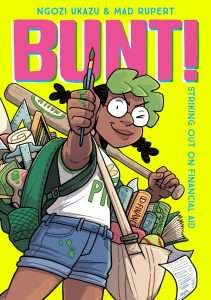 At PICA, the Peachtree Institute of Collegiate Arts, art is everything! Peachtree native Molly Bauer spent her whole life with the plan to attend the art school in her own backyard. Sure, the school isn’t perfect, but being a student there would be a dream come true for Molly. In Ngozi Ukazu and Madeline Rupert’s Bunt!: Striking Out on Financial Aid, things don’t work out anywhere near how Molly expects, so desperate times call for desperate measures…softball.
 We’re in this together! V for victory! The onset of World War II brought a whole new way of life to the United States, one that affected everyone in many different ways. The latest addition to First Second’s History Comics series, World War II: Fight on the Home Front, written by Kate Hannigan with art by Josh Rosen, details the realities of living in America during that unprecedented time.
 accents. (Yes, their accents!). Maybe you’re familiar with tadpoles as part of the frog life cycle but did you know out of 2000 eggs, only five will make it to adulthood? (Don’t worry, not only have frogs adapted but they’ve flourished!) There is so much to learn about frogs and Liz Prince’s
 Your face is crooked. You’re going to make everyone you love sick and die. You’re ugly and no one likes you and you’re going to be alone forever.
 shops, with people from all over the world making the pilgrimage every single day. Jillian Tamaki and Mariko Tamaki’s incredible new adult graphic novel
 become the Mousetress’s sidekick but things like friendship, jealousy, and, oh yeah, robots just keep getting in the way.
 Asking for help isn’t always easy … and what do you do when that help causes you to develop superpowers overnight? Welcome to Hannah’s world, told in

