Gruesome. Dramatic. Utterly wild. And just the beginning. I need more.
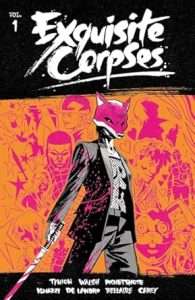
James Tynion IV is among the most exciting writers working in comics today. For Exquisite Corpses from Image Comics, he partners with Michael Walsh along with other artists and writers to deliver the first volume in a blood soaked battle royale conducted by the thirteen richest families in America who wield unchecked power from the shadows. To keep the peace between their factions, every five years these families select champions and unleash them within an unsuspecting small town on Halloween night. The last killer standing will claim a reward and another five years of unquestioned power for the family who sponsored them. The other killers will be dead. As for the town—well, it doesn’t look promising. This time, the killers have landed in Oak Valley.
Tynion has already built a reputation for layered, unflinching horror. What helps set his work apart is the thematic depth and character development that emerges amidst the carnage and action and intriguing stories he continues to build. As quickly as the body count starts to rise at the hands of mercenaries and flashy murders alike—we also meet the inhabitants of Oak Valley. A young couple. A young boy and his mother. A gas station attendant. Two EMTs unaware of the horrors that await them in the night. Tynion and the other writers (including Walsh and the acclaimed Pornsak Pichetshote), build a tapestry of character on all sides—townsfolk, ruling families, and the killers themselves. Even among the families and the killers, the story doesn’t shape the characters with only broad strokes. We get glimpses into rivalries, old resentments, and heartfelt loyalty among the shadowy rulers. Among the killers themselves—some are out for blood alone, but others have more complex reasons for stepping onto the killing floor. No side is entirely villainous. No side is only sympathetic. Some of these folks are larger than life while others are just trying to get by. It is these few, the desperate and the hopeful, that take the story beyond an action set-piece and into something that is crafted with flair—but also perhaps more relevant to today than some of us might care to notice.
Walsh’s art also maintains a gritty feel across each issue, blending shadowed realism with flashes of vibrant color. Along with Marianna Ignazzi and Valentine De Landro, the creative team build a small town that feels lived in and real, tucked in some quiet corner of the northeast where—unfortunately for them—help will likely not be arriving in time. This stylized realism balances well with the neons and blood spatter that explode across the page, especially in the presence of the eccentric killers. The visuals create a world of real places and people, telling story through costumes and expressions as much as the written narrative. Visually, the book is a delight—and as the chaos begins to unfurl, this unsuspecting town is only just starting to take notice.
Exquisite Corpses earns a solid mature rating with somewhat graphic violence and some language. It’s a story aimed at adults, though not out of reach of older teens who can handle the content. My only notable complaint about the book is that, at 3 issues, it was over far too quickly. There’s plenty more story to come, and this volume would sit happily in any collection with a focus on horror and crime-thrillers. Fans of titles like The Hunger Games, Battle Royale, and Alice in Borderland as well as Tynion’s other horror titles are sure to find plenty to enjoy within these pages. I highly recommend this one for anyone willing to take a step into the dark, and I look forward to the next installment.
Exquisite Corpses Vol. 01 By James Tynion IV Art by Michael Walsh Image, 2025 ISBN: 9781534331044
NFNT Age Recommendation: Adult (18+), Older Teen (16-18) Creator Representation: Canadian, Gay, Character Representation: Black, Gay,
Eating fries at the beach. Creative ways to pull a tooth. Fishing for something just a bit too big. Life can be tricky when you’re a kid.
Published by Kids Can Press, Bob Holt delivers three stories of unlucky mishaps featuring Quin, along with Quin’s family, friends, and a deadpan cat named Kitty. Each story begins simply enough, but Quin is The Unlucky Kid, and nothing he does ever seems to go to plan. Hang out at the beach while eating a burger and fries? That horde of seagulls is mighty interested in getting a treat. Want to pull a loose tooth? It’s more exciting to have a multi-step plan involving string, pets, and one excited sister. Fishing at the pond? Some of those fish might be bigger than Quin. As each adventure escalates to increasingly wild circumstances, Quin and the others manage to find laughter no matter what goes wrong.
Holt’s stories are simple and self-contained—each with a setup, escalation, and payoff embracing plenty of slapstick humor and visual gags. There isn’t a lot present in the way of deeper themes or lessons, but the joy and humor of the book is consistent and laughter is clearly the point as Quin manages to face anything that comes his way. As wild as each story becomes, the initial setups will be familiar to plenty of kids. And between jokes about eating worms and accidentally taking flight on kites, Holt understands how to elicit laughter from young readers.
The art is full of energy, with text bubbles exploding across the page, exaggerated expressions, and an eye for visual humor as things go from bad to worse for young Quin. The colors are bright, the scenes are dramatic, and Kitty is always there to roll his eyes and offer some commentary on what’s happening next. The comic style lends itself to action and humor, carrying much of the storytelling burden as the chaos unfolds.
It’s a book clearly aimed at kids, and the content should be suitable to all but the most sensitive young readers. There’s mild depictions of injury on occasion and exaggerated accidents, but Quin always bounces right back with a bright attitude so none of the harm lasts long. Overall, The Unlucky Kid sets out with a simple mission, and Holt serves up a healthy amount of physical comedy and fun situations. Kids will appreciate the silliness of the whole book, but it’s also full of enough life and fun that parents and older readers should be able to enjoy themselves as well. For any collection looking for a bit of slapstick absurdity for young readers, Holt’s book should offer a quick and easy read that’s still plenty of fun.
The Unlucky Kid By Bob Holt Kids Can Press, 2024 ISBN: 9781525306594
Are art and past friendship enough to overcome the painful void left behind by both time and grief?
Disconnect from Magnus Merklin and Black Panel Press opens with three young musicians recording themselves making music in the bright, youthful hope that the footage will be featured in the eventual documentary about their rise to stardom. Fast forward, and those dreams are cut short by the death of one of the trio. Adrift and grieving, the remaining two go their separate ways for a time as they process the hole left in both of their lives.
A year later, the two friends reunite at the summer home where they used to play music together. The house is full of old instruments and a host of memories. Life hasn’t turned out as expected for either of them. Adrift, nearly giving up on old dreams, the pair struggle to reconnect with the weight of so much pain still hanging over them. That’s when they discover an unfinished song left behind on a laptop, perhaps the creative inspiration they both need to pick up their instruments again and find their way back into the music. However, still drowning in grief, carrying fears and hurts they aren’t sure how to express, finishing the song will require them both to face themselves and each other if they hope to find something fresh on the other side of their pain.
With the comic’s title serving as both the name of the characters’ band and one of the core themes of the story, Merklin focuses his attention closely on the emotional journey of his two characters. Isolated at the summer home, the emphasis remains solidly on the two friends and their memories. The plot is a mix between present-day conversations, efforts to finish the song, and flashbacks to the happier times they shared before everything came crashing down. In many ways, this focus serves the story well; Merklin has ample time to explore his characters as they slowly allow themselves to be vulnerable about how much they have lost. At the same time, there is little else to fill out the story beyond this reunion—the rekindled friendship and flares of conflict that make up the healing journey. The shifts and passage of time are occasionally abrupt, but overall, the story is a striking and deeply personal look at what it means to create and to live when someone who was once a significant piece of that creativity is simply no longer there.
As both writer and artist, Merklin brings a striking visual style to the book. Anthropomorphizing stylized animals as the characters, the book unfolds in black and white with heavy line work except for the sequences where music comes into play. The more connected the characters are to the music—whether it be their own or the constant soundtrack of their favorite songs—the more color grows across the page in geometric designs. It’s an excellent creative decision the elevates the reading experience while also helping chart the experiences of the characters. From isolating sorrow to tender moments to youthful joy—the art has a bold, sometimes punk aesthetic that suits the characters and adds a fresh layer atop the more somber subject matter.
Black Panel doesn’t attach an age rating, but due to the overall themes, scattered sexual references, and some strong language, the book is best suited to adults—particular those in their 20s and 30s who may find themselves facing similar questions and challenges to these characters. That being said, there’s also plenty here that older teens may also appreciate, especially those who connect with any part of the subject matter. Overall, the book is more of a grounded emotional journey, but it moves with a quick enough pace that it’ll appeal to more readers than only those inclined toward more literary comics. For any reader trying to create art in the midst of pain, for musicians, and for anyone who wants to settle into a deeply vulnerable story told through distinct and striking visuals—Disconnect should be worth the read. Despite having areas where it could perhaps have gone deeper, it’s a book willing to take a hard journey that I expect will resonate with many who open up these pages.
Disconnect By Magnus Merklin Black Panel Press, 2025 ISBN: 9781990521379
NFNT Age Recommendation: Adult (18+), Older Teen (16-18) Creator Representation: Danish,
AI simulations, corporate mismanagement, and a psychological mystery intertwine in this first graphic novel from cartoonist Kit Anderson.
From Avery Hill Publishing, Second Shift brings us across a frozen wasteland far from Earth and into a lush habitat where the second shift of Terracorp employees are just being brought out of stasis. Enter Birdie Dornan, the senior of the two employees signing on for the current shift. The other is her brother Heck. After artificially cheerful greetings from the automated farm machines and an awkward passing of responsibilities as first shift heads into stasis, it’s time for Birdie and Heck to run management operations on the multitude of automated systems slowly working to capture minerals from passing asteroids and terraform a hostile landscape.
Second shift is there for repairs in the midst of increasing mechanical breakdowns and to monitor the status of the “payloads” harvested for the resources they contain. Through it all, they are assisted by the station AI, a digital projection which manifests into any number of forms considered pleasing to the human inhabitants.
Wondering how much their employers care about them and often on edge amidst the relative isolation, Birdie and Heck pass their free time in a series of simulations offered by the Station AI, all carefully tailored to the individual inhabitants. From adventure games to nighttime meditations, algorithms and virtual reality add depth and complexity to this remote corner of space. Everything changes when an unexplained signal leads Birdie and Heck to discover a second station, seemingly abandoned by people but also unlocking a host of questions which Birdie must decide if she truly wants answered.
Offering worldbuilding in small details and interlude messages spread between chapters, Anderson paints enough of a picture for the reader to grasp the circumstances of these characters while allowing the fullness of the larger world to exist in ambiguity. It’s a decision that works as Birdie and the others, out of touch with the wider galaxy, also find themselves cut off, disoriented, and questioning exactly how they fit into larger events going on somewhere beyond where they can see. There is plenty of sci-fi intrigue, but Birdie’s uncertainty after so much time with Station are central to the story. As she and Heck delve into virtual realities and the artificial environment of their current home, lines of understanding begin to blur. Terracorp is likely keeping secrets while the Station AI assures the team that everything is truly fine. Far from help and caught between the virtual and the real, Birdie’s willingness to ask questions—and to embrace the answers they bring—will shape much of what is to come.
With heavy line work and a muted palate of colors, Anderson gives richness and emotion to each segment of the story. The art is stylized enough to hold the dreamlike unreality of certain sequences, but also realistic enough to ground the narrative firmly in Birdie’s boots as she finds her way through each twisting corridor of the mystery surrounding her. For such a contained cast, each character and voice steps onto the page in memorable fashion, and as we follow Birdie down the rabbit hole, the psychological and tangible realities of the situation begin to show themselves across the panels of the story, larger than life but simultaneously all too real.
Avery Hill does not assign the volume an age rating. Though there is no mature content to speak of, the general themes and pacing of the book will more likely appeal to older readers from teens to adults. Despite the wider sci-fi setting of the narrative, the story itself is relatively slow paced and deeply personal as the characters navigate more existential questions of the place where they have found themselves. For readers who appreciate the ability of science fiction to explore future possibilities and the human condition, Second Shift should provide an engaging read. Balancing ambiguity with lovingly crafted detail, it’s a mystery that takes its time to unfold—but what it reveals drives at truths far deeper than just the nature of the mysterious second station. As a Terracorp missive asks in the book’s opening, “Isn’t it all worth it?”
Second Shift By Kit Anderson Avery Hill Publishing, 2025 ISBN: 9781917355209
NFNT Age Recommendation: Adult (18+), Older Teen (16-18)
Aside from being the creator of Citizen Kane, who was Orson Welles?
If you’re like me, mention of Citizen Kane’s director brings to mind some concept of an early and influential Hollywood figure, someone who set the course of filmmaking and left a mark for decades to come. But what if you were asked to describe his other films? Perhaps his roles in television, on stage, on the radio? Even his connection to the early and infamous radio broadcast of The War of the Worlds. How much does the average moviegoer know about Welles’s antagonism with Hollywood, or his career and artistic vision which were hampered by a variety of obstacles that seemingly stood between him and the artist he craved to be? Created by French cartoonist Youssef Daoudi and published by 23rd St., The Giant Orson Welles: The Artist and the Shadow seeks to capture the life of the influential director honestly, but also with an artistic flair worthy of a man who chased his vision regardless of whether those around him believed it possible.
Narrated by Welles himself, this graphic biography highlights key moments in the life and career of the director, writer, and actor. Although he continually crossed paths with other significant figures in world and film history, the story keeps the lens close to Welles. From his childhood as a declared prodigy where he was told he could accomplish everything, through an adulthood where such promises failed to materialize, until he found himself raging against a world that felt it did not appreciate him. Welles created Citizen Kane at only 25 years of age, and despite its controversies, it was the film that would follow him for the rest of his career, setting the bar for any later attempts to grasp success.Welles was a complicated man who created goodwill documentaries and artistic films that pressed back against the mainstream, and faced accusations of communism and the fears of the red scare. It is these complexities that Daoudi tries to capture on the page. With the character of Welles as storyteller, the book is immensely sympathetic to the man and all that seemed stacked against him. At the same time, it shows that he was a man who struggled with his own success, who could be abrasive and uncompromising to those around him, and who struggled to find his way while he refused to let others chart his course. The Welles of this book would prefer to watch his promising career crumble around him than compromise the artist he sees himself to be. It is a difficult thing to create a biography of any person, much less to condense such an immense life and career into a singular graphic novel. Nevertheless, with extensive citations and a clear appreciation for a man who shaped modern cinema, Daoudi’s book is an immensely inviting and readable guided journey that feels informative without ever failing to remember that it is meant to be telling a story.
And make no mistake, the book is entertaining. It is nonfiction, but from the opening pages of Welles striding across the Hollywood landscape in a long coat and hat, swirling smoke around him as he declares his name to the reader, it is also clear that this will be no dry recounting of facts. The book unfolds with stylized realism, moving across time with a mix of straightforward presentation and interjections from Welles himself. The color palate is bold black and white with shocks of yellow consistently brightening the illustrations. Daoudi does not waste the graphic format. Episodes are introduced and play out with script directions and scene setting. The imagery splays across the page with a cinematographer’s intent. Sequential panels follow dual page spreads scattered with scenes from movies, advertising posters, and dramatic stagings of Welles’s own life. In one of the more remarkable scenes, a pile of televisions reminds the director of the multitude of seemingly worthless commercial jobs he has taken, solely in an effort to fund his more passionate projects. At another turn of the page, Welles is confronted by characters from his own incomplete films, specters that follow him through life as reminders of the things he has yet to achieve. Always easy to follow but never overly simple, the book endeavors to create a visual and artistic experience that gives shape to a story with the completeness that such a life deserves.
The book does not carry a specific age rating, but 23rd St. is a comics line aimed at adults. The more mature content elements include violence both in a science fiction context and in realistic depictions of bullfighting. There is occasional strong language and a couple illustrations of nonsexual nudity. None of these elements are pervasive, but coupled with the tone and content of the comic, it’s a read aimed mostly at adults and older teens with an interest in film history. Anyone curious to learn more about Welles or the earlier days of Hollywood should find something to appreciate here, along with more general readers of graphic nonfiction and anyone who wants to take a journey through a biographical comic clearly created with intention, respect, and striking artistic vision. Whatever else one may say about Orson Welles, he was an imposing man, a driven visionary whose work casts a shadow even into the present day.
Turning an eye toward that legacy and those complexities, The Giant Orson Welles is a bold and quite readable work of graphic biography that earns a place in any collection where a comic of this subject matter and style might be appreciated.
The Giant Orson Welles: The Artist & The Shadow By Youssef Daoudi Macmillan 23rd St., 2025 ISBN: 9781250805942
NFNT Age Recommendation: Adult (18+), Older Teen (16-18) Creator Representation: French,
When an unremarkable player in an expansive virtual fantasy world discovers legendary blacksmithing abilities, it’s not exactly the answer to all his problems—but the ability to craft godlike equipment certainly goes a long way toward changing his circumstances.
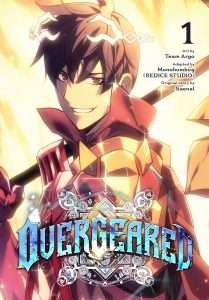
Overgeared from IZE Press adapts this story of Youngwoo Shin from the Korean light novel of the same title. Youngwoo ks a bit of a loser in real life, and in the massive online VR Game Satisfy, he’s also a low ranging errand boy. However, when a job goes badly, he uses a powerful in-game item to turn his character into a smith and the successor to the greatest blacksmith in the game’s lore. Reset to base level but with an abundance of new abilities, Youngwoo decides to seize the opportunity in front of him in an effort to make something of himself in the game and out of it (there’s a pile of debt waiting for him back in the real world after all). However, alone and with the odds stacked against him, his only chance will be to craft an arsenal of advanced gear capable of offsetting his weaknesses (and there are many of those). It’s a difficult enough challenge on his own, but Youngwoo’s change has not gone unnoticed, and there are others who are quite interested in seeing what the newly forged smith will make of himself.
Volume 1 opens with intercuts of past and present, introducing Youngwoo’s in-game character named Grid in his overgeared state along with flashbacks to how this adventure began. It’s a bit of a jarring opening to follow, but once the stage is set, the story settles on following Grid in the immediate aftermath of his rebirth as an adventuring smith. There’s lots of game lore and rule mechanics mixed in with the gameplay, but with excitement and humor, the story strikes a fairly quick pace of daring and misadventures. Outside of the game, Youngwoo proves to be a bit of an unlikeable character. Struggling with money, jobs, and relationships, his video game addiction and general lack of motivation hang over his decisions. It’s early in the story yet, so there’s presumably room for growth, but it’s Grid’s sometimes bumbling attempts at gaining levels and fighting enemies that drives most of the story. Volume 1 already establishes a cast of in-game characters and conflicts that promise to kick off more shenanigans. And back in the real world, the game’s developers have also taken notice of Youngwoo’s new fortune, though it remains unclear exactly what they expect of him.
Illustrated in full color, this volume is a vibrant romp through the digital world of Satisfy. Video game menus and notifications are integrated into the story, visible to the characters as much as they are to the reader. And when the action kicks off, magic and combat explode across the page with stylization worthy of adventure comics and video games alike. The characters are distinct and the narrative is generally easy to follow, hitting the range of emotional beats effectively. It’s a comic that seems to relish its own concept and execution, and the art team brings the story to life with a visual language that’s engaging and fun to read.
On the whole, Overgeared is an enjoyable start to a new series. For those not thoroughly familiar with the genre already, the digressions into game mechanics and stats screens might be a bit distracting. And though I expect there’s much more to come, Youngwoo’s shortcomings as a protagonist make him occasionally tricky to root for with full sincerity. All that aside though, there’s a great deal to enjoy here in a comic that, while not necessarily treading any new ground, seems to have a great deal of fun setting out on an adventure. It’s a story aimed comfortably at teens, with plenty of fantasy violence but nothing too troubling in the content otherwise. Especially if readers have previously enjoyed titles like Solo Leveling and Ready Player One, Overgeared should find happy readers ready to settle into familiar territory and see where Grid’s often poor decision making leads next.
Overgeared Vol. One By Team Argo IZE Press, 2023 ISBN: 9798400900518
Related media: Book to Comic
NFNT Age Recommendation: Older Teen (16-18), Teen (13-16) Creator Representation: Korean, Character Representation: Korean,
It’s possible you’ve heard his name, but there’s little doubt you’ve heard his music. This is the life of one of Hollywood’s greatest composers.
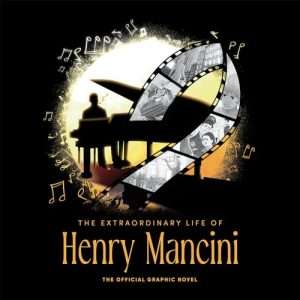
In collaboration with the family and estate of Henry Mancini, David Calcano sets out to tell the life story of the famed songwriter and composer in The Extraordinary Life of Henry Mancini: The Official Graphic Novel from Fantoons. Born into an Italian immigrant family, Mancini discovered the power of film and music at a young age. Torn between competing expectations and the challenges of breaking into a competitive industry, he fought to make a name for himself while always chasing the next opportunity, uncertain if it all might fall apart around him. Along the way, he married a woman named Ginny, who would go on to become an icon in her own right. And over the course of his career, Mancini would create songs such as “The Pink Panther Theme,” “Peter Gunn,” and “Moon River,” written especially for Audrey Hepburn.
Jumping between different periods in Mancini’s life and a reflective 70th birthday party where the composer regales listeners with his story, Calcano creates a book that is a celebratory retrospective of a life dedicated to family and to music. Even with the shifts in time, the narrative remains clear, shepherding the reader from Mancini’s earliest days through the end of his life and into the legacy he left behind. Presented accessibly, this is not a critical biography, but neither does it claim to be. Factually researched (including a bibliography at the end) the book smoothly sets about marking the key moments and passions of a man whose massive influence began in remarkably simple ways. It’s not an overly complex narrative, but there are some poignant moments which Calcano lays before the reader, giving them time and space for them to make an impact. These are often the more intimate moments where Mancini expresses uncertainty about his career—but also an especially remarkable scene where an entire audience shifts into only Mancini’s father, as the composer grapples with the weight of both love and expectation that have followed him all his life. Overall, the book is crafted with care, designed to bring a history readers may not know to vibrant life across the pages.
In the artwork, Mancini’s life is bright indeed. Illustrated by a full Fantoon’s team, the illustrations have touches of realism but embrace a bright and colorful animated aesthetic that shifts the experience from simple biography to an energized expression of a life lived with excitement, art, and passion. The images move across decades, not only depicting the life and career of Mancini and his family, but also adding stylistic nods and cameos from some of Hollywood’s most iconic directors including Orson Welles and Alfred Hitchcock. It’s a visual style that’s enjoyable to look at, but also easy to follow and inviting for readers who may not be certain about diving into a biographical graphic novel.
Though there’s not really anything here in terms of mature content, the book will likely appeal most to adults, who may be more likely to be familiar with Mancini’s work. It’s also perfectly accessible to teens with musical inclinations or interests in nonfiction, especially any who are interested in music or composing. Ultimately, The Extraordinary Life of Henry Mancini may not be a heavy draw for graphic readers more inclined toward genre or intrigue, but for any audience interested in biography or the arts, Calcano’s graphic biography of Mancini is a book clearly created with care and admiration, opening wide the life of a man whose work will likely live far beyond him.
The Extraordinary Life of Henry Mancini: The Official Graphic Novel By David Calcano Art by Lindsay Lee Fantoons, 2024 ISBN: 9781970047288
NFNT Age Recommendation: Adult (18+), Older Teen (16-18)
Sacrificed in the honor of the Four Bishops of the Old Faith and lost between life and death, Lamb meets the One Who Waits, an ancient power determined to exterminate its enemies and return to existence. This begins Lamb’s return to life, to seek vengeance and gather influence by raising a cult in the name of the old god imprisoned below. At first, revenge seems the natural choice against Lamb’s murderers. However, things grow more complicated when Lamb meets pious Ratau and innocent Nana—the first two members of the group they will soon gather. It is in this—caught between devotion to an ancient being and the possibility of joy in a harsh world—that Lamb will be forced to make a choice. Will the cult become a fresh start for those who are rescued; or will it also grow from the blood of sacrifice?
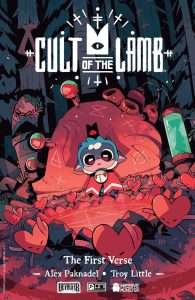
With this first volume, Cult of the Lamb: The First Verse, Oni Press brings the popular video game to the page with Alex Paknadel and Troy Little capturing the animal cuteness and pervasive violence of the original in equal measure, humor and horror entwined into one epic adventure. I confess that, though I’ve seen others play portions of the game, I have yet to play through it entirely on my own. This gave me a measure of freedom from expectations regarding the adaptation, though nothing contained in this volume appeared to be a notable departure from the source material.
The story is consistently delivered in lighthearted tones, borrowing familiar language of chosen heroes and epic fantasy for this bright and colorful world of animals and strange magic. There are some pretty direct references to certain game mechanics which will likely be more humorous to those familiar with the game, but largely, the story takes its own shape without expecting the reader to have any great deal of previous knowledge.
And for a game that involves a lot of building and combat, Parknadel does an excellent job narrowing the focus to Lamb and the surrounding characters. At the core of the story, is the rise of a hero overshadowed by impending tragedy. With themes of devotion, friendship, and sacrifice, a comic that could have simply been an action-filled joke, takes on a surprising sense of gravity as even Lamb’s most sincere efforts seem to lead only toward more suffering. It’s a legitimately fun and entertaining read, but watching the rise of a well-meaning hero who may become the very thing they are fighting against gives the story a weight deeper than just watching Lamb battle cultists across the dark forest and beyond.
At the same time, Little’s art remains true to the original style. With bright colors, dramatic action, and visual humor, each page infuses the story with whimsy enough to balance out the darker elements of the world. Moving from light to dark with bold, cartoon illustrations, Little captures the shifting moods and ancient magic of the narrative, making the book a joy to read, even as things begin to turn toward the worst. The story is action-adventure and dark fantasy, and this imaginative world feel very alive at every turn, as do the hopes and sorrows of the characters that live there.
Oni gives the book a 16+ rating for older teens, which suits the audience well. Teen readers are likely to be familiar with the original game and may find themselves drawn to a comic adaptation. Though combat, blood, and sacrifice are core elements of the story and do appear regularly on the page, they’re depicted cartoonishly rather than realistically and never to such an extent that the violence overtakes the story being told. Along with some darker themes, mature teens of varying ages should be fine to pick this up—and it’s likely to be a hit with audiences who are fond of the game or similar media where cutesy characters find themselves in decidedly not-cutesy situations. In the end, Cult of the Lamb offers surprisingly focused layers of depth, complexity, and nuanced storytelling while also remaining true to the original material. This volume is only the opening act, but I’m seated and ready to follow Lamb wherever they lead, be it victory or tragedy.
Cult of the Lamb, Vol. One: The First Verse By Alex Paknadel Art by Troy Little Oni Press, 2024 ISBN: 9781637155226
Company Age Rating: 16+ Related media: Game to Comic
NFNT Age Recommendation: Older Teen (16-18), Teen (13-16)
A magical land of imagination and infinite possibilities collides with very real dangers in this portal fantasy epic from a pair of debut comics writers who are here to show readers what they’re capable of.
Rose’s imperfect but bright childhood fell entirely to pieces in a single night when the land of her fantasies ended in bloodshed and horror the same night she lost her mother. Years later, institutionalized and with only her friend, Elliott, left to support her, Rose’s life is again upended by the discovery that the imaginary land she used to play in is very real.
And not only that, the violence she witnessed there as a child has raged in her absence, threatening the lives and futures of the colorful animal denizens who were once her loyal subjects. When Rose and Elliott are pulled between worlds by Rose’s faithful lieutenant—Wallace the purple elephant—they will find that lives and futures on both sides of the portal now hang in the balance.
Kill Your Darlings from Image Comics is complete in a single volume. With a couple time jumps across Rose’s life and interwoven with a historical legacy that carries dire implications in the present, this is a bright, colorful story with scarlet blood in its heart. Rose’s growth and isolation lie at the center of the comic, but the writers also capture questions of generational trauma, the flaws of childhood memory, and the power of joy even in the face of tragedy. It’s an immensely personal story of one young woman growing up with a past that haunts her; but across sweeping landscapes, it’s also a thrilling and dramatic fantasy epic complete with lovable creatures, fierce battles, and sinister powers lurking in the dark places of the world. If there’s one criticism to be made, it’s that the book’s ambition stretches a little beyond its reach.
For a debut told in a single volume, there are a lot of threads to be untangled and everything doesn’t quite have the space to breathe that it might deserve. Especially toward the ending, there are moments of plot and character where I would have loved to get even more time to watch things unfold with the level of development they deserve. But even this complaint is simply a desire for more of what the story has to offer, and what we do get remains a thrilling quest of heart, empathy, and grand adventure.
This may be a debut for two exciting new writers, but Quinn and Hill are no strangers to the world of comics and bring the art and visuals of worlds both real and imagined to vibrant life across these pages. Full of bright colors and fantastical designs, the artists take us into the wonders of a child’s imaginary kingdom. It’s not all rainbows and talking animals though on panels soaked with gore of overcome with dark magic. Shuttling the reader across time and worlds, the art is rich and delightful—albeit occasionally horrifying as well. Entire worlds feel larger than life with stakes that fit the setting, but the artists are equally able to capture the moments of heartache and uncertainty that make grand stories worth telling. It’s a great blend of realism and the dynamic visual possibilities that comics offer as a medium.
Kill Your Darlings rightly carries a mature rating. Don’t be fooled by the color and whimsy of the early pages; the story also includes graphic violence, child death, strong language, and some intense themes wrapped up together in a tale of adventure. It’s a story most meant for adults, but following Rose on the journey from childhood to adult understanding, there’s some narrative work here that’s sure to resonate with older teen readers who can handle a bit of blood spatter. Overall, a few hiccups in pacing and development aren’t enough to derail this wonderfully engaging story. Especially for readers of Kelly’s I Kill Giants, Gillen’s Die, or Young’s I Hate Fairyland, the blending of real-world issues with the tropes and visuals of epic fantasy make for a wild ride of a story that also has something much more personal to say. It’s worth adding to the shelves of any collection for older readers who like their fantasy stories wrapped up with themes and experiences that land quite a bit closer to home.
Kill Your Darlings By Ethan S. Parker, Griffin Sheridan, , Art by Bob Quinn Image, 2024 ISBN: 9781534397828
NFNT Age Recommendation: Adult (18+), Older Teen (16-18)
“The night the last queen dies, the age of darkness will be upon us.” It’s a refrain repeated throughout Rochette’s quiet epic of humanity and nature which rings more true each time it is spoken.
From publisher Self Made Hero and the co-creator of Snowpiercer, Jean-Marc Rochette, The Last Queen spans more than 100,000 years of history, with the core story following Édouard Roux, a World War One survivor adrift in a new world rapidly chasing modernity.
The broader narrative follows the history of a people who have lived close to the land, defending the existence of the bears they revere even as wars and human powers encroach, demanding tribute, seizing resources, and targeting outsiders for witchcraft. It is this tradition Édouard was born into. After the war, seeking an artist who can sculpt him a new face to cover his violent disfigurement, he crosses paths with a woman named Jeanne Sauvage. Their passionate relationship grows, as Édouard inspires Jeanne to craft her greatest sculpture, a monument to vibrant and untamed nature. However, in a world that prizes progress and profit, Jeanne and Édouard find themselves facing forces that seek to tame nature itself, and neither of them may be strong enough to stand against the rising tide.
Rochette’s name has immediate selling power from a comic as iconic as Snowpiercer, but The Last Queen is quite a different story narratively. There are still plenty of big themes to explore, but this historical drama takes its time and reads quite intimately in places, even with the grand timeline of events. There is a great deal going on here, from romance to art to war and conflict. The story unfolds, in danger of spiraling out of control but managing to weave all of these distinct parts into a meditation on humanity’s relationship with itself and with nature. The ideas underlying the text are bold and clear, but never feel forced. The scope is quite large, but Rochette keeps the reader grounded as the text moves back and forth across the centuries. And even the ending—not tied up neatly in a bow as it might have been—feels more honest for finding connection between all these pieces without forcing them to fit too tightly together.
Along with this often melancholy narrative exploration, the art features a wide palate of muted colors and heavy use of inks. There are clear visual similarities to Snowpiercer, but Rochette shapes the visual style to the story. We get close-up panels full of detail, capturing the vulnerability of the characters at their most difficult moments. Pages later, the colors lighten and the view pulls back to impressive views of wide landscapes untouched by human expansion. Throughout the book, the imagery is compelling, with the visuals capturing the feelings of freedom and looming oppression which underly so much of the narrative.
The Last Queen seems aimed at a mostly adult audience. Mature elements include violence against humans and animals, as well as the aftermath, occasional strong language, and on-page sexual content without significant, clear detail. Additionally, with a relatively thematic and character-driven story, younger readers may not feel as interested in the events taking place. However, for those teen readers interested in a historical fiction comic with strong environmental themes, the content should not be so objectionable as to pose a major issue. Overall, this book leans more in appeal to what some might call readers of “literary” comics, but with a deft hand and compelling storytelling, Rochette has created a rich and rough narrative that leaves the reader with plenty to ponder after the pages themselves are finished.
The Last Queen Vol. By Jean-Marc Rochette Self MadeHero, 2024 ISBN: 9781914224195
NFNT Age Recommendation: Adult (18+), Older Teen (16-18) Creator Representation: French, Character Representation: Prosthesis,

 Eating fries at the beach. Creative ways to pull a tooth. Fishing for something just a bit too big. Life can be tricky when you’re a kid.

 Anderson.
 Aside from being the creator of Citizen Kane, who was Orson Welles?
 answer to all his problems—but the ability to craft godlike equipment certainly goes a long way toward changing his circumstances.
 It’s possible you’ve heard his name, but there’s little doubt you’ve heard his music. This is the life of one of Hollywood’s greatest composers.
 pair of debut comics writers who are here to show readers what they’re capable of.
 epic of humanity and nature which rings more true each time it is spoken.

