Though fiction is often thought of strictly as entertainment, there are moments where it can teach, particularly when said fiction looks at a rather dark period of American history. The reasoning behind using historical facts as the backdrop of fictional stories is often to show how such events happen, but those events take on a greater urgency when readers see similar events playing out on our newsfeeds, which makes Death to Pachuco, a graphic novel noir written by Henry Barajas and illustrated by Rachel Merrill, an example of how history, as the old saying goes, often repeats.
The book takes readers to Los Angeles, circa 1943, following the murder of Carlos Urbanos. With the police arresting the wrong person and racial tensions escalating, private detective Ricardo “Ricky” Telles realizes the clock is ticking. Mexican-American youths (pachucos) and Navy servicemen are on a collision course that will lead to the Zoot Suit Riots, when American servicemen assaulted Mexican-Americans in the streets with brutal efficiency. Knowing that “it’s not a good time to be Mexican” (a direct quote from the book and from historical accounts), Ricky, a two-fisted, fast-talking gumshoe in the same mold as Sam Spade or Mike Hammer, has only his wits, his fists, and his charm to survive in a Los Angeles that’s ready to explode.
In Ricky Telles’ personal history and habits, writer Barajas shows that he understands the appeal and genre conventions of noir detectives. This history includes being abandoned as a child while habits like his casual use of heroin reveal Ricky to be a broken man still trying to do the right thing. Fans of detective stories like those from Raymond Chandler might recognize and subsequently enjoy Ricky and the LA he lives in. Ricky also lives in a world where Spanish and English are used interchangeably and without translations the readers must often engage in the dialogue and story by looking for context clues. Beyond the book’s immersion into the Hispanic community, historians will notice how Barajas has turned this graphic novel into a history lesson about one of the darker periods of American history. He incorporates quotes from those who lived through the Riots along with published material about the Sleepy Lagoon murder case, a catalyst for the Riots where several young Mexican-American men were convicted of murder on scant evidence. This book is not only an example of solid noir storytelling, but it’s an example of how to integrate lived history with fiction.
This book never becomes a dry textbook because Barajas’s writing and Merrill’s illustrations capture this period in history as well as noir conventions. Merrill’s illustrations draw readers into a 1940’s Los Angeles brimming with design influences from neighboring Mexico. Bright colors pop against night skies and shadowy interiors in the same way female silhouettes wrapped in colorful dresses pop from the page. Thanks to Merrill’s handiwork, jaws are suitably chiseled (or, in Ricky’s case, boyish), women’s lips are red and inviting, and bad guys’ sneers are menacing in authentic noir style.
This graphic novel would be a welcome addition into any adult collection that not only values noir but also history, especially a reflection that refuses to sugarcoat its history. Its subject matter might also invite librarians looking for stories that reflect the current political and social climate to add this to their collection.
Death to Pachuco By Henry Barajas Art by Rachel Merrill Image, 2026 ISBN: 9781534335226
NFNT Age Recommendation: Adult (18+) Creator Representation: Latinx,
Classic Fantastic is our series of features on the classics of the format—please check out our other picks for the most important titles, in terms of appeal, innovation, and storytelling, that every library should own.
What’s it about?
This Southern Gothic fairy tale features Emmy, who lives with her Pa on his farm, enjoying a fairly idyllic existence, this despite the surrounding woods being home to all sorts of haints that don’t want to stay dead and monsters who don’t mind a little human in their diets. What lurks in these woods becomes front and center in Emmy’s thoughts when, on her 18th birthday, she discovers her connection to Hester Beck, a witch who tormented the people of Harrow County until the people finally had enough and murdered her. Upon discovering the truth about Hester Beck and the people of Harrow County, Emmy goes on a dark journey of self-discovery.
As the series progresses, Emmy must learn more about the supernatural world she’s discovered and the powers she’s inherited, while also ultimately deciding who she is. As the resident “witch,” Emmy becomes the one Harrow County’s human inhabitants go to when they’re plagued by dark forces and often she is also a mediator between the humans with whom she lives and the various spirits and supernatural creatures that respect her power. Luckily, Emmy has some help in protecting Harrow County from the things going more than bump in the night. There’s Bernice, her best friend who throughout the series becomes a formidable magic user; Priscilla, a goblin who helps Emmy in her interactions with monsters, and a skinless boy whose helpfulness extends beyond being both a skinless boy and an empty sack of talking skin. Throughout this series, Emmy grows in her powers while discovering more about her heritage, including her true “family,” a group of supernatural beings that, like Hester, considers Harrow County’s citizens expendable.
Revealing Emmy’s complete character arc, The Complete Harrow County Compendium truly lives up to the name by offering a plethora of extras. Not only does the book have the complete Harrow County story, but it also includes shorter comics, intros that were created for the library editions, sketchbooks used by artist Tyler Crook, scripts written by author Cullen Bunn, and more.
Notable Notes
While much of this book leans heavily on an idea of the early American South infested with haints, this universe offers many different kinds of tropes and stories. While there are some side stories that feel like “Monsters of the Week” tales where Emmy simply finds and then banishes a pesky monster or haint, the main story is Emmy’s coming of age story. Like many tales featuring fantasy protagonists, Emmy fights a constant battle between using her powers responsibly and letting them corrupt her, especially as her antagonists learn how to strike Emmy where it will cause the most physical and emotional pain. Along with Emmy’s story, the land of Harrow County and its strange, rich mythology is expanded upon throughout the series.
Bunn might be familiar to fans of mainstream superhero comics, having written for titles such as Deadpool Kills the Marvel Universe and Green Lantern: the Lost Army. Bunn, however, also has quite a portfolio of horror comics series he created, including The Damned, a 2007 tale of crime families warring for souls, supernatural western series The Sixth Gun from 2011, and the monster horror revenge tale Basilisk in 2021. Harrow County, which was first published in 2015, is considered his most well-known horror work, if not his best.
Collaborating with Bunn while illustrating most of Bunn’s world of ghosts and monsters inspired by Appalachian folklore is artist Tyler Crook, who gave the book its signature look thanks to his use of watercolors, which makes each page look like they belong in the Saturday Evening Post or on a postcard purchased from a general store. However, just because this series’ aesthetic might remind people of a romanticized rustic life in early 20th century America, there are more than enough graphic depictions of violence to turn the most modern stomachs. Like any good historical horror, this book threads the needle between historical authenticity and skin-crawling horror.
Significance
Many readers think of EC Comics like Creepshow and Tales from the Crypt when they think of horror comics, but there are also horror comics that construct richly textured worlds and deeply complex characters like Mike Mignola’s Hellboy and Joe Hill’s Locke & Key. Harrow County deserved to be mentioned alongside these seminal horror comics containing longer story arcs. Not only is this world gorgeously rendered in this book, Bunn and Crook’s universe has also led to spin-off series like Tales from Harrow County, which allows them to explore the backstories of the book’s secondary characters, meaning this book can be a spectacular jumping off point for those who love this fictional universe and Southern Gothic horror.
While many other creators like Jeff Lemire and Scott Snyder helped define how to depict horror in a comic book format, Bunn and Crook also deserve their props for creating in Harrow County a book that’s nostalgic, terrifying, and heartfelt. And Harrow County isn’t just a flash in the creative pan for both men. Bunn has created several different horror graphic novels for Oni Press, Dark Horse, and Boom! Studios, and Crook has worked in both video games and in graphic novels like BRPD. Much like chocolate and peanut butter, when the two combine their talents, much like they did for , they create graphic storytelling magic. Harrow County can be seen as a book where Bunn and Crook were continuing to cut their individual creative teeth, but it also represents Bunn and Crook at what many will say is the height of their creative prowess. In a world where graphic novels can be optioned into movies and series, it may only be a matter of time before we see Emmy played by Anna Taylor Joy interacting with a CGI-rendered Priscilla.
Appeal
Fans of horror comics will love the gore that Crook renders in watercolor as well as his imaginatively rendered monsters. Those who love historical fantasy stories will want to visit Harrow County, walk through the town’s dusty streets, and be aware of the setting sun at their backs and what the darkness could bring. While not necessarily a book for the squeamish, and its depictions of blood and guts in watercolored reds might make it too bloody for a library’s teen section, Emmy’s story, despite taking place in a very significant period in American history, is still a timeless one about how a young person grows up and decides, through missteps and heroics, who they are.
Why should you own this?
Many dark fantasy shows like “Supernatural” utilize the trope of protagonists discovering a world lying just underneath the one that normal people take for granted, and that this underworld has very sharp teeth. Like Sam or Dean Winchester in Supernatural, Emmy must not only protect Harrow County from the encroaching darkness, but often has to make some difficult decisions to do so. Its setting offers up a slice of Southern Gothic Americana, its magical elements draw on a delightful mix of dark fantasy tropes, and its characters will, for many readers, feel like old friends who sadly will leave them once the book is closed. An important work of horror in the graphic novel medium, this should be a top choice if you’re a librarian building an adult graph novel collection for patrons who also love horror.
The Complete Harrow County Compendium By Cullen Bunn Art by Tyler Crook Dark Horse, 2025 ISBN: 9781506745091
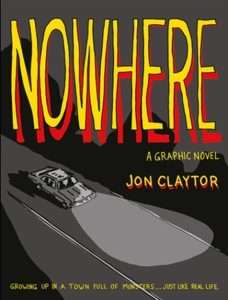
The monsters in horror fiction, whether those monsters are ghosts, vampires, or zombies, always seem to represent something beyond the natural fear a person would have against something with fangs and claws. Many times, these monsters are symbolic of a more universal fear involving a person’s space in society or in the universe at large (at least according to critics). Ghosts, for example, are often connected to humanity’s universal fear of death. Zombies are often symbols of death as well as disease. Author and illustrator Jon Claytor, however, presents an interesting idea in his book Nowhere, the world of zombies, vampires, and aliens represents the very modern fear of growing up.
Nowhere takes place in Beauséjour. Beauséjour, a small town in Canada and it’s where teenage Joel ends up, along with his morose mother, his verbally abusive but generally useless stepfather, and various animals. When the family’s car breaks down in Beauséjour, they stay at a roadside motel and slowly become accustomed to what makes Beauséjour different from other towns. Those differences include vampires that talk to therapists, ghosts that look like sheets and who actively engage with the living, and a massive cube that sits on the edge of town. And don’t forget about the zombies that wander around at night.
People might look at Claytor’s story and think of shows that run on late 20th century nostalgia like Stranger Things, especially when Joel finds a group of his friends close to his own age to hang out with. However, these friends don’t battle the various monsters that show up in town; they simply accept them as part of living in Beauséjour. In fact, no one within this book expresses any emotions other than melancholy, even when more apocalyptic elements start happening. Many have likely read action/adventure stories with a coming-of-age element that has the protagonist learns more about who they are and who they’re going to be due to the events in the book, but if Joel comes of age within Nowhere’s pages, Joel grows to realize that banality is the norm, which is perhaps the most terrifying thing to realize.
Banality could be used to describe the book’s artwork, which, in any other book, would be a critique, but the banality fits into the book’s overall tone. Claytor uses a deceptively simplistic art style that nevertheless depicts realistic human faces that are struggling to emote within a muted black and white world. Colors are also used sparingly, such as the blood on the vampire’s teeth when he talks with his therapist, and only provide a speck of brightness in Claytor’s universe. Even the aliens, typical grays with bulbous eyes and small mouths, approach their job of manipulation with the enthusiasm of security guards who’d much rather watch the clock tick toward the end of their shift, which is not surprising considering the universe they inhabit.
While lacking the excitement of Stranger Things, this book does share some DNA with an intellectual property well-known for weirdness. “Welcome to Night Vale,” a novel and podcast created by Joseph Fink and Jeffrey Cranor, features a supernatural town where residents accept the supernatural to an absurd degree. Fans of that book/series will want to visit Beauséjour, as well as fans of shows like “X-Files” and “Supernatural,” particularly of their sillier episodes.
Nowhere By John Claytor Goose Lane Editions, 2026 ISBN: 9781773104584
Company Age Rating: 14 Years and Up
NFNT Age Recommendation: Adult (18+), Older Teen (16-18)
The graphic novel medium has the ability to convey complex ideas and emotions through images, revealing many interesting aspects of the human condition. Then there are books like Final Boss, Vol. 1, written and drawn by Tyler Kirkham with additional art by David Miller.
Final Boss is not a story that will have its readers feel a variety of emotions or discover any universal truths, save for the truth that seeing people hit extremely hard appeals to many people. However, it’s important to note that this book is not trying to be anything complex or grandiose; Kirkham and Miller seem perfectly fine with Final Boss being a vehicle to show characters that could have stepped out of a video game pummel each other.
The person that does the majority of the pummeling in this story is Tommy Brazen, which is a name that could have been picked up from any martial arts movie script floating around Hollywood or Hong Kong during the 90’s. Brazen earns money by being really good at hurting people, whether it’s through his job as a paid enforcer or competing in underground street fighting matches. He’s recently acquired an ancient talisman left to him by his grandfather that not only increases his strength but lets him acquire the strengths of the various opponents he dispatches. This newfound power will be put to the test as he and his best friend Rabak travel to the mysterious country of Farthica for a fighting tournament, and while there, he meets several enemies that feed his and his talisman’s power.
The setup Kirkham presents of a mysterious fighting tournament is the same basic premise for nearly every fighting game that’s been played on a computer, gaming console, or arcade cabinet, and Kirkham leans heavily into the plot merely being the connecting tissue between bloody, high-octane fighting. In fact, Kirkham’s story could be one used for a fighting game that follows a particular protagonist. Brazen might be an ex-Special Forces guy searching for information about his grandfather, but he’s not exactly a well-developed, multifaceted character. He ultimately doesn’t need to be well-developed, though, as long as he beats the enemies he encounters within an inch of their lives, often in cinematically violent ways.
And “cinematically violent” seems to be what Kirkham and Miller are going for in their artwork, along with equating this book to a fighting game/online role-playing game. Among the splattered skulls and bisected bodies, all rendered in stunningly vivid reds, the book is presented like a video game. Panels will describe the stats of Tommy and whoever he’s fighting before a panel declares “FIGHT!” and victories are announced with words like “BRUTALITY!” plastered across the page. After Tommy kills his opponent, the book details Tommy’s updated stats in the same way many online role-playing games do.
Final Boss isn’t a book that requires deep thinking, going straight for the readers’ collective hypothalamus. To clarify, many studies have concluded violent video games don’t necessarily cause violence, but for fans of fighting games and online role-playing games, reading this book will feel like picking up a controller and playing. Librarians who count these video games fans among their patrons should consider getting this book and letting their patrons play.
Final Boss Volume 1 By Tyler Kirkham Image, 2026 ISBN: 9781534334243
When most people think of Robert Kirkman’s zombie apocalypse story The Walking Dead, they likely remember two aspects of the show. The first is, of course, the zombies (or “walkers,” as they were called on the show). Everpresent and always hungry, they drove much of the story’s survival narrative. The second aspect, and perhaps the secret of the show’s popularity, was its non-zombie characters, humans who once had jobs, families, and lives before society collapsed and are now stuck simply trying to survive this new, deadly world. Everything Dead & Dying, a zombie apocalypse tale by writer Tate Brombal and illustrated by Jacob Phillips, shows Kirkman’s legacy throughout its DNA, even as it makes a subtle but poignant tweak to his formula.
The series focuses on Jack Chandler, the lone survivor of a zombie outbreak that has decimated the community and is consuming the world, but Jack cares little about the outside world. All he cares about is the community that had once welcomed him and the husband and daughter he loves. Despite the fact that they are zombies, he still treats them like human beings. He makes sure his zombified husband and daughter eat at the dinner table and that the members of their community, despite showing minimal awareness, are able to still go about the routines they performed while alive. Jack is able to maintain this precarious pantomime of existence until a group of survivors come to his community to “rescue” Jack by destroying all the zombies that were his family and friends.
Brombal’s zombie tale might seem like a lot of other zombie apocalypse stories that came before it, but he adds his own spin. The story takes place between two narratives, before the zombie outbreak and after. The reader is introduced to these characters as living, breathing human beings with personalities before showing them in their current undead state, sometimes on the same comic page. Readers also see these people accept Jack’s lifestyle when his own father doesn’t, which makes their zombified state even more tragic. Salt is finally poured into the emotional wounds when the book delves into Jack’s time with his husband Luke, revealed to be a man who was many times Jack’s anchor, and his daughter Daisy, a precocious child whom he loved dearly. In other zombie stories, the zombies are seen mostly as obstacles or environmental dangers; Brombal forcefully reminds readers that these zombies with a taste for human flesh were once human.
That isn’t to say that the book ever downplays the fact that these zombies eat human flesh. Phillips’s art showcases the dichotomy between the community pre and post zombie apocalypse. Many of his panels are bursting with reds, showcasing blood and viscera no longer contained by human skin. The zombies definitely look like zombies, with skin sloughing off and mouths and clothes stained red from previous meals. However, the realistic way Phillips illustrates human faces and anatomy hammers home the similarities and differences between these people when they were alive versus after they became zombies. Finally, Philips’s rural landscapes evokes a bucolic rural existence, even if that existence becomes a grim, bloody parody of itself.
This book should be resting in the same section as Kirkman’s The Walking Dead and other horror graphic tales that skew toward adults. It offers enough gnarly illustrations to attract graphic novel gorehounds, but the story is a tragic, heartbreaking tale of a man who’s trying to hold onto his humanity by helping his community hold onto theirs. Like The Walking Dead, this book ultimately asks how long a person can remain human when so much of humanity has become inhuman.
Everything Dead & Dying By Tate Brombal Art by Jacob Phillips Image, 2026 ISBN: 9781534332539
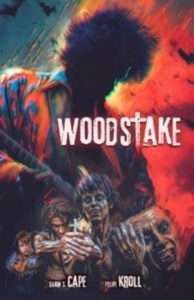
If Dracula himself had a drop of blood for every retelling and reimagining of his story as written by Bram Stoker, then he might never have to bite another neck to sustain himself. Since stories about Dracula (and about vampires that owe so much of their aesthetic to him) are so prevalent, doing one that’s wholly original is about as difficult to find as it is to find a vampire that loves the sun. Woodstake: Three Days of Peace, Music, and Blood Vol. 1 is writer Darin S. Cape’s and illustrator Felipe Kroll’s attempt to retell the Dracula mythos, setting it at a very famous music festival synonymous with the 60’s and the Summer of Love.
The story follows Jon Harper, an aspiring music journalist. Along with his girlfriend Nina and their buddy Artie, Jon attends Woodstock to interview Jimi Hendrix, an interview that could bring notoriety to Jon’s fledgling rock magazine. However, Dracula also awakens near that famous field in New York, and he is not spreading peace and love, but is spreading death and newly turned undead. Along with a suspiciously knowledgeable coroner, Jon and his crew might be the only ones who can stop Dracula from turning Woodstock into a wholesale slaughter.
Those familiar with Stoker’s original work might snicker as they see names from the original novel reused (Jon Harper for Jonathon Harker, for example) and Dracula fans reading this could easily turn it into a scavenger hunt as they look for references in Stoker’s novel, but those fans would miss the compelling story. Cape goes beyond simply retelling Stoker’s tale with a psychedelic 60’s paintjob; he tells a solid vampire story that captures the time in which it was spawned. This can be seen in the lingo used by the characters as well as the names of chapters that reference songs of that era. Through this work, Cape manages to show his love for both Dracula and the 60’s.
Illustrator Kroll’s highly detailed style of digital painting helps the book go beyond simply setting Dracula at Woodstock. Thanks to Kroll’s nearly photorealistic images, the faces of many characters have distinct features and shading that make them look more like Polaroids taken during the concert. Dracula also benefits from this aesthetic. Not only has he traded in the black cape for a denim jacket, but his lined and rugged features have him looking more like a music lover who hitchhiked from very far away and less like a Transylvanian count, which is an important aspect of the character many adaptations miss. Dracula, as the ultimate apex predator, blends thoroughly in with his prey, even taking up smoking weed, until he is ready to strike.
If you have patrons that love vampire stories, especially retellings that add a completely different vibe like Alex de Campi’s Dracula, Motherf**ker!, then this book should join the ranks of the other vampire-centric books in your adult graphic novel collection. Just note that, since this is volume 1 in a series, there may be more stories that will either build on this first volume or tarnish the entire story.
Woodstake: Three Days of Peace, Music and Blood By Darin S. Cape Art by Fellipe Kroll SHP Comics, 2026 ISBN: 9798992749915
NFNT Age Recommendation: Adult (18+), Older Teen (16-18)
Some readers erroneously believe that adult graphic novels should have sophisticated art, particularly in a day and age where art can be easily generated through a computer. “Sophisticated” means, in this case, the artwork has aspects like realistic looking human faces, shading, and color gradation that makes the book look more like a collection of photographs than anything drawn by a human being. It’s important to remember that “graphic novel” is a medium rather than a genre, and a medium can convey a variety of different ideas. For example, Heaven, West Virginia, written and illustrated by Ravi Teixeira, doesn’t need chiseled jawlines or a computer-generated color palette to tell an emotionally wrought story about coming home to find oneself.
The book follows Lamont, a man who has come home to Heaven, West Virginia to stay with his aunt while dealing with the passing of his homophobic father, a religious man who liked to share his bigotry from the pulpit. Learning tea making from his aunt provides a measure of peace, along with his conversations with handsome cowboy Coyote. Threatening to shatter that peach is a monster lurking in the woods, a monster whose eyes glow red and whose teeth are perfect for rending flesh. Lamont sees this creature and knows that it wants to devour him. Unfortunately, Lamont cannot run from this beast. He must ultimately face this monster as well as his own identity.
Teixeira’s seemingly supernatural evil evokes the folk horror traditions of something evil lurking in the woods, but it gets much more mileage in the readers’ minds thanks to his use of symbolism. For Lamont, as for many LGBTQ + individuals from a less than welcoming family, coming home often reawakens some very real traumas as fearsome and brutal as anything with teeth made to tear flesh. However, Teixeira’s story is not all doom and gloom because his Appalachian home provides healing. They demonstrate this thanks to medicinal tea recipes, with ingredients provided by Appalachian soil, interspersed throughout the book’s various chapters. This use of recipes, along with the beast in the woods, also demonstrates Teixeira’s skill with symbolism.
And those symbols are beautifully rendered, even if you can’t see the individual hairs on the beast stalking the woods. Teixeira’s style utilized blocky lines, flat surfaces, and simple colors, but they do a great deal with them. The artwork is clear and vibrant while the characters are still expressive, despite not seeing every wrinkle. Teixeira’s art style ultimately serves the story, especially as it seems to evoke images of Appalachian folk art.
For those who actually inform you of their beliefs that simple art work cannot be considered “sophisticated,” you can give them examples like Art Speigelman’s Maus and this book. The book’s uncomplicated beauty and rustic charm make it perfect for librarians in rural areas like Appalachia, as well as for librarians looking for well-told LGBTQ+ stories.
Heaven, West Virginia By Ravi Teixeira Oni Press, 2025 ISBN: 9781637158746
NFNT Age Recommendation: Adult (18+) Creator Representation: Trans , Character Representation: African-American,
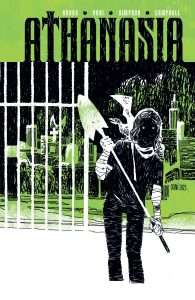
Superheroes might seem like they’re everywhere, from movies to underwear, but imagine living in a world where men and women with superpowers actually exist and save the world on a regular basis. Comics like Kurt Busiek’s Astro City have discussed what it’s like for mostly regular people to live in a world populated by people with powers, but Athanasia written by Daniel Kraus and illustrated by Dani, takes a much darker look at this concept. It not only explores what happens to superheroes who have lost their lives but what their remains mean for those with more earthbound problems.
Kraus’s tale takes us to Venture City, a town known for its superheroes, and follows young Forrest Molson. Forrest is a recovering addict who is looking for direction after graduating high school, so she goes into the family business. Like her father and grandfather, Forrest helps maintain the grounds at Athanasia, a cemetery housing the fallen members of Venture City’s greatest superhero team, the Dynamic Guild. Frustrated with her life and prospects, Forrest soon makes an astounding discovery: a chemical oozes from Athanasia’s soil that gives Forrest different superpowers. This new drug of choice (and the power that comes with it) soon takes over Forrest’s life. As friends and family try to pull Forrest back from the brink, her brush with superpowers soon becomes her villain arch.
Kraus is an author who’s better known for horror novels like Whalefall and Angel Down, but Athanasia is a horror story that touches upon many modern anxieties. The superheroes of this world mainly appear through their memorials, meaning they are not there when the Molson family, who have a deep respect for their positions as Athanasia’s caretakers, actually need them, illustrating how some heroes fly so high that they miss seeing the people who need their help. However, the truly harrowing moments in this book are when Forrest’s addiction spirals out of control, and she commits acts that both shock and appall readers.
Enhancing this story’s dark tones is Dani’s artwork, which eschews the dynamic colors in most superhero epics in favor of black and white ink drawing. This contrast shows readers that this story takes place far below the eyes of heroes, but the black and white also lets the book’s main villain shine. When the ooze makes its appearance and begins corrupting Forrest in earnest, the ooze (and the energy Dani manipulates when on the ooze) is colored a radioactive green, signifying its toxic nature and the frightening power now at Forrest’s fingertips.
There are many superhero stories that have cemented their status in our pop culture, but there are a multitude of stories, like Alan Moore’s Watchmen, that show the shadowy underbelly of these stories. This book will draw fans of both “Watchmen” and “Astro City” because it walks a thin tightrope of hope, like the kind in superhero narratives, and despair, like when readers take too long a glimpse beneath the capes.
Athanasia By Daniel Kraus Art by Dani Vault, 2025 ISBN: 9781638492818
NFNT Age Recommendation: Adult (18+), Older Teen (16-18)
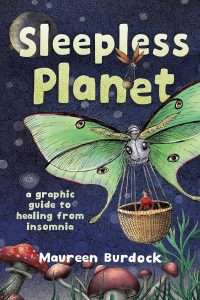
There are many people who take a good night’s sleep for granted while others would do anything to have it. In a world where caffeine is plentiful, doomscrolling is the number one activity behind pickleball, and anxiety is seemingly a cornerstone of our society, a good night’s sleep, for many, seems to be more unattainable by the day. Graphic storyteller Maureen Burdock has dealt with insomnia for much of her life and chronicles her journey in Sleepless Planet: A Graphic Guide to Healing from Insomnia, a book that’s part memoir, part self-help book, and part good sleep manifesto.
Burdock has suffered from insomnia since childhood. As an adult, she sought out doctors and specialists for quick fixes, including drugs and machines to help her breathe properly while sleeping. She eventually comes across a more holistic approach that includes diet, exercise, spirituality, and realizing how our culture of consumerism and progress are detrimental to our own mental health and even the health of the planet.
Far from a simple how-to-sleep manual, Burdock introduces a lot of concepts that don’t initially seem connected. The book can swing wildly from biography to environmental studies to dream studies and mediation. However, there is a slow and steady progression of ideas that are well-researched, according to the footnotes at the end of the book. Burdock’s work is broken up into four chapters, which helps break up the information she presents into manageable chunks and each chapter feels like its own separate book on better sleep. By labeling each chapter as one of the four elements (air, fire, earth, and water), Burdock also creates a mystical, dreamlike aesthetic that suits a book presenting an overall holistic approach to getting better sleep.
That dreamlike aesthetic is only reinforced by Burdock’s artwork, which, while eschewing color, presents a vivid landscape where slices of life are intertwined with symbolic imagery. Presenting information within comic panels along with pictures can often be more accessible, whether those pictures use illustration to demonstrate an idea in action or simply to create a sense of whimsy, what Mary Poppins would call a “spoonful of sugar” that helps the didactic text blocks be remembered. Burdock presents a lot of whimsy in the form of talking koalas, inanimate objects with expressive faces, and an anthropomorphic representation of menopause that smothers the author much in the same way an MMA fighter smothers an opponent.
Adult services librarians interested in purchasing this book should reconsider simply sticking this book in your library’s Graphic Novel collection. Consider putting it in your library’s nonfiction section with other books on diseases and how to cure them. It will improve the chances of a person in need of a good night sleep (and in need of advice from someone who’s lived with insomnia) finding it.
Sleepless Planet A Graphic Guide to Healing from Insomnia By Maureen Burdock Graphic Mundi, 2025 ISBN: 9781637790939
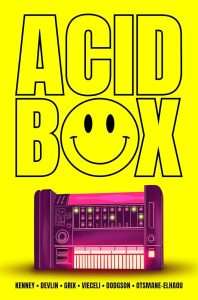
Many science-fiction stories follow Mary Poppin’s advice of providing a spoonful of sugar to go with one’s medicine. While readers are usually enjoying the fantastic technologies and interdimensional shenanigans, they are also assimilating the story’s moral about universal problems that affects most everyone on earth, at least ideally. Sometimes, that’s a delicate balance. Too much sci-fi sweetness and the author’s message becomes lost, but too little and the audience becomes resistant to the author’s didactic delivery. Luckily, Acid Box, with its story provided by Sara Kenney and art provided by James Devlin, Emma Vieceli, and Ria Grix, manages that delicate balance.
This time travel adventure begins in 2026 with Jade Nyo, a Glasgow woman more interested in dancing and getting high (and taking care of her brother) instead of saving the world. During a trip to a seemingly normal restroom, however, she becomes acquainted with three women who call themselves Liminals, guardians of doorways through space and time. Jade becomes responsible for the Acid Box, a device that can potentially cause geological catastrophes. Jade and her companions, including her brother, go on a quest, traveling through space, time, and the 90’s rave culture scene to repair the Acid Box while hopefully not destroying the world.
As much as Kenney’s story is about environmental issues and humanity’s role in them, this story also serves as a love letter to rave culture and what music itself provides. Jade and the people she encounters on her journey serves as musical and historical tour guides through the ‘90s as the book explores the rave music genre along with historical events. Such a statement might sound like a synopsis from a PBS show about the power of music, but that’s not necessarily a bad thing. The main benefit of this musical genre, argued by Kenney’s story, is its power to connect people and unite them under a common cause. This trip through musical history also allows Jade to experience her own hero’s journey of self-discovery once she stops relying on recreational drugs to handle the mindbending time-travel narrative.
Complementing this mindbending journey is the visuals provided by the multiple artists that lend their talents to this book. There are many opportunities for these artists to be creative, from depicting natural disasters that seem to be sentient to trips through different time periods that take their toll on the body. Many of these panels take up whole pages, so the artists have a lot of canvas to show off their talents. Combined with Kenney’s story, the art is as vibrant and stirring as the music serving as the narrative’s heartbeat.
This book is ideal for librarians wanting graphic novels that take advantage of both the linguistic and visual aspects of the medium. Acid Box provides a visual feast for the eyes, a compelling protagonist, and a story that doesn’t dilute this message, the proper ratio of sugar and medicine.
Acid Box By Sara Kenney Art by James Devlin Not in listAvery Hill Publishing, 2025 ISBN: 9781917355056
NFNT Age Recommendation: Adult (18+), Older Teen (16-18) Creator Representation: British,

 Though fiction is often thought of strictly as entertainment, there are moments where it can teach, particularly when said fiction looks at a rather dark period of American history. The reasoning behind using historical facts as the backdrop of fictional stories is often to show how such events happen, but those events take on a greater urgency when readers see similar events playing out on our newsfeeds, which makes Death to Pachuco, a graphic novel noir written by Henry Barajas and illustrated by Rachel Merrill, an example of how history, as the old saying goes, often repeats.
 in terms of appeal, innovation, and storytelling, that every library should
 always seem to represent something beyond the natural fear a person would have against something with fangs and claws. Many times, these monsters are symbolic of a more universal fear involving a person’s space in society or in the universe at large (at least according to critics). Ghosts, for example, are often connected to humanity’s universal fear of death. Zombies are often symbols of death as well as disease. Author and illustrator Jon Claytor, however, presents an interesting idea in his book Nowhere, the world of zombies, vampires, and aliens represents the very modern fear of growing up.
 The graphic novel medium has the ability to convey complex ideas and emotions through images, revealing many interesting aspects of the human condition. Then there are books like Final Boss, Vol. 1, written and drawn by Tyler Kirkham with additional art by David Miller.
 When most people think of Robert Kirkman’s zombie apocalypse story The Walking Dead, they likely remember two aspects of the show. The first is, of course, the zombies (or “walkers,” as they were called on the show). Everpresent and always hungry, they drove much of the story’s survival narrative. The second aspect, and perhaps the secret of the show’s popularity, was its non-zombie characters, humans who once had jobs, families, and lives before society collapsed and are now stuck simply trying to survive this new, deadly world. Everything Dead & Dying, a zombie apocalypse tale by writer Tate Brombal and illustrated by Jacob Phillips, shows Kirkman’s legacy throughout its DNA, even as it makes a subtle but poignant tweak to his formula.
 If Dracula himself had a drop of blood for every retelling and reimagining of his story as written by Bram Stoker, then he might never have to bite another neck to sustain himself. Since stories about Dracula (and about vampires that owe so much of their aesthetic to him) are so prevalent, doing one that’s wholly original is about as difficult to find as it is to find a vampire that loves the sun. Woodstake: Three Days of Peace, Music, and Blood Vol. 1 is writer Darin S. Cape’s and illustrator Felipe Kroll’s attempt to retell the Dracula mythos, setting it at a very famous music festival synonymous with the 60’s and the Summer of Love.
 be easily generated through a computer. “Sophisticated” means, in this case, the artwork has aspects like realistic looking human faces, shading, and color gradation that makes the book look more like a collection of photographs than anything drawn by a human being. It’s important to remember that “graphic novel” is a medium rather than a genre, and a medium can convey a variety of different ideas. For example, Heaven, West Virginia, written and illustrated by Ravi Teixeira, doesn’t need chiseled jawlines or a computer-generated color palette to tell an emotionally wrought story about coming home to find oneself.
 with superpowers actually exist and save the world on a regular basis. Comics like Kurt Busiek’s Astro City have discussed what it’s like for mostly regular people to live in a world populated by people with powers, but Athanasia written by Daniel Kraus and illustrated by Dani, takes a much darker look at this concept. It not only explores what happens to superheroes who have lost their lives but what their remains mean for those with more earthbound problems.
 There are many people who take a good night’s sleep for granted while others would do anything to have it. In a world where caffeine is plentiful, doomscrolling is the number one activity behind pickleball, and anxiety is seemingly a cornerstone of our society, a good night’s sleep, for many, seems to be more unattainable by the day. Graphic storyteller Maureen Burdock has dealt with insomnia for much of her life and chronicles her journey in Sleepless Planet: A Graphic Guide to Healing from Insomnia, a book that’s part memoir, part self-help book, and part good sleep manifesto.
 Many science-fiction stories follow Mary Poppin’s advice of providing a spoonful of sugar to go with one’s medicine. While readers are usually enjoying the fantastic technologies and interdimensional shenanigans, they are also assimilating the story’s moral about universal problems that affects most everyone on earth, at least ideally. Sometimes, that’s a delicate balance. Too much sci-fi sweetness and the author’s message becomes lost, but too little and the audience becomes resistant to the author’s didactic delivery. Luckily, Acid Box, with its story provided by Sara Kenney and art provided by James Devlin, Emma Vieceli, and Ria Grix, manages that delicate balance.


