Originally released in Japan as Mach GoGoGo in 1967, Speed Racer was one of the first anime to be adapted for American audiences. Despite being relatively short-lived (with only 52 episodes produced) it still developed a devout following. It was strong enough, at least, that there have been multiple attempts to update it on both sides of the Pacific, with the 2008 live-action movie by The Wachowskis being the most famous. And yet, for my money, none of them have truly managed to update the premise while remaining true to the spirit better than the new Mad Cave Speed Racer series.
The series is set in Palm City; a coastal town with a tradition of Formula X racing. This extreme sport differs from classic formula/open-wheel racing in two important respects. First, the pit teams are allowed to modify their cars with whatever experimental gimmicks they want. (Indeed, the X in Formula X stands for eXperimental.) The second is that there is an underground Formula X league that competes in the city streets rather than the official tracks. This last point is of particular concern to the Palm City Police Department, who are fighting a losing battle trying to keep up with the fast and furious unsanctioned matches.
Speed Racer is the latest scion of a legendary Palm City legacy, who has abandoned university studies for underground racing. However, while he feels most at home in the driver’s seat, he does not race for glory. He went into the underground to help his father pay the bills, since his dad won’t let him drive in the official Formula X league. However, Speed gets his chance after a gang attack sends his father to the hospital and fate gives him a chance at a sponsorship that could solve their problems. All he has to do is prove he’s as good as he thinks he is.
Writer David Pepose doesn’t change the formula from the classic cartoons so much as he builds on it, with a few modern touches. Speed’s younger brother Spritle, for instance, is still the same fanboy with a tendency to get into trouble. However, he has been aged up a bit and now operates as Speed’s social media manager, hyping his brother to the masses with videos of his latest runs. Similarly, Speed’s girlfriend Trixie is still the same spitfire who defied the damsel-in-distress tropes popular to animation at the time. The only major change is that now she’s the daughter of a car manufacturer rather than an aviation firm. This has her acting as Speed’s sponsor, giving her a reason to be in the pit beyond offering emotional support. Beyond that, the core of the cartoon is the same, with thrilling action facing sinister villains.
That thrilling action is amazingly illustrated by a crack team that works like a Formula X pit crew. Davide Tinto’s anime-infused design captures the spirit of the cartoon, but with a detail-driven yet streamlined edge. Rex Lokus provides a paint-job with his colors that leaves every panel popping on the page. And Buddy Beaudoin throws in a few neat tricks with the word balloons for the finish.
Mad Cave has rated Speed Racer Vol. 1 as appropriate for teen audiences. I consider that to be a fair assessment. There is some intense action, as one would expect with a racing manga where the villains are gangsters, but nothing inappropriate to a 13+ audience. There is no nudity and the sexual content is limited to kissing. There is one scene of Speed and Trixie driving to a romantic overlook, but they spend the time talking about cars and their dreams while sitting on the hood rather than in the back seat.
Speed Racer Vol. 1 By David Pepose Art by Davide Tinto Mad Cave Studios, 2026 ISBN: 9781545823422
Company Age Rating: 13+ Related media: TV to Comic
NFNT Age Recommendation: Older Teen (16-18), Teen (13-16)
After her mom dies, teen protagonist Joey is forced to move to Kodiak, Alaska to live with her dad; quite different from where she lived in Seattle!
Her dad hasn’t been present in her life until NOW, and even though everyone tells her he’s a nice stand-up guy, that previously didn’t include her, apparently. The only friend she’s made is a 3000-pound grizzly living in the woods near her house. While Kodiak people talk about a mythical “spirit bear”, no one has seen it except her. Did I mention that her dad is a state trooper? Did I mention that Joey can see auras? When Joey goes missing in a snowstorm while taking her dad’s boat out, (without his permission) the bear comes to her rescue. (The bear also rescues her twice!) State troopers and volunteers with rifles start a search, and well, you can imagine how this turns out. BUT WAIT! MORE drama is in store – Eons-old Mama Grizzly knows her cub has been killed, and BOY IS SHE PISSED!
I’m on the fence about this title. The pacing of this story is awkward. It seems like a LOT of sturm-und-drang in a very short time. Joey is already dealing with her mom’s death and a move and has to witness the brutal killing (TWICE!) of the only friend she’s made. Any ONE of these things would be profoundly disturbing to any teen, and the bloody killing scenes by the hunters AND THEN AGAIN by the troopers and searchers could be triggering to some teens. They were to me, and I’ve had Hunters Education classes! Car crashes, plane crashes, evacuations of people, explosions everywhere and the destruction of downtown Seattle follow. After Mama’s rampage, the story hustles on to a hurried-up and (what I felt was) unlikely, too-easy ending. Joey and her father finally work together to lead Mama and her dead cub back to the wilderness. I like a good kaiju story as much as anyone, but it’s too much plot for only 168 pages. Authority figures and adults (with some exceptions) are one-dimensionally portrayed as testosteroney enthusiastic killers. The plot lurches from one unlikely situation to another. Finally, there are plot threads that are never explained, like the huge bones found during a construction site excavation, and the hunters who kill a grizzly without facing consequences. (It’s illegal to do that in AK without a bear tag, which is won in a organized lottery, and only used legally during a certain period of time.)
The art is well developed, but I feel like the women are more realistically and positively drawn. The men are drawn with sharp angles and scatological grimaces. Joey’s dad is drawn in a two-dimensional way that blocks us from imagining the “guy everyone loves.” All the animals are drawn in a wonderfully realistic and mystical fashion.
We certainly need more comics and graphic novels that depict native Alaskan peoples, stories and culture, but I think this comic tries to do too much. Is it a Godzilla/Kaiju action story? Is it a story about a teen processing her grief? Is it about life challenges and changes? One barely has time to catch one’s breath and think about it.
The comic is marked for “Young Adult” age range, and I would shelve it there. Despite my quibbles, teens may like it purely for the action. I would call it an optional purchase.
Queen Kodiak By Christopher Greenslate Art by Riccardo Faccini Mad Cave Studios, 2026 ISBN: 9781545821015
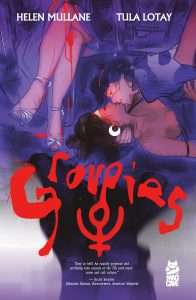
Anima. Lisa Storm. Vera Vicious. Morgaine La Fey. Gaia.
Five different women, both friends and rivals. Five women among the hottest and wildest girls to be found cruising the Sunset Strip. They make the scene. They go backstage. They enjoy the drugs and the bands just passing through. Every night is a new party. Every party is a new adventure.
That changed with the arrival of The Moon Show—a band on the verge of becoming the next big thing. The girls are there when a major label signs them. They go on the road with the band as they go on-tour. And for a while they are living the dream in style.
However, the girls start noticing something is wrong. Other women the band picks up go missing. And some of the girls start seeing strange things while they’re high. Visions of some darkness behind The Moon Show. Something that calls for blood!
Groupies is a hard comic to quantify. It is horror, but it is a slow-boiling horror story where the terrors are more existential than gory and largely left to the imagination. There is a mystery, but the big secret of the story is telegraphed early and somewhat predictable given stories about musicians selling their souls are common enough. (The label that signs The Moon Show is called Asmodeus Records, for crying out loud!)
Thankfully, that’s not really what Groupies is about. The mystery and horror are just background dressing to the true focus of the comic. Namely, the stories of five different women trying to find meaning in their lives amid the sex, drugs, and rock and roll culture. And their vastly different reactions to everything around them.
Lisa Storm, for instance, enjoys the scene, but still dreams of finding true love with The Moon Show’s front-man, Si, despite knowing deep down he’s a dog. Gaia and Morgaine work together to bring rock stars into bed, yet both would rather spend time with alone with one another. The irony is they are both fearful of saying anything for fear of ending what they have. And then there’s Vera Vicious, who for all her blunt talk and complaints about other women trying to steal her man of choice, is the first to realize there’s something strange about the people from “the label” and something sinister going on. All in all, Helen Mullane does a fantastic job of developing these characters and putting the reader inside their heads.
Similarly, Tula Lotay turns every chapter into a different sort of visual journey. It does the artwork a disservice to describe it as merely psychedelic. Oh, there are shifts in the artwork as the characters get high, but there are different alterations to the style and colors depending on the drug. The dark visions Gaia has after taking datura, for instance, are different than the shared hallucination the women enjoy as they drop acid before going for a walk in the woods and start imagining themselves as dryads.
Groupies is rightly recommended for Mature readers. There is cursing. There is nudity. There is everything one would expect in a story devoted to exploring the dark side of sex, drugs, and rock-and-roll. And that’s before you bring in all the murder, assault and demons. In short, this is one to put in the adult collection of the public library and one to keep away from the kids and teens.
Groupies By Helen Mullane Art by Tula Lotay Mad Cave Studios, 2026 ISBN: 9781545821268
Company Age Rating: 18+
NFNT Age Recommendation: Adult (18+) Creator Representation: British, Character Representation: Bisexual,
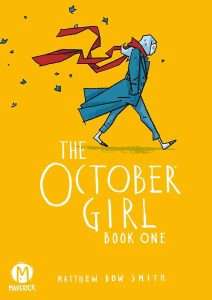
Eighteen-year-old Autumn is in her senior year of school and works in a coffee shop. It seems like a humdrum life, but what she’s going to do after graduation eludes her. Her dad left a couple years ago, and her mom doesn’t have any money to send her to college. So, her future holds just work, and for not enough to live on by herself. Is this all there is?
Then, a boy from her school (who owns a bookshop) and an imaginary friend from her childhood (who’s a… well, it’s not explained right away… ) pop back into her life through a series of increasingly unlikely events. Statues of animals in the park speak to her, tiny glowing fairy lights find her in the park, her hands start *glowing*, and a HUGE guardian troll named Fred finds her and then disappears! The coffee job suddenly seems soothingly boring after that. But strange people keep finding her. Just when a dark, purple-suited man with a Van Dyke shows up and threatens her, her MOM shows up and defends her! (With her same glowing hands and eyes!) Why won’t anyone tell Autumn what’s going on? All she keeps hearing is “not now”.
The art is sharp edged, with broad marker inking, and is somewhat two dimensional. Washes of color help portray the light values and keep the art more interesting. It reminds me a bit of Mike Mignola’s art, back in the first days of Hellboy, or his graphic novels of Leiber’s Fafhrd and the Grey Mouser. And just like those comics, this spooky tale starts with a teenager’s discovery that the world isn’t exactly what she thought it was. It’s filled with creatures, fae, and dark powers. Who IS Autumn? Who is her mom? Adolescent anxieties and rites-of-passage sync perfectly with this story, which flows smoothly and should interest teens and young adults. Autumn is challenged to decide who she wants to be. But she needs to figure it out soon, because Mr. Purple-Suit’s threats are getting louder and more powerful. (OTOH, isn’t it useful when the baddies just TELL you what nefarious plans they have? Bad call, Mr. Purple Suit. And stop the mansplaining, would you?)
No adult situations, and minimal violence. Suggested for the young adult section.
The October Girl, Book 1 By Matthew Dow Smith Mad Cave Studios, 2025 ISBN: 9781960578594
NFNT Age Recommendation: Adult (18+), Older Teen (16-18), Teen (13-16)
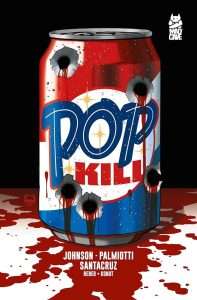
Those who remember the 80s will remember the Cola Wars, where Coke and Pepsi duked it out in the realm of public opinion through eye-catching ads and seemingly random taste tests. These companies mainly fought for our attention but Pop Kill, from writers Dave Johnson and Jimmy Palmiotti and illustrations from Juan Santacruz, shows two other rival soda companies using much more conventional and destructive weapons to settle their differences.
The companies in question are Fizz One and Popso, each one run by twin brothers who were once conjoined and now can’t stand each other, both looking to destroy the other’s corporation. Enter corporate saboteur/hitman Jon Pyle, a man of many skills and many one liners, currently working for Fizz One due to a misunderstanding among Pyle, Fizz One’s CEO, and the CEO’s mistress. His latest task is to eliminate Dina Deluxe, a scientist who has developed a formula for soda that doesn’t fall flat, a formula that could finally bury Fizz One and put Popso on top. But nobody, not even Jon, thought he would fall for Dina and her pug. Now all three are on the run from two megacorporations who can afford an army of assassins and agents.
The Cola Wars might offer a blueprint for Johnson and Palmotti’s story, but either soda, being a drink that bubbles and pops while having no nutritional value, is the overall metaphor for the narrative, which is not necessarily a bad thing. Pyle spends a lot of time shooting people, causing lots of explosions, and having sex with attractive and often topless women (one panel has him crawl from underneath a pile of them). Neither he nor the plot allows time to ruminate on a career that often involves killing people; instead the book moves briskly from quip to violence and back again, making it not a story one savors after the book is closed but a tale that will be loads of fun while reading it.
And speaking of violence, Santacruz depicts that violence with syrupy blood splatter and automatic weapon gunfire that burns bright while its accompanying “Blam!” sound effects pepper the page. Not only are the players in this action movie committed to paper all look like they stepped off of Central Casting, but the vibrant colors are ones that Coke and Pepsi have used in their own commercials. This book might not feed the brain but it is most assuredly a feast for the eyes.
Many librarians know that some reading is for education or enlightenment, the same way we might eat oatmeal for breakfast and avoid, say, a stack of waffles dripping with chocolate sauce and whipped cream. Pop Kill definitely falls in the “stack of waffles” category. Those adult graphic novel readers who love high-velocity action films like The Transporter and Bullet Train will enjoy Jon Pyle’s adventures, which might seem like a guilty pleasure to some but the copious amounts of sex, nudity, and dry wit are guaranteed not to rot your teeth.
Pop Kill By Jimmy Palmiotti, Dave Johnson Art by Juan Santacruz Mad Cave Studios, 2025 ISBN: 9781545817872
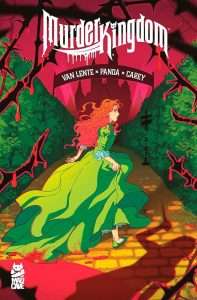
The words “meta” and “horror” weren’t typically mentioned together until the 1996 movie “Scream.” Not only did the movie revitalize the waning slasher genre, but it also serves as a blueprint as to how a movie can still entertain audiences while explaining the tropes it uses. Since the premier of Scream and its multiple sequels, horror movies have been given permission to give audience members well-versed in horror permission to get a good look behind the blood-streaked curtain. This has, in fact, become a trope in itself, one that has been adopted by Murder Kingdom, a garish, grim, and gory tale written by Fred Van Lente and illustrated by Chris Panda. Not only does this story stick the knife into the slasher genre, but it also eviscerates the notorious magical theme park down in Florida.
Tanith is disillusioned because, as the conductor of the Rock Candy Mountain Railroad, she has experienced the hardships of creating the magic at Storybook Kingdom theme park. Thanks in part to Tanith’s red locks, she is called away from her conducting duties to do meet-and-greets as princess Briar Rose. Unfortunately, the actress Tanith replaced is murder by a Girl with No Hands (a fairy tale character) and as more and more people are dispatched in methods taken from Grimms’ Fairy Tales, Tanith must find the killer to keep her own story from prematurely ending.
Those who have worked in theme parks (or in any job involving customer service) might find the horrors Tanith endures, such as leering fathers and the errant ashes of loved ones, just as awful as the prospect of a possible killer running around. Van Lente’s story follows all the slasher tropes, from red herrings to characters serving as convenient infodumps, but it saves its sharpest knives for the fairytale land it occupies, from skewering the sanitizing of what were quite gruesome children’s stories to exposing the corporate machinations behind the magic.
Rather than simply being a copy of Walt Disney World with enough changes to avoid Disney’s lawyers, Storybook Kingdom feels like a realized theme park, which is helped by Chris Panda’s illustrations. Everything from the overall look of the park to its underground tunnels (which do exist underneath Walt Disney World) have a look that balances authenticity and artifice. The colors seen here are vivid and vibrant, especially the reds when someone’s innards are exposed. Some of Panda’s artwork even has the look and feel of a page pulled from a storybook that could give young reader nightmares. With the ending leaving room for a sequel (as great slashers do), it will be interesting to see what kind of theme park aesthetics Panda creates next.
If Murder Kingdom is an ongoing series, this issue might be a good one for adult librarians to add for their horror and Disney loving patrons, particularly if those Disney/horror fans have a sense of humor. Even slasher fans who hate Disney might want to check it out because, as “Scream” has proven, sometimes the most memorable slashers are those who can make fun of themselves.
Murder Kingdom By Fred Van Lente Art by Chris Panda Mad Cave Studios, 2025 ISBN: 9781960578785
NFNT Age Recommendation: Adult (18+), Older Teen (16-18)
Library patrons of a certain age may remember when a crime wave hit local cinemas back in the 90s. Nothing was actually stolen but money was lost from fans who gladly spent their money on tickets to see films like Quentin Tarantino’s Pulp Fiction and Guy Ritchie’s Lock, Stock, and Two Smoking Barrels, films that show the sometimes comedic and often chaotic world of criminals behaving criminally. Mugshots, written by Jordan Thomas and illustrated by Chris Matthews, is something of a throwback to that era, even if it does take place in the year 2008, while also managing to tell its own unique story.
As mentioned before, the story takes place in 2008 in a version of Bristol, UK that Guy Ritchie could have visited for inspiration. John Bannon might be an unrepentant criminal but he’s still a loving uncle, which is why he heads back to Bristol to help find his missing niece. Bristol is especially dangerous for John since crime boss Harry Woods has declared Bristol off limits for John. This means that John’s investigation into his niece’s disappearance will make him the target of gangsters, killers, and corrupt cops, all while a gang war threatens to tear the city apart.
For those patrons that love crime stories that follow Tarantino’s and Ritchie’s aesthetics, stories with twisted plots and casual violence, Thomas’s story more than provides. Many of these characters are immediately likable, or at least charismatic in the way that good villains are. In the book’s intro, Thomas says this about his characters: “These people are doing terrible things, but goddamn if they aren’t entertaining to spend time with.” Many of them are entertaining despite how they quickly and brutally resort to violence and intimidation to get what they want. Differentiating his story from filmmakers like Tarantino and Ritchie, Thomas avoids the pop culture quips and rapid fire exchanges that are often part of their films, instead focusing on efficiently telling a noir-ish story of how crime doesn’t always pay but one must eventually pay for their crimes, one way or the other.
This efficiency is also the theme in Matthews’s unique and eye-catching artwork. Matthews uses a retro art style that would look right at home on a poster for a thriller from the 60’s. Using minimal colors and details, Matthews still manages to clearly tell a story visually with dynamic movement from his characters, along with small touches like character designs with distinct head shapes and hairstyles, that make what’s going on in the story easy to follow.
This book from Mad Cave Studios shows how this studio is diversifying its offerings and not simply relying on horror and fantastic stories. Such diversity among their titles will put this publisher up there with other comic publishers like Image Comics and Dark Horse. Adult graphic novel fans who fondly remember 90’s crime movies, or who watched those movies on streaming, should like reading and untying this tangled plot to reveal a simple story of how crimes, both big and small, eventually catch up to us.
Mugshots By Jordan Thomas Art by Chris Matthews Mad Cave Studios, 2025 ISBN: 9781545815915
The heartwarming queer romance Navigating with You by Jeremy Whitley and Cassio Ribeiro is one of my favorite graphic novels that I read this year. Meet Neesha Sparks, an outspoken yet guarded teenager from Queens. Florida surfer girl Gabby discovers how to win Neesha over with persistence, an upbeat attitude, and vulnerability. Both girls are new to their high school in Durham, North Carolina. They quickly connect over a manga series that they each read but never finished and form a book club to re-read and, this time, complete the series. The problem is that Super Navigator Nozomi is out of print and ordering a set of the books online is quite expensive. Gabby proposes a competition to find the seven books of the series and Neesha accepts.
Navigating with You has phenomenal representation that plays out naturally in the story and art. Neesha has spastic diplegia cerebral palsy, so she uses assistive devices such as leg braces. She confronts ableism and discrimination, such as when vehemently explains to her new principal that just because she is disabled, it does not mean he should re-assign her from Advanced Placement classes to Special Education classes. Neesha is Black. She has dark skin and wears her hair in braids. We see Neesha stumble and fall, and we see her sew fabulous costumes, drive Gabby around, and visit the farmers market. She typically wears long skirts or pants that conceal her leg braces. Gabby is half Puerto Rican and half Mexican. Her mom died and she lives in an apartment with her dad and two brothers. Gabby is bisexual and has a toxic long-distance boyfriend who does not validate her sexual orientation. She suffers from Post-Traumatic Stress Disorder which triggers flashbacks and panic attacks related to her mom’s death. Ribeiro deftly illustrates one of Gabby’s flashbacks by alternating between each girl’s viewpoints, so we see Gabby’s memories unfold as Neesha observes and tends to her girlfriend.
Pages from Super Navigator Nozomi intersperse the main story, so the reader can enjoy the manga alongside Neesha and Gabby. As the manga sections are in traditional black and white with a cartoony style, and the rest of the story is in rich earth and jewel tones, it is easy to distinguish between the two.
This unpaged volume contains wonderful characterization with a sweet romance. Whitley unspools each teen’s backstory as they become better acquainted with one another. By the end, the protagonists feel real and their romance feels hopeful. Language, content, and themes are appropriate for tweens and up. Be sure to acquire and recommend Navigating with You!
Navigating With You By Jeremy Whitley Art by Cassio Ribeiro Mad Cave Studios, 2024 ISBN: 9781952303609
NFNT Age Recommendation: Teen (13-16), Tween (10-13)
Character Representation: Black, Mexican, Puerto Rican, Bisexual, Gay, Cerebral Palsy, Post-Traumatic Stress Disorder
Horror is one of those genres that fits in everywhere. There’s horror westerns, horror romances, and even horror comedies, but perhaps the most serendipitous pairing occurs when horror and action get together in a genre mashup. Both genres, through different methods, are designed to get the readers’ hearts pumping and blending action sequences with terrifying images is sure to keep those heart rates up.
A recent example of action/horror comes from Mad Cave Studios, the publishers behind Edenfrost and Hound. Mad Cave’s latest The Devil That Wears My Face is described as Face/Off meets The Exorcist and the book, written by David Pepose and illustrated by Alex Cormack, blends the best of both of those movies.
The story takes place in 1740 (making this a historical/action/horror tale). Father Vieri is a priest who is currently having a crisis of faith, even though he is a kind-hearted man. That does not stop him, however, from accepting an assignment from the Church. He must travel to Spain to exorcise a demon that resides within a Spanish nobleman’s son. This demon has already killed others who have tried to remove it, but when Vieri encounters it, the demon named Legion does something worse to Fieri: he switches their bodies. While Vieri is imprisoned and tortured, with many believing he is the demon, Legion returns to the church in Fieri’s body to wreak havoc.
Pepose’s story borrows heavily from the movie Face/Off, a 1997 action film starring Nicolas Cage and John Travolta. Cage’s and Travolta’s characters switch faces and in the ultimate case of mistaken identity leads to the hero not only trying to catch the villain but staying ahead of the police who think he’s the villain. It’s important to mention the plot of Face/Off because The Devil That Wears My Face basically borrows the entire plot of that movie. However, that doesn’t make this book a Face/Off reimagining with a possession added in. Pepose adds his own action elements that rival anything on screen, whether it’s riding a cart through a flaming city or Legion using his supernatural abilities to leap great heights and climb walls like Spider-Man.
Cormack’s art not only showcases the action in Pepose’s story, making the supernaturally powered Legion in Vieri’s body as dynamic as Batman, but he also adds the horror that goes beyond mentions of demons. Blood flows generously on Cormack’s pages and bodies are not only torn apart but showcased in a way that could turn a few stomachs. When the story begins to dig deep into the supernatural and show the mental battle between souls and demons in a visual way, Cormack gives these scenes featuring horrific demons their deserved epic scale.
Some genre mashups lean too heavily into one genre or another but The Devil That Wears My Face manages to straddle that razor’s edge, being both thrilling and disturbing. The book doesn’t shy away from gory scenes, but it’s mainly written for adult horror fans who don’t mind if the monsters are soaring over rooftops like a hero (or villain) straight out of Marvel or DC.
The Devil That Wears My Face By David Pepone Art by Alex Cormack Mad Cave Studios, 2024 ISBN: 9781952303838
No matter if a superhero was bitten by a radioactive something, caught in the heart of a nuclear explosion, or watched a bat fly through their window, a large part of that hero’s narrative is their origin story. Of course, it’s not just the event that gave the hero their powers, but it also provides their motivations, whether they use their powers to preserve order or destroy evil, which transforms the debate into whether or not the hero is using their powers responsibly.
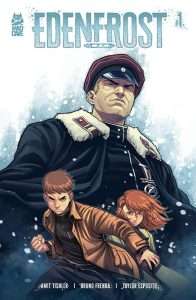
Even though Edenfrost, written by Amit Tishler and illustrated by Bruno Frenda, is a historical fantasy story set during the Russian Civil War, it borrows many plot points from the archetypal superhero narrative.
The story’s unlikely heroes are brother and sister, Alex and Yuli, who are on the run after their village is attacked by Russian soldiers. However, this is more than just a village being razed by superior firepower. A survivor of the onslaught says that a terrible monster sprang up out of the earth and attacked them. Alex knows about this monster and soon Yuli will, too. It is a monster that is immensely powerful, but it also craves someone who will use that power, whether for good or evil purposes.
It’s easy to get lost in the geopolitical nuances of this war that hangs over the book, but Tishler does a good job of keeping this story on a very basic path of conflict: hero(es)’s home destroyed, hero(es) must try to escape the charismatic yet evil villain (in Edenfrost, it’s the ice-cold Colonel Krasnov) pursuing them. Tishler does sprinkle some commentary about the effects of war, such as when Alex and Yuri must hide out with a woman who would kick them out (or worse) if she knew about their Jewish heritage and a soldier who tries to tempt Alex into using the golem’s power in the war effort. This tale could be applied to any story where the heroes must make some very difficult choices with the power they’ve been given.
That power is depicted through Frenda’s dynamic artwork. Fans of “Avatar: The Last Airbender” and how it depicts earthbending will love to see columns explode out of the ground. When the golem, a creature made out of earth and stone, not only appears but mow down enemy soldiers, the creature acts with a speed and brutality one typically sees in martial arts battles displayed in the graphic format. However, Frenda’s artwork isn’t just “Dragonball” or “Ranma ½” set in Ukraine. The faces of these characters all feel real and distinct. Alex and Julia are young and their emotions are all over their faces. Krasnov emotes very little, merely sneering at those who challenge his superiority until he tells the troops under his command to shoot those challengers.
Edenfrost is a superhero story, but it doesn’t necessarily end with its heroes soaring over a city skyline. Alex and Yuli are still surrounded by war, death, and social upheaval. Their powers don’t guarantee that they’ll even survive, much less survive this war with their values intact. Its mature themes might land with an adult audience who have grown up reading superhero comics but have lived long enough to know that one’s problems, or society’s ills, are solved by a radioactive spider bite.
Edenfrost By Amit Tishler Art by Bruno Frenda Mad Cave Studios, 2024 ISBN: 9781960578686
NFNT Age Recommendation: Adult (18+), Older Teen (16-18) Creator Representation: Israeli-American, Character Representation: Ukrainian,

 Originally released in Japan as Mach GoGoGo in 1967, Speed Racer was one of the first anime to be adapted for American audiences. Despite being relatively short-lived (with only 52 episodes produced) it still developed a devout following. It was strong enough, at least, that there have been multiple attempts to update it on both sides of the Pacific, with the 2008 live-action movie by The Wachowskis being the most famous. And yet, for my money, none of them have truly managed to update the premise while remaining true to the spirit better than the new Mad Cave Speed Racer series.
 After her mom dies, teen protagonist Joey is forced to move to Kodiak, Alaska to live with her dad; quite different from where she lived in Seattle!
 They make the scene. They go backstage. They enjoy the drugs and the bands just passing through. Every night is a new party. Every party is a new adventure.
 to do after graduation eludes her. Her dad left a couple years ago, and her mom doesn’t have any money to send her to college. So, her future holds just work, and for not enough to live on by herself. Is this all there is?
 eye-catching ads and seemingly random taste tests. These companies mainly fought for our attention but Pop Kill, from writers Dave Johnson and Jimmy Palmiotti and illustrations from Juan Santacruz, shows two other rival soda companies using much more conventional and destructive weapons to settle their differences.
 the waning slasher genre, but it also serves as a blueprint as to how a movie can still entertain audiences while explaining the tropes it uses. Since the premier of Scream and its multiple sequels, horror movies have been given permission to give audience members well-versed in horror permission to get a good look behind the blood-streaked curtain. This has, in fact, become a trope in itself, one that has been adopted by Murder Kingdom, a garish, grim, and gory tale written by Fred Van Lente and illustrated by Chris Panda. Not only does this story stick the knife into the slasher genre, but it also eviscerates the notorious magical theme park down in Florida.
 money was lost from fans who gladly spent their money on tickets to see films like Quentin Tarantino’s Pulp Fiction and Guy Ritchie’s Lock, Stock, and Two Smoking Barrels, films that show the sometimes comedic and often chaotic world of criminals behaving criminally. Mugshots, written by Jordan Thomas and illustrated by Chris Matthews, is something of a throwback to that era, even if it does take place in the year 2008, while also managing to tell its own unique story.
 graphic novels that I read this year. Meet Neesha Sparks, an outspoken yet guarded teenager from Queens. Florida surfer girl Gabby discovers how to win Neesha over with persistence, an upbeat attitude, and vulnerability. Both girls are new to their high school in Durham, North Carolina. They quickly connect over a manga series that they each read but never finished and form a book club to re-read and, this time, complete the series. The problem is that
 comedies, but perhaps the most serendipitous pairing occurs when horror and action get together in a genre mashup. Both genres, through different methods, are designed to get the readers’ hearts pumping and blending action sequences with terrifying images is sure to keep those heart rates up.
 fly through their window, a large part of that hero’s narrative is their origin story. Of course, it’s not just the event that gave the hero their powers, but it also provides their motivations, whether they use their powers to preserve order or destroy evil, which transforms the debate into whether or not the hero is using their powers responsibly.

