Lee Nordling, one of the creators of the Three-Story Books, teams up with another creator to bring young readers a new imaginative, wordless series.
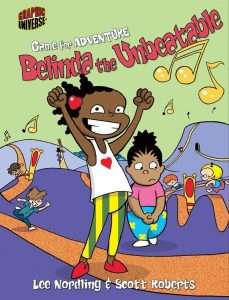
The story begins with a row of children marching past their lockers. Belinda is at the lead, showing all her friendly confidence. She stops and goes back to collect her friend, Barbara, who is shy and not feeling like participating. Once they all arrive in the gym, the game begins. It’s musical chairs: the teacher starts the cd player, and they start marching around the chairs… but what’s this? Everything is changing! Soon they’re marching across a surrealistic landscape, where the path twists and turns and the chairs are giant. The musical notes crash down and the floor swells like an ocean. Two of the kids are determined to win at any cost, even if it means cheating. Belinda and Barbara are more focused on helping each other out, though. But as the game gets more dangerous, who will be left standing, or rather, sitting?
At the front of the book, dark blue endpapers show the kids running through the hills, and again through the same maze at the back, this time captioned with their names and little hints about their characters. The pace of the story is slow, with plenty of time for readers to observe each subtle change in the characters’ faces as they react to the transformed landscape and compete with, and against, each other. Wild colors splash across the page, with the floor turning from rich purple to vibrant, textured orange and the music notes swelling like giant, gooey balloons in shades ranging from turquoise to red. The cast of children is diverse, with two black girls in the main roles, and a variety of body types, races, and genders represented.
While kids not familiar with musical chairs will need some context, this is a great book to teach sequencing, prediction, and some social skills as well. As a fun, stand-alone read I find it a little lacking, as there isn’t much plot. It reminds me of those old Walt Disney cartoons that illustrated musical numbers, and the sudden transformation of the gym into a wildly gyrating landscape is actually a little creepy, if you think about it. However, kids are sure to get a laugh out of the comeuppance visited upon the cheaters and teachers are sure to find an audience for a comic-themed lesson with this title.
Game for Adventure: Belinda the Unbeatable by Lee Nordling Art by Scott Roberts ISBN: 9781512454130 Lerner Graphic Universe, 2017 Publisher Age Rating: Grades K-3
Lerner Graphic Universe brings another French comics creator to the US: Miss PATY and her Whiskers Sisters series. The sisters live alone in the woods, waiting for their grandfather to return from a long trip. Maya, who has pink hair and antlers, is the oldest and into fashion and being in charge. Mia is a blue cat and she likes playing games and cooking. May is the littlest, with orange hair and big pink eyes.
When Maya and Mia get a mysterious letter, they start preparing for a big party for all the woodland creatures. They forget to tell May, who cannot yet talk, what’s in the letter. Frustrated at being left out, she sneaks into Mrs. Owl’s mail bag. Little May spends a fun day in the forest delivering mail with the animals while her sisters clean and prepare for a party. There are some anxious moments when they realize she’s missing, but the day ends with a party and a surprise for everyone.
I liked the cartoonish and colorful art in general, but found the depiction of the three sisters to be a little unnerving. Maya and May have odd paste-white skin, and Maya’s pupil-less pink eyes push the character a little past cute and into creepy territory. The forest scenes are sweeter, and readers who like seeing lots of green trees and cute animals will enjoy the pictures, as well as the little woodland creatures that whisk about the pages. The art shifts easily from close-ups of the cute creatures and sisters to wide landscapes of the forest with lots of details in the trees and bushes. There’s a sleepy bear, friendly hawk, and bevy of cute squirrels, not to mention the nervous and absent-minded owl.
There really isn’t much story here and what there is doesn’t necessarily hang together well. While the sisters all have very distinct appearances, their names and actions are so similar that it’s hard to tell them apart. May can’t talk with her sisters, but she can talk with the animals who understand her. But her sisters can also understand the animals. There’s no explanation for why one of the sisters is a cat and one has fluffy antlers. Their grandfather is the “guardian of the forest,” but there’s no explanation for why he’s gone on a long trip or how he interacts with the forest. However, the book works as an introduction to the three sisters and their forest and the animals that live in it.
It’s not a particularly badly written or illustrated book; I think it just did not translate well. The simple adventures of May in the forest are depicted lovingly, and there is plenty of cuteness throughout. The ideal audience for this book are young readers who have a high reading ability, but aren’t ready for more mature stories yet. Presumably future volumes will expand the adventures of the sisters further and offer more explanations of how the forest works. The book is available in paperback or library binding, both in a large, picture-book size format. I would recommend it to readers who like cute and colorful art with sweet, simple stories and who enjoy Lerner’s other works like Tib and Tumtum, Hotel Strange, or Mr. Badger and Mrs. Fox.
The Whiskers Sisters, vol. 1: May’s Wild Walk by Miss PATY ISBN: 9781512454161 Lerner Graphic Universe, 2017 Publisher Age Rating: 8-10
It seems like a long time ago now, but Cici used to be a regular girl with a regular family: mom, dad, little sister Sofia, and Abuela. But then her dad left, her Abuela came to stay, and Cici turned 10 and discovered she was a fairy! Since then she’s been struggling with learning to control her powers and use them correctly, adjust to family changes and her mom’s new friend, and learn to look beneath the surface and think about her actions.
In her third adventure, A Perfect View, Cici and her new friend Kendra, her mom’s boyfriend’s daughter, are going camping with Cici’s dad and little sister. Cici has everything planned down to the last detail despite her Abuela’s warning that she should be open to surprises, especially with her magic. But she hadn’t planned for getting the wrong campsite, rain, missing marshmallows, or a mischievous forest sprite!
Page and Doerrfeld’s art is consistent with the first two books. Cici looks younger than her ten years, with her large head and eyes. Readers can see her in transition, moving from a young child to a teen, as she struggles with her feelings, her magic, and her changing family. Kendra has a more mature face and often seems taken aback at Cici’s childish behavior, but she’s also understanding of her struggles. Cici’s fairy sight continues and through her eyes we see her father portrayed as a lovable, happy-go-lucky bear, her little sister as a cautious turtle, and brief glimpses of her mother as an octopus, whose many arms are always busy. The colorful illustrations and their pink and purple backgrounds, shifting to green for outdoor scenes, are as charming and eye-catching as in the first volumes.
This series won’t appeal to readers who have moved on to the more exciting and involved middle grade graphic fantasies like Amulet or Bone, but readers who are still not quite ready to leave childhood, are struggling with family and friendship issues, or enjoy sparkly-sweet stories will be delighted by the next volume in this series. Parents will appreciate the gentle lessons about growing up that are woven into each story, and the introduction of new magical creatures, like the forest sprites, are sure to charm new readers immediately. The portrayal of a happy, suburban Hispanic family is also a welcome addition to the canon of graphic novels for elementary age students.
Cici: A Fairy’s Tale: A Perfect View, vol. 3 by Cori Doerrfeld Art by Tyler Page ISBN: 9781467761543 Lerner Graphic Universe, 2017 Publisher Age Rating: 8-12
In the third volume of the quaint adventures of the inhabitants of Hotel Strange, the focus is on Kiki, a floating, purple, fluffy creature. Kiki is not overly fond of work, so when he discovers a crown and scepter in the forest and is hailed as King of the Mushrooms, he is delighted. Kiki enjoys ordering his new subjects and friends about, but when he discovers there’s more to being a king and something dangerous is on the move, will his friends still help him or will Hotel Strange—and the Mushroom Kingdom—be destroyed?
The fourth volume of Hotel Strange focuses on yet another of the odd inhabitants, the ghostly Mr. Snarf. Mr. Snarf, although he’s not very chatty, is a loved member of the staff and does an excellent job as receptionist. So why have some determined ghosts appeared and taken Mr. Snarf away? The staff of Hotel Strange set out to rescue Mr. Snarf, entering a strange, spooky world where they have to depend on some unexpected help to rescue their friend.
The Ferriers’ art remains colorful and quirky, re-introducing readers to the main characters and also adding new creatures. Rosy-cheeked mushroom people, their heads topped by colorful mushrooms, spooky, self-righteous ghosts, and cute but creepy bugs populate the pages of this woodland fantasy. Reminiscent of the art and stories of Jansson’s Moomins, Hotel Strange remains unique with a plethora of forest creatures, natural beauty, and gentle, slightly spooky stories with a touch of humor.
These latest volumes lightly touch on morals, like being responsible, brave, and friendly, but are mostly just for amusement and wonder. Whether readers have encountered the inhabitants of Hotel Strange before or not, they will be happy to delve into the latest volume and explore the world of Hotel Strange. The quiet stories won’t have the universal appeal of popular series like Bone or Amulet, but younger readers who want something light and funny to read and fans of Hildafolk and the Moomins will happily curl up with this series. Larger collections or those assured of an audience will want to purchase the whole series in library bound editions while smaller collections or those not sure of the interest may try a paperback or two and see if there’s interest in their library.
Hotel Strange, vol 3: His Royal Majesty of the Mushrooms ISBN: 9781512411546 Hotel Strange, vol 4: The Ghosts in the Clouds ISBN: 9781467785877 by Katherine and Florian Ferrier Lerner Graphic Universe, 2016 Publisher Age Rating: 8-12
On a dreary, stormy night, a strange monster sits above the city of Edinburgh and reflects on the history of the city. Meanwhile, a horrific murder has occurred and the city is abuzz with rumors and whispers. When thirteen year old Craig, who has no home, no prospects, and no hope, climbs the cathedral to jump, he discovers Silex the Stone Man, a strange, demonic creature imprisoned in stone who can speak. Craig is enlisted to work in Silex’s detective agency, along with Father Harris of the cathedral. As Craig investigates the murder and meets the other operatives of this strange detective agency, he discovers there is much he has to learn about life—and death—in Edinburgh.
This first book, Stone Man Mysteries: Stone Cold, sets the scene for further mysteries in an alternate, fantastical Edinburgh. There is magic, superstition, science, and religion. The character of Craig has very little development or elucidation, but readers do learn a little about the past and motivations of Silex, the Stone Man. The art of the book is heavily atmospheric; smeared black and white pencil drawings seem to be continuously wet from the rain and many of the scenes take place in the dark, smoky corners of the streets. While the art suits the dark nature of the story, it does not make for a very easy plot to follow. The characters are difficult to distinguish and very few emotions are shown on the indistinct faces. The black and white settings show readers little of the city that is so important to the story, and readers will have a hard time identifying recurrent places in the narrative.
While the black and white art does not emphasize the gore and horror, there is enough misery and death to make this unsuitable for teens looking for a light, engaging mystery. Most teens won’t be interested in picking it up, due to the convoluted plot and bleak art. Graphic Universe’s library-bound titles are expensive and this is unlikely to repay that investment. Readers looking for gothic fantasy will do better with Ted Naifeh’s CourtneyCrumrin.
Stone Man Mysteries: Stone Cold by Jane Yolen and Adam Stemple Art by Orion Zangara ISBN: 9781467741965 Lerner Graphic Universe, 2016 Publisher Age Rating: Teen
Cici returns in another magical adventure, along with some new family and school issues to face. In her first adventure: she discovered her magical heritage, faced her parents’ separation, and dealt with the growing distance between herself and her former best friend. Now, she’s accepted her wings, the magic that goes along with them, and her Abuela says she’ll be able to help the people in her life. But it doesn’t feel that way to Cici.
She and her little sister are having a hard time adjusting to visitation with their father, and money is tight at home with their mom. Then her Abuela’s dog/dragon, Egon, toasts her doll! Cici’s Abuela says she can change how she sees people around her, but Cici doesn’t see the point in having magic when she can’t actually do anything with it…or can she? To make things worse, Cici’s mom is having a guy over—and his daughter is princess bee Kendra, one of the most popular girls at school! Then Cici discovers she really can make changes with her magic… but are they good or bad? After a heart-to-heart with her Abuela, and learning a little more about how her magic works, Cici sets out to make some good magic for her family and friends.
Doerrfeld and Page continue their sweet series with this latest book that gently teaches a lesson while appealing to readers with a swirl of magic and a touch of humor. Page’s illustrations show a colorful world through Cici’s fairy sight; her friends cackle and flock like chickens, and her mom switches hues from warm and comforting to mean and gruesome as Cici lets her emotions get the best of her. Cici’s father is a grouchy bear who is as upset as Cici and her sister with their difficult adjustment to the divorce. One of the nice touches in the illustrations is the similarity between Cici’s mother and her new friend, Mr. Richards; both have octo-arms. The strong emphasis on pink continues throughout the art, fitting perfectly with Cici’s younger attitude and reluctance to grow up just quite yet.
While not as in-depth or as serious in facing tween issues as Raina Telgemeier or Jennifer and Matthew Holm’s works, Cici’s second title marks this series as a great intermediate series for readers ready to move on from lighter graphic fare like Papercutz’ Tinkerbell and Scholastic Branches, but not quite ready for the more complicated emotions and issues of upper middle grade fare. Cici’s Latina heritage is a welcome touch of diversity as well, making this appeal to a wide range of readers. Lerner’s Graphic Universe offers their titles in both library-bound editions and paperback and the more expensive library-bound editions are definitely worth the investment for this series which is sure to fly off the shelves.
Cici: A Fairy’s Tale: Truth in Sight, vol. 2 by Cori Doerrfeld Art by Page Tyler ISBN: 9781467761536 Graphic Universe, 2016 Publisher Age Rating: 8-12
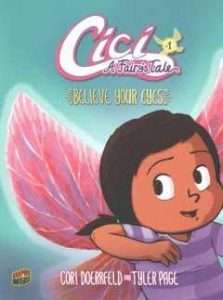
Someone heard my cry for more fun books featuring Latinas and Cici was born. The story opens as Cici gives her dad a tearful goodbye. Then she runs out to school, refusing to talk to her mom and younger sister. She tries to keep up appearances, but her best friend Mia keeps talking about all the fun they’re going to have at her birthday party with her dad, at least until she overhears something more interesting. Cici is off-balance and miserable and it only gets worse when she discovers her Abuelita (along with Egon, her dog) have come to stay indefinitely. Then, to top matters off, the most popular girl in school is having a fantabulous birthday party with makeovers, a hot tub and more on the same day as Cici’s and….Cici’s best friend Mia wants to go!
Lonely and miserable, Cici wakes up the next morning and discovers she has WINGS! Cici has an interesting talk with her Abuelita and spends a day with her eyes opened to the world around her, seeing things she never thought possible. Everything climaxes at the party when Cici finally tells Mia the truth; her parents are getting a divorce and she didn’t know how to tell her. They have a fight, and Cici realizes that no matter how much she wants things to stay the same, there will be changes. Cici must make one final decision; will she keep her wings and choose to believe, or will she go in a different direction with Mia and the other girls?
Doerrfeld is a fairly prolific picture book author and illustrator, with a few early graphic novel credits under her belt as well. Most librarians know her for her picture books that combine cute with substance, such as Penny Loves Pink. Cici is no different; there is plenty of cute and sparkle, with pink and purple fairy wings, dazzling special effects, and cute clothes. But Cici is dealing with some serious changes in her life as well as some growing pains. Doerrfeld teams up with Tyler Page (Chicagoland Detective Agency) to deal with Cici’s struggles in a light but serious way, taking her emotions and trials seriously while adding a touch of magic with the fairy aspect.
While this first volume is light on plot and only hints at magic through most of the story, it’s a great set-up for a series and will draw readers in, wanting to know what happens next in Cici’s life and the consequences of her final choice. Kids who are going through transitions with family and friends will relate to Cici’s struggles and fairy fans will love the additional touches of magic. This is a great choice for kids who are not quite ready for Raina Telgemeier’s realistic stories or who still like a touch of magic and a healthy dose of humor with their comics, as well as some cute and sparkle.
Cici: A Fairy’s Tale, vol 1: Believe Your Eyes by Cori Doerrfeld Art by Page Tyler ISBN: 9781467761529 Lerner Graphic Universe, 2016 Publisher Age Rating: 8-12
This series is both adorable and creepy. A cast of the characters is presented on the endpages; cheerful Marietta, spooky Mr. Snarf, bookish Mr. Leclair, grouchy Kiki, and helpful Celestin. All but Celestin are inhabitants of the very odd Hotel Strange, and in their first story, Wake up, Spring, they are peacefully sleeping the winter away when guests begin to arrive! This is naturally a great shock to all the inhabitants of the hotel. After all, spring isn’t supposed to arrive for a long time yet; or is it? It turns out that Mr. Spring has mysteriously gone missing! Marietta leaves the hotel in the charge of the ghostly receptionist, Mr. Snarf, and sets off with Mr. Leclair, the night watchman, and Kiki to find Mr. Spring. Their odd but knowledgeable friend Celestin promises to help them, and they set off to visit Mr. Winter to see if he is holding Mr. Spring captive. Along the way they will have many adventures, meet strange and frightening creatures, and finally brave the dreaded Mr. Winter himself. But will they ever find Mr. Spring and get Hotel Strange up and running?
In their second adventure, Kiki is greatly annoyed at the noisy preparations for the annual music festival at the hotel. While Marietta is chasing him down to convince him to help, they come upon a strange monster, the Arrgoyle! He’s eager to participate in the music festival, but he needs lots of practice. Lots and lots! Marietta has a suggestion; she takes him off to a quiet spot to practice on his own….but then she never comes home! Kiki, Mr. Snarf, and Mr. Leclair set off to find her, only to discover Marietta is in great danger. She’s been captured by bandits. Leaving Mr. Leclair behind as a hostage, Marietta, Kiki, and Mr. Snarf set off to ask Celestin for help in finding the robbers’ stolen sapphire and ransom back Mr. Leclair. More strange and wonderful adventures await the intrepid crew of oddballs until they finally make a surprising discovery.
These picture book-sized volumes include a wealth of sweet, quirky, and creepy characters. From helpful Celestin, to the hilarious and fuzzy Mumblers who herald catastrophe, every creature has a unique personality, purpose, and distinctive appearance. The stories are set primarily in the outdoors where mountains, streams, forests, and lakes abound and lush greenery and flowers seem to be everywhere. The characters are colorful not only in their oddities but literally—Marietta favors bright and cheerful pinks, reds, and oranges while grouchy Kiki is a plush lavender. Mr. Snarf glows a sickly green with appropriately somber black and white formal attire, and shabby Mr. Leclair brightens his outfit with a colorful scarf. Celestin’s close connection with the woods is shown in his green and brown clothing, and indoors or out, he is never without his mushroom hat and pipe.
The quirky stories, distinctive characters, and gentle philosophy woven into the wandering plots are clearly an homage to Tove Jansson’s classic stories of the Moomins. It may be difficult to get kids to pick up these cute and quirky stories, but they are available to purchase as inexpensive paperbacks. Although the skinny volumes may get lost on the shelves, they’re worth trying even if you’re unsure of their reception. However, if you have fans of the Moomins or Hildafolk, these books are sure to find an audience.
Hotel Strange by Katherine Ferrier, Florian Ferrier Vol. 1: Wake Up, Spring ISBN: 9781467786485 Vol. 2: On the Sapphire’s Trail ISBN: 9781467785853 Lerner Graphic Universe, 2015-2016 Publisher Age Rating: 8-12
Matthew Henson, the African-American explorer who accompanied Robert Peary to the North Pole and actually reached it before the famous explorer, has largely been overlooked and forgotten by history. This book, as the subtitle says, not only attempts to revive Henson’s story it also combines many different threads of Henson’s life and legacy, historical events, and Inuit culture to create a nuanced portrait of Matthew Henson as a man and an explorer.
The introduction explains Schwartz’s motivations and reasoning behind how he presented Matthew Henson, most notably saying, “I am not a historian but a graphic novelist, which is why I made no attempt at nonfiction.” The story itself begins with Schwartz’s imagined legend of Tahnusuk (death) and the Raven, then opens out into Matthew Henson as a custodian in the museum. As he goes about his life and looks at the artifacts, some of which he himself collected, he goes back in his memories to his childhood as a cabin boy, to his experiences with the Peary expeditions, his first meeting with Peary in the jungle, his relationship with his wife Lucy, and his experiences with prejudice and with the native Inuit peoples he encountered. Henson’s memories blend together with the Inuit Spirit Masks as he drifts back and forth between his memories and his current life. The story ends with a poignant moment as Henson visits his wife’s grave and reflects on his brief recognition at the end of his life, followed by a story illustrating his legacy among the Inuit people. The back matter includes a map, chronology of Matthew Henson’s life and a reminder that the story is a literary interpretation, black and white photos, and a brief bibliography.
The art is more heavily emphasized than the text; many parts of the story, especially Henson’s later life, are mostly wordless. The arctic shades of blue, gray, brown and white dominate the story from city to jungle to the frozen tundra. Henson’s emotions are shown in his lack of emotion, his expressionless face grim as he suffers prejudice and struggles with his conscience and makes difficult choices. Peary’s increasing despair, anger and eventual breakdown and betrayal are shown in sharp contrast to Henson’s stubborn survival. The sections that impose art with Inuit styles over the actions and characters are interesting and add an additional dimension to the narrative.
I found this comic fascinating, but it left me feeling conflicted—which is, perhaps, part of the point of the book.This is a powerful story with riveting art but some of the choices in the narrative are troubling. Peary’s relationship with an Inuit woman is shown, but Henson’s only relationship is shown as with his wife Lucy, despite the fact that she was actually his second wife and his only child was born with an Inuit woman. The “Inuit legend” at the beginning of the story appears to be a literary fabrication and, from the (very little) I know of Inuit culture, not consistent with the way cultural stories are told and passed down—it’s far more linear. Because so much of the story is told through the suggestions and emotions of the art, I didn’t get a good feel for the emotions of the local populations or Henson’s relationship with them. He seemed to hold himself apart from all the other protagonists in the story and expose a sense of deep loneliness and disconnection. This, coupled with the ignoring of Henson’s Inuit wife and son and the appropriation of Inuit culture, made me feel as though the history and lives of the native people were overlooked in favor of making Henson a larger-than-life heroic figure, rather than a fallible human.
It’s difficult to define an audience for this book. The publisher recommends it for high school and it could certainly spark many discussions on the accuracy of historical legend, the representation of minorities and native people in historical events, different perspectives of said historical events and comparing and contrasting historical fiction and history. However, I find it difficult to picture the average teen taking this off the shelf to read on their own. The muted palette and heavy subject matter could be a difficult sell for librarians encouraging recreational reading. However, this would definitely be a title that could spark a lot of intense discussion in a classroom or book club with mature readers.
First Man: Reimagining Matthew Henson by Simon Schwartz ISBN: 9781467758420 Lerner Graphic Universe, 2015 Publisher Age Rating:
This is the second installment in Nordling and Bosch’s unique graphic tales, Three Story Books. Three wordless but overlapping stories are told through three parallel panels, running across each spread.
The opening spread introduces the story and how to read it. The reader can follow the top story, which shows the adventures of a lone fish who swims all alone, “Because I don’t need anybody else.” The second storyline shows a hungry barracuda who eats everything, “Because nobody can stop me.” The bottom panel follows the story of a school of small fish who swim together, “So we can help each other.” You can also read each page in the traditional format, from top to bottom.
The storyline is not particularly new; it’s a tried and true plot that will be familiar to fans of classic picture books like Leo Lionni’s Swimmy. The hungry barracuda and the lone swimmer learn a lesson when the school of fish gets together to protect themselves with the beginning and ending notes confirming the moral. However, the unique art style of the three stories gives an additional perspective to, well, different perspectives.
The art is divided into three long panels which are then further divided into threes so each spread has a total of eighteen panels until the pictures and stories are joined together in the last two panels. The jigsaw puzzle of panels will encourage readers to mix and match the stories and characters as they think about different actions and their results. Bosch’s cartoon fish have tiny but detailed faces, with comical expressions from determination to indifference to shock and surprise. Alert readers will be able to follow the subtle and sometimes humorous details that reappear in panels from page to page and add new dimensions to the story.
It’s an interesting artistic concept and could work well in a school setting, teaching narrative structure or looking at stories from different perspectives. However, while it’s certainly unique and well-done, it’s one of those graphic novels that strikes me as just a little too unique, at least for the average public library. It’s available only in paperback or expensive library binding and is formatted to look like a picture book. While a picture book audience might enjoy looking at the fish and figuring out the story, it seems like it needs an older audience to really appreciate the art and layout. The exception would be if you can get kids who like I Spy or puzzle books interested in the series. Unless they’re willing to pick it up, it’s only a good addition to a collection with an audience interested in art and more complex narratives, but not something the average graphic novel reader would pick up off the shelf.
FishFishFish by Lee Nordling Art by Meritxell Bosch ISBN: 9781467745765 Lerner Graphic Universe, 2015

 Lee Nordling, one of the creators of the Three-Story Books, teams up with another creator to bring young readers a new imaginative, wordless series.
 Lerner Graphic Universe brings another French comics creator to the US: Miss PATY and her Whiskers Sisters series. The sisters live alone in the woods, waiting for their grandfather to return from a long trip. Maya, who has pink hair and antlers, is the oldest and into fashion and being in charge. Mia is a blue cat and she likes playing games and cooking. May is the littlest, with orange hair and big pink eyes.
 It seems like a long time ago now, but Cici used to be a regular girl with a regular family: mom, dad, little sister Sofia, and Abuela. But then her dad left, her Abuela came to stay, and Cici turned 10 and discovered she was a fairy! Since then she’s been struggling with learning to control her powers and use them correctly, adjust to family changes and her mom’s new friend, and learn to look beneath the surface and think about her actions.


 Someone heard my cry for more fun books featuring Latinas and Cici was born. The story opens as Cici gives her dad a tearful goodbye. Then she runs out to school, refusing to talk to her mom and younger sister. She tries to keep up appearances, but her best friend Mia keeps talking about all the fun they’re going to have at her birthday party with her dad, at least until she overhears something more interesting. Cici is off-balance and miserable and it only gets worse when she discovers her Abuelita (along with Egon, her dog) have come to stay indefinitely. Then, to top matters off, the most popular girl in school is having a fantabulous birthday party with makeovers, a hot tub and more on the same day as Cici’s and….Cici’s best friend Mia wants to go!
 Matthew Henson, the African-American explorer who accompanied Robert Peary to the North Pole and actually reached it before the famous explorer, has largely been overlooked and forgotten by history. This book, as the subtitle says, not only attempts to revive Henson’s story it also combines many different threads of Henson’s life and legacy, historical events, and Inuit culture to create a nuanced portrait of Matthew Henson as a man and an explorer.
 This is the second installment in Nordling and Bosch’s unique graphic tales, Three Story Books. Three wordless but overlapping stories are told through three parallel panels, running across each spread.
