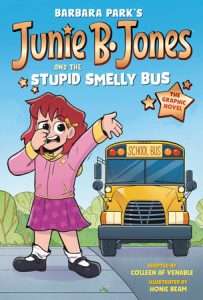
There is a long and storied tradition of bratty kids in children’s literature: Ramona B. Quimby, Max, basically every kid except Charlie in Charlie and the Chocolate Factory. And, of course, Junie B. Jones. Barbara Parks’ kindergarten heroine first entered the scene in 1992 and has graced 31 books, multiple stage plays, and a video game, even finding her way into Banned status in the early 2000s for not displaying good social values, poor grammar, and “mouthiness”. That by itself, in addition to being a straight up mood, could attract new readers to this legacy series. Now our kindergarten sass mouth is starring in her own graphic novel series from Penguin Random House, adapted by Colleen AF Venable and illustrated by Honie Beam. The first three books, Junie B. Jones and the Stupid Smelly Bus, Junie B. Jones and a Little Monkey Business, and Junie B. Jones and Her Big Fat Mouth, are already available and the fourth is expected September 2026.
All three graphics follow the original books closely with mild nods towards modernization (a fidget seat in Junie B.’s classroom and the appearance of a cell phone) but no real structural changes. Junie B. Jones and the Stupid Smelly Bus sees Junie B. on her first day of kindergarten and her dread over the too loud, too crowded, too much bus pushes her to hide in her school overnight with disastrous results. Junie B. Jones and a Little Monkey Business has Junie B. get confused over the arrival of her new baby sibling and telling an oopsie lie about him being a monkey. Finally, Junie B. Jones and Her Big Fat Mouth follows our main character dealing with an upcoming job day at school and realizing that she occasionally talks before she thinks things through.
Visually, the graphic is cute with a bright, animated art style and easy to follow panel flow. Beam adds fun, wavy cell borders when Junie B. is imagining wild scenarios and the book plays with different text styles for moments of emphasis. Venable sticks incredibly closely to the source material, in fact a little too closely.
I’m not sure this graphic does enough that’s different from the books. I mentioned nods towards modernization and they really are only nods. Venable didn’t leave room for changes in how contemporary children move through what is essentially a new world from what Junie B. inhabited. I’m not saying kids today can’t be “mouthy” or opinionated, there’s just something about this that feels out of step for me. Not only Junie B.’s behavior, but the reactions from the adults in her life seem really far removed from how kids today may behave. The books are filled with moments of Junie B. struggling or lashing out in a way that’s played for laughs, but reads as almost upset and none of the adults in the book seem to acknowledge or provide thoughtful help. I really wanted to like this -I love a mouthy, rude kid- but I finished feeling a little indifferent.
Junie B. is a hard character to like and that has always been part of her draw. She represents that main character part of us that remembers each questionable childhood moment or sees others having those same moments and can take a minute to laugh at them. Having these stories in a new format may introduce a new generation to their parent’s favorite sassy, mouthy rude kid. But, I suspect they’re going to meet her and not know what to do with her.
Junie B. Jones By Colleen AF Venable Art by Honie Beam Penguin Random House Viking Books for Young Readers, 202
Volume
ISBN
Junie. B. Jones and the Stinky Smelly Bus
9780593706701
Junie B. Jones and a Little Monkey Business
9780593706718
Junie B. Jones and Her Big Fat Mouth
9780593706725
Company Age Rating: 6-9
NFNT Age Recommendation: Easy Readers (5-9), Picture Books (3-8)
After the death of her husband Paulo, Julia reluctantly adopts the garden plot he left behind. She’s distressed one day to find it wrecked, dirt everywhere, plants destroyed. She determines the culprit must be a mongoose because only an animal could have been so ruthless. To her great frustration, no one in her life believes it exists or takes her seriously. As she begins to see traces of it everywhere the mongoose becomes an obsessive focal point for Julia as she wafts through a new period of her life.
A few years ago I lost my mom and discovered that when someone close to you passes, there’s this distinct before and after that suddenly redefines the timeline of your life. You can never return to the before and the after is so incredibly weird that it’s hard to describe to someone who hasn’t been there. It’s this bizarre time and place where nothing feels right, where isolation creeps in even when you’re surrounded by well-meaning people, and where you feel out of step with the universe.
Julia is in this strange after place and she’s struggling in the free-fall of grief and mourning after losing Paulo. She sleeps a lot, eats very little, and can’t get back into her routine. But she’s coping just fine, if you ask her. Her family tries to be helpful, but they’re each dealing with their own issues and tend to get under each other’s skin.
Don’t go into this book expecting to see a well defined path through grief or mourning. This is an exploration of the experience of grief and specifically not dealing with it. There is a lot of symbolism and moments that are left up to interpretation, allowing for different understandings from different readers. It’s a deft way to represent the individual responses to loss that show up in our lives and a subtle but impactful investigation of a difficult set of emotions.
Author and illustrator Joana Mosi uses a minimalist, but effective black and white drawing style to convey her story. There are noticeable empty spaces between panels, which also occasionally appear out of order to convey the fragmenting and mixing of Julia’s memories and thoughts. As if the book itself were making physical space for her brain fog. There are memories we don’t see and photos in Julia’s physical space are represented as blank picture frames, further defining an undercurrent of before and after.
There really aren’t any content warnings other than the obvious devastating loss that occurs before the story begins. Some readers might come away from this feeling like they didn’t fully understand everything on every panel or how everything connects, but this is a story where confusion is an important part of the experience. The ending is left somewhat open-ended, mirroring the process of grieving.
This book is best suited for the adult collection but I could see older teens connecting with it as well. Mosi has said that she conceived the idea for this book after the loss of her father and she has such a good grasp on the range of feelings and numbness that Julia experiences that I wonder if there are some autobiographical elements quietly tucked in. I think if you have been in that strange “after” time brought on by a major death in your life, you’ll connect with Julia and her story, even if your grief took a different path. Readers who are less familiar with mourning will still understand Julia’s very human response to such a traumatic event in her life.
The Mongoose By Joana Mosi Pow Pow, 2025 ISBN: 9782925114475
NFNT Age Recommendation: Adult (18+), Older Teen (16-18) Creator Representation: Portuguese, Character Representation: Portuguese,
The rules of the game are simple: don’t get tagged, don’t cross the Uphill/Downhill dividing line, and no adults allowed. If you get tagged, you’re immediately placed in the other side’s jail (until the streetlights come on, until the school year starts). Passed down through generations, everyone in Lakeside knows these rules are integral to keeping this decades long capture the flag game going. Newcomers must complete a puzzle in order to show their responsibility and be sworn into the game. When Fred’s family moves to Lakeside, he spends his summer playing The Endless Game, a summer he and the town will never forget.
The Endless Game, written by J.D. Amato with art by Sophie Morse, is a new middle grade graphic novel focusing on Fred’s first summer in his new town. He’s not happy his family’s moved again but almost immediately meets his fellow Downhill kids. After passing the entry test, Fred is sworn in as a member of the Downhill by the Council of Homeschooled Kids and quickly learns all about Lakeside’s infamous game. There’s DIY castles, root beer speakeasies, and bike races, plus years of lore and history to catch up on. As the summer flies by, Fred learns that the game always takes priority, even if winning never seems fully possible.
At home, Fred’s mom is glad he’s made friends and has finally fit in somewhere. She deals with her own job hunting struggles, something hinted at off page and in larger spreads, but not a main focus of Fred’s energy. His dad’s absence, however, is strongly felt throughout the story. Fred just wants his dad to finally move to Lakeside to be with his family, a move being held up by his work situation. They’re all tired of having to uproot their lives for his dad’s job and just want him to be home with them in this new place they love. Amato weaves the more emotional family touchpoints into more of a background plot, while still being a crucial element of Fred’s summer.
The Endless Game reads like the best kind of kids summer movie from the 80’s or 90’s but written for the kids of today, giving it a very timeless feeling. It takes place in a pre-cell phone time, seemingly the 90’s, without constant references to cultural touchpoints of the time, making it enjoyable and welcoming for readers of all ages. The kids of Lakeside are diverse, one benefit of this modern graphic novel over some existing classic “kids in summer” stories, and many young readers will see someone similar to themselves.
Morse’s art is lively, full of motion and movement, an excellent complement to the action-packed story. The colors are warm summer tones to go along with its seasonal setting. The characters are very expressive. One particular highlight is the spreads at the beginning of each chapter, which often feature quick looks into Fred’s life and family beyond the game.
The Endless Game is a fast-paced graphic novel full of summer fun for middle grade readers. It will appeal to readers looking for slice of life graphic novels and those looking for exciting action in their graphic novels. While it is intended for ages 8 to 12, it has appeal beyond that in both directions, as well as older readers as well. It is an excellent summertime read.
The Endless Game By J.D. Amato Art by Sophie Morse Simon & Schuster Books for Young Readers, 2026 ISBN: 9781665927154
Company Age Rating: 8-12
NFNT Age Recommendation: Middle Grade (7-11), Tween (10-13)
Lindsey Cheng is like most college freshmen, trying to find herself even as everyone is trying to tell her who she should be. This includes everyone from her overbearing and very traditional Chinese mother to her best friends and bandmates. It seems like everyone has an opinion on who Lindsey should be and where her attention should be focused, be it the band or her studies.
The sole exception to this is Jason—the super-chill lead-singer of a different band, who stuns Lindsey by calling her his girlfriend as he tries to give her a gift while shopping for old records. This stuns Lindsey, who barely started dating Jason and never had a boyfriend before. This makes her anxious to be everything a good girlfriend should be. More, she wants to be cool enough to be the girlfriend of a cool guy like Jason. But is Jason really the best thing to ever happen to her? Or is she just stunned at the idea of any boy being interested in her after a sheltered childhood?
The early press for Lindsey Cheng Dates a White Boy described it as “perfect for fans of Bryan Lee O’Malley and Mariko Tamaki.” I can see why it might draw comparison to the Scott Pilgrim series. It is based around young adults and indie band culture in the early 21st century and Asia Miller’s art shares a certain aesthetic. The general plot even emulates the lessons of that comic, albeit through the female lens. However, it dramatically oversimplifies the story to write Lindsey Cheng off as an older Knives Chau, who has the good sense to realize that Jason is scum before it is too late.
What really sets this comic apart—and indeed inspires the need for a sequel—is the final chapter. This is told from the perspective of Lindsey’s friend and bandmate Mel; a fierce romantic who loves love. It is she who first gets an inkling of who Jason really is but puts on a false face because she wants to support her friend. At the same time, Mel copes with her growing attraction to their third bandmate, V, and the hint that V (who loves video games and hates boys) might return her feelings.
The opening of the book focused on Lindsey does deliver an important message upon the dangers of repressing yourself for the sake of a relationship. And yet, the chapter with Mel is the strongest and feels the most genuine. Personally, I’d love to read a comic about the awkward romance between tomboy V and girly girl Mel as a follow-up to Lindsey’s hard lessons regarding her first love.
There’s no official publisher rating for Lindsey Cheng Dates a White Boy!!! I would personally consider it appropriate for most teen audiences and indeed perfectly suited for that audience given the ultimate moral of the story. There is no sex or even so much of a mention of it. The closest we get is Lindsey taking off her T-shirt to reveal her bra while hanging out with Jason while lounging on his bed. There’s no violence or nudity and no language worse than what might be heard on broadcast cable.
Lindsey Cheng Dates a White Boy!!! By Asia Miller Andrews McMeel, 2026 ISBN: 9798881605827
NFNT Age Recommendation: Adult (18+), Older Teen (16-18), Teen (13-16) Creator Representation: Chinese-American, Queer, Character Representation: Chinese-American, Bisexual,
Growing up is hard. Changes are hard. Especially in the middle grades, right before high school. I can’t imagine how much harder it must be now, with the internet, smart phones and social media. Even without any of that, I remember how awkward and unsure I was.
Charisse must be about my age and have grown up in the 70s. The clothing, references, and houses look very 70s. (The boom box and “Shake your booty” on page 236 gave it away.) Maybe that’s why she reminds me of me back then. My junior high school was packed with kids, I only had about three friends, and I was also obsessed with everything. It was hard for me to make friends too. I also broke the rule about going off campus and skipped a period to go to the 7-11. I was also obsessed about getting actual Candie’s shoes. (Google it) (Too expensive, but my mom bought me knock-offs at Zayre’s) I also changed best friends about then—I didn’t have so dramatic a falling out with the one I had grown up with, but we hung out less and less as she got more and more involved in things I didn’t do. Just like Charisse, I felt grouchy and hurt.
I remember how up-and-down the early teens are—how I was so sure NO ONE ELSE EVER FELT LIKE THIS. It’s a tough time for any young woman. You’re not sure you’re good enough, you don’t like your skin or your teeth or your whatever. Then the next day, things are good. Things are changing fast. Charisse can talk to her mom, though, and her brother and her mémé – if only in halting French in her mémé’s case. Charisse has a lot to be thankful about. Negotiating changing friendships is a difficult thing sometimes, and sometimes you don’t want to talk to anyone about it. This book can help middle-schoolers and early teens to not feel like they’re so alone. It’s helpful to know that feeling awkward and trying different things to see if they fit is normal. It’s also normal to think that something is going to last forever. It’s telling that Charisse fears running into her ex-bestie through the whole book, but when she does, it’s not really a thing. She’s moved on.
The artwork is brightly colored and sharp, and the panels are varied in size to break the story into different sections. This helps give the reader a break during some emotional parts. It also slows the pacing, which is perfectly executed. I reviewed the digital copy, so can’t speak to the printing or binding. The book is 262 pages, plus whatever is added to the print edition. Harper has also written “So Embarrassing—Awkward Moments and how to get through them”, which would be a natural partner to this book. Recommended for any middle school library.
Wrong Friend By Charisse Mericle Harper Art by Rory Lucey Macmillan First Second, 2026 ISBN: 9781250851970
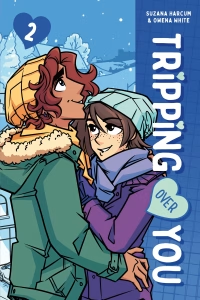
Tripping Over You, Volume 2, from Suzana Harcum and Owena White, picks up not long after the first graphic left off, showing unlikely couple Liam and Milo navigating their maturing relationship. This slice of life romantic comic was adapted from real life couple Harcum and White’s webtoon in February and promises more volumes to come. Fresh out of high school, the pair are growing into young adults and trying to allow their relationship to grow with them. Liam and Milo are in a very interesting phase, kind of semi-out to their families (who bring their own baggage into their relationship) and striving to make room for each other as their lives grow fuller. Liam doesn’t know what he wants out of his future and Milo seems plagued with self doubt, but they keep circling back to find comfort in each other. This volume catches our couple at a very real, very vulnerable time where a high school relationship can evolve into an adult one or where it can flounder under the weight of growing up.
This is a sweet story that young readers can easily connect with. The art is incredibly cute with Harcum and White using a style that hits me as a kind of Disneyified Manga: characters with big eyes and bold lines in a world of saturated color. It is very easy to read and honestly just pretty. Liam and Milo give classic black cat/golden retriever energy and seem hyper aware of the struggles that can come with relationships where people have different needs and communication styles. While this comic does show a growing young adult relationship and the intimacy that comes with it, there’s nothing explicit on page or even suggested and I would probably recommend it as young as 6th or 7th grade, depending on the reader. There are a couple of shirtless scenes and implied sex and Liam still hasn’t kicked his smoking habit from book one. But with that, their relationship maintains an innocence that will keep it accessible to a wide range of readers.
The plot beats were a bit of a hang up to me. The small domestic moments of our couple meeting new people, fighting to find time together, struggling with demanding families, and eventually moving in together feel almost like filler, like all of these moments are leading towards conflict in a future volume. The most striking of these involve Milo’s new friend Hebert, an American theater student. There isn’t immediate conflict but there is definitely unresolved tension and Hebert’s motives are questionable at best. Many of the plot points feel unresolved. Liam still does not have a clear career path and Milo still seems uncertain in aspects of their relationship. All of these things made this feel less like a step in their story and more like laying groundwork for the next book.
But honestly, I don’t know if I care. It was still a lovely read. The characters are ones you want to spend time with and their relationship is easy to invest in. It’s sweet and loving and a ready made next read for my Heartstopper fans. Parts of it do come off as wish fulfillment, particularly the moment where Liam comes out to his father. But queer kids deserve as much wish fulfillment as they can get. I can’t help but worry that these boys will have a tough time ahead of them, but my fingers are crossed for a happy ending.
Tripping Over You, Volume 2 By Suzana Harcum Macmillan First Second, 2026 ISBN: 9781250330734
Company Age Rating: 14-18
NFNT Age Recommendation: Middle Grade (7-11), Older Teen (16-18), Teen (13-16) Creator Representation: Lesbian, , Character Representation: Queer, Jewish ,
Some readers erroneously believe that adult graphic novels should have sophisticated art, particularly in a day and age where art can be easily generated through a computer. “Sophisticated” means, in this case, the artwork has aspects like realistic looking human faces, shading, and color gradation that makes the book look more like a collection of photographs than anything drawn by a human being. It’s important to remember that “graphic novel” is a medium rather than a genre, and a medium can convey a variety of different ideas. For example, Heaven, West Virginia, written and illustrated by Ravi Teixeira, doesn’t need chiseled jawlines or a computer-generated color palette to tell an emotionally wrought story about coming home to find oneself.
The book follows Lamont, a man who has come home to Heaven, West Virginia to stay with his aunt while dealing with the passing of his homophobic father, a religious man who liked to share his bigotry from the pulpit. Learning tea making from his aunt provides a measure of peace, along with his conversations with handsome cowboy Coyote. Threatening to shatter that peach is a monster lurking in the woods, a monster whose eyes glow red and whose teeth are perfect for rending flesh. Lamont sees this creature and knows that it wants to devour him. Unfortunately, Lamont cannot run from this beast. He must ultimately face this monster as well as his own identity.
Teixeira’s seemingly supernatural evil evokes the folk horror traditions of something evil lurking in the woods, but it gets much more mileage in the readers’ minds thanks to his use of symbolism. For Lamont, as for many LGBTQ + individuals from a less than welcoming family, coming home often reawakens some very real traumas as fearsome and brutal as anything with teeth made to tear flesh. However, Teixeira’s story is not all doom and gloom because his Appalachian home provides healing. They demonstrate this thanks to medicinal tea recipes, with ingredients provided by Appalachian soil, interspersed throughout the book’s various chapters. This use of recipes, along with the beast in the woods, also demonstrates Teixeira’s skill with symbolism.
And those symbols are beautifully rendered, even if you can’t see the individual hairs on the beast stalking the woods. Teixeira’s style utilized blocky lines, flat surfaces, and simple colors, but they do a great deal with them. The artwork is clear and vibrant while the characters are still expressive, despite not seeing every wrinkle. Teixeira’s art style ultimately serves the story, especially as it seems to evoke images of Appalachian folk art.
For those who actually inform you of their beliefs that simple art work cannot be considered “sophisticated,” you can give them examples like Art Speigelman’s Maus and this book. The book’s uncomplicated beauty and rustic charm make it perfect for librarians in rural areas like Appalachia, as well as for librarians looking for well-told LGBTQ+ stories.
Heaven, West Virginia By Ravi Teixeira Oni Press, 2025 ISBN: 9781637158746
NFNT Age Recommendation: Adult (18+) Creator Representation: Trans , Character Representation: African-American,
A lunchtime party under the bleachers leads to a group of middle schoolers facing a week of detention. Except instead of regular old boring detention, they’re roped into helping out with the school’s new Enviro-Club. In The Greenies by Emma Mills, with art from Sarah Nicole Kennedy, readers meet kids just like them who want to make their world a more environmentally friendly place and have some fun doing it too.
After her parents’ divorce, Violet moved to St. Louis with her mom, where she’s about to start a brand new school halfway through the school year. She’s thankful for having her cousin Kris there to help out but she mostly plans on relying on faking it till she makes it. When she gets invited to the Best Under Bleachers Party of the Century, she figures it’s a great way to meet her classmates. It’s fun, everyone’s having a good time… until they’re caught by a teacher who makes them clean up and assigns a week’s worth of detention to all the kids under the bleachers.
This week of detention turns into forced participation in the Enviro-Club, a group with a very passionate leader but very little interest from other students. The Greenies take on tasks around the school to make it into a greener, more beautiful space. There are some mishaps along the way, including a big one involving the mysterious 4th floor of their school and missing recycling, but there’s lots of joyful and funny moments. One standout is when the group rescues a chipmunk at school, which animal lovers will appreciate. The group also deals with some minor infighting and squabbles, showing readers that even when you’re working together, sometimes personalities and ideas will clash and it’s okay.
As the first book in a new middle grade graphic novel series, much of the action and story in this particular book involves the group as we get to know them, with a special focus on Violet as our main character. She realistically struggles with sharing her true emotions and trying her best to fit in at a new school in a new city. She misses her friends from home and seeing her dad everyday. Mills’ writing does a good job including these emotions in the novel without them overtaking the storyline. Yes, Violet is the main character but there’s more to the story than just her.
Kennedy’s art complements the story perfectly and is pleasantly reminiscent of other popular middle grade graphic novels, a selling point for voracious graphic novel readers. The characters in the book are diverse and expressive, with their facial expressions being a particular highlight for how realistic they are and their part in driving the book forward.
The Greenies is very focused on social responsibility and how small acts can make a difference. This particular aspect of the group makes it a fine choice for a classroom or book club read, where readers can consider what they can do and work together to make changes like the group does. The focus on a neighborhood clean up makes it an excellent springtime choice that may spur middle grader readers into action in the environment around them.
The Greenies By Emma Mills Art by Sarah Nicole Kennedy Macmillan, 2026 ISBN: 9781250815767
Company Age Rating: 8-12
NFNT Age Recommendation: Middle Grade (7-11), Tween (10-13)
A young boy navigating a near-future world that is both like ours, and also not. A story woven through with commentary on where we find ourselves today.
Street Noise Books brings us Hybred from Jamie Mustard and Francesca Filomena. Set in an alternate future, the book introduces us to Johnny James, 9 years old when the story begins. Mixed race, outcast, and living in a slum walled off beside the bright lights of Follyland, the rich and shining section of city just next door, Johnny splits his time between a home for boys and his fractured family, living life alongside gangs, despair, and a consistent stream of violence.
What Johnny learns from a young age is that those who give up, do not survive. And Johnny is determined to survive. Through years of childhood and into adulthood, Johnny crosses paths with a range of characters, all the while hiding the secret that he is even more different than those around him can know. As everyone claws their way toward survival, Johnny’s love of art may be his path toward safety, but only if he can endure the dangers laying in his way.
Written entirely in narration, Hybred doesn’t use paneling or text bubbles to deliver its relatively short narrative. Instead, the series of standalone, full-spread images and text blocks carry us through each moment of Johnny’s story. Written and with art direction from Mustard, this book tackles a lot—race, inequality, mental health, exploitation, and more—all grounded in an examination of the role that art can play in shaping society. It’s an ambitious and admirable undertaking to address so much in a singular story. Unfortunately, the scope of the themes ultimately harms both Johnny’s narrative and the broader ideas Hybred seeks to convey.
The story itself is never given room to breathe, unfolding in a series of vignettes that never quite find cohesion, while the dramatic conclusion of certain plot points happens largely in summary and off the page. Quiet storytelling and ambiguity can be immensely powerful. The challenge with Hybrid is the size of the gaps the reader is left to fill themselves. Similarly in theme, Mustard turns a lens on vitally important social issues, but in packing so many in with such passionate intensity, it becomes a struggle to walk away from the book with a greater understanding of any idea in particular. In trying to show us all the sights along the way, Johnny’s story struggles to reach a clear destination.
But this is not to downplay what the book does achieve. Not only does Mustard approach the writing with vision, but Filomena’s painted illustrations bring a wealth of character and visual style to the story. Reminiscent at times of Dave McKean’s art, Filomena’s hazy and stylized approach fills the book with life, blending rich colors with striking visual designs that showcase this strange-but-familiar world and the multitude of characters who inhabit it. Pages move from more cinematic presentations to portraits to paintings that demand focus on key elements of the story. Across the range of palates and scenes, Filomena’s style invites the reader to keep looking, following Johnny into this strange alternate world he is navigating.
Throughout Hybred, there are moments of drug use, violence, death, strong language, racism, human trafficking, and sexual themes. With only a couple exceptions, the book does not linger overly long on these moments—and with the early portion of the book framed through a child’s eyes, some of the darker plot points are clearer to the reader than they are to Johnny himself. Nevertheless, the often bleak combination makes the book best suited for adults alongside some older teens who know what they’re in for. In the end, I wish I liked Hybrid more than I did. It’s a respectfully ambitious undertaking from a writer who clearly has a lot to say, and I admire any piece of art that’s willing to aim big. Additionally, Filomena’s art deserves to be seen as it brings this complex tale to life. Hybred doesn’t achieve much of what it sets out to do, but I respect its vision even as I wish more of Johnny’s story had landed effectively along the way.
Hybred A Graphic Novel By Jamie Mustard Art by Francesca Filomena Street Noise Books, 2025 ISBN: 9781951491437
Stories can make you sigh for all sorts of reasons. Frustration, contentment, resolve. Angelica and the Bear Prince, published by Random House Graphix in October 2025, pulls a deep, comforting, swoon-like sigh from the reader, at least this reader. This is a cup of cocoa of a graphic novel. A warm, joint popping hug of a graphic novel. A fully broken-in hoodie of a graphic novel. It’s the best kind of sweet, romantic, comfort read.
Angelica and the Bear Prince, author/illustrator Trung Le Nguyen’s follow up to the award winning The Magic Fish, is a very loose reimagining of the Norwegian fairy tale East of the Sun and West of the Moon. It follows Angelica, Jelly to her friends, who is picking herself back up after hitting a pretty serious burnout wall. Jelly is an over-achiever and a people-pleaser who got so wrapped up in her desperation not to disappoint people that she ran herself right into the ground.
With perfect timing for her to realign herself, Jelly gets an internship at the theater company that was her happy place as a child. She gets to spend the whole winter stage managing her favorite play with her best friend Christine who is starring opposite the play’s lead and the theater’s mascot Peri the bear in Jelly’s favorite play. The mascot whose social media account Jelly has developed a pen pal style relationship with. The mascot who is embodied by a figure from Jelly’s past who is desperate to reconnect with her. The reveal here and the shift in their relationship takes a while to develop but is so, so satisfying.
Per Nguyen, this is a story about grief and it drips off every page. The grief that comes with growing up, grief of mourning a loved one, grief of dealing with mental health struggles. And with all that heaviness, this is an incredibly light, hopeful graphic, partially because of Nguyen’s stunning art. The illustrations are like a manga processed through a Disney lens, giving the graphic a bright, beautiful flow that is incredibly easy to read. The characters feel lived in and real and their hopes and struggles are incredibly relatable. The story is romantic and sweet and so beautifully told.
One of my favorite things about this graphic is that all the characters are given room to grow. So frequently in stories like this anyone who is not the central romantic couple just fade into the background, but Nguyen doesn’t fall into that. Jelly’s mom, still mourning the loss of her own mother, is anxious and uncertain and desperate to help her daughter grow while keeping Jelly her little girl. The stern manager of the theater is learning how to keep loving after their own loss and massive life changes. Christine, who easily could have been relegated to the barely-seen-best-friend role or the focus of Jelly’s jealous for landing the lead role of the Princess in the play, is a ride or die bestie throughout both being there for Jelly to lean on and going to her for support when she realizes her relationship isn’t what she deserves.
Angelica and the Bear Prince is such a lovely, cozy graphic. Teens and preteens alike can easily get wrapped into the romance and coming of age elements of the story and the focus on transformation and growth. It’s a legit pleasure to read.
Angelica and the Bear Prince By Trung Le Nguyen Penguin Random House Graphic, 2025 ISBN: 9781984892669
Company Age Rating: 12+
NFNT Age Recommendation: Older Teen (16-18), Teen (13-16), Tween (10-13) Creator Representation: Vietnamese, Nonbinary , Character Representation: South Asian, Trans, Anxiety, Depression

 Charlie and the Chocolate Factory. And, of course, Junie B. Jones. Barbara Parks’ kindergarten heroine first entered the scene in 1992 and has graced 31 books, multiple stage plays, and a video game, even finding her way into Banned status in the early 2000s for not displaying good social values, poor grammar, and “mouthiness”. That by itself, in addition to being a straight up mood, could attract new readers to this legacy series. Now our kindergarten sass mouth is starring in her own graphic novel series from Penguin Random House, adapted by Colleen AF Venable and illustrated by Honie Beam. The first three books, Junie B. Jones and the Stupid Smelly Bus, Junie B. Jones and a Little Monkey Business, and Junie B. Jones and Her Big Fat Mouth, are already available and the fourth is expected September 2026.
 line, and no adults allowed. If you get tagged, you’re immediately placed in the other side’s jail (until the streetlights come on, until the school year starts). Passed down through generations, everyone in Lakeside knows these rules are integral to keeping this decades long capture the flag game going. Newcomers must complete a puzzle in order to show their responsibility and be sworn into the game. When Fred’s family moves to Lakeside, he spends his summer playing The Endless Game, a summer he and the town will never forget.
 to tell her who she should be. This includes everyone from her overbearing and very traditional Chinese mother to her best friends and bandmates. It seems like everyone has an opinion on who Lindsey should be and where her attention should be focused, be it the band or her studies.
 must be now, with the internet, smart phones and social media. Even without any of that, I remember how awkward and unsure I was.
 couple Liam and Milo navigating their maturing relationship. This slice of life romantic comic was adapted from real life couple Harcum and White’s webtoon in February and promises more volumes to come. Fresh out of high school, the pair are growing into young adults and trying to allow their relationship to grow with them. Liam and Milo are in a very interesting phase, kind of semi-out to their families (who bring their own baggage into their relationship) and striving to make room for each other as their lives grow fuller. Liam doesn’t know what he wants out of his future and Milo seems plagued with self doubt, but they keep circling back to find comfort in each other. This volume catches our couple at a very real, very vulnerable time where a high school relationship can evolve into an adult one or where it can flounder under the weight of growing up.
 be easily generated through a computer. “Sophisticated” means, in this case, the artwork has aspects like realistic looking human faces, shading, and color gradation that makes the book look more like a collection of photographs than anything drawn by a human being. It’s important to remember that “graphic novel” is a medium rather than a genre, and a medium can convey a variety of different ideas. For example, Heaven, West Virginia, written and illustrated by Ravi Teixeira, doesn’t need chiseled jawlines or a computer-generated color palette to tell an emotionally wrought story about coming home to find oneself.
 boring detention, they’re roped into helping out with the school’s new Enviro-Club. In The Greenies by Emma Mills, with art from Sarah Nicole Kennedy, readers meet kids just like them who want to make their world a more environmentally friendly place and have some fun doing it too.
 find ourselves today.
 Random House Graphix in October 2025, pulls a deep, comforting, swoon-like sigh from the reader, at least this reader. This is a cup of cocoa of a graphic novel. A warm, joint popping hug of a graphic novel. A fully broken-in hoodie of a graphic novel. It’s the best kind of sweet, romantic, comfort read.

