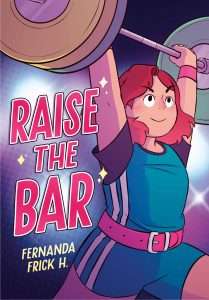
Samanta Sanchez is determined to become the greatest weightlifter Latin America has ever seen and nothing will get in her way, especially not her parents’ anxiety about her goals. In Raise the Bar, Fernanda Frick H.’s debut graphic novel, readers follow Sam’s journey from the municipal gym in Santiago, Chile, to the world stage at the Pan American Games.
Sam has always been too strong, too stubborn, and too independent. She scares off the other kids at school and her parents just want her to fit in. No one really knows how lonely she is or how she’s always doubting herself. Still, she sets a goal and works to meet it, no matter how hard it is to fight for her spot at the table. Her brother offers his support but their parents are another story. When she’s accepted into the High Performance Center of Corazon (aka the HPC), with the chance to study under gold medalist Eva Dos Santos, her determination and persistence on following her dream win out over her parents’ disapproval.
At HPC, Sam meets other kids from around the world working towards their own gold medal dreams, including one of her idols, an American medalist named Barb Miller. The other athletes studying alongside Sam are diverse, with multiple countries and cultures represented. There’s also strong LGBTQ+ representation within the characters. The story still focuses primarily on Sam but the story grows to include the stories and experiences of the other athletes, with everyone’s unique personality given a chance to shine.
Some readers might be initially turned off by a graphic novel so heavily about sports but Raise the Bar is a book about strength in all its forms: physical, emotional, and mental. Sam and her friends are proud of what they’re capable of and that pride goes beyond just what happens in the gym. Even the most confident athletes have moments of weakness and self-doubt. When characters realize they want to take a path other than sports, it’s never portrayed as a betrayal or dismissive of their dreams; the other characters are proud of them for following their heart and embrace them as such. Excellent work-life balance is on display throughout the book.
Raise the Bar’s art is very animated and colorful. Frick’s background as an animator is evident throughout. The excellent multiple pages of backmatter explains it was originally conceived as an animated television show. Everyone is expressive and emotive, even Sam’s pet chinchilla. Scenes of self-doubt and anxiety are dark and cloudy, an excellent representation of that particular mindset. Competition scenes feel lifelike and readers may find themselves holding their breath as Sam attempts to lift her goal weight.
It is quite a long book, with long chapters. Because of this, the ideal audience for Raise the Bar straddles both older middle grade and younger young adult readers. There’s some romance in the story but the main focus is self confidence and friendship. Raise the Bar is especially recommended for readers who enjoy sports related graphic novels or animated shows or anyone who gets caught up in the thrill of international competitions. Also of note is that the graphic novel will be published in Spanish later this year, giving it a more authentic feel and wider audience.
Raise the Bar Vol. By Fernanda Frick H. Dial Books, 2026 ISBN: 9780593407325
Company Age Rating: 8-12
NFNT Age Recommendation: Middle Grade (7-11), Teen (13-16), Tween (10-13) Creator Representation: Chilean, ADHD, Autistic Spectrum, Character Representation: Chilean,
Deep within the mountains of northern Spain lies a hidden temple. Here, the secret order known as the Knights of Heliopolis labor to shepherd the destiny of humanity and guide them towards enlightenment. As selective as they are secretive, the Knights of Heliopolis make up for their lack of numbers in divine power, having mastered true and holy alchemy and acquired the secret of long life.
Set in an alternate 18th century, the story opens as the ten Knights of Heliopolis on Earth are preparing to induct a new member to their order, a youth known to them only as Seventeen. After Seventeen completes the final trial to secure their place among them, Seventeen’s master, Fulcanelli, reveals the secrets that made it necessary for him to hide Seventeen’s identity and origins from the rest of the Knights. For Seventeen is Louis XVII, the secret child of Marie Antoinette and King Louis XVI of France!
This is a matter of great import, as the Knights of Heliopolis’s gifts include the power of prophecy. Their dogma speaks of the coming need for a warrior who must balance both the masculine and feminine aspects of themselves—along with body and soul—to save the world from the Knights’ greatest mistake, a would-be emperor now known as Napoleon, who has corrupted their guidance and teachings in a bid to make himself into an immortal god-king that will rule the Earth forever! In addition to their royal lineage, Seventeen is also of great interest due to being intersex (within the text referred to by the historical term “hermaphrodite”).
The Knights of Heliopolis is an interesting graphic novel that is hard to pin down into a single genre. It is a work of alternative history and includes several historical figures among its cast, yet it is far more fanciful than most alternate history works. Yet those fantastic elements and the Alchemy employed by the Knights are based on real-world mystic traditions. It also draws upon several literary works, most notably The Man in the Iron Mask. Throw in a little bit of science-fiction in the fourth and final chapter (as the Knights are revealed to have acquired their knowledge from ancient aliens) and you have a book whose setting is both familiar in many respects yet uniquely its own beast.
The script by Alejandro Jodorowsky is more concerned with mythology than character development. The Knights do not get much in the way of personality apart from Louis XVII. Even then, their chief conflict centers around their belief that they are destined to destroy Napoleon yet love him as a fellow mutant manipulated by fate. Thankfully, the story is engaging, and the ideas put forth intriguing.
The artwork by Belgian artist Jérémy is simply stunning. Intricately detailed and beautifully colored, Jérémy does a fantastic job of depicting the various period costumes as the story progresses from the French Revolution through World War II. The action sequences are well-blocked and even the static conversations seem eternally active.
Knights of Heliopolis is rated for audiences 17+ and that is a fair rating. The book is full of sex and violence and does not shy away from the gritty details of both. There is full frontal nudity of men and women, several sexual assaults and severely grisly deaths and dissections. This book is not for children or the faint of heart, but it is memorable and well worth reading if you are a fan of alternative history tales.
Knights of Heliopolis By Alejandro Jodorowsky Art by Jérémy Titan Comics, 2021 ISBN: 9781787736085 Publisher Age Rating: 17+
NFNT Age Recommendation: Adult (18+) Creator Representation: Belgian, Chilean, French Character Representation: French, Bisexual, Intersex

 Samanta Sanchez is determined to become the greatest weightlifter Latin America has ever seen and nothing will get in her way, especially not her parents’ anxiety about her goals. In Raise the Bar, Fernanda Frick H.’s debut graphic novel, readers follow Sam’s journey from the municipal gym in Santiago, Chile, to the world stage at the Pan American Games.


