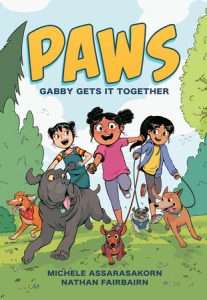
Best friends Gabby, Mindy, and Priya are very different, but they have the same problem: all three girls love animals, and none of them are allowed to have pets. Determined to get quality cuddle time with some critters, they try out several schemes before creating a dog-walking business, which they name PAWS (an acronym—sort of—for Pretty Awesome WalkerS).
Several clients sign up immediately, and suddenly the girls have all the dogs they can handle—maybe even more than they can handle. Conflict bubbles up: Priya plays lots of sports, so the other two keep having to walk extra dogs when she has practices or games. Mindy can really use the dog-walking money, so she’s keen to take on more dogs even when the trio is already struggling. Gabby is the youngest, and sometimes feels that the other two don’t listen to her.
When the girls finally solve these issues, more trouble pops up: Mindy’s mom starts dating, which makes Mindy feel insecure and afraid of change just as the other two girls want to ask a new friend to join PAWS. Then Priya’s family moves across town, and her parents want her to switch schools. How will the girls of PAWS keep their business—and their friendship—going strong?
This fun series will inevitably draw comparisons to the Baby-Sitters Club, another series in which tween girls form a business together and deal with professional and personal issues. Both feature characters who are very different in personality and background but are close friends: Gabby comes from a secure, well-to-do family and is a little sheltered; Mindy is a stylish, chronically-online latchkey kid with a single mom; Priya is an athlete and the child of immigrants. Hazel, who joins PAWS in the second book, is new in town and uses a wheelchair. Each book focuses on the character whose name is in the title, with occasional sections following one of the others. Like the girls of the Baby-Sitters Club, these kids work through the practical details of how pre-teens might realistically organize and run a business.
PAWS is set in Vancouver, Canada, and feels very much of the present day. The girls use some current slang, especially when they squeal over animals, calling them “pupper,” “floof boi,” “lad,” “fren,” and “king,” and exclaiming “I would boop that nose so hard!” Phones and social media also feature frequently. All of this feels natural, and while the language may eventually seem a little quirky to future readers, the storylines and themes of friendship, accepting change, and taking care of yourself are timeless.
The art is a colorful, lightly cartoonified version of reality. The characters are expressive, sometimes becoming comically exaggerated to show extreme emotions. They are distinct and easy to tell apart, and each has an individual style, including plenty of different outfits. The animals have a lot of personality, too. While the focus is on the characters, the backgrounds are detailed enough to keep the settings—mostly parks, school, and the kids’ homes—clear and present. There are also a couple of illustrated recipes: Mindy narrates how to make gamja bokkeum, a Korean dish, and her mom’s boyfriend Mike explains how to make a kind of breakfast casserole.
There is no violence, no swearing (unless you count an embarrassed character mumbling “Oh God”), and no romantic content other than Mindy’s mom innocently hanging out with her new boyfriend. The stakes are emotional and logistical, not physical danger, except for one instance when Priya falls and hurts her leg.
These funny, relatable characters learn problem-solving and other life lessons through engaging stories. Definitely hand this series to fans of the Baby-Sitters Club, as well as to readers of other middle-grade realistic fiction, like the work of Raina Telgemeier and Shannon Hale.
PAWS By Nathan Fairbairn Art by Michele Assarasakorn Penguin Random House Razorbill, 2022 ISBN: 9780593351864
Volume
ISBN
2
9780593351932
3
9780593351963
Publisher Age Rating: 8-12
NFNT Age Recommendation: Middle Grade (7-11), Tween (10-13) Creator Representation: Canadian, Thai, , Character Representation: Black, Indian, Korean, Wheelchair User, Hindu ,
When Evie is trapped in the Cretaceous period, she quickly discovers she’ll need to engage with her surroundings to survive.
Evie rescues an egg from being eaten after several terrifying encounters with a variety of dinosaurs. The egg hatches into a pterosaur she names Ada and together they find a way to survive in an abandoned human building. Evie discovers that there are recordings from the building’s previous inhabitant, Jameson, who reports on various nearby food sources such as fruit trees and fish. Jameson also mentions a device known as a temporal communicator that allows the user to communicate across all of time. Unfortunately, it is at their second base. And although Evie finds a map with the second base’s location, it is quite a distance away across a large body of water.
By this time, Ada appears to be an adult, so Evie decides to try flying on Ada to reach the second base. This involves making a saddle and reins, as well as training and practice for both Evie and Ada to adjust to the extra weight and long distances. When they make it to the second base, Ada, trying to help, accidentally dislodges the battery of the temporal communicator that is then scooped up by a water dwelling dinosaur. Evie had been looking forward to apologizing to her moms due to a fight she’d had with them right before she disappeared. Frustrated with Ada, she despairs of ever speaking with her parents again and ignores her companion in her grief. Eventually, she realizes that she is hurting Ada and herself with this behavior, and they find a way to power the communicator.
This book was marketed as How to Train Your Dragon meets Jurassic World, and I can see why. The relationship between Evie and Ada is central to the plot and it contains dinosaurs. What I didn’t know, until almost the end, is that Evie is from a time that has developed time travel, so she isn’t surprised to find a building as much as she is surprised to find one so quickly. However, that isn’t explicitly stated nor is that fact mentioned in the summary, so I was confused at first as to how Evie was able to travel back in time, since the story starts when she wakes up in the Cretaceous period. Otherwise, the story is simple to follow and the colorful illustrations are sure to appeal to the middle grade audience it was written for. The bright colors also convey the hopefulness and resilience of the main character. Darker colors are reserved for night scenes and during Evie’s grief period.
Readers will be happy to know this looks like a standalone with a happy ending and that the dinosaurs are illustrated in the updated form with feathers on many of them. There are also a few pages at the end devoted to labeling the various dinosaurs featured throughout the story. The casual diversity of Evie having two mothers is refreshing and sure to appeal to readers looking for representation that isn’t central to the plot or relationships of the characters. I recommend this for any middle grade collection and especially to middle grade readers interested in dinosaurs or portal fantasy (even though this is technically science fiction).
Lost Time By Tas Mukanik Razorbill, 2023 ISBN: 9780593327036
Publisher Age Rating: 8-12 NFNT Age Recommendation: Middle Grade (7-11), Tween (10-13)
Bad Medicine is essentially fairly good medicine—a graphic novel celebrating oral storytelling, Cree folklore, friendship, with five creative teens around a campfire by the river, telling horrific tales. The stories are cautionary tales that become more and more spooky as the teens try to excel each other’s stories and telling skills evoking monsters such as impish little folk, ghosts, shapeshifters, and demons from local folklore.
The first tale is told about the vivid experiences of a man fishing in the river in close proximity to the campfire where they are sitting. Although one of the teens protests from the onset that the story is not true, the others are a willing audience to the tale of the man and his fatal adventures with the small trickster beings in the river. The teens are spooked but ready for the next story which “is true, at least.” This tale is also eerie, but the malevolent creature in it is much too human and the story much too familiar for many young Indigenous women on their own. The third story begins in the daylight but, once again, the tale takes a very dark turn with the audience left feeling uncomfortable and uneasy at its conclusion. The supernatural in this story is perhaps not as frightening as the other evil creatures in the previous tales, but perhaps that depends on your perspective. Before the next storyteller takes a turn, one of the teens leaves the campfire to go home, not because he wants to leave but, as the others explain, because he needs to protect his sisters. His story is told next, but not as something that happened in the past. The horror is, unfortunately, much too authentic, happening to him over and over again each evening when he finally is at home. After he leaves, the four remaining teens safely extinguish the fire and make their way home in the dark. They are feeling satisfied with the evening and plan to tell more stories around the fire at a later date.
Brief and natural conversations around the campfire between each of the tellings and among the teens put the stories in context and make the reader feel that perhaps they too are sitting around the fire with the storytellers. The illustrations have simple unadorned backdrops that, at the same time, establish the distinct setting for each tale. The illustrations accentuate the natural world surrounding the teens as well as real-life concerns that also envelop them as they make their way in the modern world. The rectangular panels are coloured with a mostly subdued palette with the exception of the first tale, which offers bright yellows that fade away to the darker hues of browns and black for the remaining episodes. I did have a little trouble telling characters apart at times.
Writer and illustrator Christopher Twin is from the Swan River First Nations reservation in northern Alberta, Canada. He is a freelance illustrator and comic book artist currently living in Edmonton. He focuses on telling stories, both in text and illustration, of social and cultural divides and life as a mixed-race individual.
This graphic novel is suitable for a teen audience who like horror, scary stories, and realistic fiction featuring Indigenous people. Highly recommended for First Nation collections, those interested in the art of storytelling, and local Alberta lore.
Bad Medicine Vol. By Christopher Twin Emanata, 2023 ISBN: 9781772620870
Publisher Age Rating: 14-18 NFNT Age Recommendation: Older Teen (16-18), Teen (13-16) Creator Representation: Canadian, Cree Character Representation: Canadian, Cree
Told in an episodic way, Coral’s story is like that of other teenage girls—except she’s a sea sprite and her best friends are a siren and a dryad. Coral has a lot of responsibilities she must balance between helping her mom sew dresses at her shop to teaching tourists how to surf at the local resort. One day, Coral is surfing in a little cove that rarely sees visitors when a fire ifrit named Nick Inferno washes up on the beach. Quite literally! It turns out he is trying to learn how to surf, but had a mishap and was just floating in the ocean until he was pushed ashore in Coral’s cove.
Coral develops a crush on Nick after talking to him, but he’s not from the area and she doesn’t know if she’ll ever see him again. In the meantime, Coral meets the new dryad assigned to revitalize the area’s nature and helps her learn about social interactions, including the very important reason for always wearing clothes—boys. Coral also bestows the name Lillyana to her new friend. Other slice-of-life and humorous moments are included in the narrative to flesh out the first volume.
My favorite part of this graphic novel is the color palette. The pastels and preference for cool colors in the storytelling and creating the characters evokes calm emotions and pleasant feelings. It also helped the characters with warm color schemes stand out when introduced.
At first, the story felt very episodic with little connecting plot; however, after the first couple of chapters, things start coming together. A mystery about Coral is introduced, misunderstandings abound, and relationships develop at a believable pace. The book also ends with a massive cliffhanger, so be prepared for readers to want the second volume as soon as possible! This is a great addition to any collection that has preteen or teen readers.
Coral’s Reef, Vol. 01 By David Lumsdon Art by Shiei Hollendonner Seven Seas, 2023 ISBN: 9781645059790
Publisher Age Rating: 8-12 NFNT Age Recommendation: Teen (13-16), Tween (10-13)
A strange curse seems to have settled over Bridgetown. If the misfortune of dead crops and housepets wasn’t enough to prove it, a fearsome dragon terrorizing townsfolk from the skies certainly adds more fuel to the fire. Fortunately, the braggadocious knight Sir Kelton arrives on the scene, vowing to vanquish the reptilian menace while leaving behind his bookish squire for his own safety. And yet, Squire notices something off about town, as stories about the dragon’s destruction constantly conflict and bright yellow eyes appear to follow him from the dark. Secrets and mysteries pile on the longer Sir Kelton is away, until it all falls to Squire to save the day. Can this bookworm truly be a match for the dragon or will he find himself burned in the process?
Scott Chantler’s Squire & Knight is a story that sides with the clever and inquisitive folk that are more comfortable asking questions than impulsively rushing into danger. Chantler establishes this dichotomy immediately, setting up Sir Kelton’s brash, arrogant man-of-action disposition against Squire’s more reflective, soft spoken, and analytical demeanor. It’s an odd couple pairing that is familiar, yet still adds a good dose of comedy to their shared scenes. I have been enjoying the uptick in comics having characters use nonviolent means to solve a problem, whether that is through their intellect, ability to delegate and negotiate, or exceptional critical thinking. To my and certainly other brainiacs’ delight, this story is no different. Though Sir Kelton is quick to cast off Squire’s knowledge, claiming that books have no place in slaying dragons, it is ultimately Squire’s investigations and deductions that fare better than the traditional hack and slash nature of knights. While having the basis of a typical quest narrative, Chantler subverts the expected as rationality strikes truer than any blade.
The author cites T.H. White’s The Sword in the Stone as a major influence for the graphic novel, which is definitely apparent from the character types and designs, bringing to mind those of the Disney adaptation. There are qualities of Sir Kay and Wart in the titular characters, though the story develops them in a way that makes them completely their own. Squire may be shy and reserved, though he is also curious, courageous, and clever. Sir Kelton, well, he’s your standard knight of valor looking for glory and fame, but that only makes it all the more hilarious when he gets in way over his head with the dragon. Even the dragon brings a lot of sharp wit to the story, his dry humor a great addition to the comedic elements of the story. Also, he looks really cool, and really that’s all what anyone wants out of a comic with a dragon in it.
There is a nostalgic charm about Chantler’s style, from its thick outlines to the use of muted oranges, yellows, grays, and blacks, the colors contributing a distinct medieval aesthetic. Orange is especially prominent, being perhaps the brightest and most lively hue, especially in contrast to the comic’s opaque blacks, which make nighttime scenes a little more ominous, not knowing what could be hiding in the dark. The presence of a lantern becomes even more precious, illuminating the shadows with a comforting, reassuring light. Along with color playing a large role in establishing mood and tone, Chantler utilizes a diverse array of paneling techniques to convey elements such as the passage of time and energy of the scene. Slower, reflective moments have consistent paneling, whereas more action or plot based scenes use panels of varying size and layout, keeping the pace moving and instantly grabbing the attention of the reader. In turn, each page manages to be captivating and atmospheric, as we are thrust alongside Squire to a place where things aren’t as they seem, especially when everyone is telling a different story.
Squire & Knight is the start of a series that is bound to become a favorite of young fantasy readers with a love for simple, but fun quests, cunning heroes, and a touch of mystery to their adventures. Lovable characters, a great sense of humor, and an engaging art style make this title appeal to a broad age range, though the publisher has given a recommended age range of readers 8-12. Given the accessibility of the story with its dynamic layout, as well as its lighter tone, this would be the most ideal audience for this title. Librarians and educators looking to acquire humorous fantasy graphic novels that play with the typical messages of the genre should consider purchasing this title.
Squire & Knight By Scott Chantler Macmillan First Second, 2023 ISBN: 9781250249340
Publisher Age Rating: 8-12 NFNT Age Recommendation: Middle Grade (7-11), Tween (10-13)
Tegan and Sara are twin sisters, living in Calgary, Canada, ready to face their first year of junior high together. They’ve been inseparable their whole lives but things aren’t so certain these days. Tegan and Sara: Junior High, by Tegan Quin and Sara Quin themselves, with art by Eisner Award winning artist Tillie Walden, tells the story of one year in the life of the twins as they discover who they are, both together and apart.
Their dad has a new girlfriend. Their best friend isn’t going to the same school as they are. People keep getting them confused and even calling them clones. The sisters have always been close, but maybe junior high is the time to start to explore who they are outside of being a duo and who they are as individuals. Their bodies are changing so quickly that it feels unexpected, like being caught off guard with a tampon on the very first day of your very first period. Drama happens within their new friend groups. There’s crushes on cute girls and the beginning of understanding their queerness. There’s a guitar in the garage and the growing desire to put all those feelings into a song.
Tegan and Sara: Junior High is the latest addition to the Tegan and Sara universe, which consists of not only their music, but their memoir about their high school years, aptly titled High School, and a subsequent television show based on it. Middle grade readers may not be as familiar with these previous outputs. However, no prior knowledge of the duo is needed to appreciate the story being told here; at its very core, this is a story about two sisters.
Unlike many other graphic novel memoirs for middle grade readers, the book does not reflect the time period when it actually happened, which was the early 1990s. Instead, it has been moved to the present day, potentially making it more relatable for its intended audience. These stories are timeless, there will always be certain aspects of the tween years that are inescapable, but making it modern may help some readers connect more with the story being told. It’s current but not too current. The characters have cell phones and watch streaming videos, but it never overtakes the story.
Readers seeking a realistic look at these in-between years will enjoy Junior High. It may not be as bright and fast paced as other graphic novels about similar years, but there is something reflective and honest about the combination of Walden’s art and the Quins’ story. The warm colors add a calming sense to the stress of tween years. The conversations between the sisters that begin and end each chapter are a highlight. Readers learn more about their individual inner thoughts and also their close connection to each other.
Tegan and Sara: Junior High will appeal to readers of Shannon Hale and LeUyen Pham’s Friends series or Jennifer Holm and Matthew Holm’s Sunny series. This graphic novel also has crossover appeal for some teens, especially those who have enjoyed Walden’s previous graphic novels. The book is a charming, optimistic look at seventh grade and all the possibilities it brings.
Tegan and Sara: Junior High By Tegan Quin, Sara Quin, Art by Tillie Walden Farrar Strous Giroux, 2023 ISBN: 9780374313029
Publisher Age Rating: 10-14
NFNT Age Recommendation: Middle Grade (7-11), Teen (13-16), Tween (10-13) Creator Representation: Canadian, Lesbian Character Representation: Canadian, Queer
Machine Boy, our protagonist, falls from the sky and accidentally lands in the domed city Mega 416. He destroys everything in his path, including an elderly couple’s large tomato garden that was bursting with beautiful, ready to pick fresh tomatoes before the elderly man is able to alter Machine Boy’s programming. Unfortunately the extreme stress from the event causes the man to pass away from a sudden cardiac arrest. Machine Boy, despite being filled with mechanical parts, now seems to possess a bit of heart. We see tears streaming down his face as he watches the Grandfather breathe his last breath. The newly widowed Grandma and Machine Boy, with bumps along the way, form a partnership.
Grandma teaches him how to do all kinds of things that she can no longer physically do. He learns karate, battles beasts in the sewers beneath his school, rescues cats from trees, and runs errands for Grandma. Together they even rebuild the greenhouse into a spectacular and enviable structure filled with delicious and plump looking red tomatoes that are perfect for making fresh spaghetti sauce.
This book reads and looks like a cross between manga and a graphic novel. There are a lot of action and fight scenes with dramatic word bubbles popping out off the pages. It’s very light on text with simple vocabulary. The characters display a lot of manga style facial expressions with big tears and big emotions bursting from their faces. There’s a mix of fantasy in this sci-fi adventure with animal-like characters and images of mythical creatures like unicorns tossed around.
This adventure didn’t pack the punch that I anticipated from the wonderful blurb we see across the front cover from the outstanding author, Faith Erin Hicks, who described the book as, “Astro Boy meets The Iron Giant, a sweet, funny, action-packed story for every sci-fi loving young reader!” There isn’t a lot of text for children to read to continue improving their grasp of the English language, so it wouldn’t be an excellent choice for educational purposes. Additionally, I found the book didn’t grab my attention and hold it throughout the story. Overall, this book isn’t bad by any means, but I wouldn’t say that I highly recommend adding this to your collection. There are so many other exciting and beautifully done action-packed graphic novels out there to choose from that could also help youngsters with their reading comprehension.
Everyday Hero Machine Boy By Irma Kniivila Art by Tri Vuong Image Skybound, 2022 ISBN: 9781534321304
Publisher Age Rating: 9-12 NFNT Age Recommendation: Tween (10-13) Creator Representation: Canadian
Love comes in all shapes and sizes, whether it’s between adventurous pirates, burgeoning demon hunters, smooth spies, or even your average couple trying to make it all work. Young Men in Love, edited by Joe Glass and Matt Miner, showcases all these relationships and more, containing twenty stories from queer creators devoted to exploring the romantic hurdles and queer joy of male/masculine couples. This graphic novel boasts a variety of genres: fantasy, sci-fi, paranormal romance, contemporary slice of life, etc., ensuring that each reader will be able to find at least a story or two to enjoy.
Typical of most anthologies, not every story is going to be as hard hitting as the next one. With an average length of four to eight pages, there are some that struggle to break beyond their concept, leaving the reader more with an idea rather than a fleshed out narrative. The majority of contributors, however, manage to pace their stories so that, though we may not spend much time with these characters, they still leave a great amount of impact. Despite the varying appeal of each story, there is an admirable amount of honesty, vulnerability, and love interwoven within them all. An immense sense of pride lives in these pages that comes from an unwavering self-acceptance and the ability to love openly without shame or fear. Moments of loneliness, depression, and doubt play roles in multiple stories, but they always come around to love in the end, whether it comes from a partner or within themselves.
Given the graphic novel’s notable range in terms of content and themes, there are several stories that display aspects of queerness that are rarely discussed in the community. Ned Barnett and Ian Bisbal’s “Another Name” deals with a trans man realizing his identity and coming out to his partner in what was once a heterosexual relationship, highlighting the fears and anxiety that may come with such a discovery. “Act of Grace,” written by Anthony Oliveira and illustrated by Nick Robles, follows a teen expressing religious guilt to his priest, afraid of how his feelings for a boy may conflict with his Catholic upbringing. Editor Joe Glass, along with Auguste Kanakis, throw in a moving inclusion in “Love Yourself,” which has a character experience the fetishization of plus sized men in the community and how validation and love for someone comes from appreciating and celebrating the whole of them rather than a singular aspect. These are all facets to the queer experience that I have seen firsthand, but seldom are they reflected in media tailored to those they are meant to represent. Seeing these conflicts approached and resolved with such depth and respect allows the reader a touch of hope and comfort, even if they may not entirely relate to it.
Intent on including as many voices and experiences as possible, Young Men in Love also gives a tremendous amount of diverse representation in terms of ethnicity and body type. It shies away from solely depicting the stereotypical skinny, white, gay man, as there are several stories with black, brown, and plus-sized protagonists. What’s so refreshing about these depictions is that, aside from “Another Name” and “Love Yourself,” none of the stories make the characters’ backgrounds the focal point of their conflict. They exist as people foremost, without their identities being a source of added trauma.
As there is a separate artist accompanying each installment, there is a vast variety in art styles, ranging from charmingly cartoonish to engagingly realistic. I will forever throw praise onto Nick Robles, who puts so much life into his textures and instills a healthy dose of emotion and drama into “Act of Grace” through his use of lighting and character expressions. There is something Leyendecker-esque about his style where he captures the male form exceptionally well, making it the perfect fit for this collection. I also really appreciated the yellow tinge given to the palette and borders of Paul Allor and Lane Lloyd’s “The Way Home,” producing a nostalgic effect reminiscent of those old comics that had probably been left in the basement for too long. Overall, there is a vibrant rainbow of color throughout the graphic novel, as the reader is treated to vibrant pastels to moody, atmospheric shadows. Each story, as a result, becomes visually distinct and memorable, even if its content may not have lived up to the one that preceded it. None of the art in this graphic novel disappoints, which brings a certain coherence to all the differing perspectives within.
For fans of uplifting romantic stories with happy endings or layered depictions of queer experiences, Young Men in Love will hit that emotional, sappy spot in spades. As a romance comic, the content is fairly clean, with nothing going further than the occasional cuddle or kiss. The featured protagonists range from being young teens to full adults, so it may appeal most to readers fourteen and up. Librarians and educators looking to obtain graphic novels with positive and varied queer representation from queer creators should consider purchasing this title.
Young Men in Love Vol. By Joe Glass, Matt Miner A Wave Blue World, 2022 ISBN: 9781949518207
Publisher Age Rating: 13+ NFNT Age Recommendation: Adult (18+), Older Teen (16-18), Teen (13-16) Creator Representation: Black, Brazilian, British, Canadian, Greek, Latinx, Malaysian, Mexican-American, Bisexual, Gay, Queer, Nonbinary, Trans Character Representation: Black, British, East Asian, Latinx, Gay, Queer, Nonbinary, Trans, Catholic
Before opening the cover of the graphic novel, I knew that this was a true story, a memoir that had been originally told in an animated film for the National Film Board of Canada, but I had no other familiarity with the story or the reaction that it would generate within me. I was perplexed when I immediately recognized the setting of the story—I had been at that camp myself, a gift from an unknown sponsor much earlier and, while I distantly recalled much of the camp experience, I had totally forgotten where it was located until I saw the provided map. Memories came flooding back. Like my earlier experience, the author/protagonist was also attending the camp for the first time and, like this reviewer, was more excited about the accessibly of comic books and time to read than anything else!
The camp, in central Alberta, Canada, is located close to the small town of Eckville which, in the 1980s, became notorious because of its anti-Semitic mayor who also was a grade nine teacher in the local school. For several years the teacher, Jim Keegstra, taught his students that the Holocaust was a hoax. This was eventually halted by a parent campaign that resulted in a law case regarding hate and anti-Semitic propaganda. Keegstra was fired, but what was his legacy in the belief systems of those students? “Believing the curriculum was “incomplete,” Keegstra had been teaching Holocaust denial and anti-Semitic conspiracy theories in his classroom – that Jewish people had an international plot to control the world and were to blame for everything that’s wrong” (17).
To combat Keegstra’s troublesome legacy, the Alberta Jewish communities invited the students taught by Keegstra to the summer camp for a day of basketball and fellowship encouraging cultural understanding. The reader is privy to the initial worries and concerns of Hart and his fellow campers regarding the admission of these students into the camp and their lives. What follows is an illustration of misunderstandings and beliefs…and the natural healing and changing of worldviews through the game of basketball. The illustrations are simple line drawings, mostly in black and white, with spots of bright colors and backgrounds emphatically aiding in the emotional telling of the story. The perspective of the text and the illustrations is that of the children with the colored panels accentuating the outlandish monsters created by their imaginations and lack of knowledge of each other.
In the author’s note at the end of the book he discusses the effect Keegstra’s trial had on him as a grade 6 Jewish student. “Keegstra was successfully convicted of criminally promoting hatred of Jewish people, which was an important test of Canada’s hate speech legislation” (83). Hart continues to explain that the public debate surrounding this trial, although uncomfortable, forced Canadians and others beyond our borders to seriously consider the dangers of racism, the necessity of critical thinking skills, and the personal responsibilities to stand up against hate.
Although the basketball game took place in 1983, the trial in 1985, and Keegstra’s appeal to the Supreme Court of Canada in 1996, the issues of racism, anti-Semitism, critical thinking, conspiracy theories and the dangers of hatred are not limited to the past.
I was a mother with two young children when the Keegstra Affair came to light. I lived locally and followed the news faithfully but was never aware of this basketball game until now. This is a story that needs to be read and revisited both the in the original filmic version and this newly published graphic novel again and again. The book includes an introduction, follow up to the trial, study questions, and a glossary. It is a concise and accessible entry to the ease of spreading conspiracy theories, fake news, misinformation, and hatred. Highly recommended for school and public libraries.
The Basketball Game By Hart Snider Art by Sean Covernton Firefly, 2022 ISBN: 9780228103912
Publisher Age Rating: 12+ Related media: Movie to Comic
NFNT Age Recommendation: Adult (18+), Middle Grade (7-11), Older Teen (16-18) Creator Representation: Canadian, Jewish Character Representation: Canadian, Jewish
The nineties were a time when a company could sell a comic simply on the artwork, of what many would call style over substance. It was a time of holographic covers, collector’s issues, and the gorgeously-rendered characters within these books all possessed a gritty, acerbic aesthetic and attitude (in short, a typical ‘90s attitude). Some might look at these kinds of characters with a feeling of nostalgia while others might simply find them exhausting. The main character in Purgatori: Witches Get Stitches, the latest Purgatori collection written by Ray Fawkes and illustrated by Alvaro Sarraseca, highlights this dichotomy.
The character of Purgatori looks more devil than vampire, complete with fiery red skin and leathery bat wings. She is a thousands-year-old vampire who sustains herself from the blood of others, not only stealing their life essence, but also their memories. Feeding adds to Purgatori’s own skills and abilities, but it also leaves her with a swirling cacophony of memories and emotions all struggling for dominance. A coven of young witches seek to take advantage of this and use Purgatori for their own selfish purpose. Purgatori must stop them before she begins to lose control of herself.
Ray Fawkes inserts some interesting folklore creatures and the people who hunt them, but the very nature of Purgatori, and Fawkes’s rendition of her, makes Purgatori a character that doesn’t seem capable of having her own identity. Purgatori is basically a cypher who absorbs the memories and personalities of those upon which she feeds to the point that she is swept away on the experiences of her victims. She even comments on how she feeds on bad people for awhile, until she becomes bad, then she feeds on enough good people to point her moral compass the other way. Purgatori has a distinct lack of agency in her long-lived existence, and with her dialogue being mainly snarky and suggestive one-liners doesn’t allow her to be a multifaceted character. Purgatori’s dialogue also affects the story. When humor is purposefully inserted into horror, it creates moments of levity in what could otherwise be suffocating darkness. When humor is used too much, it saps all the tension from the story..
Sarraseca’s artwork offers some eye-catching horror moments, such as the shapeshifters Purgatori encounters and the witches combining more than just their energies to attack her. However, it doesn’t detract from the scantily clad, centerfold-adjacent renditions of the heroine, whose uniform is a black leather bikini. Purgatori isn’t contorted into unnatural shapes that defy physics and anatomy, but there’s also no denying that Purgatori’s pin-up looks are a major part of the book’s appeal. The book tacitly admits this in their cover gallery by inserting photos of a few professional models dressed up as Purgatori among the other sexualized drawings of the book’s star.
As for this book’s purpose in a library’s collection, it might find some circulation among other gen-X and millennial males who spent their hard-earned money at their local comic shops, and in that vein, it could even be considered an artifact of a long-ago age. But unless a library has a collection featuring other pin-up fantasy comic heroines like Vampirella and Lady Death, this book could probably stand to be lost to history, or at least passed over when making selections.
Purgatori: Witches Get Stitches By Ray Fawkes Art by Alvaro Sarasecca Dynamite, 2022 ISBN: 9781524121679
Publisher Age Rating: 13 and up
NFNT Age Recommendation: Adult (18+), Older Teen (16-18) Creator Representation: Canadian,

 of them are allowed to have pets. Determined to get quality cuddle time with some critters, they try out several schemes before creating a dog-walking business, which they name PAWS (an acronym—sort of—for Pretty Awesome WalkerS).
 When Evie is trapped in the Cretaceous period, she quickly discovers she’ll need to engage with her surroundings to survive.
 Bad Medicine is essentially fairly good medicine—a graphic novel celebrating oral storytelling, Cree folklore, friendship, with five creative teens around a campfire by the river, telling horrific tales. The stories are cautionary tales that become more and more spooky as the teens try to excel each other’s stories and telling skills evoking monsters such as impish little folk, ghosts, shapeshifters, and demons from local folklore.
 Told in an episodic way, Coral’s story is like that of other teenage girls—except she’s a sea sprite and her best friends are a siren and a dryad. Coral has a lot of responsibilities she must balance between helping her mom sew dresses at her shop to teaching tourists how to surf at the local resort. One day, Coral is surfing in a little cove that rarely sees visitors when a fire ifrit named Nick Inferno washes up on the beach. Quite literally! It turns out he is trying to learn how to surf, but had a mishap and was just floating in the ocean until he was pushed ashore in Coral’s cove.
 A strange curse seems to have settled over Bridgetown. If the misfortune of dead crops and housepets wasn’t enough to prove it, a fearsome dragon terrorizing townsfolk from the skies certainly adds more fuel to the fire. Fortunately, the braggadocious knight Sir Kelton arrives on the scene, vowing to vanquish the reptilian menace while leaving behind his bookish squire for his own safety. And yet, Squire notices something off about town, as stories about the dragon’s destruction constantly conflict and bright yellow eyes appear to follow him from the dark. Secrets and mysteries pile on the longer Sir Kelton is away, until it all falls to Squire to save the day. Can this bookworm truly be a match for the dragon or will he find himself burned in the process?
 Tegan and Sara are twin sisters, living in Calgary, Canada, ready to face their first year of junior high together. They’ve been inseparable their whole lives but things aren’t so certain these days.

 Love comes in all shapes and sizes, whether it’s between adventurous pirates, burgeoning demon hunters, smooth spies, or even your average couple trying to make it all work. Young Men in Love, edited by Joe Glass and Matt Miner, showcases all these relationships and more, containing twenty stories from queer creators devoted to exploring the romantic hurdles and queer joy of male/masculine couples. This graphic novel boasts a variety of genres: fantasy, sci-fi, paranormal romance, contemporary slice of life, etc., ensuring that each reader will be able to find at least a story or two to enjoy.
 animated film for the National Film Board of Canada, but I had no other familiarity with the story or the reaction that it would generate within me. I was perplexed when I immediately recognized the setting of the story—I had been at that camp myself, a gift from an unknown sponsor much earlier and, while I distantly recalled much of the camp experience, I had totally forgotten where it was located until I saw the provided map. Memories came flooding back. Like my earlier experience, the author/protagonist was also attending the camp for the first time and, like this reviewer, was more excited about the accessibly of comic books and time to read than anything else!
 substance. It was a time of holographic covers, collector’s issues, and the gorgeously-rendered characters within these books all possessed a gritty, acerbic aesthetic and attitude (in short, a typical ‘90s attitude). Some might look at these kinds of characters with a feeling of nostalgia while others might simply find them exhausting. The main character in

