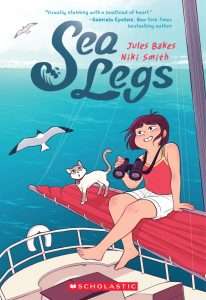
If the nature of life is to change, then Janey is no stranger – she describes herself as a “boat kid.” Her parents own a steel schooner called the Merimaid (read that again—it’s not the same name as the mythical woman with a fish’s tail), and they delight in using her for extensive travel around the world. And although Janey loves going on these adventures, they definitely get in the way of a lot of other things that come standard-issue with most childhoods: the comfort of stable floors, consistent power and screen time, and even making best friends.
Janey’s journey is as rough as the sea during a storm. She loves being a boat kid, but she also hates it; the all-encompassing loneliness is almost constant, but she also gets to experience a school of flying fish on the water at sundown – something most people (let alone kids her age) will never see. Her parents take her from Florida, to the Bahamas, the Dominican Republic, Puerto Rico, and the US Virgin Islands. It’s there that Janey finally, FINALLY, meets another boat kid roughly her age. But…Astrid (aboard the Valhalla) isn’t someone that Janey would ordinarily hang out with. She’s hard to get along with, guarded, and doesn’t seem to mind taking small risks that could result in big trouble. Janey doesn’t want to be alone, but with friends like Astrid, being alone doesn’t always sound so bad… or so Janey might think.
The art style is whimsical and soft – lots of rounded edges and a delicate, warm color pallet. I would describe it as “friendly.” This is a voyage you want to be on, even when you’re seasick. The text is easy to read and even employs some nifty affects when implying echoes.
The story is both a heartwarming and tear-inducing memoir about the author’s experiences with facing challenges while growing up in the years before easy access and widespread internet. Although her stories are unique, they are still relatable: never underestimate the healing power of a good scream, it’s okay to be pushed outside of your comfort zone, best friends are best friends – no matter how far away (and it’s normal to fight with them sometimes), and we all miss Carl Sagan.
There are hard discussions about abusive family members, so take heed if that brothers you. Read all the way through for the author’s notes on how she spent much of her early life sailing and living in a schooner that her parents were able to build and rig themselves through her father’s employer. Although the story is geared to be child-friendly, I would recommend it to anyone. It’s a quick read and although the subject matter can get heavy, it never feels dense or crowded.
It’s a delightful, fascinating story, and not many kids can call themselves “boat kids.” Take that, van families!
Sea Legs Vol. By Jules Bakes Art by Niki Smith Scholastic GRAPHIX, 2025 ISBN: 9781338835885 NFNT Age Recommendation: Middle grade (7-11), Tween (10-13), Teen (13-16)
Company Age Rating: Series ISBNs and Order Related media:
NFNT Age Recommendation: Middle Grade (7-11), Teen (13-16), Tween (10-13)
The Nib compiles approximately fifty webcomics (many of which were previously published on thenib.com) from forty creators on a wide variety of LGBTQ+-related topics into this Kickstarter-backed anthology. The comics run the gamut from one-page funnies to ten-plus-page detailed glimpses into queer history. Associate Editor Matt Lubchansky’s introduction explains the origin of the title’s source, the phrase “Be Gay, Do Crime.” Lubchansky also discusses the significance of comics as a means to express queer identity in a singularly accessible manner.
Some of the most interesting comics in the anthology serve to educate readers about various aspects of the queer experience. These include histories, cultural and national disparities in treatments of queer people, and procedures like embryo adoption and securing birth control as an asexual person. One historical highlight is The Life of Gad Beck, written by Dorian Alexander, which details gay Jewish Beck’s resistance under Nazi Germany. Levi Hastings’ gorgeous illustrations are rendered in black, white, and pale blue, with thick outlines (there is no art tool information in the book, but it looks like Hastings used oil pastels). Another particularly informative contribution is Sam Wallman’s A Covert Gaze at Conservative Gays, an illuminating piece about historical and contemporary right-wing activism among queer people. At first glance, Wallman’s panelless comic closely resembles a infographic by a Mad Magazine artist; Al Jaffee comes to mind. But this black, white, and pink comic strikes a perfect balance between discussing “gay supervillains” like Milo Yiannopolous and more sympathetic conservatives like gun advocates in the wake of the Pulse Nightclub shooting. Kazimir Lee’s What’s It Like to Raise Kids in Malaysia When You’re LGBT? is another interesting piece which details political perspectives and individual experiences of queer people in Malaysia. The standout art is reminiscent of a mid-20th century picture book; the full-color illustrations are predominantly in earthy reds, pinks, yellows, and browns, and there are minimal outlines in the characters’ block-like head and body shapes.
The anthology balances its drier informational pieces with funny one-page strips and relatable memoirs. A memoir highlight is Dancing with Pride by Maia Kobabe (Gender Queer) and is about eir experience in a folk dancing class where dancers are assigned different roles based on their perceived genders. The simple illustrations appear to be in pencil and watercolor, and feature a page where the dancers are lined up in order so their shirts make a rainbow, a very subtle and sweet nod to queerness in non-queer spaces. Another moving piece is written by Sarah Mirk and details activist Pidgeon Pagonis’s experience as an intersex child. The piece, Gender Isn’t Binary and Neither Is Anatomy, is illustrated by Archie Bongiovanni (A Quick & Easy Guide to Pronouns, Grease Bats). A couple laugh-out-loud funny highlights include Joey Alison Sayers’s The Final Reveal, in which the extremes of gender reveal parties are spoofed, and Shelby Criswell’s Astrological Signs as Classic Queer Haircuts.
As is always the case when I read comic anthologies, there were pieces that didn’t resonate as well with me as those I’ve named above. Rather than specify them, I will argue that it is because this book features something for every reader. If a piece didn’t resonate with me, it is sure to resonate with someone else. The queer representation is so varied, with gay, lesbian, bisexual, trans, nonbinary, intersex, and ace representation, and with countless intersectional queer identities, that I am confident every queer reader will find something to relate to in this book. Due to its array of art styles and queer representations, I would particularly recommend Be Gay, Do Comics for fans of Iron Circus’s anthologies, like FTL, Y’all, Smut Peddler, and The Sleep of Reason.
Be Gay, Do Comics Edited by Matt Bors ISBN: 9781684057771 IDW, 2020
Title Details and Representation NFNT Age Recommendation: Adult (18+), Older Teen (16-18) Character Traits: Asexual, Bisexual, Gay, Lesbian, Queer Gender Nonconforming, Genderqueer, Intersex, Nonbinary, Trans Creator Highlights: Black, Filipino-American, Puerto Rican Asexual, Bisexual, Gay, Lesbian, Queer Gender Nonconforming, Genderqueer, Nonbinary, Trans
Biographical comics strike me as one of the most difficult genres in the world of graphic novels. How do you sum up a life, particularly one that is well-known and researched, in 200-ish pages, using a format that can consume pages at a time with a single picture? You can pare down your story to key moments, ones that reflect the subject, how they lived their life, the choices they made, and the impact they had on the world around them. Inevitably something gets left out, but depending on the story you tell and the way you tell it, your omissions may make for a stronger tale. But then again….
21: The Story of Roberto Clemente revolves around the September 30, 1972 game, when Clemente made his 3000th hit. We bounce back to his childhood, growing up in Puerto Rico and playing baseball with a homemade bat and bottle caps. We see his family tragedies, his time in the Puerto Rico Baseball League, and his struggle with Jim Crow segregation. Santiago intermittently returns to the 1972 game, but also explores Puerto Rican history and the debate over its independence, as well as Clemente’s humanitarian work. Throughout the biography, Santiago weaves in the story of the three magi kings, visually tying it in with the plane crash that ended Clemente’s life in December, 1972. His 18 seasons with the Pittsburgh Pirates are portrayed in scattered episodes, with focus on their 1960 World Series run against the Yankees.
The art is done in bold strokes and sepia tones. Santiago fills the page with warm tones, using a style reminiscent of charcoal and mixed with off-whites, bright oranges, and brown-blacks (as a Giants fan, I have to say the color scheme reminded me more of San Francisco’s than Pittsburgh’s). Many of the side characters are drawn as caricatures, particularly the crowds attending the games, while Clemente, his teammates, and family members are drawn more realistically. Anyone familiar with the iconic pictures of Clemente will see the similarities between those and Santiago’s art. This style beautifully portrays the intense games and Clemente’s epic playing style.
Santiago’s art is the star of the book. The writing is fractured, leaping to different points in Clemente’s life with little reference for the reader. The story shifts quickly and the panels on the page are inconsistent in their flow – I often felt disoriented by the narrative. The book suffers from its lack of focus – is it about Clemente’s amazing career? The racism that he and other players overcame? Or Puerto Rico’s history? It’s about all of these things, and yet doesn’t cover any of them satisfactorily.
As someone who follows baseball but has limited knowledge of its history, I was eager to read about this important player. I came away knowing little more about Clemente and his career. Perhaps those with a stronger background in baseball history would find more to enjoy about this biography, but I’m not sure that they’d glean anything new about Clemente or baseball in the 1950s and 60s. I was inspired to research more about his life and career, particularly his impact on the game and humanitarian efforts; for such a fascinating person, 21 gives you a limited glimpse of his life. It’s the depictions of Clemente’s games that create the most powerful moments in the book, and those don’t make up a large part of the story.
This book is listed on YALSA’s Great Graphic Novels for 2012, but it’s hard to see the teen appeal in this biography. Baseball fanatics may pick it up, but might be disappointed with the minimal amount of games featured in the story. When they are the focus of the story, they’re gorgeous, relying on a classic, old-school style and color scheme. As a biography, though, there are large gaps in information about Clemente and his career. The narrative style is confusing and may leave veteran graphic novel-readers rereading pages at a time. While the book is a visual treat, the story leaves a lot to be desired. For those interested in learning more about Clemente, Santiago provides a list of online and print references.
21: The Story of Roberto Clemente by Wilfred Santiago ISBN: 9781560978923 Fantagraphics Books, 2011

 called the Merimaid (read that again—it’s not the same name as the mythical woman with a fish’s tail), and they delight in using her for extensive travel around the world. And although Janey loves going on these adventures, they definitely get in the way of a lot of other things that come standard-issue with most childhoods: the comfort of stable floors, consistent power and screen time, and even making best friends.
 The Nib compiles approximately fifty webcomics (many of which were previously published on thenib.com) from forty creators on a wide variety of LGBTQ+-related topics into this Kickstarter-backed anthology. The comics run the gamut from one-page funnies to ten-plus-page detailed glimpses into queer history. Associate Editor Matt Lubchansky’s introduction explains the origin of the title’s source, the phrase “Be Gay, Do Crime.” Lubchansky also discusses the significance of comics as a means to express queer identity in a singularly accessible manner.
 Biographical comics strike me as one of the most difficult genres in the world of graphic novels. How do you sum up a life, particularly one that is well-known and researched, in 200-ish pages, using a format that can consume pages at a time with a single picture? You can pare down your story to key moments, ones that reflect the subject, how they lived their life, the choices they made, and the impact they had on the world around them. Inevitably something gets left out, but depending on the story you tell and the way you tell it, your omissions may make for a stronger tale. But then again….

