Hayao Miyazaki needs no introduction to most anime fans. Even if his name is not known to most American fans of the artform, the odds are good that they’ve seen one of his movies. Nausicaä of the Valley of the Wind, My Neighbor Totoro, and Spirited Away are only some of the classic movies he’s directed. Indeed, the greatest challenge in assessing Miyazaki’s career is not debating his influence on the genre and other directors. It is deciding which of his great works might be considered his best.
The Worlds of Hayao Miyazaki does not try to answer this question or even offer fodder for that discussion. What author Nicolas Rapold does instead is look at Miyazaki’s influences, both in his life and his reading. Through this, and a series of essays, Rapold tries to find the source of the creativity of the man called the “godfather of animation in Japan.”
This might be seen by some as spoiling the magic. However, Rapold’s intent is not to prove the truth of C. E. M. Joad’s saying that “the height of originality is skill in concealing origins.” Instead, he uses this examination to show how Miyazaki’s genius lay in how he twisted the stories he loved as a child in new directions.
The first quartet of essays set the tone for what follows, as Rapold explores four of Miyazaki’s greatest influences. These are given as Lewis Carroll, Frances Hodgson Burnett, Homer, and Jules Verne. However, in discussing these, the essays spin out to cite other influences and common themes with books Miyazaki named as his favorites and why they relate to his work.
It is no intuitive leap to tie most of Miyazaki’s films to Carroll. Many of his protagonists stumble into strange worlds, much like how Alice Found Wonderland. Burnett’s The Secret Garden is an obvious influence on Howl’s Moving Castle and the secret garden hidden within it. Yet Miyazaki also comes back to that book’s theme of regrowth and the power of one person to heal the world and others.
Homer’s Odyssey informs the theme of the wandering stranger trying to get home, as does Gulliver’s Travels. And Verne’s advanced science may be reflected in the flying machines of Castle in the Sky. Yet his books also continue the recurring theme of motion and the power of the self-motivated individual.
However, Rapold also examines Hayao Miyazaki’s work through nonthematic avenues. There are essays and photos of the real-world locations that inspired his visuals. There are also looks at other creators who may have influenced him or were influenced by him. This includes an essay comparing Miyazaki and Stephen Spielberg.
This is all a bit academic for the children for whom Miyazaki made his works. Indeed, I was stunned by how much text there was contained within a book about a visual artist. This is not to say that there are no pictures from the movies, but they are shockingly small for a volume this size and there are few full-page images. Despite that oddity, I think most art history and anime history library collections would benefit from owning a copy of The Worlds of Hayao Miyazaki.
The Worlds of Hayao Miyazaki By Nicolas Rapold Frances Lincoln, 2025 ISBN: 9781836004813
NFNT Age Recommendation: Adult (18+), Older Teen (16-18)
In a world where supernatural being and humans tensely live in proximity to each other, a turf war between organized families of demi humans is the spark that will trigger a much larger conflict to come.
Gran Familia is the first serialized story from creator Louis Yamani and Titan Comics. The book introduces us to Leo, the somewhat haphazard but sincere manager of Goodfellas Bistro. Along with fellow employees Rose and Zach, Leo seems committed to keeping his head down and his spirits up as he runs a business amidst the growing threat of demi human attacks on humans across the city.
Through genetic mutation, these demi humans take a variety of forms—vampires, werewolves, mermaids, and more. It’s a bit like folklore meets superheroes. And whispers that a new family of demi humans is making a power play in the city have everyone tense. However, it’s not until this new family attacks a friend of Leo’s that readers learn the bigger picture; Leo is a part of the Gran Familia, the most powerful of the demi human families, and is a powerful vampire in his own right. But when Leo steps in to punish the upstarts who hurt someone he cared about, it sets off a series of consequences involving law enforcement and local criminals, all of whom have their own interests as well as a score to settle with a member of the Gran Familia.
Yamani balances episodic storytelling with a larger narrative in a way that serves the story well. Each section of the book finds Leo and friends caught up in the circumstances of the humans and demi humans that live around them. With each new adventure (or misadventure) readers learn more about the characters and the world as Leo can’t seem to stop himself from helping those in need around him even as he balances his demi human and human lives. At the same time, members of human law enforcement are on a quest to eradicate all demi humans, regardless of who they are.
As Leo’s interventions gain attention from unfortunate places, the narrative ups the stakes toward the inevitable confrontations. Overall, the idea of supernatural beings living alongside humans is not fresh, but this manga never makes the concept feel stale either. Leo’s clumsy affects do feel a bit like other manga characters we’ve seen before, but when the mask comes off and he leaps into action, he proves himself a hero worth following. Overall, the writing delivers an entertaining and packed first volume while putting plenty of pieces in place for these characters and the larger world.
Yamani’s art as well, is excellent. Sometimes sparse and sometimes full of fine detail, the visuals shift well from mundane sequences to highly stylized moments of supernatural action. There are a few rough moments where the visual sequence is a little hard to follow, but for the vast majority of the volume, the imagery is a treat to behold. Beyond the cityscapes themselves, some of the high points visually are when Leo and the other demi humans unleash their powers, changing form and dashing across the page—each character with their own distinct abilities and presentation. From start to finish, there’s a great deal to enjoy in the artistic storytelling, and Yamani shifts layouts and tones enough to keep that journey interesting.
Titan lists the age for the title as 15+. There’s some stylized but occasionally intense violence, scattered language, occasional mild fanservice, and some non-detailed nudity in nonsexual contexts. It’s nothing most older teens can’t handle, but definitely worth being aware of for those on the edge of that age range. As a first volume, Gran Familia isn’t necessarily doing anything groundbreaking, but it’s a whole lot of fun that manages to put its own touch on this blend of supernatural action and mafia-esque crime thriller. There’s humor to balance the more intense moments and a distinct cast of characters that propel each episode of the story along in a way that still manages to feel cohesive. There’s plenty here to delight readers of supernatural action manga, and the story is engaging but straightforward enough that this could be an excellent entry point for readers without much manga experience. Simply put, I had a fun time diving into this world and I hope to be there to see what trouble Leo gets himself into next.
Gran Familia By Louis Yamani Titan, 2025 ISBN: 9781787747135
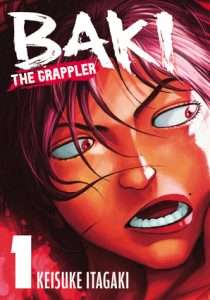
Baki Hanma has just upset the annual karate championship and sent shockwaves through the world of martial arts. This wide-eyed, 17 year old white belt newbie shouldn’t have been able to face off against more seasoned fighters, yet somehow he toppled them all to win first place. What’s going on with this kid?
Originally serialized for the magazine Weekly Shonen Champion in 1991, Baki the Grappler is among the best selling manga in Japan, however the still-ongoing manga has never been officially translated for English readers until now. A Netflix anime adaptation was released in 2020, but that series covers a later arc in the overall story. This is truly the first time the earliest part of Baki’s tale has been readily available to English speaking fans.
Coming fresh to the series, I expected this to be a one dimensional story about fighting and relentlessly beating opponents, and at first at first glance, that seemed true. Baki initially appears to just be an oblivious wunderkind with a lucky streak and a heart of gold. When asked directly, he can’t quite articulate his training goals, other than to say he’d like to become the strongest man on the planet. But there are hints that there’s more beneath the surface. Readers see him meticulously mark off photos of defeated opponents. His typically kind demeanor cools significantly when dealing with bullies, and betrays a cold and calculating side. There are also mysterious scars all over his body that strangely allow him to withstand even the most intense punches. He may even have ties to dangerous underground fighting rings. Clearly there’s much more going on with this seemingly happy-go-lucky kid. You don’t get all the answers in this volume, but I immediately wanted to crack open the second volume to see what makes Baki tick.
Almost every page is filled with action and the art is crisp and easy to follow. The manga style in this volume is a bit dated with rounder and softer lines than more recent iterations of the character, but it contributes to the classic feel of this manga. In terms of theme I’m reminded of other popular manga and anime series of the 1980s and 90s, such as Naruto and Dragon Ball, with their stories of (mostly) young men pushing themselves to be the strongest fighters in their community. There are no magical powers or fantastical elements for Baki, even if everyone’s muscles bulge just as unrealistically as Goku and Vegeta’s. Machismo practically drips off each page.
Other than the fighting that occurs in almost every panel, there are only a few content warnings. Some of the fighting turns more violent, with visibly broken bones and blood. There is a panel with teenage nudity and somewhat crude mentions of male anatomy. There is one awkward scene between 17 year old Baki and his attractive older landlady, where she is a little too eager to put her hands on him and he is visibly uncomfortable. The landlady and her teenage daughter are the only women in the first volume, and both are in supporting roles to the men.
The publisher rates this volume for older teens and I agree that’s probably where it fits best in a library collection. Adult readers might also enjoy it, and I could see it ticking the nostalgia box for fans of 80s and 90s manga and anime. While definitely aimed at a male audience, any reader that enjoys stories of perseverance, athleticism, and martial arts should give Baki the Grappler a try.
Baki the Grappler By Keisuke Itagaki Kodama Tales, Inc., 2024 ISBN: 9781966523000
Company Age Rating: Older Teen
NFNT Age Recommendation: Adult (18+), Older Teen (16-18) Creator Representation: Japanese,
A cryptic mystery ensconced in a fairy tale fantasy world permeates Keiichi Hara’s (Colorful, Miss Hokusai) anime adaptation of Mizuki Tsujimura’s Lonely Castle in the Mirror, an enchanting tale about the ties of friendship that bind us together. A story centered on a group of outcast middle grade adolescents who, for various reasons, avoid going to school, find connection with each other in a fantastic world where they band together to unravel a mystery while discovering that they share more in common than they realize.
The story begins when Kokoro wakes up one morning with stomach pains that prevent her from attending school. She has been confined to her home for several weeks now after a bullying incident at school instigated by a gang of mean-spirited girls. The mirror in her bedroom emits a sparkling glow on this morning, casting a light that turns into a magical portal. Upon stepping through the mirror, she beholds a castle straight out of a fairy tale perched on a cliff surrounded by the sea. She is greeted by a young girl wearing a wolf mask who assigns a single task: Kokoro, along with six other students who have somehow also transported to this world, must find a secret room containing a key that will grant its finder a wish, but there is one caveat: This task must be completed by spring time, and they must leave the castle by five o’clock each day or else face a ferocious wolf that prowls about, stalking its prey with a voracious appetite.
Segmented into a series of months, each scenario unpacks the inner stories of each student: Timid Kokoro suffered from bullying classmates at school; headstrong Aki experienced molestation from her father; Masamune the gamer was taunted for his habitual lying; pushover Ureshino was teased for his failed attempts to win affection from girls, and so forth. Despite their imperfections however, these students learn to accept each other and their flaws. What shines are their back stories as they crystalize and sharpen into focus, highlighting deeper secrets that reveal they have more in common than they initially realized. But what unites them all and why can they not find each other in the real world? In this blend between fantasy and reality, the architectural aesthetics of the castle rooms contrast in tone and style with the tawdry mundaneness of their everyday lives, poignant moments unravel through unspoken silences, and an uplifting musical soundtrack reinforces the narrative action, propelling the story to its triumphant climax.
At the heart of Lonely Castle in the Mirror, themes of bullying, acceptance, isolation, trust, and friendship interlock like shifting pieces of a complex yet beautifully rendered mosaic, bridging the disparate lives of each character across time and space. A refuge for the harsh toils of school and life itself, this anime combines elements of magical whimsy, mystery, and fantasy that will appeal to middle grade viewers, illuminating the astonishing connections we hold and cherish within each other.
Lonely Castle in the Mirror Directed by Keiichi Hara GKIDS Films/Shout! Factory, 2023 Run time: 116 minutes minutes Stream this series
NFNT Age Recommendation: Teen (13-16) Creator Representation: Japanese, Character Representation: Japanese,
Many young people know what they want to do with their lives from the very beginning. Ema Asano is one such person. Most of her classmates are focused on fashion and dating. But Ema cannot be bothered with such things. She dreams of following in the footsteps of her parents, who were both police officers before their deaths defending their community. Until such time as she can become a real cop, Ema roams the streets of Tokyo as a vigilante.
Ema’s diligence leads her into the bad part of town one night after her older sister, Yuko, goes missing. To her horror, she discovers that Yuko was lured there by one of her co-workers, Tamaki, who is a vampire in need of a meal. Ema is ready to call the authorities, but is stopped by another of Yuko’s co-workers, Taiga, who also a werewolf.
That encounter marks the night when Ema’s vigil becomes something else entirely. For there are monsters in the shadows besides vampires and werewolves. And Tamaki and Taiga, despite nominally being on opposite sides of an eternal war, find they have more in common with each other than their own kind. Thus forms an unusual team, as the trio work to put down those monsters who cannot control their urges to kill.
On the surface, there is little to distinguish Outsiders from other urban fantasy series. Indeed, creator Akira Kanou freely admits to having been inspired by the Twilight Saga. And there certainly are innumerable horror series built around the idea of a rivalry between werewolves and vampires. Despite this, Outsiders puts enough unique spins on its mythology to mark it as unique. It also boasts some twisted artwork with a far lighter and sketchier style than one would associate with a horror shojo.
Outsiders defies expectations in other ways as well. Usually, a novel of this sort would inevitably feature a love triangle between the teen heroine and the two dashing older men who barely look older than her. There is no such romance in Outsiders. While Ema does show some casual interest in wondering what dating a vampire or a werewolf would be like, her feelings are not reciprocated by Tamaki or Taiga. In fact, most of the romance in this first volume involves subtle hints of a growing attraction between the vampire and werewolf. All these twists help to make Outsiders into something unique that may appeal to fans of the genre looking for something different.
Outsiders Vol. 1 is rated 12+ by Titan Manga. I consider that to be a fair grade for the content. There is a fair bit of violence and bloodshed, but nothing inappropriate to a T-rated Manga. As noted, there is no sexual content or nudity. Indeed, there is barely any hit of romance and most of that confined to meaningful glances between the two male leads that the heroine presumes mean something more. The closest any of the characters come to impropriety is Tamaki undressing and dressing an unconscious Ema in clean clothes after her own clothing is torn while trying to save her sister. Even then, he is a perfect gentleman, and explains he only did this because he couldn’t well let Ema (who is immune to his hypnosis powers for some reason) run off into the night in a bedraggled state.
Outsiders Vol. 1 By Akira Kanou Titan, 2025 ISBN: 9781787745711
Company Age Rating: 12+
NFNT Age Recommendation: Older Teen (16-18), Teen (13-16) Creator Representation: Japanese, Character Representation: Japanese,
The world of Blade Runner has always favored Japanese aesthetics. This is not uncommon in the cyberpunk fiction of the 1980s, which was born of a belief that Japan would come to dominate the world of technology. The irony is that, for all that influence, Blade Runner is intensely focused on American interests. The original movie was set entirely in Los Angeles and the spinoffs which followed remained largely set in southern California. This makes Blade Runner: Tokyo Nexus notable as the first work in the franchise to be set outside of the United States or deep space.
Our story is set in 2015, four years before the events of the first Blade Runner movie. The action centers around former soldiers, Mead and Stix. After leaving the service, they came to Tokyo and established a detective agency. However, there’s a lot in their past they don’t want uncovered. For one thing, Stix is a Replicant; one of the class of artificially created human that are technically illegal on Earth. However, they both went AWOL after deciding they didn’t want to die on a suicide mission and stole some classified information as they made their escape.
The sins of their past catch up with the duo, as their latest case forces them to butt heads with the Yakuza. There is also the complication of an American Blade Runner arriving in Tokyo, hunting a rogue Replicant that has started killing to cover their tracks. The Blade Runner is convinced Stix is her man, but even that hunt may be covering up something bigger. Something tied into the Tyrell Corporation and a group of rogue scientists seeking to create their own Replicants outside of the Tyrell machine.
Writer Kianna Shore does a fantastic job of capturing the aura of the Blade Runner setting while presenting this world’s take on Tokyo. There are plots within plots and multiple intrigues, as Mead tries to investigate a murder while throwing the Blade Runner off the scent of the one friend she has. At the same time, it becomes apparent that Stix has his own secrets, even if he isn’t the killer in question. All the characters are engaging, and the secret heavy story is sure to keep readers guessing until the end.
The artwork of Mariano Taibo is equally engaging. Despite the Noir aesthetic of the story, the artwork is unusually bright and airy. This creates an immediate visual contrast with the dark alleys and neon glow that dominated the Los Angeles of the Blade Runner film. What is more, we see the sun. This might not seem like a huge point, but it’s a rather amazing revelation given the original movie depicted a city shrouded in perpetual rain and gloom even in the light of day. And yet, despite this disparate distinction, this is still undoubtedly a Blade Runner story, with high octane action and intense combat sequences.
Titan Comics rates this first volume as appropriate for readers 15 and up. I believe that to be an appropriate rating. There is considerable violence and bloodshed. There is even a scene showing a dead Replicant being dissected. However, there is nothing here that would be considered excessive for an audience of older teenagers. There is no suggestion of sex and one nude Replicant with undistinguished anatomy in a body bag.
Blade Runner: Tokyo Nexus Die In Peace By Kianna Shore Art by Mariano Taibo Titan, 2025 ISBN: 9781787738492
Company Age Rating: 15+ Related media: Movie to Comic
NFNT Age Recommendation: Adult (18+), Older Teen (16-18) Creator Representation: Korean-American, Character Representation: Black, Japanese,
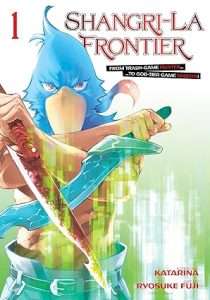
Set in a future where videogames are all virtual reality (VR) based, Shangri-La Frontier (SLF) is a multi-player fantasy game with lots of unique characters, scenarios, and items, making it stand out from other VR games that are not well-developed and full of bugs and broken mechanics. Sunraku is a player that tackles these terrible games as a challenge; however, he picks up SLF during summer break and discovers his own unique scenario that keeps drawing him back to the game. His unconventional choices come from his many hours playing broken games and wanting to maximize his fun.
In volume one, Sunraku skips the beginning tutorial town and almost dies from the area boss monster guarding the second town. Wanting to get ahead of most of the players, he goes back to exploring after purchasing some new gear. While exploring, he runs into one of the unique boss monsters of the game, which don’t respawn after being beaten by players. He puts up a good fight but is no match for Lycagon; however, the beast acknowledges the strength of the player by cursing Sunraku to not be able to wear armor on his torso or legs and lower-level monsters will avoid him. Shortly after that, Sunraku finds a unique scenario involving a vorpal rabbit leading him to a hidden area called Rabituza.
In volume two, Sunraku is targeted by a group of player-killers (pk’ers) after an image of him with the unique non-player character (NPC) vorpal rabbit Emul is posted to an online forum without his permission. One of the pk’ers is an old gaming buddy, so we learn more about Sunraku’s other gaming adventures with Pencilgon and Katzo, who joins the game later. Sunraku is saved from being pk’d by a player known as Psyger-0, the “Attack Master,” who’s a female classmate with a crush on him but is too shy to even say hello. Next, Sunraku goes back to Rabituza to tackle the unique training scenario he was offered. He must fight a total of ten bouts with monsters, using only vorpal weapons, and wearing an item that lowers the experience he earns.
Volume three shows Sunraku finishing the epic training scenario and Pencilgon deciding that her clan has failed her game aspirations, and she needs to form a new group who can help her. After helping him escape pk-ers a second time, Psyger-0 sends a friend request to Sunraku, which he accepts to be polite and because he didn’t want to offend such a high-level player. This is when Sunraku explores the world by going into the Prismatic Forest Grotto and observing the monsters that populate the area. Pencilgon explains her plan to Sunraku and Katzo to take down one of the unique NPCs, Wethermon. The rest of this volume and the fourth shows how they prepare for this epic fight as well as its beginning.
This series is a unique contribution to action manga that utilizes isekai tropes, explores multiple game settings, and the interactions of characters in the game as well as outside of it. Due to the on-page violence and use of adult language, this is firmly a teen and up series; however, it is not much different from videogames that this audience plays anyway. In fact, gamers are the target audience. Adult readers would also find a lot to enjoy, especially the extras found in between chapters. This is where you can find additional lore about the games, monsters, items, and characters. Sometimes it repeats information that was explained during the story but sometimes it is new information that wouldn’t necessarily be easy to convey in the story without interrupting the pacing but enhances the reader’s knowledge. The illustrations have great detail and add to the world building as well and are one of my favorite aspects of this series after character building.
There are currently fourteen physical volumes available to purchase with the fifteenth set to be released at the end of February. If you have access to a platform that provides digital manga, there are eighteen volumes available. Another note is that we featured this series in our recent anime column, Anime Club Picks. The first season of anime covers the first six volumes of manga while the second season picks up immediately where the first stopped. Patrons who want to read ahead of the anime as it airs will find plenty of material as will readers looking to learn more about the world presented.
Shangri-La Frontier Vol. 1-4 By Katarina Art by Ryosuke Fuji Kodansha, 2022 ISBN: 9781646514823
Volume
ISBN
2
9781646514830
3
9781646514847
4
9781646514854
Company Age Rating: 16+ Series ISBNs and Order Related media: Comic to TV
NFNT Age Recommendation: Adult (18+), Older Teen (16-18)
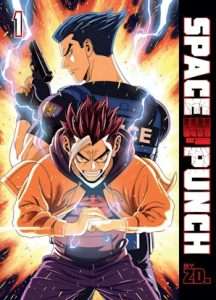
Zack and Joe Kazuma went down drastically different paths after the death of their father. Zack followed in their father’s footsteps, becoming a Police Sergeant in the Mirai City Police Department. Joe dropped out of school and spent his days playing video games until his mother made him get a job as a delivery boy.
Life has not gone the way either of the Kazuma brothers hoped. Zack is frustrated by the indifference and corruption of his superiors regarding the gangsters running wild in their city. Joe is similarly outraged, after he is fired from his job after being repeatedly cheated by customers who wouldn’t pay for their food or simply being mugged for what money he collected. The only release the two brothers have is a shared love of boxing, though Joe is out of practice and hasn’t hit the gym in a while.
Things change after a gangster hunts Zack down while the brothers are on a camping trip together, seeking revenge for Zack’s trying to arrest him. The two brothers fight back, with Joe finding a strange reservoir of strength when he wears his father’s old boxing gloves. This inspires Joe to head back to the gym, as Zack renews his efforts to clean up his department and take on the mob.
Space Punch is notable as the first manga by French comic creator ZD. However, had I not been informed of that fact, I would never have guessed this was a freshman effort. The story represents a unique blend of genres, with the early chapters presenting dual crime and slide-of-life dramas that are united only by the connection of the two brothers. Things shift into second gear midway through the book, however, as Joe starts displaying super-strength through feats like ripping the door off a car and throwing it like a discus. By the end of the final chapter, the story takes a supernatural turn, as it becomes clear that Joe’s newfound powers are tied to his father’s old boxing gear. Each of these story elements is introduced naturally and they all mesh splendidly.
The same can be said of ZD’s artwork. There is intricate line-work throughout, particularly in the action sequences featuring Zack. The sequences focusing on Joe look more comedic by comparison, but the visual differences between the brother’s stories flow into one another as they cross paths. Things shift at the end subtly, as Zack’s true crime tale begins to look more light-hearted compared to the body horror Joe experiences as he tries to remove his father’s boxing gear. This continual shift keeps things interesting, and I look forward to the next volume of this series.
Kana rates this volume as appropriate for readers 13 and up. I consider that a fair assessment. There is no sexual content or nudity in this volume and no real romance apart from some one-sided flirtation between Joe and Kim, a childhood friend who works at the boxing gym. The violence and action is considerable, however, with some intense car chases and bullets flying. There is nothing more intense than what would be seen in a PG-13 movie, however, making this a worthy read for any fan of Shonen manga.
Space Punch, Volume 1 By ZD Morrison Kana (Abrams ComicArts), 2025 ISBN: 9781419777943
Company Age Rating: 13+
NFNT Age Recommendation: Adult (18+), Older Teen (16-18), Teen (13-16) Creator Representation: French, Character Representation: Japanese,
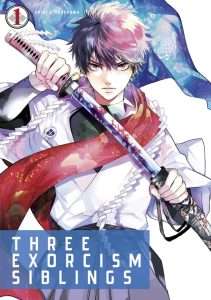
High in the mountains of Japan, the Tengu still roam free. These monstrous demons prey upon those who travel too far from civilization, feasting upon them. The more humans a Tengu consumes, the larger and smarter they become. Some legends say a Tengu who eats enough humans might become one. Others say that those who are bitten by a Tengu and survive might become one themselves!
21-year-old Mamoru Yamaemori has devoted his life to fighting the Tengu near the Yamae Shrine, like his father before him. He was given no choice in this, being kept out of school and savagely trained in the duties of a Guardian. Mamoru never questioned this, not even after his parents died when he was 12, leaving him to raise his two brothers by himself. The people of the nearby village leave them alone, for the most part, believing the Yamaemori line to be cursed, due to them all dying young, violent deaths. The local authorities know the truth and are thankful for Mamoru’s help, but most are ignorant of the threat Tengu pose in modern times.
Mamoru’s only comfort is that his actions have given his brothers the chance to live normal lives. 17-year-old Kei is a genius and a master chef, holding top marks in all subjects at his school. 15-year-old Yu is a popular athlete, whose football team is heading to the national finals. They have offered to help Mamoru with his duties, but he refuses to allow them to join his vigil. At least, until the night when Yu is attacked by a Tengu and Mamoru nearly killed as the beast devoured him.
Since that night, Mamoru has begun transforming into a Tengu. Under the guidance of an elder Guardian, Kei and Yu begin their training as Guardians themselves. It is their hope that they may cleanse the mountains of Tengu before their brother changes completely or maybe find some way to reverse his transformation. Unfortunately, the urges to attack those he loves most are growing stronger, and another nearby Guardian is ready to kill Mamoru himself at the first sign that he has crossed over completely.
Three Exorcism Siblings is an interesting take on the old warning that one should not battle monsters, lest they become one themselves. Unfortunately, this idea has been done before and done better in other supernatural shonen. While Mamoru’s plight is gripping and the drama around it well-played, the rest of the cast are strictly stock characters.
The artwork of Three Exorcism Siblings is a bigger issue. Shinta Harekawa’s style becomes muddy to the point of being incomprehensible during the fights with the Tengu. Given that this is an action manga centered around fighting Tengu, that is something of a problem.
Titan Manga rates this volume for readers 15 and up. I believe that to be a fair assessment. There is no sexual content or nudity. Indeed, there are barely any female characters apart from a few nameless classmates of the younger brothers, one delivery girl, and a young woman Mamoru saves in the opening action sequence. There is considerable bloodshed, however, but none of it is all that interesting. All in all, while this might appeal to fans of Tokyo Ghoul and Attack on Titan, there is nothing to make it essential reading for a library manga collection.
Three Exorcism Siblings, Vol. 1 By Shinta Harekawa Titan, 2024 ISBN: 9781787741379
Company Age Rating: 15+
NFNT Age Recommendation: Adult (18+), Older Teen (16-18) Creator Representation: Japanese, Character Representation: Japanese,
The seven children of the wealthy Shiunji family are the talk of their town. Numbering five girls and two boys, with two sets of twins in the middle, they are unmistakable when they go out. All the Shiunji siblings are good-looking and gifted, with the majority of them being talented scholar athletes. The girls all have their own fan clubs and students from other schools travel out of their way to watch them from afar.
All of this is an annoyance to Arata, the oldest of the two Shiunji boys. While many boys are jealous of him for being surrounded by such grace and beauty, the reality of living with five girls your own age is a far cry from the sister fetish stories other boys obsess over. His older sisters bully him. His younger sisters tease him. And worst of all is his twin, Ouka. Given that, and his fears of introducing his crush into the mix, it is no wonder the 16-year-old Arata has never had a girlfriend, despite being the most eligible young man at their school.
That changes on the night of the youngest Shiunji sibling, quiet Kotono, turning 15. It is then that their father confesses to a secret that he kept hidden from his children all their lives. Namely, that all of them are adopted and that apart from the younger set of twins, Minami and Sion, none of them are blood relatives.
This changes nothing for Arata, who is determined to protect the girls as a big brother should. Unfortunately, the girls he thinks of as his sisters all start showing signs that they might be viewing him in a different light. Even Ouka!
In the afterword of The Shiunji Family Children Vol. 1, creator Reiji Miyajima says they were inspired to write a story about sibling relationships because they had no chance to do so in their earlier series, Rent-A-Girlfriend. Because Siblings can be your best friends and your worst enemies. It is a fascinating dichotomy which they wanted to explore.
Your enjoyment of The Shiunji Family Children will likely depend upon how much you enjoy that dichotomy and harem manga. Because make no mistake, that is what The Shiunji Family Children is, despite Arata’s frequent protests that his life is NOT a light novel. Even as his youngest sister hugs him while naked, his second oldest sister mounts him in her bed clothes, his second youngest sister calls him sempai, and his older sister jokes about having a date with him.
Reiji Miyajima’s artwork remains excellent, however, with each of the siblings having a distinctive appearance. They also have unique personalities, moving beyond the usual stereotypes of “smart science girl” and “sporty tomboy” as the first issue goes on. This helps distinguish the book from other harem manga that are only concerned with the sexy bits.
On that note, Yen Press has rated The Shiunji Family Children as OT for Older Teens, 16 and up. I consider that a fair assessment. There is full nudity from the side of the 15-year-old Kotono and a lot of discussion of sexual content. There is no actual sex, however, but given the subject matter this book is rightly aimed at older audiences who can appreciate the emotional issues involved. Amazingly, these issues are treated seriously even as most of the comedy is born of Arata’s discomfort with the conflicting feelings that he and his sisters are dealing with.
The Shiunji Family Children, Vol. 1 By Reiji Miyajima Yen Press, 2023 ISBN: 9781975371418
Company Age Rating: OT
NFNT Age Recommendation: Adult (18+), Older Teen (16-18) Creator Representation: Japanese, Character Representation: Japanese,

 odds are good that they’ve seen one of his movies. Nausicaä of the Valley of the Wind, My Neighbor Totoro, and Spirited Away are only some of the classic movies he’s directed. Indeed, the greatest challenge in assessing Miyazaki’s career is not debating his influence on the genre and other directors. It is deciding which of his great works might be considered his best.
 demi humans is the spark that will trigger a much larger conflict to come.
 Baki Hanma has just upset the annual karate championship and sent shockwaves through the world of martial arts. This wide-eyed, 17 year old white belt newbie shouldn’t have been able to face off against more seasoned fighters, yet somehow he toppled them all to win first place. What’s going on with this kid?
 Tsujimura’s Lonely Castle in the Mirror, an enchanting tale about the ties of friendship that bind us together. A story centered on a group of outcast middle grade adolescents who, for various reasons, avoid going to school, find connection with each other in a fantastic world where they band together to unravel a mystery while discovering that they share more in common than they realize.
 classmates are focused on fashion and dating. But Ema cannot be bothered with such things. She dreams of following in the footsteps of her parents, who were both police officers before their deaths defending their community. Until such time as she can become a real cop, Ema roams the streets of Tokyo as a vigilante.
 was born of a belief that Japan would come to dominate the world of technology. The irony is that, for all that influence, Blade Runner is intensely focused on American interests. The original movie was set entirely in Los Angeles and the spinoffs which followed remained largely set in southern California. This makes Blade Runner: Tokyo Nexus notable as the first work in the franchise to be set outside of the United States or deep space.
 Set in a future where videogames are all virtual reality (VR) based, Shangri-La Frontier (SLF) is a multi-player fantasy game with lots of unique characters, scenarios, and items, making it stand out from other VR games that are not well-developed and full of bugs and broken mechanics. Sunraku is a player that tackles these terrible games as a challenge; however, he picks up SLF during summer break and discovers his own unique scenario that keeps drawing him back to the game. His unconventional choices come from his many hours playing broken games and wanting to maximize his fun.
 becoming a Police Sergeant in the Mirai City Police Department. Joe dropped out of school and spent his days playing video games until his mother made him get a job as a delivery boy.
 civilization, feasting upon them. The more humans a Tengu consumes, the larger and smarter they become. Some legends say a Tengu who eats enough humans might become one. Others say that those who are bitten by a Tengu and survive might become one themselves!
 the middle, they are unmistakable when they go out. All the Shiunji siblings are good-looking and gifted, with the majority of them being talented scholar athletes. The girls all have their own fan clubs and students from other schools travel out of their way to watch them from afar.

