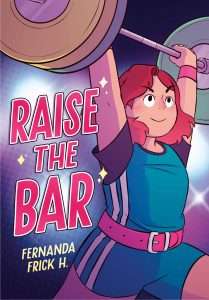
Samanta Sanchez is determined to become the greatest weightlifter Latin America has ever seen and nothing will get in her way, especially not her parents’ anxiety about her goals. In Raise the Bar, Fernanda Frick H.’s debut graphic novel, readers follow Sam’s journey from the municipal gym in Santiago, Chile, to the world stage at the Pan American Games.
Sam has always been too strong, too stubborn, and too independent. She scares off the other kids at school and her parents just want her to fit in. No one really knows how lonely she is or how she’s always doubting herself. Still, she sets a goal and works to meet it, no matter how hard it is to fight for her spot at the table. Her brother offers his support but their parents are another story. When she’s accepted into the High Performance Center of Corazon (aka the HPC), with the chance to study under gold medalist Eva Dos Santos, her determination and persistence on following her dream win out over her parents’ disapproval.
At HPC, Sam meets other kids from around the world working towards their own gold medal dreams, including one of her idols, an American medalist named Barb Miller. The other athletes studying alongside Sam are diverse, with multiple countries and cultures represented. There’s also strong LGBTQ+ representation within the characters. The story still focuses primarily on Sam but the story grows to include the stories and experiences of the other athletes, with everyone’s unique personality given a chance to shine.
Some readers might be initially turned off by a graphic novel so heavily about sports but Raise the Bar is a book about strength in all its forms: physical, emotional, and mental. Sam and her friends are proud of what they’re capable of and that pride goes beyond just what happens in the gym. Even the most confident athletes have moments of weakness and self-doubt. When characters realize they want to take a path other than sports, it’s never portrayed as a betrayal or dismissive of their dreams; the other characters are proud of them for following their heart and embrace them as such. Excellent work-life balance is on display throughout the book.
Raise the Bar’s art is very animated and colorful. Frick’s background as an animator is evident throughout. The excellent multiple pages of backmatter explains it was originally conceived as an animated television show. Everyone is expressive and emotive, even Sam’s pet chinchilla. Scenes of self-doubt and anxiety are dark and cloudy, an excellent representation of that particular mindset. Competition scenes feel lifelike and readers may find themselves holding their breath as Sam attempts to lift her goal weight.
It is quite a long book, with long chapters. Because of this, the ideal audience for Raise the Bar straddles both older middle grade and younger young adult readers. There’s some romance in the story but the main focus is self confidence and friendship. Raise the Bar is especially recommended for readers who enjoy sports related graphic novels or animated shows or anyone who gets caught up in the thrill of international competitions. Also of note is that the graphic novel will be published in Spanish later this year, giving it a more authentic feel and wider audience.
Raise the Bar Vol. By Fernanda Frick H. Dial Books, 2026 ISBN: 9780593407325
Company Age Rating: 8-12
NFNT Age Recommendation: Middle Grade (7-11), Teen (13-16), Tween (10-13) Creator Representation: Chilean, ADHD, Autistic Spectrum, Character Representation: Chilean,
“As I delved deeper into the narrative, day by day, step by step, I realized that the fact which made this story famous worldwide became almost secondary.”
It’s a bold claim.
But we’ll get into that later.
Just a quick note: I am very far removed from this story. And this is not the case with author Frédéric Bertocchini, who states that he was born almost 1 year after Uruguayan Air Force Flight 571 and the harrowing events that followed. The first I had heard of this story was, strangely, in my high school freshmen chemistry class. Couldn’t tell you how it came up.
The story about the Uruguayan rugby team (Old Christians Club) that crash landed in the remote Andes and what they did to survive is perhaps not well-known in this day and age. Certainly, not particularly well-known to American audiences – there is one movies from the 90s that I can recall (Alive, directed by foreign media have covered the story through documentaries, films, and even theater. And seeing this book up for release, well, I was compelled to take a look. This is Bertocchini’s English-language debut.
The story is told from the perspective of Roberto Canessa; at this point in his life, he is a 19-year-old medical student and has nothing but hope for his future. The comic wastes little time; the disaster strikes early, and now Canessa is tasked with doing what he can with his medical knowledge to try to keep the first round of survivors alive. But the conditions are harsh out this far, the snow is falling, and the airplane has little amenities to offer first aid, let alone serious medical treatment. And it’s not just outside forces that threaten the survivors – infighting, power struggles, threats, dwindling supplies, and paranoia also take hold.
It is on the 10th day of their suffering that Canessa suggests eating the bodies of the deceased. Obviously, an incredibly difficult and painful thing to put forth, something that only can be done by someone who is on the brink of death with no other options for life-supporting nutrition. This is the “fact which made this story famous worldwide” that does, in fact, become secondary to the day-to-day survival activities this group of people had to endure. The story gets grimmer as the days go on – the search for their plane is eventually abandoned by the authorities, the mountain sends its arbitrary wrath, more survivors die, and the ups and downs of hope and despair are experienced with disgust and faith in turn. For the sake of the review, I will say that the survivors are eventually rescued after Canessa and Fernando Perrado trek through the mountains for 10 days, eventually coming to the nearest town and alerting the authorities. The passengers of Uruguayan Air Force Flight 571 were stuck in the remote Andes for 72 days. Of the 45 occupants on the plane, 16 survived.
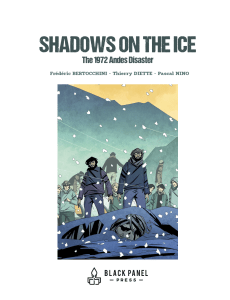
The art is flat and blocky with a minimalist color pallet, reminiscent of Mike Mignola’s work. There is something matter-of-fact about the straight lines and square compositions. It makes for an enjoyable, straightforward reading experience.
This story is certainly not for everyone, but I was that kid in school reading about the Donner Party and Franklin’s lost expedition for fun, and I knew what I was getting into. The illustrations are not graphic or violent, an amazing feat, really, considering the subject matter. The book is not exploitative nor morbidly gaze-y. But the slicing of human flesh from human bodies for consumption is shown, and I would say the overall melancholy of the events depicted is definitely something to be aware of. If you can get through that, then you will be able to enjoy this harrowing narrative of loss, grit, and teamwork.
Shadows on the Ice: The 1972 Andes Disaster By Frédéric Bertocchini Art by Thierry Diette Black Panel Press, 2025 ISBN: 9781990521294
Publisher Age Recommendation: High school/16+ NFNT Age Recommendation: Adult, High school Character Representation: Uruguayan
Shadows on the Ice: The 1972 Andes Disaster? Vol. By Frédéric Bertocchini Art by Thierry Diette, Pacal Nino, , Not in listBlack Panel Press, 2025 ISBN: 9781990521294
Company Age Rating: 16+
NFNT Age Recommendation: Adult (18+), Older Teen (16-18) Creator Representation: French, Character Representation: Uruguayan,
Trailblazing French filmmaker Alice Guy-Blaché was present at the birth of modern film, a contemporary of the Lumière brothers and Georges Méliès. In Alice Guy: First Lady of Film, writer–artist duo Catel & Bocquet draw on original research from late media critic Francis Lacassin to document Guy’s career as the first major woman filmmaker and a pioneer of her industry.
The graphic biography opens with Guy’s 1873 birth and childhood in Europe and Chile. Lively and outspoken, Alice has an early interest in acting that is deemed unsuitable by her middle-class French family. Instead of taking to the stage, she goes to work as a secretary for what will soon become the Gaumont Film Company. Catel and Bocquet depict the chaos of these early years of film, with competing firms squabbling to dominate the new market. In this cutthroat environment, Alice is able to demonstrate business acumen and gain professional standing despite her gender.
In addition to business savvy, Guy has a vision for what film could be—a vehicle for telling stories. She teams up with a cinematographer to film the 1896 film La Fée aux Choux, a fantasy of cabbage-patch babies that may have been the first narrative film. As Alice finds success directing films for Gaumont, she and her collaborators develop the conventions that will define their industry, from filming on location to creating special effects to hammering out the logistics of public film screenings.
Alice also grapples with the ethical issues that face any unregulated new industry. She must take decisive action when an underaged actress is sexually assaulted by an older male professional on her set, or when a script about bullfighting raises questions of filming animal cruelty. Alice’s status as a woman filmmaker informs the way she handles these challenges and inspires her to take risks, from an attempted collaboration with activist Rose Pastor Stokes on a film about family planning to the production of A Fool and His Money, likely the first film with an all-African American cast.
Alice’s personal and professional life brings her to the United States, where she starts a family and New York-based studio with her husband, film producer Herbert Blaché. But their once-happy marriage ends in divorce, and business troubles bring Alice’s career to a premature close. Decades later, her role as a woman film pioneer has faded from memory: “The history of cinema has completely forgotten about me,” she tells Francis Lacassin.
Alice Guy’s story is an extraordinary one, and this biography is an exhaustive documentary source for information about her life. An appendix with a detailed timeline, bibliography and filmography, and 50 pages of biographical essays about historical figures depicted in the book makes this a valuable reference work for those interested in Alice Guy’s life and times.
As a casual reader, however, this book didn’t hook me. Catel’s elegant monochrome illustrations are versatile enough to capture both the domestic scenes of Alice’s personal life and the exciting variety of her film sets, but the story itself feels bogged down by the kitchen-sink detail of Bocquet’s script. A number of characters and episodes seem as if they’re present for the sake of completeness, giving the story a choppy, episodic quality. The result is a book that lacks a strong narrative arc, without a clear throughline of who Alice Guy was and what compelled her, creatively and personally, to succeed in this challenging new industry.
This book is recommended for larger graphic novel collections, particularly those that emphasize women’s history or media history. For those interested in learning about Guy’s remarkable life, it’s absolutely worth picking up, but general readers may not find it the most accessible entry point into her story.
Alice Guy: First Lady of Film By José-Louis Bocquet Art by Catel Muller SelfMadeHero, 2022 ISBN: 9781914224034
NFNT Age Recommendation: Adult (18+), Older Teen (16-18) Creator Representation: French, Character Representation: French,

 Samanta Sanchez is determined to become the greatest weightlifter Latin America has ever seen and nothing will get in her way, especially not her parents’ anxiety about her goals. In Raise the Bar, Fernanda Frick H.’s debut graphic novel, readers follow Sam’s journey from the municipal gym in Santiago, Chile, to the world stage at the Pan American Games.
 became almost secondary.”
 brothers and

